Daily insights for city builders, delivered every morning at 6 AM ET. I’m Brandon Donnelly — a Toronto-based real estate developer and founder of Globizen. I’ve been writing here since 2013.

Category: Places

  • The geographic inversion of New York’s subway ridership recovery

    May 27, 2026 · View original


    New York City is the most urban city in America, with the largest subway network by far, and yet, even here, ridership levels have yet to recover to their pre-pandemic levels. Recent data shows subway ridership hovering between 70% and 80% of 2019 levels, and the MTA anticipates that it will remain “at about that level through 2029.”

    The obvious explanation is that office workers continue to work from home on occasion, and that’s certainly a significant part of the story here. But it doesn’t appear to be the entire story.

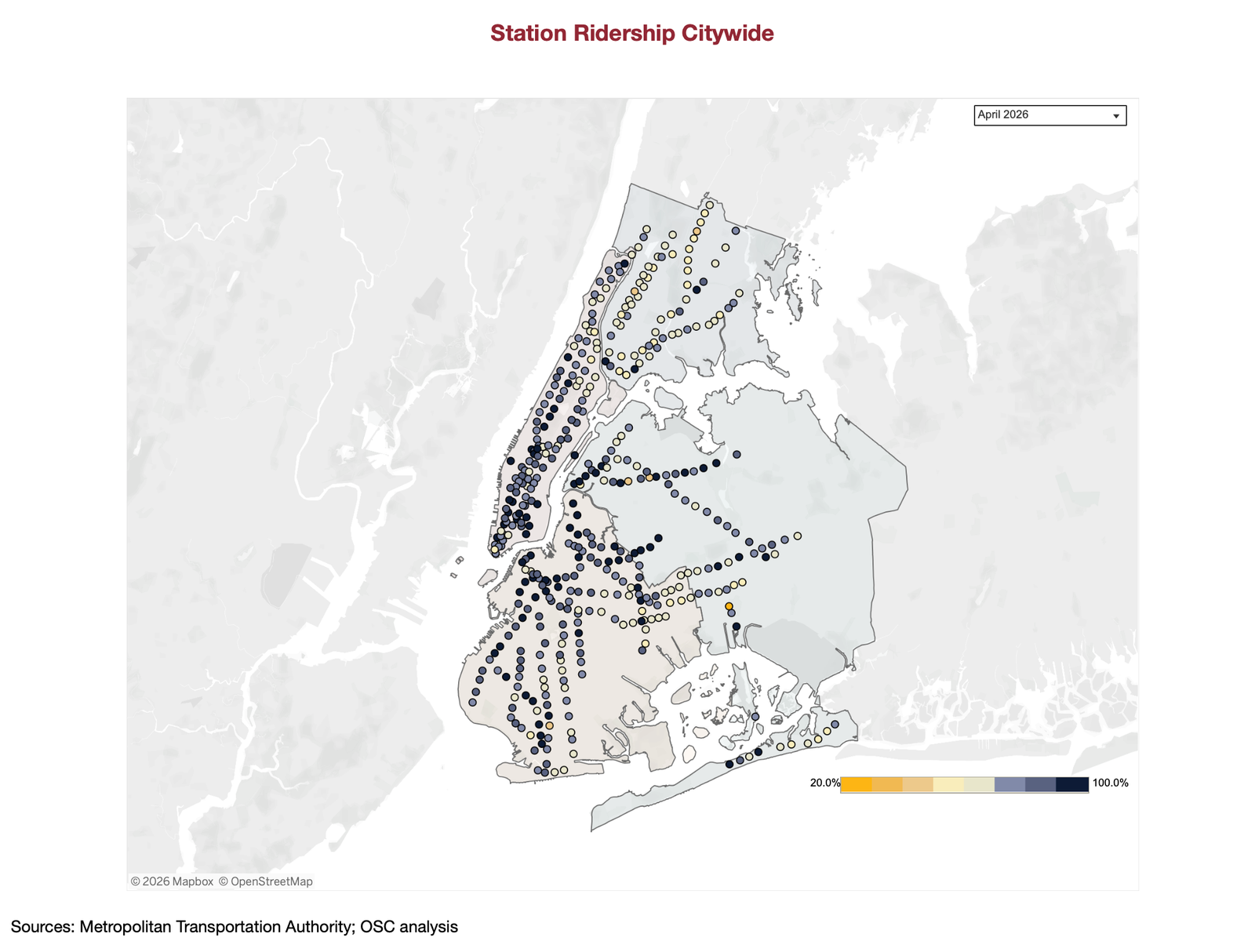
    For example, looking at station ridership recovery across the city, there visually appears to be a geographic correlation with areas in Upper Manhattan, the Bronx, and the outer boroughs in general not recovering to the same extent as Manhattan.

    In the early days of the pandemic, ridership levels were mostly correlated with median household incomes. Ridership remained higher in the outer boroughs, while residents in wealthier neighbourhoods simply worked from home. Since then, that correlation has weakened and the geography has inverted.

    This suggests to me that in addition to WFH, there has also been a structural mobility shift for many households. We know that car registrations in NYC spiked during the pandemic, and presumably that means some new mobility habits were formed.


    Cover photo by Igor Wang on Unsplash

    Chart from Subway Recovery Tracker

  • Toronto Tech Week

    May 26, 2026 · View original


    This week, May 25 to 29, is Toronto Tech Week. If you’d like to check out the event calendar, click here.

    What’s interesting about how the week is structured is that it’s not a traditional conference. It’s more of a decentralized, open platform where anyone can join or host an in-person event, as long as it serves the shared goal of showcasing Toronto as a city of builders. It feels very tech-appropriate, and it means you can tailor the week to your interests.

    I’m laser-focused on my own building right now (otherwise I’d be all over the it), but I am enjoying following it online and seeing the energy that it brings to our city. Toronto is one of the greatest cities in the world, and there’s no shortage of talented entrepreneurs working to build the future right here.

    What we do need to be better at, though, is celebrating the people taking risks and providing them with the capital and resources to make wild and crazy bets. But I’m sure that’s all happening right now at Tech Week. Go Toronto!

  • Customers, costs, and typologies in the next housing cycle

    May 25, 2026 · View original


    Because of how long it takes to build a building, real estate markets almost always overbuild at the top, and underbuild at the bottom (see yesterday’s post about the pig in the python). In a theoretically perfect economic model, supply would adapt instantly to changes in demand. But in the real world of development, this adaptation can take 5 to 10 years.

    At the same time, it’s not just about the quantity of real estate being delivered at any given time; it’s also a question of what kind of real estate. We talk a lot around here about this moment in time being a healthy reset for Toronto’s housing market (and other markets). But what exactly are we resetting? I find it helpful to think of it in terms of three prongs.

    First, there’s customer type. Who will be the buyers and tenants during the next cycle and what will they be looking for? For instance, when it comes to pre-construction condominiums, to what extent will individual investors factor in like they did during the last cycle? Many think they will play a much smaller role.

    Second, there’s the cost structure. The cost of building is changing, and hopefully we will see continued efforts to make housing more cost-effective to deliver. And third, there’s a question of building typology. As the demand profile changes and as costs evolve, it is naturally going to have an impact on the kind of buildings that get built.

    My gut is that we will see more housing geared toward end-users in medium-density builds, but only time will tell.


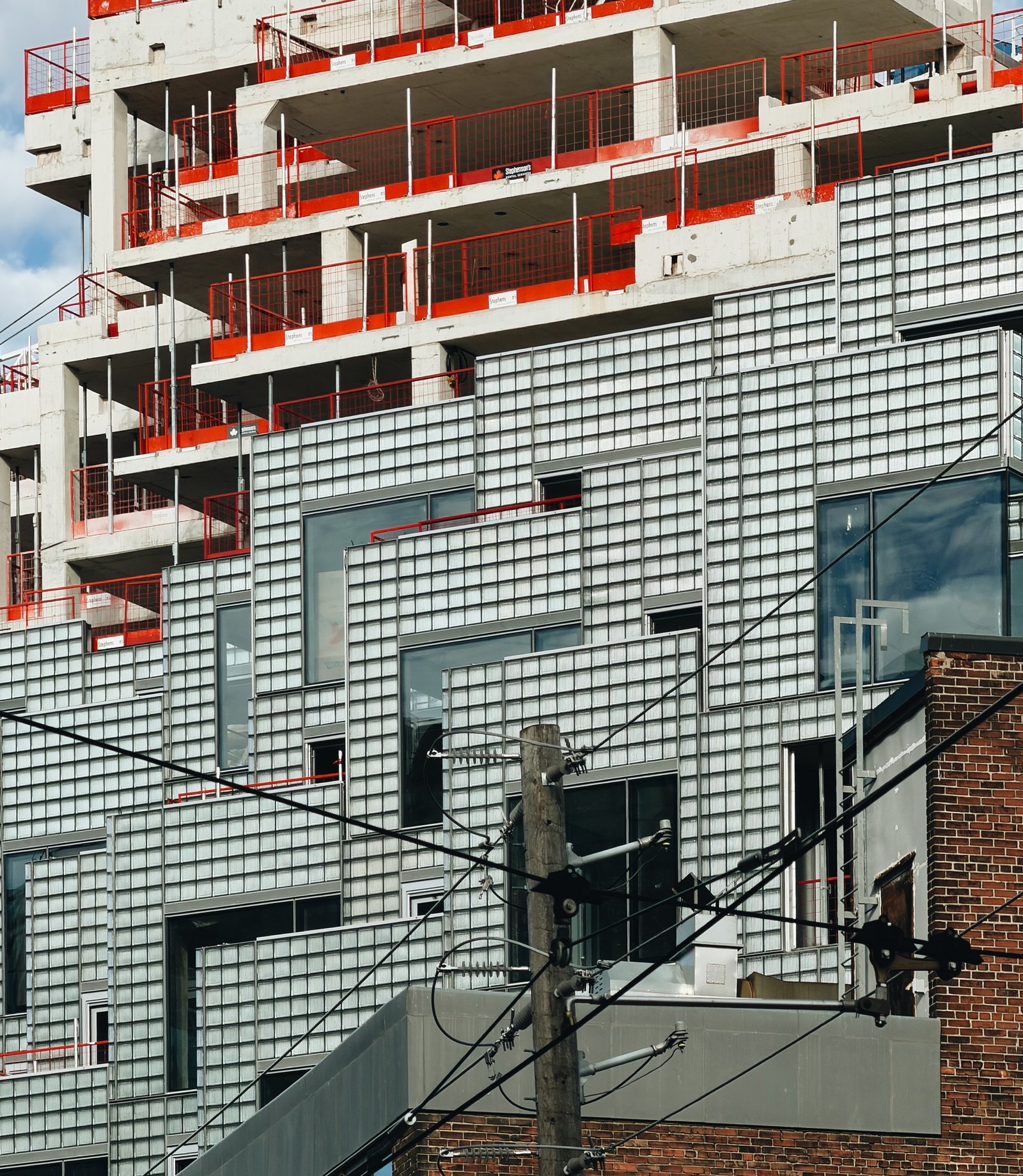
    Cover photo by Lennon Kong on Unsplash

  • Are short-haul flights on the way out?

    May 19, 2026 · View original


    Jet fuel costs have nearly doubled since the US and Israel attacked Iran in February. This is obviously straining the overall economics of air travel, but the most impacted segment is the one that has always been tenuous: short-haul flights.

    As I understand it, airlines generally prefer flights that are at least 2 hours long. Takeoff and landing consume the most fuel, and add a lot of wear and tear on a plane’s equipment, so you want a long enough flight to amortize these costs. This is why for the 10 years spanning 2016 to 2026, US flights spanning less than 250 miles declined by 11% — the largest drop of any route length.

    Now, in some cases, these short-haul flights are simply necessary loss leaders. For example, the flight from Milwaukee to Chicago is comically short. It’s only about 70 miles, translating into an actual cruising time of around 20 minutes. But it’s an important route for connecting passengers and the overall hub-and-spoke airline model.

    This also makes it slightly harder for rail to effectively compete, because you need to solve for two clear passenger demands (again, assuming they’re connecting): (1) people leaving Milwaukee will want to check their bags at the point of departure and (2) they don’t want to arrive downtown, they want to arrive at the airport for their connecting flight.

    That said, both of these wants are solvable. Hong Kong, for instance, allows in-town check-in where passengers drop their bags downtown before boarding the airport train. This is particularly convenient if you have to check out of your hotel and need to rid yourself of your luggage until you arrive at your final destination.

    Very cool, so what’s my point?

    I mention all this because if short-haul flights are the flight segment that airlines don’t love to operate, then it only strengthens the opportunity for high-speed rail to fill this gap in the market and become a seamless component of overall global mobility.

    Here in Canada, the obvious opportunity is the Toronto-Montreal corridor. This is arguably the single best opportunity in North America when you consider its geography, construction viability (lots of undeveloped land to lay new track), and ability to replace short-haul flights. The broader Windsor-Quebec City corridor is also, as we know, the densest part of Canada with roughly 50% of our entire population.

    But the overall opportunity is twofold: it will service origin-destination travel and it will connect Toronto and Montreal as global airport hubs. In fact, this is one of the stated reasons for why Air Canada joined the high-speed Alto project as a core consortium partner:

    > Connections with other modes of transport, such as rail or bus, are part of the solutions the company is already developing to offer the most relevant mobility option, responding in a sustainable way to the specific needs of each of its customers. In the longer term, the contribution of its expertise to the Cadence team will enable the airline to contribute to the harmonious integration of a future intercity rail network with existing airport hubs in the Quebec-Windsor corridor, for the benefit of all travellers.

    Here’s a specific example. Montreal largely serves as Canada’s direct gateway to France’s secondary cities, Francophone Africa, and the Mediterranean. So if you live in Toronto and want to fly to Marseille or Algiers or Mallorca, you are going to connect in Montreal (or connect across the Atlantic somewhere in Europe).

    The multi-modal train option would include an in-town baggage check at Union Station in Toronto, a 3-hour train ride to Montreal, a seamless rail connection from Gare Centrale to YUL (with the REM airport train set to open in 2027), and then your flight to Europe or Africa.

    The overall travel time should be comparable, except in the high-speed rail option you’d have more uninterrupted time to work, watch a movie, or sleep. And now that Air Canada gets to rid itself of its less profitable (or unprofitable?) short-haul flights, it should have the margin to aggressively market these tickets.

    If this customer experience is designed properly — with one booking, competitive fares, clean transfers, and convenient baggage handling — it will quickly dominate the market. We know this because it’s already working in Europe.


    Cover photo by 7 on Unsplash

  • How to fall in love with Toronto

    May 17, 2026 · View original


    This weekend I went on a long bike ride across the city with my friend Ev (who, by the way, just recently got married. Congratulations again to you both!). This was not a ride to pump my feeble Strava stats, but a ride to see and explore our wonderful city. And once again I was reminded that one of the easiest ways to fall in love with Toronto is to get on a bike and ride across it. Biking offers the best of both worlds: it’s both fast and efficient, and it’s granular. You can easily slow-ride through smaller spaces or quickly get off and walk them.

    If I’m ever in the mood to elicit a shitstorm of negative reactions, all I have to do is go on Twitter and tweet something pithy about how much I love Toronto. I don’t know why so many people seem to react like this, but I genuinely feel this way about our city. City-building is a slow process, but a spring ride after a cold winter will reveal to you all of the projects we’ve been working on quietly in the background: new streets, new mid-block connections, new public spaces, new businesses, and beautiful architecture.

    Of course, not all of it is exceptional. At one point, Ev and I came across two newly constructed courtyards in the middle of large developments that will remain unnamed. One was beautiful and held the promise of businesses and F&B lining its edges, while the other was empty and grim looking. We then turned to each other and said: “Isn’t it amazing how different these not-so-different courtyards are?”

    But objectively, there’s so much that we are getting right. New streets are now subdividing formerly large, unwalkable blocks. Existing neighbourhoods are growing, adding sustained urban vibrancy. New megaparks, like Biidaasige Park in the Port Lands, have already become fantastic, well-used spaces, setting the stage for new urban neighbourhoods to crop up all along their edges. And many of our new buildings are, quite frankly, gorgeous.

    Most importantly, though, people are using these spaces — a lot. They’re filling sidewalks, hanging out on patios, and cycling on new bike lanes. It’s easy to focus on the things that Toronto isn’t or doesn’t have, just like it’s personally easy to focus on what you may not be or have. Bringing positivity doesn’t mean ignoring the challenges that our city is facing, but being grateful for everything we are achieving is a great way to reframe our perspectives toward an abundance mindset.

    If you’re looking for an easy way to do that, try getting on a bike on a beautiful sunny day.

  • The Atlas of Greater Paris

    May 16, 2026 · View original


    Occasionally, writing a daily blog has its perks.

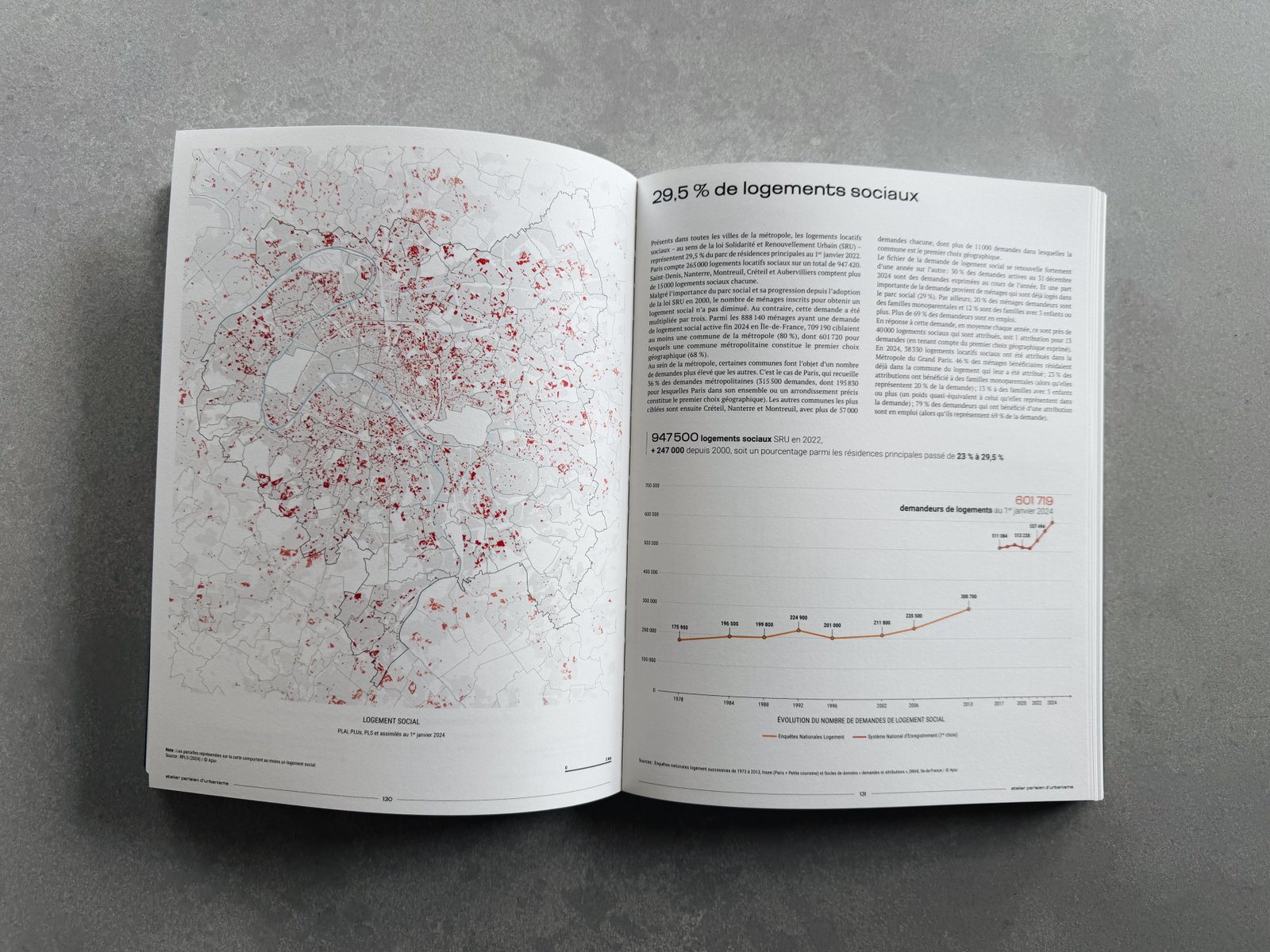
    Last month I wrote a post called “The radical transformation of Greater Paris” and, in it, I mentioned that Apur (a French non-profit focused on urbanism that I follow) had just published a new book called Atlas de la Métropole du Grand Paris.

    I also mentioned that I hadn’t been able to find a shop that would ship to Toronto, but that if anyone happens to be in Paris, it’s available in bookstores over there. Volume is apparently a great store for people who like the kind of things we talk about on this blog.

    Following the post, I got an email from Ryan Taylor at Parcel Economics who more or less said, “Hey, I’m leaving for Paris soon. Want me to grab you a copy of the book? I’ve learned a lot from your blog over the years and thought I would offer.”

    Now I have the book:

    Ryan, thanks for transporting what is a fairly substantial book across the Atlantic. If any of you are in need of a land economist, reach out to Ryan and the folks at Parcel Economics. He’s both a nice and smart guy.

    Enjoy the long weekend, everyone.

  • Toronto Pearson breaks ground on one of Canada’s largest airport expansions

    May 14, 2026 · View original


    Toronto Pearson Airport has just announced a $3 billion investment called LIFT, which stands for Long-term Investment in Facilities and Terminals. (This feels like a “how do we make this acronym work” kind of name.) The investment includes an upgraded baggage system, an expansion of the airfield to 2.2 million square metres, and a bunch of new tech.

    Following this, the plan is to refresh Terminals 1 and 3, and look for opportunities to create some net-new terminal space. And when it’s all said and done, the program is expected to grow the airport’s capacity to about 65 million passengers per year by the early 2030s.

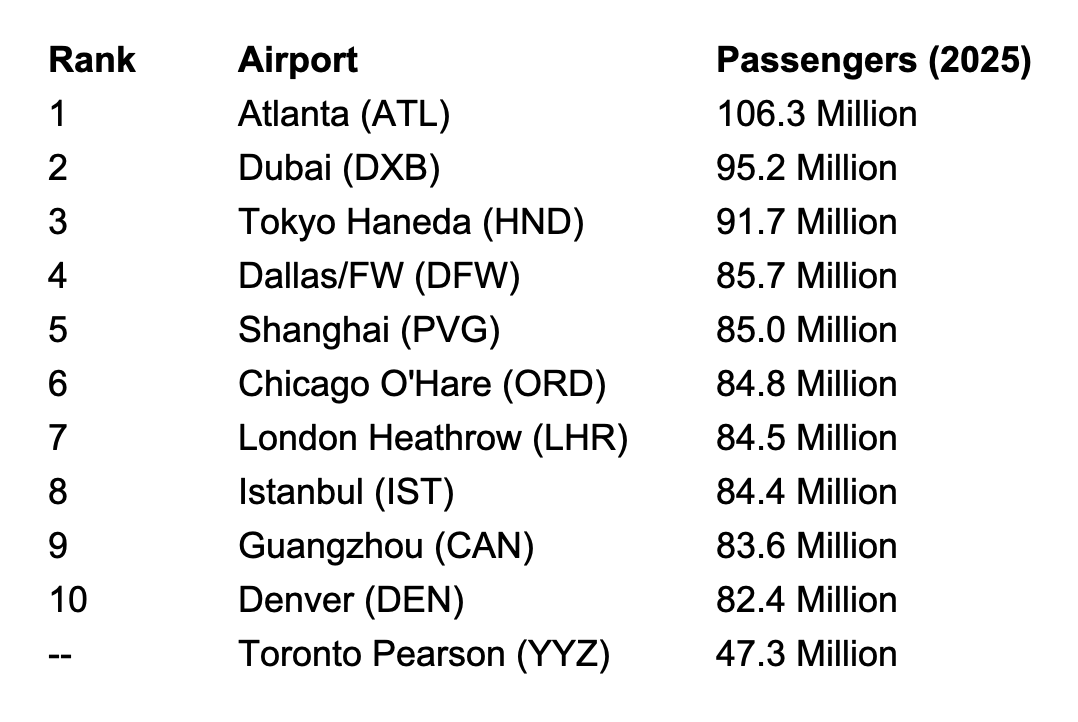
    My first reaction when I read the announcement was, “Great, let’s make Pearson better.” My second reaction was, “Why only 65 million passengers? Why not 100 million or even 125 million?” (Side note: I love airports and I think it would be a lot of fun to design and/or work on one.)

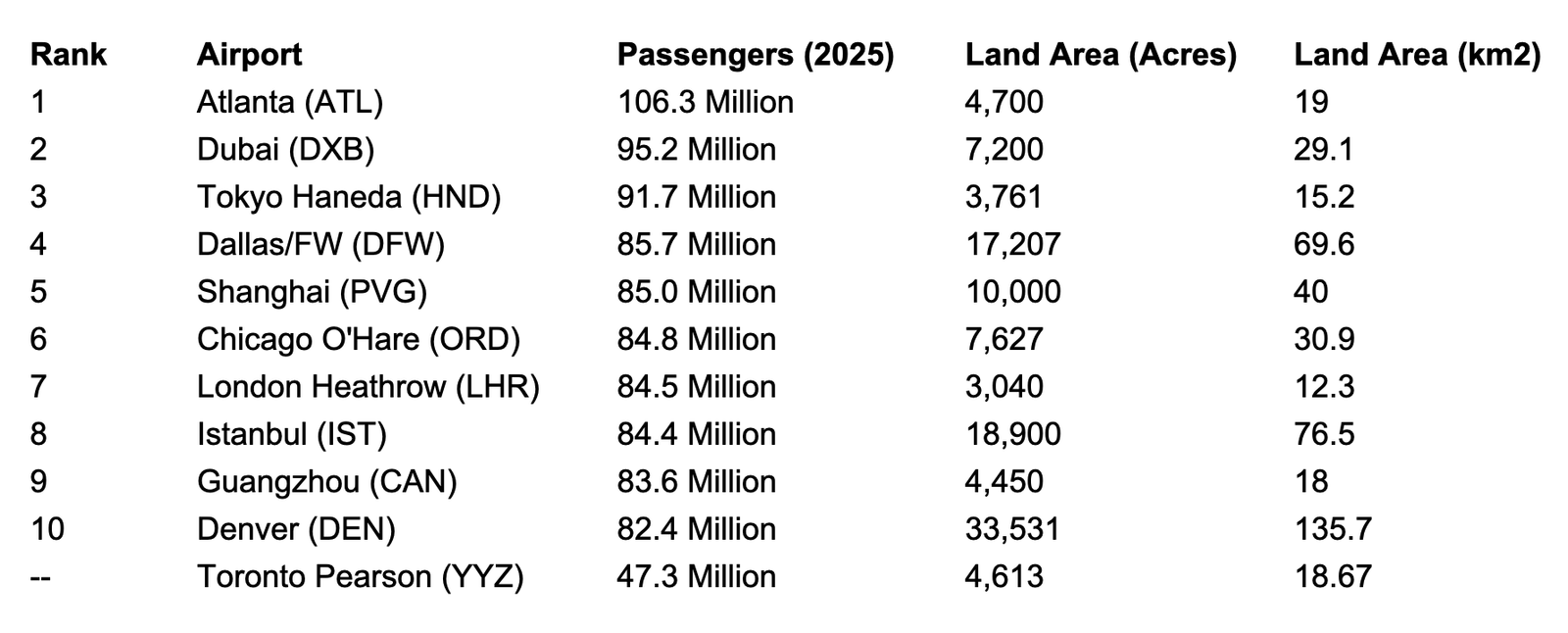
    For those of you who are curious, here are the top 10 busiest airports in the world by annual passenger volume (according to Gemini):

    My follow-up question to Gemini was my second reaction: Why not target 100 million passengers? The response I got was, “Yeah, well, the airport is physically constrained and simply doesn’t have the room for this kind of volume.” So then I asked it to give me the land area in both acres and square kilometres for the same list of airports:

    The obvious question: If Tokyo and London can achieve close to 100 million passengers on less than 4,000 acres, why can’t Toronto? Gemini then said, “Okay, yeah, I guess it might be possible,” but then gave a number of reasons why it’s currently more challenging; everything from the layout of the runways to the high percentage of origin & destination travel over connecting flights.

    I frankly don’t know enough about the operations of international airports to comment intelligently, but at the end of the day, the LIFT program is fundamentally about densifying the existing airport lands and unlocking additional capacity. And that’s what it will take to eventually get to 125 million!


    Cover photo by Michael on Unsplash

  • Jesta Group announces $30M bulk condominium buy in downtown Toronto

    And a larger $500 million condominium program

    May 13, 2026 · View original


    Montreal-based Jesta Group has just announced the acquisition of a bulk condominium portfolio in downtown Toronto valued at $30 million. This also marks the launch of a larger $500 million program targeting more than 1,000 residential units over the next 12 months. Here’s a snippet from the press release:

    > “Toronto’s fundamentals remain strong and the current market environment has created a unique window to deploy capital at scale,” said Anthony O’Brien, Senior Managing Director at Jesta Group. “We are aggressively pursuing opportunities that fit this investment ethos and encourage developers with qualifying inventory to reach out directly.”

    Anthony’s email is [aobrien@jesta.com](mailto:aobrien@jesta.com).

    Sentiment seems to be changing here in Toronto. Maybe it’s because summer is coming and the winter was long, or maybe it’s because our looming supply bottom is drawing nearer. Regardless, a $500 million program certainly suggests that somebody believes we are at or near the bottom.


    Cover photo by Rodolfo Flores on Unsplash

  • The current state of unsold condominiums in Vancouver and Toronto

    May 10, 2026 · View original


    According to recent data from CMHC via the Globe and Mail, here’s (at least part of) the housing situation in Vancouver and Toronto:

    – Metro Vancouver has 4,919 newly built unsold homes on the market (including houses, duplexes, row houses, and condominiums). – Of this total, 3,195 are unsold condominiums. All of these figures exclude homes that were sold but where the buyers failed to close. – Across Metro Vancouver, 37% of the unsold condominium inventory is priced above $1 million. – In the city of Vancouver proper, 81% of the unsold condominium inventory is above $1 million, with more than 14% priced above $3 million. – In the Greater Toronto Area, there are only 701 newly built unsold units on the market, and in the city of Toronto, 61% of these are priced at or above $1 million.

    Initially, the 701 figure seemed low to me, but the way I interpret this “unsold” metric is that it’s strictly a best attempt at a moment-in-time snapshot of developer inventory in newly completed projects that have never been subject to a purchase agreement.

    Missing from these figures are unsold homes currently under construction, and recently closed homes that have never been occupied and are now on the resale market or are simply sitting empty. Again, if a buyer failed to close, these homes would not show up in the CMHC figures.

    It also doesn’t include homes in the pre-sale phase. However, I think this supply is mostly irrelevant because if the developer doesn’t get to construction then that inventory quickly disappears from the market. It’s not sitting there needing to be absorbed (though we developers would love for it to be).

    The Globe and Mail article talks about how there are over 40,000 housing units that have been approved in Metro Vancouver but have not yet proceeded to construction, and that “newly built condos in Vancouver are too pricey to sell.” But the salient question is one of product-market fit: What housing do customers actually want, and can afford, today?

    As we have talked about many times before on the blog, I think we need to view this moment in time as an opportunity to reset our housing markets. In other words, it’s an opportunity to look at how we regulate and tax new housing, and at what and how we build, all with the goal of better serving the housing needs of Canadians.

    My specific view is twofold: We need to cut the regulatory fat around delivering new homes, and we need to better optimize for medium-density housing.

  • Paris has really small garbage rooms

    May 9, 2026 · View original


    In today’s episode of “this social housing project in Paris looks better than most market-rate housing elsewhere,” we’re looking at a recently completed boarding house in the 17e by CQFD Architecture.

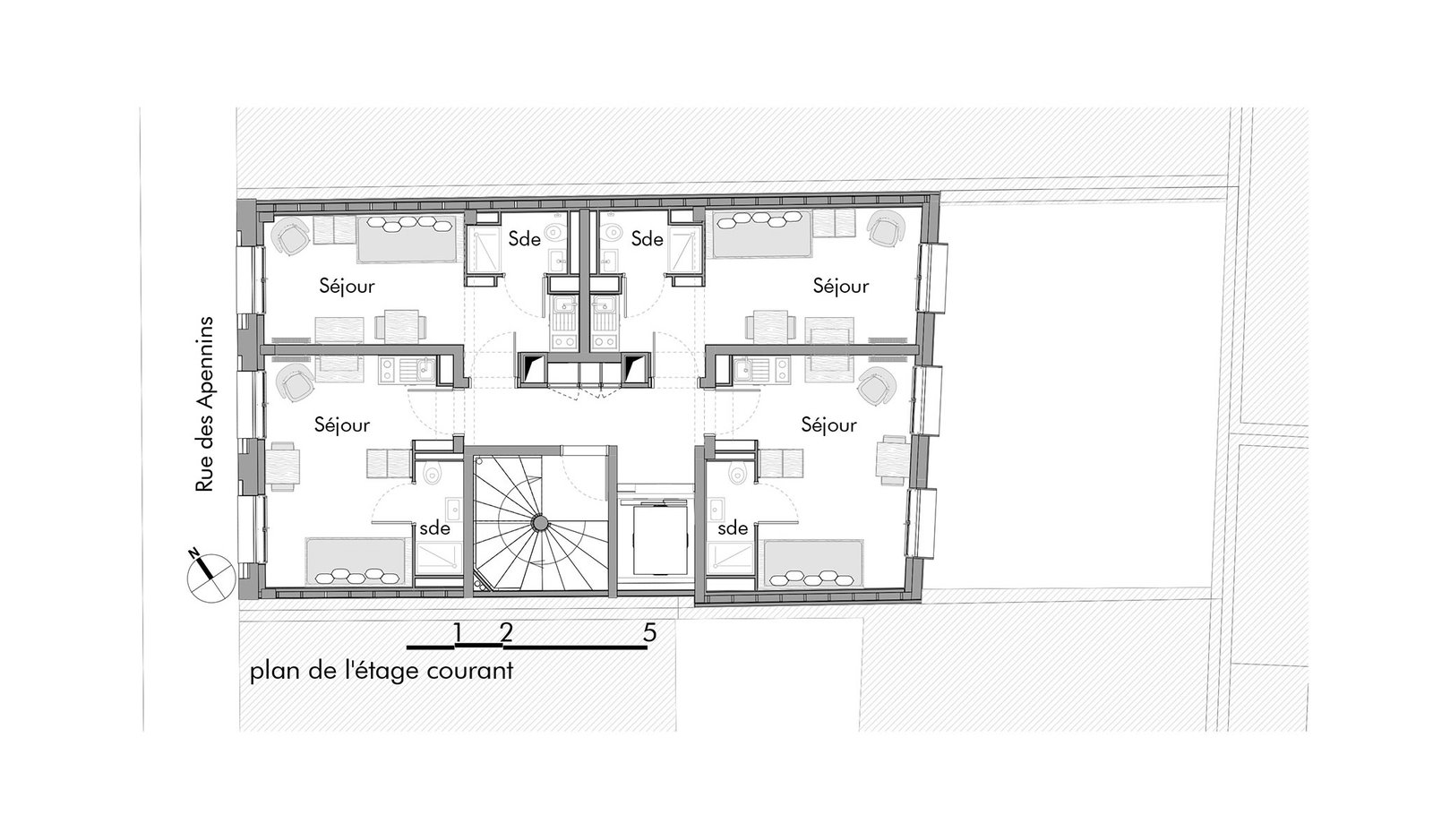
    The project has 6 storeys, a total area of 690 m2, 19 units, and a hard cost budget that was approximately €2.6 million (excluding tax). At this number, their hard costs work out to ~€3,768 per m2, ~€350 per ft2, or ~C$563 per ft2. So this was not a cheap build. Here’s what it looks like:

    When I first saw the project, I thought the total area would be larger than it is. At 690 m2, it’s basically the size of a multiplex project here in Toronto. Except here in Paris, they’ve gone vertical and they’ve managed to fit 19 studio apartments, plus amenity space.

    All of this is possible when you consider the efficiency of each floor plate. The typical floor includes 4 apartments, one stair, one elevator, and a short corridor. Add in a second exit stair and all of this blows up.

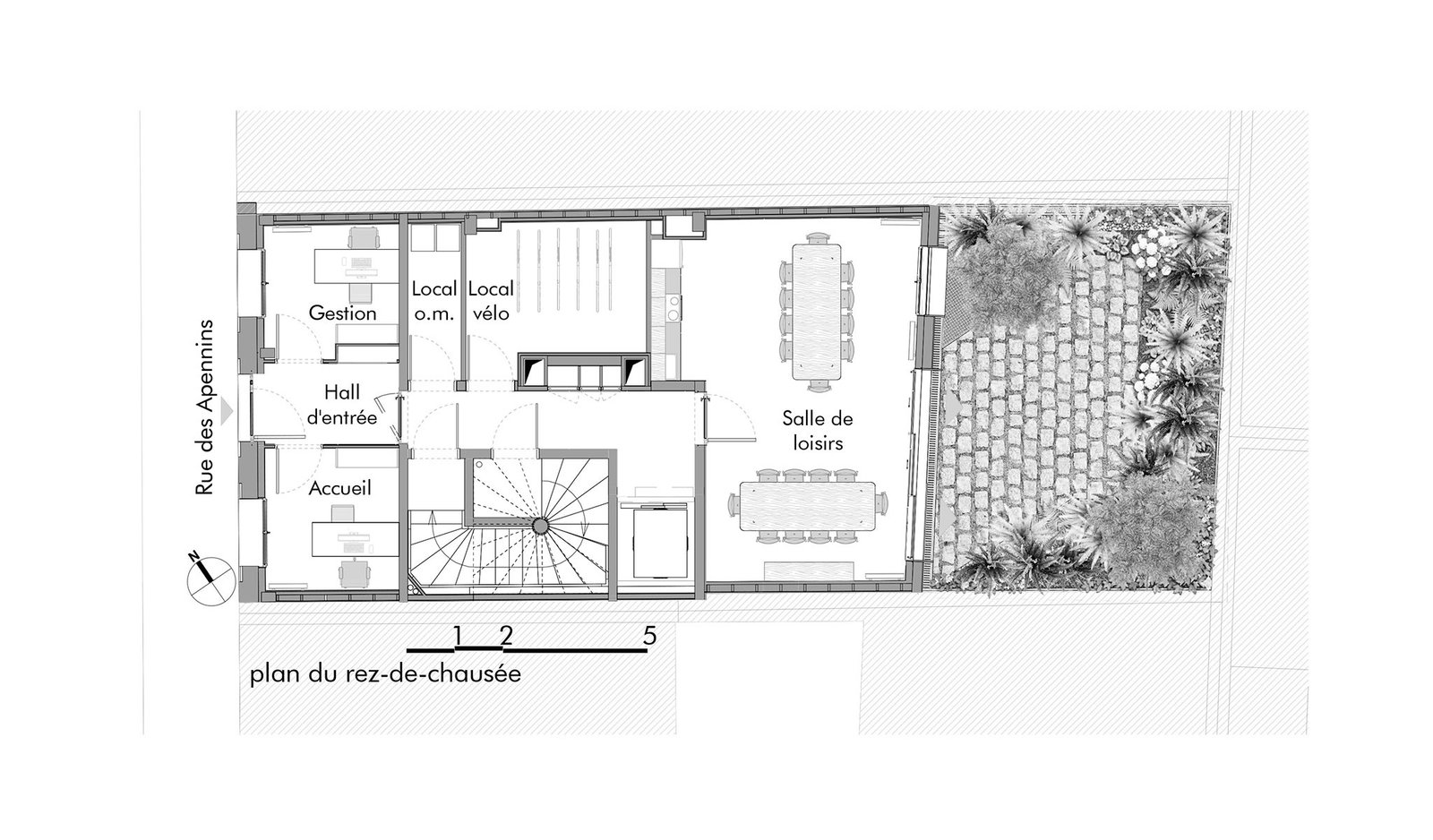
    Also interesting is the efficiency of the ground floor. There’s an entrance hall, management office, bike room, recreation room, outdoor garden, and a teeny tiny garbage room (“local O.M.” on the plan). As I understand it, this is all that’s required for refuse because of how frequently it’s picked up.

    If this were in Toronto, we’d probably need a dozen bins, meaning that the bike room and/or recreation room would need to shrink down.

    I love dissecting plans and dimensions from different cities because it shows you the invisible hand of building codes, planning policies, and cultural norms. We get accustomed to certain conventions and then we assume that it’s simply the way that things must be done.

    But the rules we have are simply the rules that somebody decided to create. As Steve Jobs once said, “Everything around you that you call life was made up by people that were no smarter than you.” This implies that everything can be questioned and ultimately changed when there’s a better solution.


    Photos from CQFD Architecture

    Floor plans from Metalocus