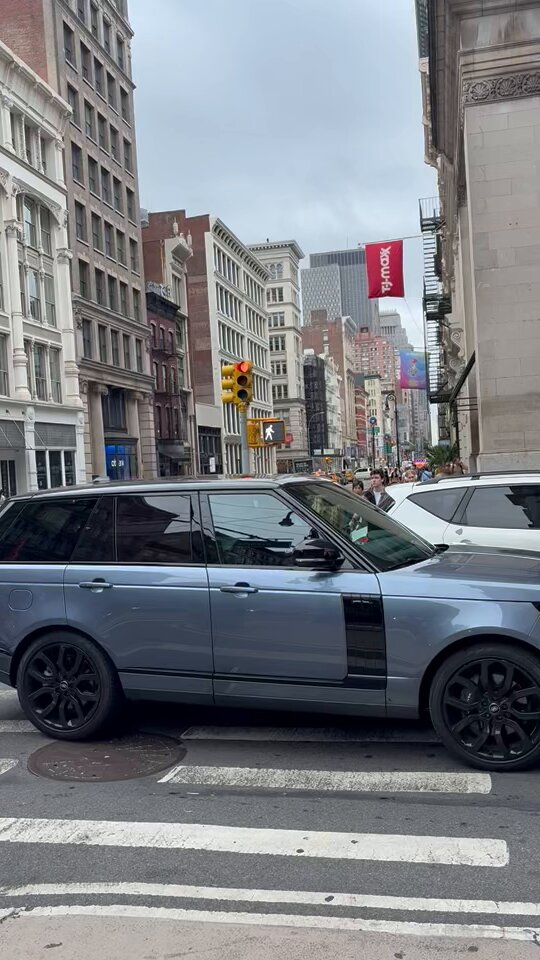
Today is the third day of New York's new congestion relief zone. And if you're curious to see how it's already impacting traffic conditions, here is a website run by Joshua Moshes and Benjamin Moshes, under the supervision of Brown University Professor Emily Oster.
The site collects Google Maps traffic data every 15 minutes for 19 routes leading into Manhattan (some of which are directly affected by the new relief zone and some of which are not). It then calculates average traffic times for each day of the week, both before and after the congestion charge.
Here is the Holland Tunnel on Sunday (which was day number one):
Today is the third day of New York's new congestion relief zone. And if you're curious to see how it's already impacting traffic conditions, here is a website run by Joshua Moshes and Benjamin Moshes, under the supervision of Brown University Professor Emily Oster.
The site collects Google Maps traffic data every 15 minutes for 19 routes leading into Manhattan (some of which are directly affected by the new relief zone and some of which are not). It then calculates average traffic times for each day of the week, both before and after the congestion charge.
Here is the Holland Tunnel on Sunday (which was day number one):
And here is the Holland Tunnel on Monday (which was the first weekday):
Already, we are seeing a meaningful reduction in average traffic times. Maybe demand is more elastic than I suggested yesterday. But obviously we're only looking at two days. So I'll check back in later once we have more data points. In the meantime, if you'd like to follow along, you now have a website.
After decades of delay and negotiations, New York City finally implemented congestion pricing for the area of Manhattan south of 60th Street. This is a first for the United States, and so it's a big deal not just for the city, but for this part of the world. It went into effect yesterday, on Sunday at midnight, so that the MTA could work out any kinks before this morning's rush hour. And apparently everything went smoothly. Drivers are now required to pay $9 to enter the zone during peak hours (5am to 9pm during weekdays). The charge is also expected to rise to $15 by 2031. Of course, this is a highly contested initiative. Trump is still vowing to kill the program as one of his first acts in office and, as soon as the pricing came into effect, suburban drivers started protesting it in Manhattan. I thought Jarrett Walker had a clever response to this:
To protest congestion pricing, Suburban drivers are driving into Manhattan and blocking traffic with their cars. These extreme activists plan to make streets so unsafe and gridlocked that NYC businesses lose money! Only car owners can shut NYC down and send a message!
And here is the Holland Tunnel on Monday (which was the first weekday):
Already, we are seeing a meaningful reduction in average traffic times. Maybe demand is more elastic than I suggested yesterday. But obviously we're only looking at two days. So I'll check back in later once we have more data points. In the meantime, if you'd like to follow along, you now have a website.
After decades of delay and negotiations, New York City finally implemented congestion pricing for the area of Manhattan south of 60th Street. This is a first for the United States, and so it's a big deal not just for the city, but for this part of the world. It went into effect yesterday, on Sunday at midnight, so that the MTA could work out any kinks before this morning's rush hour. And apparently everything went smoothly. Drivers are now required to pay $9 to enter the zone during peak hours (5am to 9pm during weekdays). The charge is also expected to rise to $15 by 2031. Of course, this is a highly contested initiative. Trump is still vowing to kill the program as one of his first acts in office and, as soon as the pricing came into effect, suburban drivers started protesting it in Manhattan. I thought Jarrett Walker had a clever response to this:
To protest congestion pricing, Suburban drivers are driving into Manhattan and blocking traffic with their cars. These extreme activists plan to make streets so unsafe and gridlocked that NYC businesses lose money! Only car owners can shut NYC down and send a message!
One of the common rebuttals when it comes to things like road and congestion pricing is this one: "yeah, this might work in cities like London which have great transit systems, but it doesn't work in our city because we don't have that and it will unfairly disadvantage those who have no other alternative but to drive." In fact, this exact excuse was recently raised by local politicians here in Toronto. But this is New York fucking City. It has the highest annual transit ridership in North America (beating out Mexico City by nearly 2x) and it has the largest system by total length. According to the 2012-2016 American Community Survey, 85% of people traveling to Manhattan's CBD (I'm assuming lower Manhattan here) also take transit. And only 11% drive a car. So what exactly is the problem here?
This objection also ignores the fact that, generally speaking, congestion pricing has two main goals: (1) to, of course, reduce traffic congestion and (2) to generate money for more efficient modes of transport. In this case, the MTA is hoping this new congestion relief zone will generate up to $15 billion that can then be reinvested in transit and other infrastructure. Demand for roads can also be relatively inelastic in the short term, meaning demand doesn't change all that much as the price moves up and down. This makes it a good place to find money for public infrastructure, but it might mean that $9 is too low to have a dramatic impact on traffic congestion. We will see; I'm sure we'll get some data soon enough.
My prediction is that this will ultimately have an impact on congestion and that people in New York will get over the $9 charge. They'll also come to appreciate the reduced traffic congestion within the zone. So I think this road pricing will stick, and my hope is that it will become an example for other cities in the US and across North America. Congratulations on finally getting this over the line, NYC. It was certainly a hard-fought battle.
When I first saw this picture of Louis Vuitton's flagship store in Manhattan I thought it was AI. That is where we are right now. When something looks wild, I just automatically assume it's fake. But alas, it's not fake. Louis Vuitton is renovating their flagship store at the corner of 57th Street and 5th Avenue and so, naturally, they decided to completely cover it with luggage facade wraps.
These wraps make the entire building look like six grey trunks stacked on top of each other and are a nod to a 19th century luggage design from the company. They even used real metal details throughout. Apparently the heaviest luggage handle weighs something like 5,000 pounds.
This is wild and remarkable in so many ways. The scale of it is remarkable. This is a 15 storey building concealed entirely by luggage trunks. It also speaks to the scale and dominance of New York as a city. Not every city can absorb a pile of giant luggage trunks and not bat an eye. But in New York, it's just another noteworthy thing within its relentless urban grid.
I also can't help but think of the work of architects Robert Venturi and Denise Scott Brown. In 1972, they published a book called Learning from Las Vegas. And in it, they defined two types of contrasting buildings: decorated sheds and ducks. Decorated sheds are, as the name suggests, nondescript buildings. Think big box stores. These buildings get their specificity from signage and other ornament because, without this, they'd just be nondescript sheds.
Duck buildings are, on the other hand, buildings that take on a symbolic form. In other words, their shape and construction tell you what they're all about. The term duck comes from an actual building that looks like a duck, namely The Big Duck on Long Island. This is a building that was built in the 1930s to help promote the owner's duck farming business and is now on the US National Register of Historic Places.
The Big Duck is and was an actual building, whereas Louis Vuitton's trunks are just temporary construction wrap. So they're not exactly the same thing. Still, the similarities are there. Both were erected to promote their respectiveness businesses. And both tell you, through their form, what's meant to happen inside. So in this sense, Louis Vuitton has just created its own Big Duck.
One of the common rebuttals when it comes to things like road and congestion pricing is this one: "yeah, this might work in cities like London which have great transit systems, but it doesn't work in our city because we don't have that and it will unfairly disadvantage those who have no other alternative but to drive." In fact, this exact excuse was recently raised by local politicians here in Toronto. But this is New York fucking City. It has the highest annual transit ridership in North America (beating out Mexico City by nearly 2x) and it has the largest system by total length. According to the 2012-2016 American Community Survey, 85% of people traveling to Manhattan's CBD (I'm assuming lower Manhattan here) also take transit. And only 11% drive a car. So what exactly is the problem here?
This objection also ignores the fact that, generally speaking, congestion pricing has two main goals: (1) to, of course, reduce traffic congestion and (2) to generate money for more efficient modes of transport. In this case, the MTA is hoping this new congestion relief zone will generate up to $15 billion that can then be reinvested in transit and other infrastructure. Demand for roads can also be relatively inelastic in the short term, meaning demand doesn't change all that much as the price moves up and down. This makes it a good place to find money for public infrastructure, but it might mean that $9 is too low to have a dramatic impact on traffic congestion. We will see; I'm sure we'll get some data soon enough.
My prediction is that this will ultimately have an impact on congestion and that people in New York will get over the $9 charge. They'll also come to appreciate the reduced traffic congestion within the zone. So I think this road pricing will stick, and my hope is that it will become an example for other cities in the US and across North America. Congratulations on finally getting this over the line, NYC. It was certainly a hard-fought battle.
When I first saw this picture of Louis Vuitton's flagship store in Manhattan I thought it was AI. That is where we are right now. When something looks wild, I just automatically assume it's fake. But alas, it's not fake. Louis Vuitton is renovating their flagship store at the corner of 57th Street and 5th Avenue and so, naturally, they decided to completely cover it with luggage facade wraps.
These wraps make the entire building look like six grey trunks stacked on top of each other and are a nod to a 19th century luggage design from the company. They even used real metal details throughout. Apparently the heaviest luggage handle weighs something like 5,000 pounds.
This is wild and remarkable in so many ways. The scale of it is remarkable. This is a 15 storey building concealed entirely by luggage trunks. It also speaks to the scale and dominance of New York as a city. Not every city can absorb a pile of giant luggage trunks and not bat an eye. But in New York, it's just another noteworthy thing within its relentless urban grid.
I also can't help but think of the work of architects Robert Venturi and Denise Scott Brown. In 1972, they published a book called Learning from Las Vegas. And in it, they defined two types of contrasting buildings: decorated sheds and ducks. Decorated sheds are, as the name suggests, nondescript buildings. Think big box stores. These buildings get their specificity from signage and other ornament because, without this, they'd just be nondescript sheds.
Duck buildings are, on the other hand, buildings that take on a symbolic form. In other words, their shape and construction tell you what they're all about. The term duck comes from an actual building that looks like a duck, namely The Big Duck on Long Island. This is a building that was built in the 1930s to help promote the owner's duck farming business and is now on the US National Register of Historic Places.
The Big Duck is and was an actual building, whereas Louis Vuitton's trunks are just temporary construction wrap. So they're not exactly the same thing. Still, the similarities are there. Both were erected to promote their respectiveness businesses. And both tell you, through their form, what's meant to happen inside. So in this sense, Louis Vuitton has just created its own Big Duck.



 extreme activists
  plan to make streets so unsafe and gridlocked that NYC businesses lose money!