
Daily insights for city builders, delivered every morning at 6 AM ET. I’m Brandon Donnelly — a Toronto-based real estate developer and founder of Globizen. I’ve been writing here since 2013.

Category: Development

  • From square to circle at One Delisle

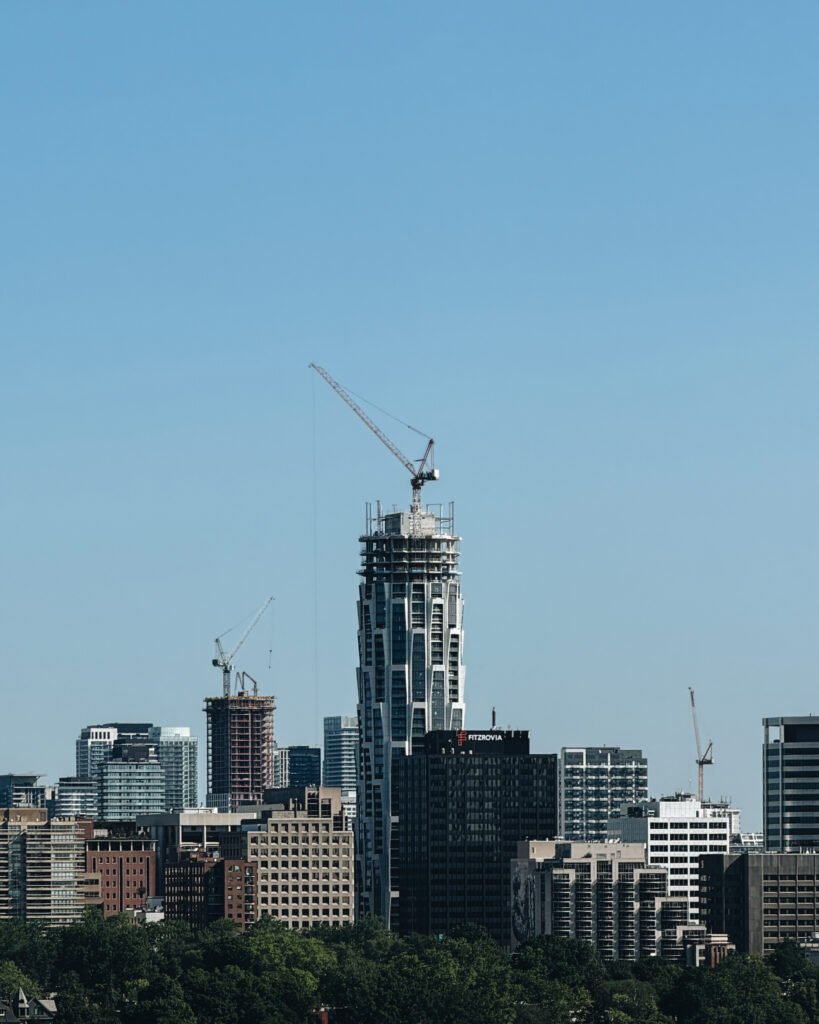
    One Delisle is really starting to make a mark on the Toronto skyline. So on a semi-regular basis, people now send me photos of the building or mention me on the socials. I love when people do that. Here’s a great photo from today from Dion on Twitter.

    One of the comments that I used to get was, “Yeah, I don’t know, Brandon, the floor plate is still looking pretty square.” And I would respond with, “Be patient.” For those of you who aren’t familiar with the design, the entire tower gradually transforms from a square floor plate to a 16-sided circular floor plate.

    Nobody makes this comment anymore.

    I also really like Dion’s photo because it shows the steel for the “crown” at the top of the building coming together. The height of the crown was something we fought for during rezoning. Studio Gang felt it was crucial for the proportions and slenderness ratio of the building. And we agreed.

    I can tell you that it had us measuring the exact height of nearby church windows to see if this crown would shadow them at certain times of the day and year. I’m sure glad we did that.

    Please keep the photos coming!

  • Customer-centricity reduces risk

    Real estate can be an abstract concept. If you’re a capital allocator, it might be a line item in one of your spreadsheets. Or, if you’re a developer primarily focused on zoning and entitlements, you might think in terms of gross floor area. How much density do I have, and what is it going to be worth?

    This is not to disparage any one component or participant within the development supply chain; it is simply to say that development is long and complicated, participants will naturally specialize, and everyone will have a lens through which they see things.

    But at the end of the day, these activities ultimately come back to fundamentals: the real estate needs to house people and things, and do something. Gross floor area has value on a spreadsheet because it can be turned into something. And it is ultimately that something that determines how much it is worth.

    If you’re a developer selling entitled land, your direct customer is the next developer, the one who will ultimately build out the site. Then, that developer’s customers are the people who will ultimately buy, rent, and occupy the space. And in some cases, those customers will also have their own customers, if, for instance, they choose to buy a space and then rent it out to somebody else.

    So there are layers to this. But regardless of where you might sit within the chain, I think it’s always helpful to focus on the customer, or customers. It’s harder to be wrong with your assumptions if you drill all the way down and consider the end use cases.


    Cover photo by Israel Andrade

  • A new study on missing middle building codes

    We talk a lot around here about the surprising difficulty of building small-scale apartment buildings. Here’s a post from earlier this year where I outlined a working list of policies, codes, and approaches that would need to change in order to unlock more of this housing type.

    But my list was just that — a list — and the reality is that each individual item can be shockingly complex. To that end, here’s a recent study, published by the Neptis Foundation, called “Ontario Building Code Missing Middle Study: Bridging the gap between houses and high-rises.”

    The authors are Conrad Speckert of Semibold Solutions (who has appeared on this blog in the past) and Jack Keays of Vortex Fire Consulting, and I encourage you to download a free copy. I haven’t gone through it yet, but I will, because we are actively working on projects at this exact scale.

    Enjoy the weekend.


    Cover photo by Danish Prakash

  • Home is not a building type

    Home is not where you live, but where they understand you. — Christian Morgenstern

    One of the things that I like to be annoying about on this blog is the fact that “home” is not a building type. I say this because “home” is often shorthand for ground-oriented, single-family housing. For example, someone might say to me, “Do you think you’ll one day buy a home?” And I will be pedantic and say, “But I already own a home.”

    The words we choose, often because of cultural convention, show our biases. When people associate home with low-rise housing, I can only assume it’s because many cities have had a long history of thinking of apartments as disease-breeding tenements. So we oftentimes see low-rise housing as homes, and apartments as something more utilitarian, like a unit.

    But in the end, a home is not a building type; it is a psychological state of belonging. It is where comfort, safety, belonging, and identity hopefully all intersect.

    One of the interesting things that Bianca and I have both noticed since bringing home our daughter, Vivienne, is that our feeling of home has been heightened. There’s additional life within these four walls, and now it is also a place where she is kept safe and protected from the outside world.

    I’m not sure if any of you have experienced this, but we both felt it immediately, and it has us saying to each other on a regular basis, “I love our home.” And you know what? The view looks pretty great from up here.

  • More homes, less rezonings

    One of the really positive things that is happening in the world of Toronto land use planning is that the minimum scale of development that is permitted as-of-right continues to grow. We’ve gone from fourplexes to 6-storey apartments, and now we’re talking about mid-rise buildings (6-11 storeys) and even some tall buildings (12 storeys or more).

    What this ultimately means is being able to build without a rezoning application. That means no site specific negotiation, and no fighting over whether the building should be 32 meters tall or 30.5 meters tall with a 2.4 meter stepback because of shadowing concerns on someone’s heritage-designated garden gnome. It means getting under construction sooner.

    Here are some of the specific ideas being reviewed:

    • Expand the number of streets designated as “Avenues” throughout Toronto (Avenues are a defined term and where we have decided that mid-rise buildings should go)
    • New Official Plan policies that would encourage more mid-rise buildings on Avenues
    • Eliminate the rear angular plane requirement (currently a mid-rise performance standard); this is expected to produce ~30% more homes in your typical mid-rise development
    • Increase as-of-right permitted heights to 6-11 storeys (the city estimates that this will unlock ~61,000 additional homes)
    • Introduce “transition zones” between Avenues and low-rise neighborhoods, which could then accommodate things like low-rise towns and apartments up to 4 storeys (it’s worth noting that transition zones were initially part of Toronto’s mid-rise performance standards but then got removed for some reason)

    This is meaningful progress. Let’s enact and keep going.

  • Canadian cities will need to freeze their development charges if they want infrastructure fund money

    Here’s some positive news. This past week, the Government of Canada announced additional details around its $6 billion Canada Housing Infrastructure Fund (CHIF). The goal of the fund is to accelerate the construction of housing-supportive infrastructure (water, wastewater, stormwater, and solid waste), and the plan is to deliver it through two distinct funding streams.

    The first is what they are calling a “direct delivery stream”, and this is how the first $1 billion is going to be allocated. Municipalities and Indigenous communities will need to apply, and the funds are expected to be distributed over the next 8 years. But to be eligible — and this is the positive news — municipalities will need to have done the following:

    • Adopt zoning permitting “four units as-of-right” per lot in all low-density residential areas that have municipal servicing
    • Implement a three-year freeze on development charge increases beyond whatever rates were in place on April 2, 2024 (which is when the initial CHIF announcement was made)

    Toronto has already done number one. But many/most other municipalities have not, so this should provide a further incentive. As for requirement number two, my understanding is that this is not (yet) in place pretty much anywhere. I haven’t heard of any municipalities committing to this. So I’m taking this as incremental good news. (Please correct me if I’m wrong.)

    There are, however, important caveats: item number two only applies to municipalities with populations greater than 300,000 people. This seems unnecessarily high. And I can speak from firsthand experience working in communities below this threshold.

    Three-years also isn’t very long when it comes to development timelines, especially in this market. A complicated rezoning process might take 3 years, or even 10 years. So this is very much for small-scale projects, which may be impactful or it may not be, depending on quickly the market responds to policy changes like requirement number one.

    The last thing I will say, and this relates to yesterday’s post, is that freezing is good, but lowering is obviously better.

  • Let’s get serious about building more homes in Canada

    I live in a condominium. I find it extremely desirable. I don’t yearn to live anywhere else. And I think of it as my home. But there is of course truth to this Globe and Mail article:

    Canadians, by and large, continue to think of condos and apartments as housing, not homes. That’s hardly surprising given the way Canada builds them: small units in tall towers clustered in downtown cores or near busy transit hubs. They’re the one- and two-bedrooms young people rent in their 20s (and, increasingly, their 30s). The starter homes. The initial landing spot for newcomers. But they are not desirable homes for two large swaths of the population. Young families need multiple bedrooms and proximity to parks and schools. Retirees looking to downsize often say they want to remain in the same neighbourhood. A dearth of higher-density homes for these two groups has dire consequences for cities.

    The problem is twofold.

    Our land use policies are too restrictive, though that is slowing starting to change for the better. And it is simply not economically feasible to build larger, family-sized apartments at any sort of meaningful scale. This is not a developer unwillingness problem, it is a math problem.

    Toronto, for instance, would be far better off if we had European-scaled apartment buildings all across the city and a lot more family-friendly housing. I believe this to be true at least. But in order to achieve this, we need to get serious. This is not serious.

    We need to dramatically reduce development charges and other government fees. We need to get rid of the site plan control process for smaller buildings. We need to remove required amenity areas (the city is the amenity for small-scale neighborhood apartments). And the list goes on.

    So if anyone in government is reading this and is truly serious about building more affordable housing in this country, please give me a call. I will gladly come into your office and run you through a development pro forma so that you can see what it’s going to take. We can fix housing.

  • Taxopoly

    The Coalition Against New-Home Taxes (or CANT) is a group of home builders, led by Matt Young of Republic Developments, who are asking all levels of government in Canada to lower the taxes on new homes. In some cities, these taxes — which include everything from development charges to HST — can account for up to 30% of the cost of a new home. This is bad for housing affordability and runs counter to our publicly stated goals. So to drive this point home, the group created a cheeky game called Taxopoly: The Unwinnable Game of Canadian Homeownership. (Credit to Blackjet for the idea and design.) I don’t think that the average buyer understands what kind of taxes are being levied on new homes, and so kudos to CANT for being a loud advocate for positive change. To learn more, sign their pledge, and/or email your representative, here’s their website.

  • Call with a Paris developer

    I had a call with a developer in Paris earlier this week and it was interesting to hear him talk about the new home market over there. It sounded a lot like Toronto. Higher interest rates cooled demand. Individual investors largely disappeared. And now developers are having to rethink their strategies and floor plans (including suite sizes).

    But in his view, this isn’t necessarily a bad thing. It now means that you actually have to be a reasonably good developer in order to have a chance at succeeding. You have to design thoughtful floor plans and build great housing. It’s a return to fundamentals, and I would argue that the same thing is happening here in Toronto.

    My other noteworthy takeaway was around social housing. All new developments in the Île-de-France region are subject to inclusionary zoning. I believe the requirement is 30% of the suites. These suites are then purchased by social housing operators, and it is one of the ways that new supply is created in the market.

    We talk a lot about IZ on this blog, but what’s interesting about this approach is that it becomes a forward sale for the developer. Meaning, it helps to de-risk projects. Before doing anything, you know you’ve sold 30% of your inventory, and somehow the numbers all work. European social housing math is baffling to me.

    I am now wondering if this creates some kind of incentive to keep development costs in check. Because if social housing operators are expected to buy 30% of all new homes, then they too are going to want them to be as cost effective as possible. I’m speculating though; I don’t know that this is the case.

    If you’re a developer or real estate person in Paris, please get in touch. I’d love to learn more about your market and trade notes.

  • Toronto announces nothing plan to create more rental homes

    Yesterday, the City of Toronto announced that it would be “unlocking” 7,000 new rental homes — including 1,400 deeply affordable homes — by doing two key things:

    • Waiving development charges on rentals
    • Providing a 15% reduction on property taxes

    And by their estimates, the value of these benefits would be roughly $58k per new rental home:

    Great news, right?

    But wait, there’s a catch. If you read the details, you’ll see that in order for a project to be approved under this program, there is also a requirement to deliver at least 20% of the homes as affordable rentals.

    So let’s look at what this could mean.

    Here is a chart comparing a market rental suite at $3,000 per month to a more affordable one at $1,500 per month:

    MarketAffordableVariance
    Face Rent$3,000 $1,500 ($1,500)
    Suite Size$600 600 0 
    PSF Rent$5.00 $2.50 ($3)
    Annual PSF Rent$60 $30 ($30)
    NOI Margin70%70%$0 
    Annual Net Rent$42 $21 ($21)
    Cap Rate4.50%4.50%$0 
    PSF Value$933 $467 ($467)
    Per Unit Impact($280,000)
    20% of Units($56,000)

    Both are assumed to be 600 square feet. In the case of the market suite, the per square foot (PSF) value is estimated at $933 psf, and the affordable suite is estimated at $467 psf. This represents a halving of the value (which makes sense because I halved the rents).

    On a per unit basis (again, we’re assuming 600 sf), this is a loss in value of about $280k. But since only 20% of the units would need to be “affordable”, I multiplied this number by 0.2. The result is a per unit loss of approximately $56k.

    What this means is that we’re basically doing a whole bunch of stuff to get right back to the same place. Like, hey, we’re not building enough rental housing and we’re certainly not building enough affordable housing — because the development margins are so dangerously thin — so here’s a credit of $58k per unit. But at the same time, here’s a bill for $56k per unit.

    What’s the point, besides making it sound like we’re doing something to create more housing? This program will do absolutely nothing to spur the creation of new rental housing.