Daily insights for city builders, delivered every morning at 6 AM ET. I’m Brandon Donnelly — a Toronto-based real estate developer and founder of Globizen. I’ve been writing here since 2013.
Bullpen Consulting just released its Q3-2024 high-rise land report for the Greater Toronto Area. Here’s a figure showing average high-density land prices (on a per buildable square foot) by quarter since 2018:
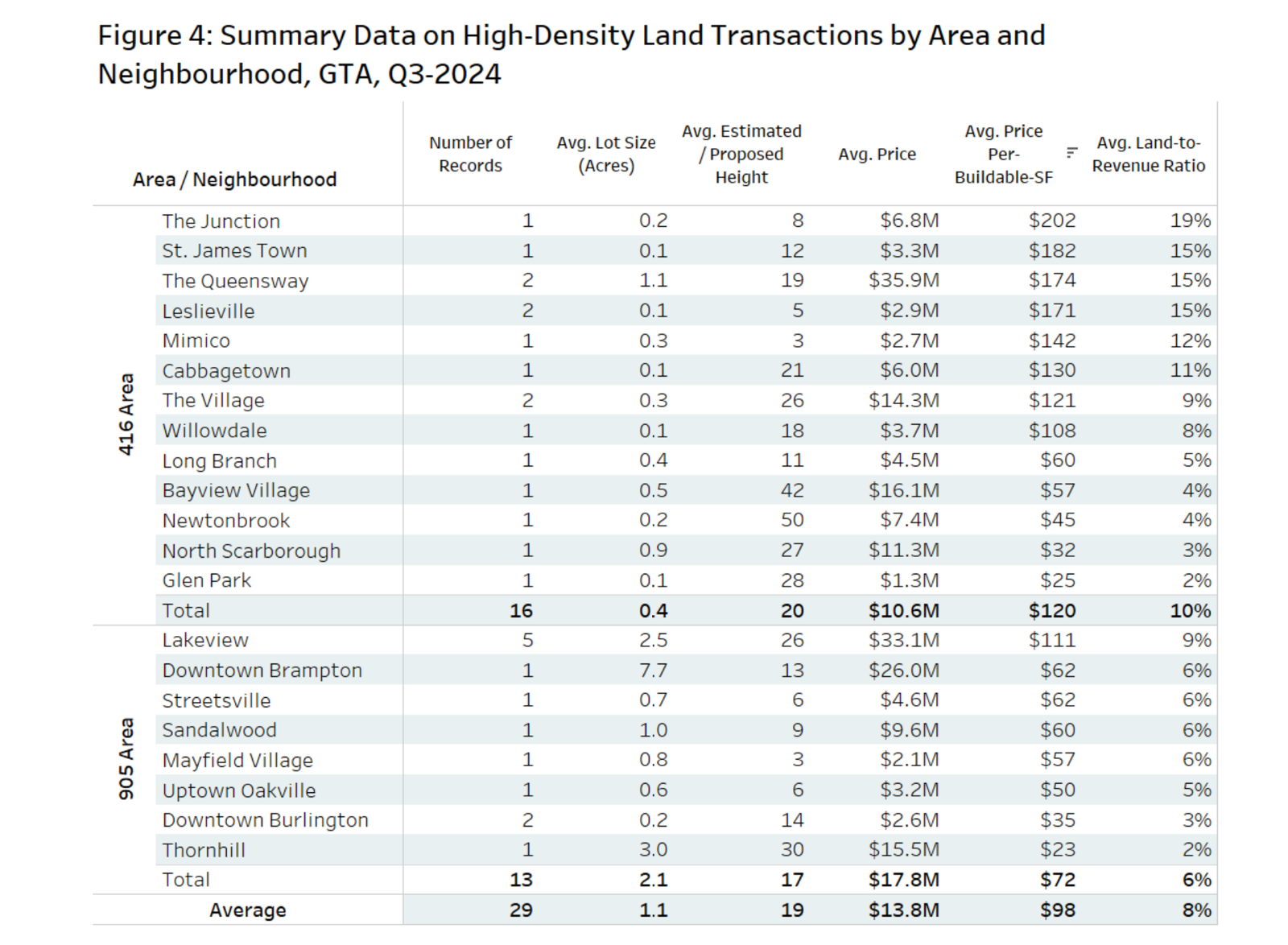
Here’s their summary data broken out by Toronto versus the Greater Toronto Area:
And here’s a list of all the land transactions last quarter:
At the highest level, the average high-density land trade last quarter across the GTA was at around $98 per buildable square foot. This is down 13% from $112 pbsf in Q3-2023. And going back to the first chart in this post, there also seems to be a longer-term decline in high-density land prices.
But as Bullpen rightly points out in their report, there are limits to what can be gleaned from data like this. And that’s because land transactions can be structured in countless ways. Did the vendor provide cheap financing? Was there a delayed close? Are there any unique site conditions that could be impacting value? The list goes on.
So even though prices and transaction volumes are down (which is what one would totally expect right now), it still doesn’t feel like this data accurately reflects what’s going on in the market today. I think the reality is worse.
I like the way that Scott Galloway describes entrepreneurship in this recent post about why he’s bearish on Tesla:
Entrepreneur is a synonym for salesperson, and salesperson is the pedestrian term for storyteller. Pro tip: No startup makes sense. We (entrepreneurs) are all impostors who must deploy a fiction (a story) that captures the imagination and attracts capital to pull the future forward and turn rhyme into reason. No business I have started, at the moment of inception, made any sense … until it did. Or didn’t. The only way to predict the future is to make it.
He then goes on to describe the difference between an entrepreneur and a liar:
This is not the same as lying. There’s a real distinction between an entrepreneur and a liar: Entrepreneurs believe their story will come true, as they are laser-focused on making it true. A liar, well, they know they’re misleading people with false data. Usually for money (i.e., fraud). This is where Tesla turns gray.
Scott continues to say things about Elon and Tesla. But that’s not the point of today’s post.
The point I would like to make is that real estate development is an inherently entrepreneurial endeavor. You need to be a salesperson and a compelling storyteller, because that’s the only way you’ll be able to create the future. And creating the future is what developers do.
We have spoken before about the importance of speed and rapid decision making in real estate development. But in practice, it’s obviously a little more complicated than just being good at making quick and high-quality decisions. And that’s because building a building is complicated and it requires teams of people, all working toward the same goal. Some of these people will be internal to your organization, but many will be external, which is a feature that further complicates matters. Because it means that, to varying degrees, there are critical path items — items that control your overall project schedule — that are not fully in your immediate control. This is one of the things makes development and construction so challenging.
Now, ordinarily, when a team is being assembled people will talk about their project experience, their systems and fancy tech, and perhaps some of the awards they’ve won because of their extreme talent. But what doesn’t often get talked about is the simplest and most basic of things: You want people who will do what they said they would do, when they said they would do it. In other words, you want responsive and reliable people. This sounds pretty banal, which is maybe why it so often goes unspoken, but it’s fundamental to the success of a project. The other nuance to this is that, most of the time, it’s less about the company itself and more about the individual human who will be working on the project. Is that person good?
Just being responsive, reliable, and on top of things goes a long way. These are the kinds of people you want on your team and it’s how you move fast.
Elevate Miami, which I wrote about last month, just announced a number of new speakers and, more specifically, a number of new high-rise development projects that will be discussed at the conference. They are (not an exhaustive list):
Dolce & Gabbana Residences, Miami
Mercedes-Benz Places, Miami
Aman and One High Line Residences, New York
Indian Creek Residences & Yacht Club, Miami Beach
Edition Residences, Miami
AGE360, Curitiba, Brazil
What should be clear from this list is that Miami is like a different planet. It is one of the places where the richest people in the world go to spend their money, much of it on real estate. Because of this, you can think of this real estate as a luxury good, which is why so many of them are now branded.
In economic terms, a luxury good is typically defined as a good where demand increases — more than what is proportional — as incomes rise. For example, if a person’s income goes up by 1%, but their demand for a particular thing goes up by 5%, then this thing would be considered a “luxury good,” as opposed to a “normal good.”
The technical definition is an income elasticity of demand that is greater than 1. More simply, this just means that as someone starts making more money, they will start spending a greater percentage of their income on luxury goods. This is in contrast to “necessity goods,” where it doesn’t matter how much money you make, you only need so much toilet paper, for example.
What all of this suggests is that as people from all over the world get rich, they are likely to want more branded residences in a place like Miami. However, the flip side of this dynamic is that as incomes fall, the demand for luxury goods should, in theory, also fall more than what is proportional. It works both ways.
So I’ll be curious to hear — from the developers at Elevate — how things are going right now. We’re at a time in the real estate cycle where everyone is rethinking their strategies. Or maybe, Miami truly is a different planet.
It’s in Google My Maps and what he has done is pin every project according to status: under construction, under renovation, approved, proposed, and recently delivered. For each pin, you’ll also find information like the expected completion date, the use(s), the area, the architect(s), and photos. It is unbelievably detailed and, according to Google, it was last updated 8 hours ago.
Here’s the full map with all statuses shown:
And here’s what it looks like if you filter by only projects under construction:
It’s interesting, but not surprising, to note that the majority of construction projects seem to be taking place outside the boundaries of Paris proper. However, if you alternate to projects under renovation, it more or less flips, with most of the projects being within Paris:
This tells you something about the city.
Sometimes when I’m looking at or for information like this, I think to myself that I must be in the minority of people who are interested in tracking development projects with this level of detail. So I find it interesting that this map has been viewed nearly 300,000 times. Clearly, I’m not actually alone.
As we have talked about many times before, the best answer to this question is that it’s worth whatever money is left in your pro forma once you’ve accounted for everything else. This is what is called the “residual claimant” in a development model. And it means you start with your revenue, you deduct all project costs, including whatever profit you and your investors need to make in order to take on the risk of the development, and then whatever is left can go to pay for the land.
This is the most prudent way to value development land; but of course, in practice, it doesn’t always work this way. In a bull market, the correct answer to my question might be, “whatever most market participants are willing to pay.” And sometimes/oftentimes, this number will be greater than what your model is telling you, meaning you’ll need to be more aggressive on your assumptions if you too want to participate. (Not development advice.)
Given that determining the value of land starts with revenue, one way to do a very crude gut check is to look at the relationship between land cost and revenue. This is sometimes called a land-to-revenue ratio. And historically, for new condominiums in Toronto, you wanted a ratio that was no greater than 10%. Meaning, if the most you could sell condominiums for was $1,000 psf, then the most you could afford to pay for land was $100 per buildable square foot.
However, this is, again, a very crude rule of thumb. I would say that it’s only really interesting to look at this after the fact. Because in reality, things never work this cleanly. For one thing, there is always a cost floor. Don’t, for example, think you can buy land in Toronto for $80 pbsf and sell condominiums for $800 psf, because this will not be enough to cover all of your costs. You will lose money.
Secondly, there are countless variables that have a huge impact on the value of development land. Things like a high required parking ratio, development charges and other city fees, inclusionary zoning, and so on. All of these items are real costs in a development model, and so they will need to be paid for somehow.
Typically this happens by way of higher revenues (in a rising market), a lower land cost (in a sinking market), or some combination of the two. But in all of these cases, it means your land-to-revenue ratio must come down to maintain project feasibility. This is why suburban development sites typically have a lower ratio — too much loss-leading parking, among other things.
Of course, there are also instances where the correct answer could be a land-to-revenue ratio approaching zero, or even a negative number. In this latter case, it means your projected revenues aren’t enough to cover all of your other costs, excluding land. For anyone to build, they will require some form of subsidy. And this is basically the case with every affordable housing project. They don’t pencil on their own. (For a concrete example of this, look to the US and their Low-Income Housing Tax Credits.)
So once again, the moral of this story is that the best way to think about the value of development land is to think of it as “whatever money is left in the pro forma once you’ve accounted for everything else.” Because sometimes there will be money there, and sometimes there won’t be.
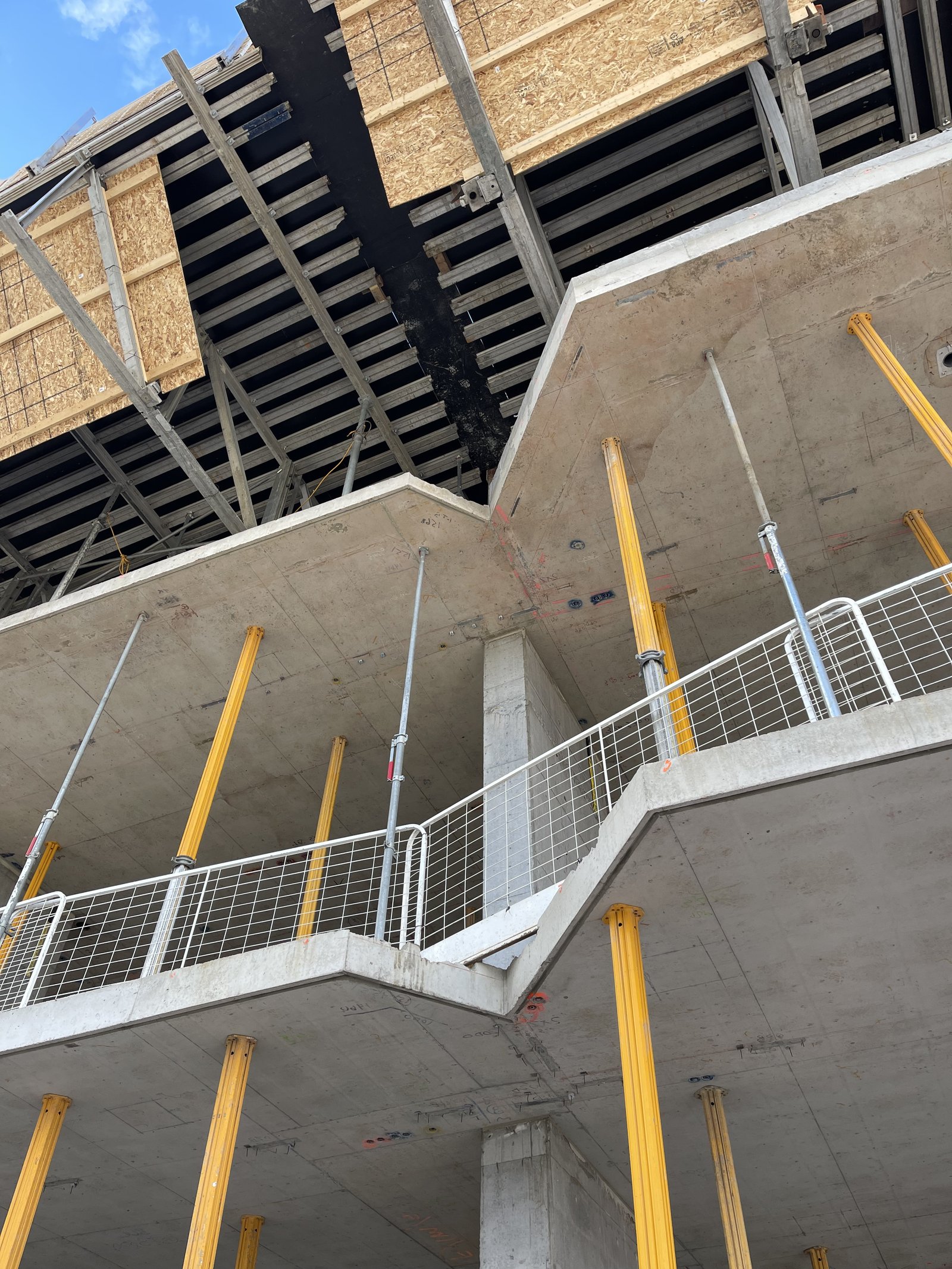
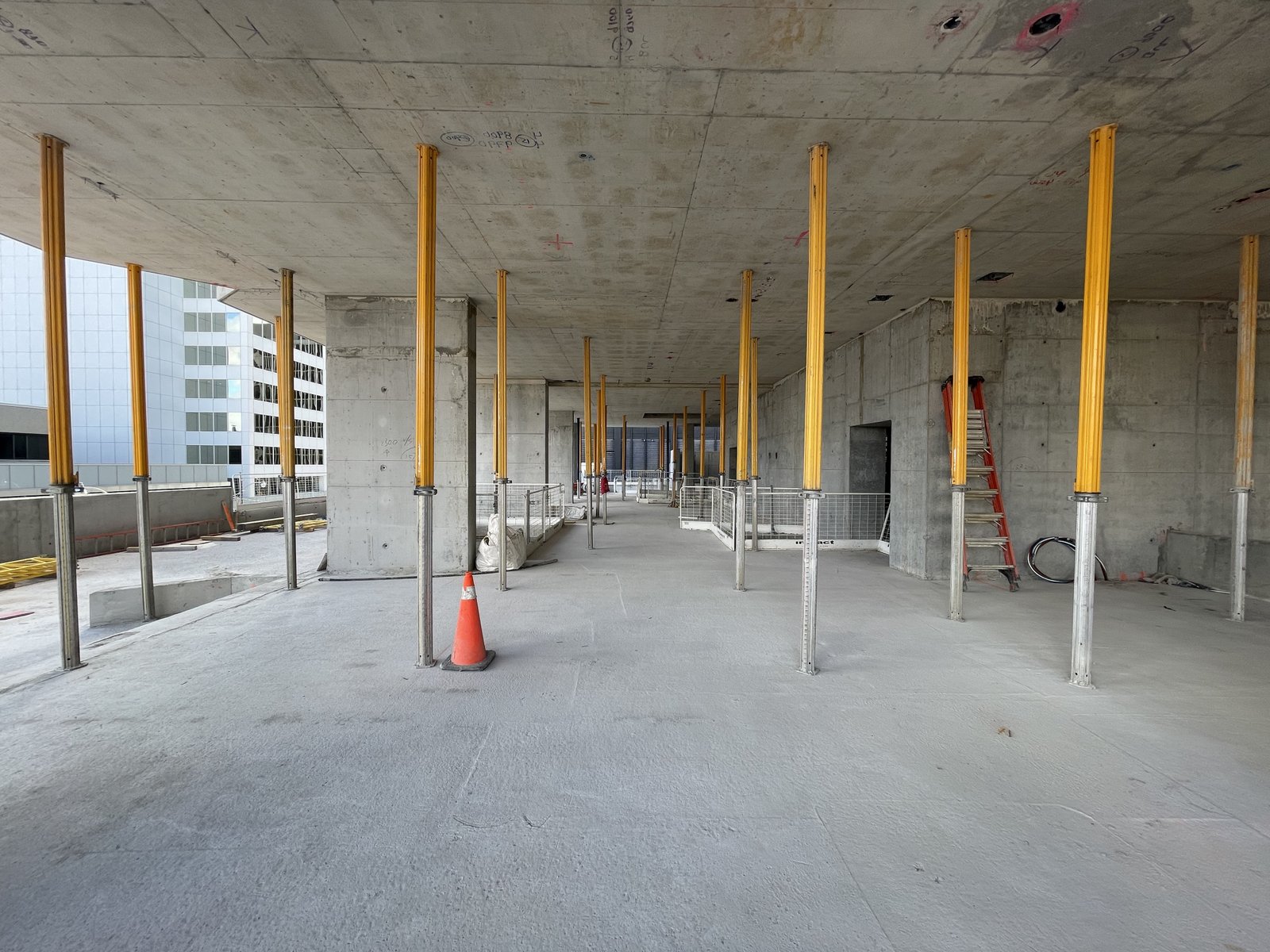
This morning I was on site at One Delisle with WZMH Architects (AOR) and Studio Gang (design architect). I aim to visit site at least once a week, but lately it’s been more than that. What’s exciting to see right now is that the geometry of the tower is starting to come through in the slab edges. (The architects also made sure to remind me today that they had to draw each and every one of these.) The above photos were taken from the level 2 retail terrace. We always imagined this space becoming an amazing restaurant overlooking Yonge Street — but we’ll see what happens.
Expect to see a lot more of these fun slab edges over the next few months.
One common mistake that people make when it comes to development pro forma is assuming that feasibility is easily attainable. It’s not. In fact, it’s best to think of a pro forma as a fragile object that is liable to break if not handled properly. So to that end, here’s a non-exhaustive list of things you may want to keep in mind when trying to both forecast and create the future as a developer:
As a starting point, you’re safer assuming that your pro forma isn’t going to work. If the numbers look too good to be true or even just really promising — especially at the outset — then there’s a good chance they’re wrong. You’ve likely missed things. Be weary if it feels too easy, especially in our current market, where very little works.
Cheap land isn’t enough. Just because your land cost feels cheap, it doesn’t mean that your development project will end up being feasible. There are instances and entire markets where even free land isn’t enough. You might actually need a negative land value. Meaning, a subsidy is required to reach feasibility. This is the case with affordable housing.
Drill down into as many line items as possible. Back-of-the-envelope math — where you just plug in a few cost per square foot assumptions — is fine for an initial screening. But if you’re really serious, you need to get deep into the weeds. Run through the entire process in your mind and think about what might happen, and go wrong. Even with this, you will still miss things.
Stress test your assumptions. What happens if the city asks you to do X? What happens if the local councillor comes at you with Y? Can your fragile object support them, or will it shatter to pieces? The sensitivity of your fragile object to various stimuli will help you decide whether you want to do the project or whether there’s simply too much risk.
Ultimately, real estate development is a creative act. You’ll need to come up with creative solutions, and then you’ll need to will your project to life. This is one way to tell that you’re on the right path. It needs to feel really hard. So if your pro forma also feels this way, then there’s a higher probability that you’re narrowing in on something close to reality.
Today, I’m excited to share that I’ll be attending the second annual Elevate event this December as an industry ambassador. This means I get to ride alongside industry celebrities like Norm Li. (He better be DJ’ing.)
Put on by Zonda, in partnership with Livabl and ARCHITECT Magazine, the event is focused exclusively on “the art of high-rise luxury living.” Everything from the overall state of the housing market to how to sell branded residences.
I wasn’t able to attend last year, but I heard from a number of industry friends that it was very well done, which is why I agreed to participate this year. That now means I have a discount code you can all use if you’d like to attend — BRANDONVIP30.
For those of you who like art and culture things, the event also happens to fall right after Art Basel. This was done on purpose, and so now you have at least two good reasons to be in Miami Beach in December.
A branded residence is, as the name suggests, a residential building with a known branded attached to it. Historically, these have tended to be hotel brands. But it really just needs to be any brand that people know, care about, and will pay a premium for. So it could also be a fashion brand, a car brand, or whatever else.
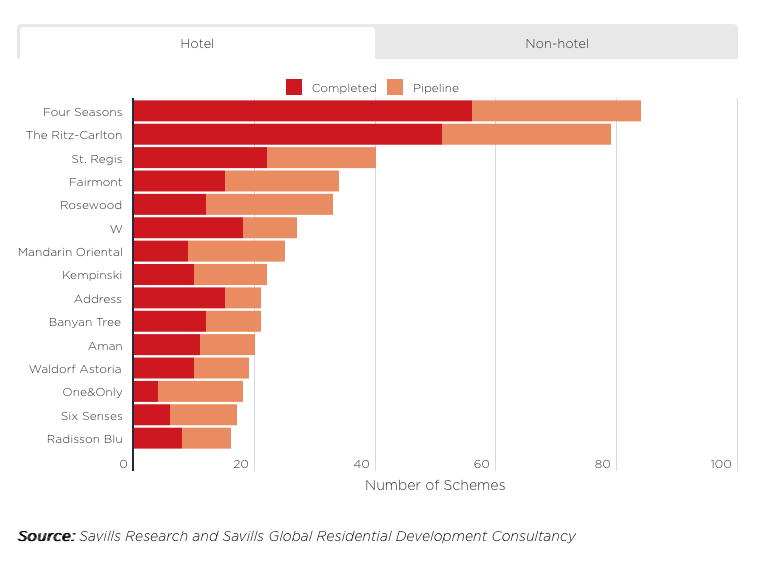
This is a growing segment of the residential market. According to UK-based Savills, there were only 15 or so of these “schemes” in the 1990s (the UK uses scheme in lieu of project, which always sounds conniving to me), but by the end of this decade they expect the pipeline of branded residences to exceed over 1,200.
I would also argue that projects designed by celebrated architects and/or designers are a form of branded residence. And this is not being captured in Savills’ number above.
Whatever your definition, today, the branded residence capital of the world seems to be Dubai, which feels right. And the biggest brands, by what appears to be a long shot, are Four Seasons and Ritz-Carlton (hotel side), and YOO and Trump (non-hotel side). Here are the full rankings from Savills:
This is an interesting part of the real estate business for a few reasons. One, it makes sense. A New Balance shoe that gets co-branded with Aimé Leon Dore unlocks additional value for both sides. ALD has a brand that certain people care about. So, of course the same would be true of real estate paired with the right brand.
Two, it’s a growing market, and I think this is aided by the fact that development is an intensely local business — so it can be hard to grow a globally-significant brand on your own. Sometimes you just need to borrow someone else’s.
And three, it’s usually a less risky approach to getting your name on buildings. Branded residences typically operate on a licensing model, which means developers pay for the right to use the brand. The brand may also capture some of the upside in the form of a percentage of sales. That’s less risky than putting up your own money.