


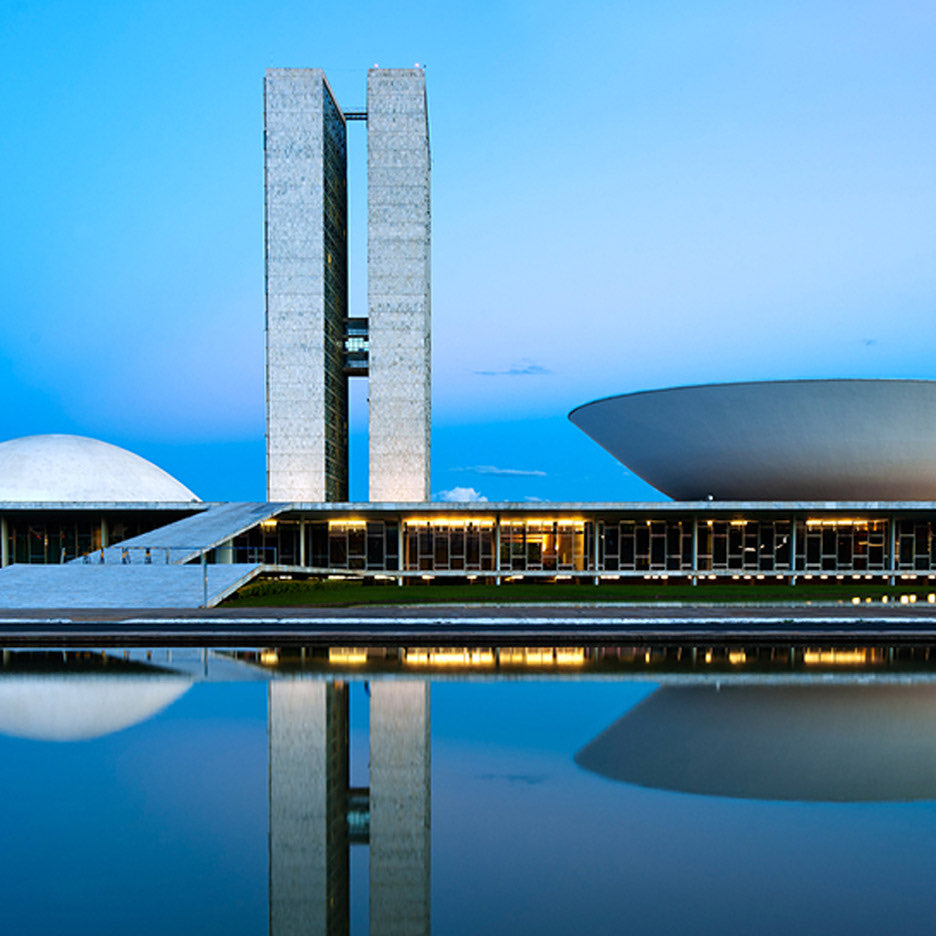

I like and agree with this tweet: "You can have bad urbanism with good architecture, and good urbanism with bad architecture." The two provided examples of this are (1) Brasilia and (2) what appears to be some random little street in Japan.
Brasilia is the capital of Brazil. It's a masterplanned city designed by Lúcio Costa, Oscar Niemeyer and Joaquim Cardozo in the 1950s. And it was all part of a plan to move the capital from Rio de Janeiro to a more central location in the middle of the country.
The result is some incredible architecture by Oscar Niemeyer that, for me, is emblematic of the country. Brazil was one of the first countries outside of Europe to adopt modern architecture and it's precisely for this reason that Brasilia is high on my list of places to visit. (Rio is also one of my favorite cities.)
But whenever I tell a Brazilian that I want to visit the city, the usual response is, “Why?” I then have to explain that it’s because of Niemeyer and the architecture, and then they say, “Oh, okay, that makes sense. But besides the architecture, there isn’t much else to see or do there.”
Part of the reason for this could be because the city has objectively bad urbanism. When you look at it in plan view, the layout of the city resembles a plane or bird in flight, and that is, I guess, symbolically cool when you view it on Google Maps. But on the ground, cities are not at their best when they're designed around abstract symbols.
They're at their best when they're designed around people. And this is what example number two does well. The architecture is ugly and nondescript, but the street is narrow, the road is shared, and the buildings contain a mix of fine-grained uses.
It's a dead simple approach, but it works — really well. It's good urbanism.
Cover photo by Thandy Yung on Unsplash
Elevate Miami, which I wrote about last month, just announced a number of new speakers and, more specifically, a number of new high-rise development projects that will be discussed at the conference. They are (not an exhaustive list):
Dolce & Gabbana Residences, Miami
Mercedes-Benz Places, Miami
Aman and One High Line Residences, New York
Indian Creek Residences & Yacht Club, Miami Beach
Edition Residences, Miami
AGE360, Curitiba, Brazil
What should be clear from this list is that Miami is like a different planet. It is one of the places where the richest people in the world go to spend their money, much of it on real estate. Because of this, you can think of this real estate as a luxury good, which is why so many of them are now branded.
In economic terms, a luxury good is typically defined as a good where demand increases -- more than what is proportional -- as incomes rise. For example, if a person's income goes up by 1%, but their demand for a particular thing goes up by 5%, then this thing would be considered a "luxury good," as opposed to a "normal good."
The technical definition is an income elasticity of demand that is greater than 1. More simply, this just means that as someone starts making more money, they will start spending a greater percentage of their income on luxury goods. This is in contrast to "necessity goods," where it doesn't matter how much money you make, you only need so much toilet paper, for example.
What all of this suggests is that as people from all over the world get rich, they are likely to want more branded residences in a place like Miami. However, the flip side of this dynamic is that as incomes fall, the demand for luxury goods should, in theory, also fall more than what is proportional. It works both ways.
So I'll be curious to hear -- from the developers at Elevate -- how things are going right now. We're at a time in the real estate cycle where everyone is rethinking their strategies. Or maybe, Miami truly is a different planet.
On this blog, we often talk about city building in the context of doing things to help improve a city -- whether that be a development project, a new public art mural, or an interesting local business. These interventions help to build a city. But even more specifically, the term has, for many, come to mean building up a city in a positive way.
But there is another way to think about city building. You can think of it in terms of building actual new cities. We've spoken about some of these before, namely this one in California and this odd one in Saudi Arabia. But apparently it is becoming more common. According to The Economist, the world is now building more new cities than it has in the last 80 or so years:
Egypt’s “New Administrative Capital” is part of a rush of city-building. Firms and governments are planning more settlements than at any time in the post-war period, with many already under construction. Ninety-one cities have been announced in the past decade, with 15 in the past year alone. In addition to its new capital in the north, Egypt is building five other cities, with plans for dozens more. India is considering eight urban hubs. Outside Baghdad, Iraq, workers have just broken ground on the first of five settlements.
In some cases, it is being done as a solution to urban congestion. If this city is too expensive and unaffordable, just create a new one. This appears to be part of the idea with the above city outside of San Francisco. Of course, new cities can also be created for ideological reasons, or for political purposes, which was the case with Brazil's capital city, Brasilia.
Here, the idea was to move the federal capital away from the country's populated southeast region to a more geographically neutral location in the middle of the country. It also turns out that seeding a new city with government institutions is a good way to get one of these started. Existing cities do, after all, benefit from network effects.
History points to characteristics shared by successful projects. State institutions can help anchor cities, as Brasília (in Brazil) and Chandigarh (in India) showed in the 20th century. Although both have had problems, people in Brazil and India are voting with their feet. Brasília’s population is growing at 1.2% a year, more than double the national average. Chandigarh, a state capital, is now India’s fourth-richest region on a per-person basis.
But putting money, ego, and ideology aside, when does it actually make sense to start a new city in lieu of just expanding (or addressing the problems in) the one(s) you've already got? Population size can't be the only factor in determining whether a city is "full", because Tokyo seems to do just fine as the largest metropolitan area in the world.
If it hasn't already been done, I think this would make for an interesting research project. Until then, there's this (paywalled) Economist article.