
Yesterday morning, we did a day trip to Monaco. The main thing I wanted to see was Le Renzo (which is a project I have written about before). Designed by Renzo Piano Building Workshop, it is among the most expensive residential buildings in the world. Condominiums have reportedly sold for as high as €120,000 per square meter (or about €11,148 per square foot).
Before the trip, I emailed the district's PR contact to see if we could get a tour inside. Unfortunately, it's August in Europe, and they told me that nobody from the development team would be around to take us through. So we ended up just walking the perimeter. Here is a photo of the project's north elevation, facing inland.

Here's the south side facing the sea:

And here's a photo of its western edge, including the building's outdoor pool amenity:

The -1 level is boat slips and retail, some of which are still in the process of opening. The fact that they placed the retail where they did stood out to me, because it feels akin to second-floor retail — meaning, it only works in certain places and under certain conditions. Maybe this is one of them.
The ground plane — or at least the level that connects inland — is visually open on all sides, except for the elevator cores and exit stairs coming down from the buildings. This gives you a clear view of the Mediterranean as you approach the district and makes the entire area feel publicly accessible. It's also meant to evoke the image of ships sitting in a dry dock.
We didn't stay in Monaco very long, but this project was the highlight for me. I would have really loved the opportunity to tour inside and get closer to its details.
Leaving Monaco requires some maneuvering if you didn't drive or take the train (which we didn't). Uber is banned within the principality. You can get dropped off in an Uber, but you can't request a car once you're there. This is what you'll see if you open up the app and try:

We were also told that they're very strict about this. If, for example, you get dropped off in an Uber and then try to go off-app for your return, the Uber driver runs the risk of a heavy fine and having their car confiscated for a week. So many drivers don't want to do this unless you're willing to compensate them for the risk.
What you instead need to do is walk to the Monaco-France border, which usually isn't far given the country has a total land area of around 2 square kilometers. As soon as the GPS on your phone signals that you're in France rather than Monaco, cars reappear in the app. And from my experience, the geofencing is accurate within a few meters. It was pretty neat.
In the future, I think a better option might be to road bike over. I saw a number of people doing that yesterday and, boy, it looked like fun.

Yesterday morning, Neat B and I were up at Friday Harbour messing about on jet skis with some friends. It was a lot of fun. It's a good little day trip if you're ever looking for something to do in the summer.
I think that the developers of Friday Harbour have done a wonderful job creating a new waterfront resort and creating an alternative to traditional cottages. I know a bunch of people who have opted for a place here instead. It's closer to Toronto, you don't have the same upkeep, and you get to enjoy urban amenities while still feeling like you're "up north."
Yesterday I also noticed that the most recent phase — which is just finishing up construction — looks like this:

Never before have I seen balcony guard glass like this — at least not here in the Toronto region. It is some kind of iridescent laminated glass, which changes color depending on the light and the viewing perspective. I would imagine that it also offers some degree of privacy benefits, because it got fairly opaque from some angles.
But the primary feature is that it just looks cool. And I think more projects should have fun like this. There's no need to be afraid of color.
What do you think?


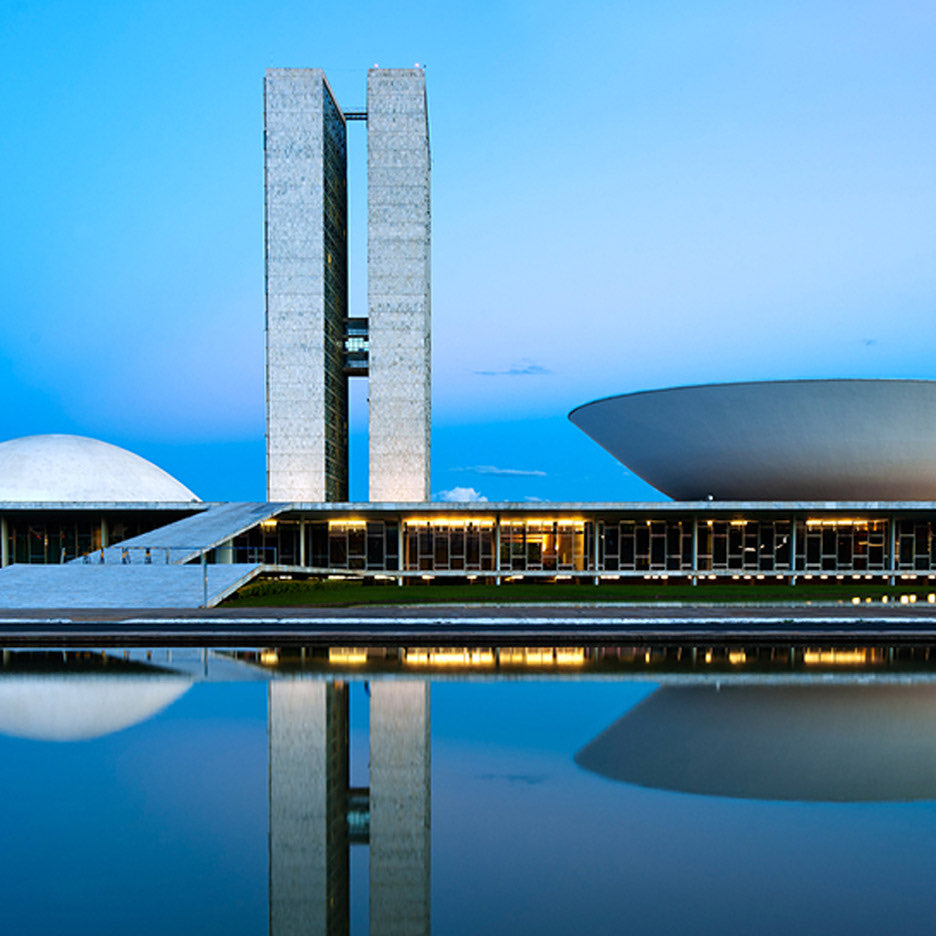

I like and agree with this tweet: "You can have bad urbanism with good architecture, and good urbanism with bad architecture." The two provided examples of this are (1) Brasilia and (2) what appears to be some random little street in Japan.
Brasilia is the capital of Brazil. It's a masterplanned city designed by Lúcio Costa, Oscar Niemeyer and Joaquim Cardozo in the 1950s. And it was all part of a plan to move the capital from Rio de Janeiro to a more central location in the middle of the country.
The result is some incredible architecture by Oscar Niemeyer that, for me, is emblematic of the country. Brazil was one of the first countries outside of Europe to adopt modern architecture and it's precisely for this reason that Brasilia is high on my list of places to visit. (Rio is also one of my favorite cities.)
But whenever I tell a Brazilian that I want to visit the city, the usual response is, “Why?” I then have to explain that it’s because of Niemeyer and the architecture, and then they say, “Oh, okay, that makes sense. But besides the architecture, there isn’t much else to see or do there.”
Part of the reason for this could be because the city has objectively bad urbanism. When you look at it in plan view, the layout of the city resembles a plane or bird in flight, and that is, I guess, symbolically cool when you view it on Google Maps. But on the ground, cities are not at their best when they're designed around abstract symbols.
They're at their best when they're designed around people. And this is what example number two does well. The architecture is ugly and nondescript, but the street is narrow, the road is shared, and the buildings contain a mix of fine-grained uses.
It's a dead simple approach, but it works — really well. It's good urbanism.
Cover photo by Thandy Yung on Unsplash