Daily insights for city builders, delivered every morning at 6 AM ET. I’m Brandon Donnelly — a Toronto-based real estate developer and founder of Globizen. I’ve been writing here since 2013.

Author: Brandon Donnelly

  • How to look even nerdier while cycling

    August 18, 2025 · View original


    The other morning I woke up and thought to myself: “My cycling isn’t nearly nerdy enough. Sure, I’ve got the spandex. But what I really need is an enormous rear-mounted selfie stick on the bike so I can capture footage of my rides and the city.” So I searched around and found a seat mount rig from Insta360 that looks like this (please note that the stick extends to 1 meter):

    Now, I don’t have an Insta360. I’ve heard they’re fantastic. I have an old GoPro Max that is, well, okay. I find it has terrible dynamic range. The sky is often blown out. It also shuts off constantly when I’m snowboarding due to the cold. It’s suboptimal and at some point I’ll likely invest in an Insta360. But for now, I used an adapter to connect my GoPro to the mount.

    Below is what the photos/videos end up looking like. As an aside, captured on the right is Good Gang Ice Cream on Annette, which my friend Chris Spoke (of Toronto Standard) tells me is top.

    And here’s a video from Instagram.

    The way these 360 cameras work is that, as long as the camera is perfectly aligned with the selfie stick, then the entire apparatus disappears in the videos it captures. But if the camera gets misaligned because, for example, things start bouncing around, then it can show up. I’m not exactly sure what’s happening in the above, but something is getting in the way of a clean 360-degree stitch.

    I’ll keep working on it.

  • Toronto is planning for a post-car future

    August 17, 2025 · View original


    One of the fundamental principles that we espouse on this blog is that land use and transportation planning are integral to one another. This matters if you’re trying to build a big, bad global city because there are limits to what you can accomplish with car-oriented planning. Eventually traffic congestion becomes unbearable and the model starts to breakdown (consider Toronto and Atlanta right now).

    This means that, if you’d like to continue scaling, eventually you’ll need to start getting serious about transit-oriented development and other forms of mobility. Japan is one of the best examples of this. But the key prerequisite for this is urban density. This is the unlock that makes transit practical and convenient for people.

    That’s why this week’s planning announcement is a big one for Toronto. On August 15, the Government of Ontario (through the Ministry of Municipal Affairs and Housing) approved, with some modifications, 120 Major Transit Station Areas and Protected Major Transit Station Areas in the City of Toronto. Here’s a summary of the MMAH’s decision via the City’s website, and below is a map of the transit station areas. (Note that some station areas are missing from this map and are still under review.)
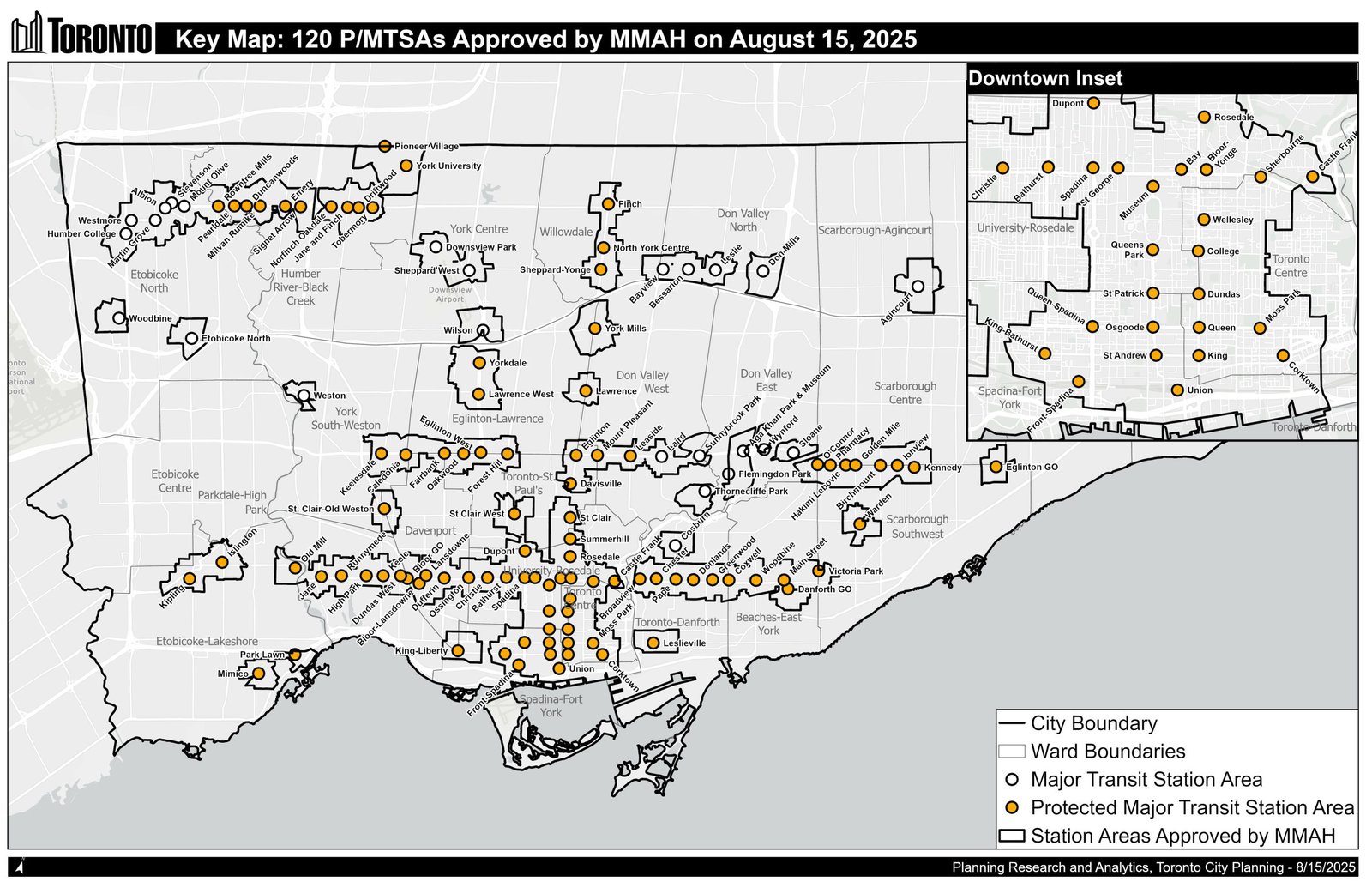
    At a high level, these are areas that fall within an approximately 500-800 meter radius of transit stations, and would therefore be less than a 10-minute walk for most people. It’s land that is best suited to transit-oriented development and that would strengthen any new/existing transit investments. For example, if you have an existing station that is underperforming from a ridership standpoint, the best solution is more density within its immediate catchment area.

    Because of this, Ontario’s Provincial Planning Statement prescribes the following minimum density targets for MTSAs:

    – 200 residents and jobs per hectare for subways – 160 residents and jobs per hectare for light rail or bus rapid transit – 150 residents and jobs per hectare for commuter or regional rail

    And to satisfy these requirements, cities need to demonstrate how they have planned for these minimum targets.

    PMTSAs are a subset of MTSAs and come with some additional features, such as minimum unit counts and/or floor space indexes (floor area ratios). These are also the only transit areas where cities have the option of enabling Inclusionary Zoning, which is something they may do when the market rents in an area are high enough that the subsidies required to build affordable housing can be shifted onto the tenants paying market rents. (My views on inclusionary zoning can be found, here.)

    Over the coming weeks, everyone in the industry is going to be analyzing the implications of this new approval. Overland (which is a legal firm that we work with) just posted on their blog that their review is underway and that they’ll be posting something shortly. But in the meantime, I’d like to say that this is meaningful progress (and one that has been a longtime coming).

    It acknowledges the important link between land use planning and mobility, and it better aligns our policies to support a post-car city. Of course, in many ways, this is an obvious thing to do. I started this post by calling it a fundamental principle of city building. But city planning happens slowly and incrementally. If you’re following along, you’ll see that Toronto is in fact growing up as a big, bad global city.

    Cover photo by Andrii Khrystian on Unsplash

  • How Paris creates such beautiful social housing

    August 16, 2025 · View original


    Back in the spring, I wrote about a small social housing project in Paris at 18 rue Pradier. And the reason I wrote about it is because it’s one of those beautiful European projects that makes every city builder in North America wonder: Why don’t we build projects like this?

    I mean, it’s nicer than most market-rate housing projects.

    As part of my post, I did some internet sleuthing to find out the site area, the gross construction area, and what appeared to be the land price. But it was a modest piece. Thankfully, developer Brendan Whitsitt (of Imprint Development) just published a far more comprehensive summary of the project.

    In it, he pieces together the building’s mechanical systems, the wall assemblies, the project costs, and even the capital stack. He also compares everything back to what’s typical and allowable by code here in Toronto. It’s well worth a read.

    However, I am going to spoil the punchline: Building in Europe is not cheaper. 18 rue Pradier is a beautiful — but very expensive — project. It only works because of subsidies. No private-sector developer would build it otherwise.

  • Impossible until it’s not

    August 15, 2025 · View original


    I’m good friends with Gabriel Fain (of Gabriel Fain Architects) and Francesco Valente-Gorjup and Aleris Rodgers (of Studio VAARO). Gabriel, Francesco, and I all went to architecture school together (undergrad). Gabriel is the architect behind Mackay Laneway House. And the three of us are really good about staying in touch, and taking group photos so we can document our aging.

    Here’s us circa 2013:

    And here’s us 10 years later at my 40th birthday:

    Earlier this year, we were all hanging out when they told me that they were working on a research project with the Neptis Foundation called Impossible Toronto. They were authoring the project’s inaugural publication and the goal was to explore a housing typology that could be suitable for the city — perhaps even highly desirable — but that is currently impossible to build.

    As they were telling me about the project, they casually added, “Oh, and we volunteered you to help the team with development feasibility and financial modeling. We need you do a pro forma for the housing type we’re proposing.” If that’s not true friendship, I don’t know what is.

    Well, that publication has landed from the printers. It’s called Impossible Toronto: On the Courtyard — Learning from European Blocks. And it’s beautiful (graphic design by Blok Design):

    The full launch is set for October 3rd, 2025 here in Toronto (mark your calendars). At that point, hard copies will be available for sale and soft copies will be available as a free download. But even before then, I want to congratulate the team and everyone involved — there’s a long list. This is important work for our great city.

    I also very much enjoy the premise of the book and the series as a whole. Most bold ideas start out as impossible, until all of a sudden they’re not. The best ideas, it has been said, are just on the right side of impossible.

  • The road safety gap between Canada and the US continues to widen

    August 14, 2025 · View original


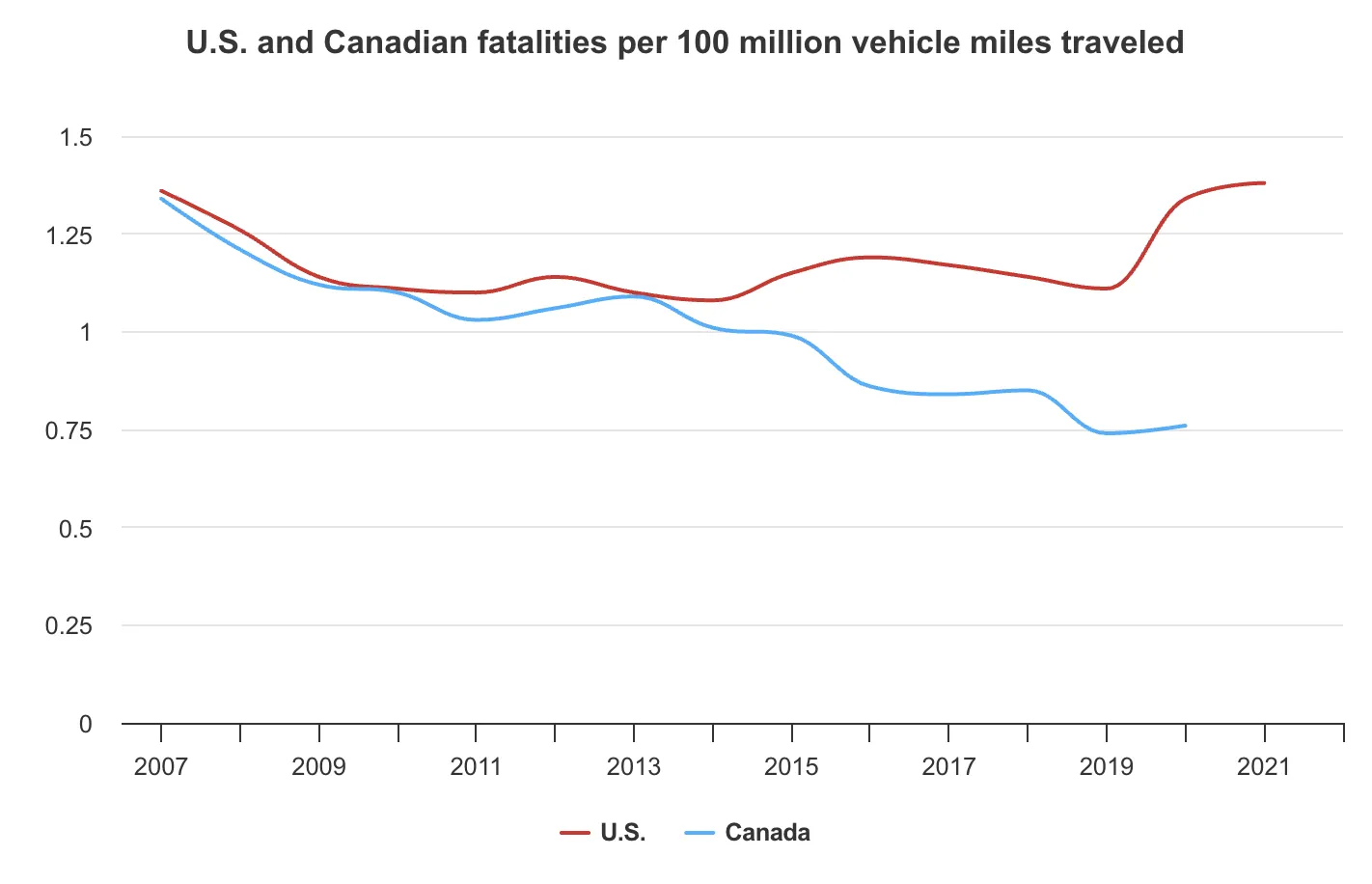
    One of the many differences between Canada and the US is that our roads are less deadly. A new study by the US Insurance Institute of Highway Safety and the Canadian Traffic Injury Research Foundation found that between 2010 and 2020, total road deaths in the US rose 18%, while in Canada they declined 22%.

    This “crash gap” also widens when you look at deaths per vehicle mile driven (as opposed to per capita), which should, in theory, normalize the fact that Americans tend to drive more on average than Canadians. So why might this be? Both countries are broadly car-oriented, at least compared to the rest of the world.

    The study presents a number of possible explanations: Canada has stricter drunk driving laws, Canada uses more traffic cameras, Canadians are relatively poorer and therefore drive less, Canada has higher gas taxes (which discourage driving), and the list goes.

    But my unproven theory is that a lot of this gap can be explained by differences in the built environment. Solutions like traffic cameras are, to give just one example, what you do when you’ve failed to design the road you actually want. They’re patches, not fixes.

    The root problem is the design of the road itself, which is why New Yorkers are only about a third as likely to die from a transportation-related accident compared to the average American. Why? Because it’s an urban place designed around non-car mobility.

    Conversely, this is also why the top 20 most deadly metro areas in the US for pedestrians are in the south, as opposed to in older northern cities. And it’s because these tend to be newer car-oriented metros.

    So when it comes to Canada vs. the US, I suspect that much of the gap can be explained by differences in the physical environment and higher transit usage north of the border. It probably also explains why Canada is safer than the US, but not safer than Europe when it comes to transportation-related fatalities. We’re simply not urban enough.

    The simple takeaway is that the more you optimize your environment for cars, the more dangerous you make it for humans.

    That said, this is likely to change with the continued adoption of autonomous vehicles. We can (and should) debate whether it’s prudent to plan our cities around them, but I think there’s little doubt that we’ll see road safety increase dramatically.

    Chart via CityLab

  • High-density land prices are starting to reflect the current market

    August 13, 2025 · View original


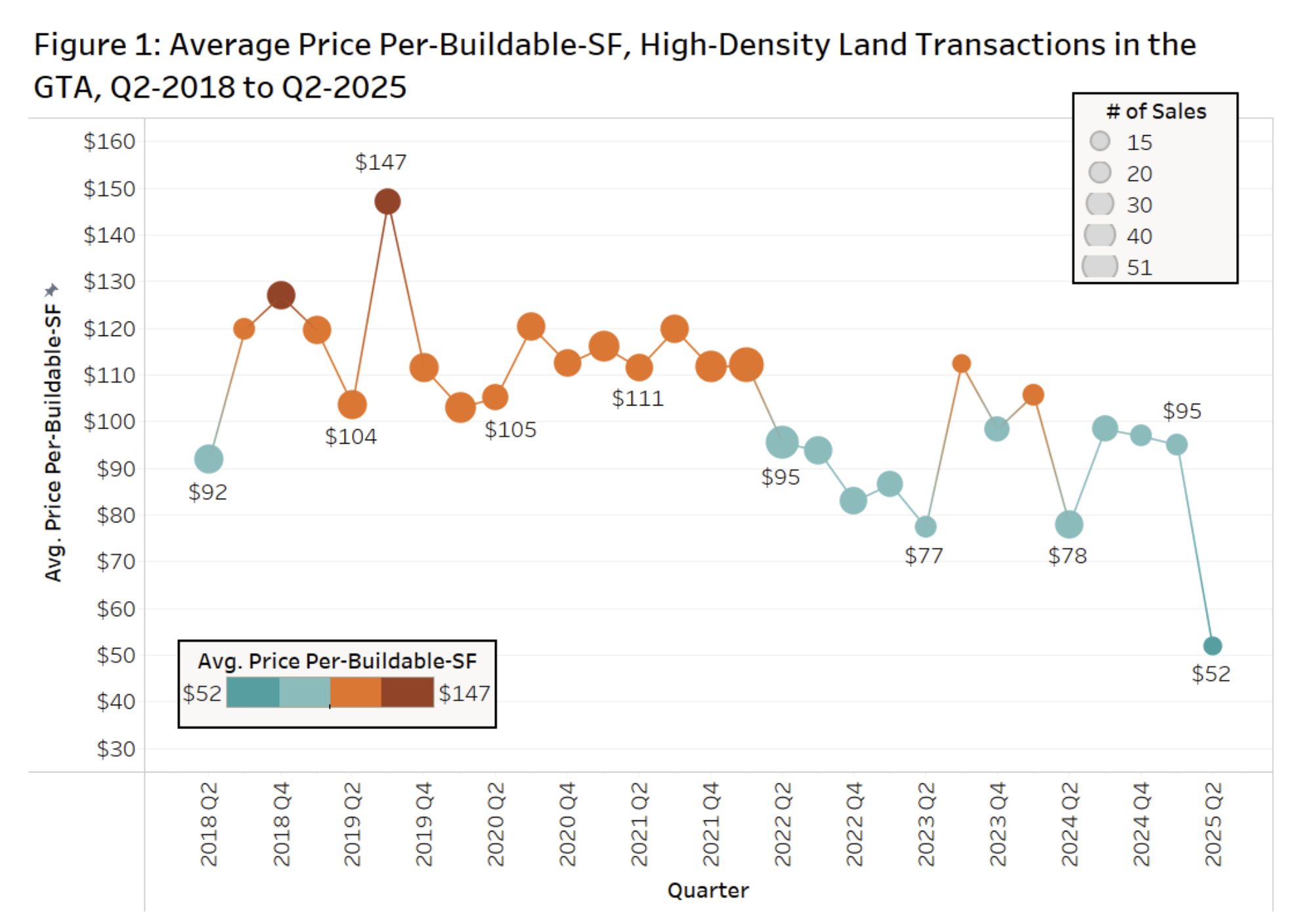
    The last time I shared Bullpen & Batory Consulting’s Land Insights report for the Greater Toronto Area was back in Q3-2024. And at that time, the average high-density land trade across the GTA was being reported at roughly $98 per buildable square foot. However, I ended my post by saying this:

    > So even though prices and transaction volumes are down (which is what one would totally expect right now), it still doesn’t feel like this data accurately reflects what’s going on in the market today. I think the reality is worse.

    Following that post, a few friends in the industry reached out and said, “The reality is much worse!” Yup. But now reality is starting to become more visible in Bullpen’s data. For Q2-2025, they are now reporting an average land price of $52 per buildable square foot across the GTA.

    This was gleaned from 15 sales recorded last quarter and represents the lowest quarterly figure since Bullpen and Batory started tracking sales in 2017. But even at these lower prices, it’s extremely difficult to accurately value development land. All we can say with certainty is that land prices are trending lower and that lower more accurately reflects the current market.

    Last year, I wrote that development value has shifted from land to the build. That’s still very much the case, but now you’re seeing it in the above chart in a meaningful way.

    If you’d like to receive their free quarterly GTA Land Insights Report, subscribe over here.

    Cover photo by Viktoriya Beshovishka on Unsplash

  • What Toronto built in the postwar years is what we’d like to build today

    August 12, 2025 · View original


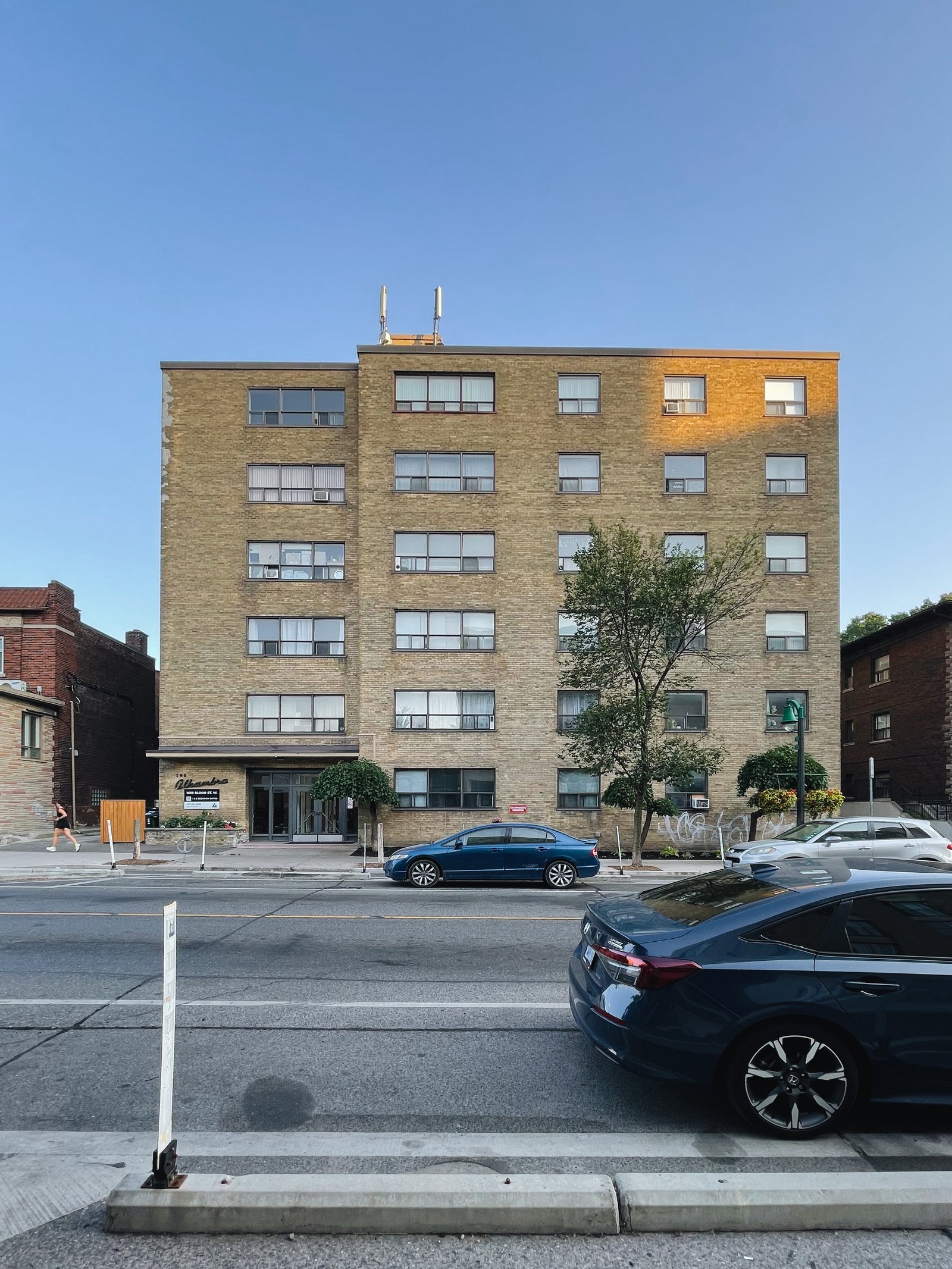
    I was lollygagging on Bloor last night while waiting for my take-out sushi to be prepared when I happened to notice the above building at 1639 Bloor Street West.

    What stood out to me was that it’s six storeys, has no stepbacks, is brick all around, and is more or less the kind of infill housing that Toronto is now trying to encourage along its major streets. Except, this building is old. The internet tells me it was built in 1954 (and houses 46 apartments). Which made me immediately wonder: did we used to know how to build this housing typology and then simply forget? Or was this the work of a cowboy developer who somehow managed to slip it through the cracks?

    Either way, I decided to walk the perimeter and take a closer look. The first thing I noticed was a row of garbage bins along the building’s east elevation, with about a dozen or so cameras keeping a close eye on them. If anyone in building management is wondering why a handsome man in a black t-shirt and stylish Birkenstocks was so curious about garbage bins — don’t worry. I was just trying to determine if you had a Type-G loading bay hidden around the back. I can now confirm: no such loading facility.

    Looking at Toronto’s maps, the site is approximately 30 meters wide by 40 meters deep — so roughly the equivalent of five lots, given the prevailing lot fabric in the area. The building itself appears to have a footprint of about 660 square metres (~7,100 square feet). If I multiply this by six floors and then by an efficiency ratio of 0.80, I get a very rough gross rentable area of 31,000 square feet. Divide this by 46 apartments and you end up with an average suite size of ~741 square feet.

    Imagine that: assemble five lots on Bloor, employ an all-brick façade on all elevations, and build to an average suite size that is probably close to 200 square feet larger than some of the city’s most recent downtown developments. The math would never math today.

  • New housing supply tempers rents — particularly in low-income neighborhoods

    August 11, 2025 · View original


    Those of us in the yes-in-my-backyard camp like to point out that increased housing supply is good for the overall health of a market because it moderates price and rental growth. And to point out just one example, there’s evidence of this happening right now in Austin.

    But one of the common objections to this mental model is that the new housing getting built is simply not affordable. It’s high-income housing. So how is that helpful to someone who maybe can’t afford the rents? And to be fair, this is generally true (unless there are subsidies involved that are allowing the homes to be offered at below-market pricing).

    The reason this is true is because development “happens on the margin.” Meaning, virtually every new project just barely makes economic sense to build. Developers have to be very precise about their costs and often have to embed some degree of optimism into their revenue assumptions in order to arrive at feasibility. This means that new home prices and rents are almost always at the very top end of what’s achievable in a market.

    But this market reality doesn’t just benefit the people who can afford high-income housing. For one thing, brand new expensive housing eventually becomes older and more affordable housing (this is referred to as filtering). But even in the immediate term, new supply serves the important function of relieving some of the pressures on a city’s existing housing stock.

    Think of this way: If you’re a high-income household that could afford new housing — if only it were being built and available — well then you’re just going to seek out the next best thing. And because you’re a high-income household, you have the ability to outbid middle-income households for whatever housing happens to be available on the next rung of the ladder.

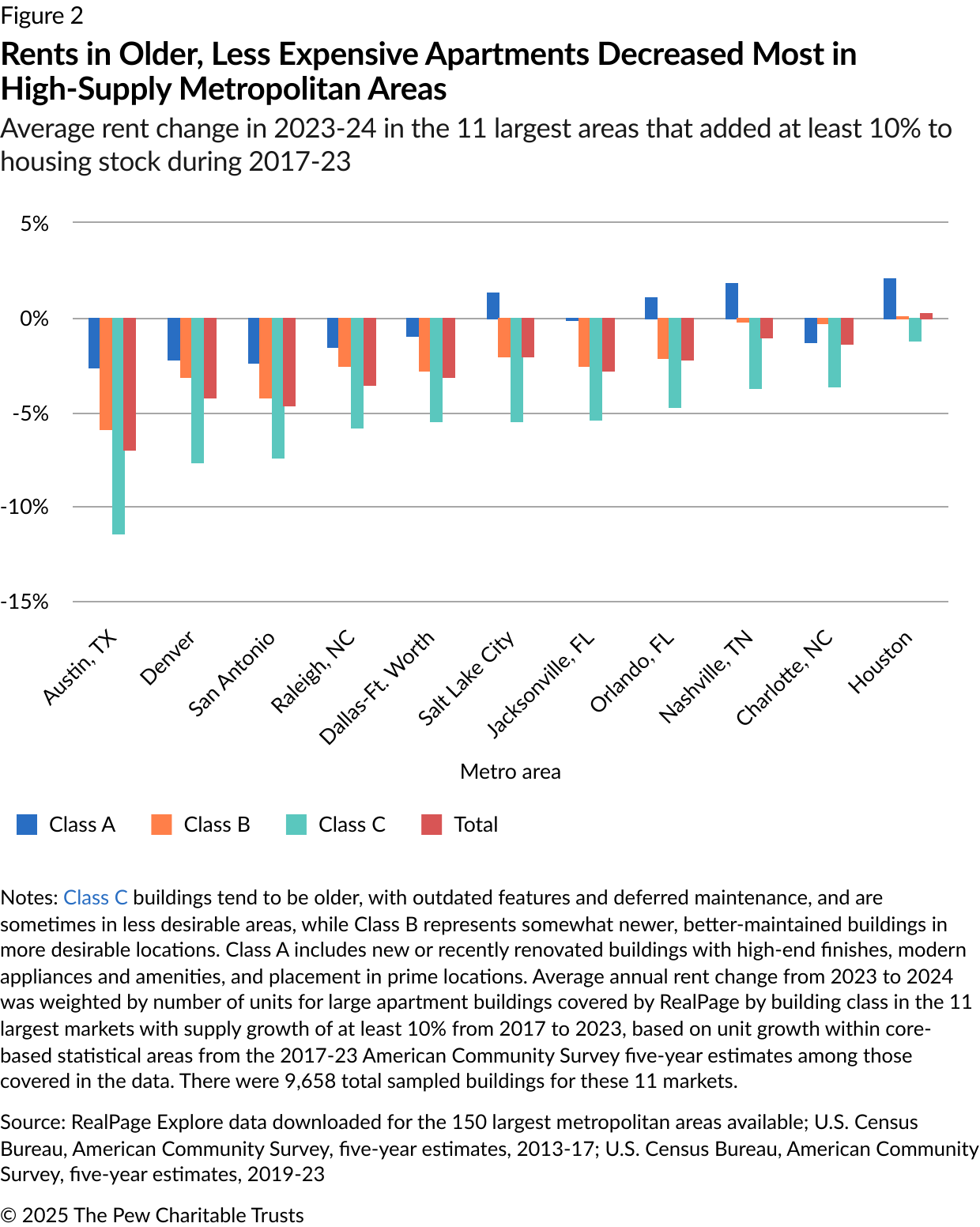
    This is what the research shows. In a recent study by Pew, it was found that building more housing — both across a metro area and in specific neighborhoods — tempers rents across all classes of buildings. Importantly, though, it was found to decrease rents the most for older, more affordable housing:

    > Looking at more than 41,000 large apartment buildings in 223 metro areas, there was a clear trend: Class C rents decreased more, relative to those for units in Class A buildings. In high-supply metro areas (those that increased their housing stock by at least 10% from 2017 to 2023), rent growth was slower than in average markets. Crucially, rent growth slowed most for Class C units, demonstrating that the additional supply was especially helpful to people living in lower-cost apartments.

    It’s understandably easy to look at new housing and say, “that’s too expensive and therefore useless to me.” Market dynamics usually make this a prerequisite for construction. But there are still direct benefits and that’s what you’re seeing in the above data.

    Cover photo by Marc Kleen on Unsplash

  • Is it finally time to trade your car for ride sharing?

    August 10, 2025 · View original


    One thing that I do not do on this blog is provide investment advice. And this post is certainly not that. But here’s an idea and thought exercise that relates to urban mobility. Let’s assume you own a personal vehicle that is currently valued at US$30k, and that this car is what you use to go about your daily life. Now imagine that you sold this car today, harvested all of the proceeds, and invested them into the following three companies: Uber, Alphabet, and Tesla. If you did this equally, your US$30k would end up as the following (based on today’s share prices and if rounded down):

    – 111 shares in Uber ($89.56/share) – 49 shares in Alphabet ($201.42/share) – 30 shares in Tesla ($329.68/share)

    Then, instead of driving yourself around, you’d put the money that you would have normally spent on insurance, gas, and maintenance toward Ubers and Waymos (assuming Waymo is available in your city). Perhaps you even own a parking spot that could be rented out for an extra few hundred dollars each month. Whatever the specifics, let’s just assume that what you used to spend to operate and service your car is now being spent on getting around using ride sharing services. It’s a wash. So the only difference is that instead of having US$30k tied up in a depreciating asset, you’re now part owner of the above three businesses.

    This, once again, is not investment advice. I personally don’t know how to make sense of Tesla’s current valuation. There’s a hell of a lot of optimism being priced in. I’m simply picking these three companies as a way to bet on Waymo’s autonomous vehicle program (which is currently in the lead), Tesla’s robotaxi promises (which, who knows, could actually materialize), and the fact that Uber might still remain the dominant marketplace for rides (though there’s already evidence that Waymo is on track to overtake Uber in San Francisco within the next ~8 months).

    It’s not clear who will be the primary beneficiary of this shifting mobility landscape. Is Tesla right about LiDAR not being necessary? Will human drivers (and therefore Uber) still be needed to manage peak demand loads? Is the asset-heavy approach of owning AV fleets the wrong way to go about things for Waymo? I think it all remains to be seen. But I also think it’s clear that autonomous vehicles have arrived and that urban mobility is changing right now, as we speak.

    So I think there’s a relatively high probability that everyone who owns a personal vehicle would be better off if they did what I am suggesting in this not-investment-advice-don’t-do-what-I-write blog post. In other words, if we freed ourselves of the old ways and made some bets on the future. And that’s ultimately the purpose of this post. It’s so that you and I can come back to it on August 10th, 2030, and see how I did with my prediction. The reminder has been set.

    Cover photo by Artur Aldyrkhanov on Unsplash

  • Conscientiousness and neuroticism are moving in the wrong directions — particularly for young people

    August 9, 2025 · View original


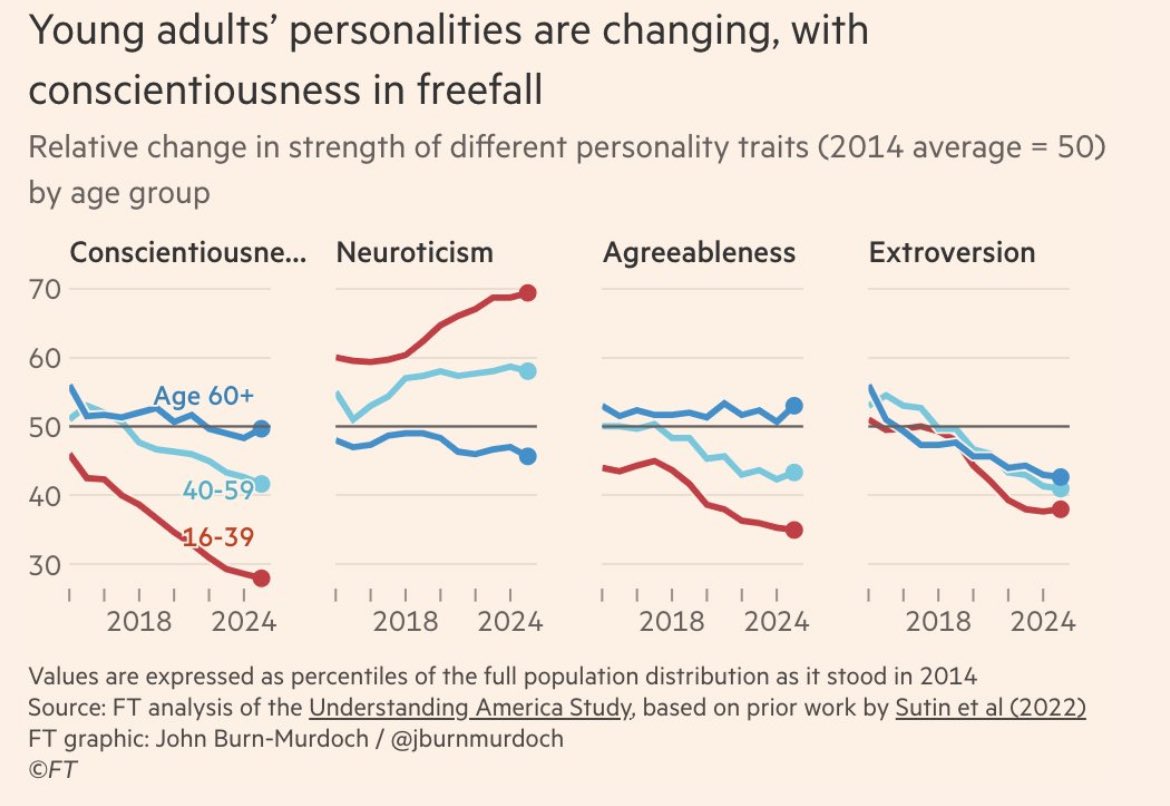
    The above charts — taken from a recent Financial Times article by John Burn-Murdoch called “The troubling decline in conscientiousness” — should be viewed as alarming. For some of our key personality traits, it is showing a decline in extroversion for all age groups, a decline in agreeableness (except for the 60+ crowd), a spike in neuroticism (again, except for the 60+ crowd), and a massive decline in conscientiousness, particularly for young people aged 16-39.

    Why does this matter?

    Well, according to Burn-Murdoch’s article (tweet summary here), the two strongest predictors for overall life success are conscientiousness and neuroticism. These traits are more important than a person’s socio-economic background and raw cognitive abilities. They predict career success, the likelihood of getting a divorce, health and life expectancy, financial stability, and more.

    Conscientiousness is defined as “the quality of wishing to do one’s work or duty well and thoroughly.” But simply speaking, conscientious people tend to dependable, disciplined, and committed. They are careful and deliberate, rather than careless and impulsive.

    Neuroticism, on the other hand, is generally defined around emotional reactivity. Psychologists define it in terms of the degree that someone is prone to things like anxiety, self-doubt, and sadness. Someone with high neuroticism might, for example, feel easily stressed, worry excessively, and/or dwell on past mistakes. This trait predicts outcomes that run in the opposite direction of conscientiousness: lower career satisfaction, higher divorce rates, reduced life expectancy, and so on. It can also heighten risk perception, which makes neurotic people more likely to overlook potential opportunities.

    So once again, it is alarming that these two traits are shifting meaningfully in the wrong directions for young people. Burn-Murdoch puts at least part of the blame on our hyper-connected and high-distraction digital lives. He also hypothesizes that AI could exacerbate this problem. If you’re a high conscientious person you might use LLMs to supercharge your abilities; whereas if you’re a low conscientious person you might use them to further check out.

    The good news is that these traits can be trained. We are all products of our habits and environments. And I’m finding it personally helpful to even just write about these findings. It is also reminding me of a good friend of mine from grad school who used to always espouse something that he liked to call “casual intensity.” His thinking was that you need to be on top of things and get shit done. But don’t stress about it. Be confident in your abilities.

    I think that’s a good way to try and approach things.