Daily insights for city builders, delivered every morning at 6 AM ET. I’m Brandon Donnelly — a Toronto-based real estate developer and founder of Globizen. I’ve been writing here since 2013.

Author: Brandon Donnelly

  • Platform > sponsor

    January 4, 2026 · View original


    I don’t remember signing up for Thesis Driven’s newsletter, but I’m on it, and it does sound like something I would do. Their latest post, the first of this year by Brad Hargreaves, is called “Seven Real Estate Predictions for 2026.” And I’d like to draw your attention to the last one. Here it is verbatim:

    > The word “sponsor” has historically implied episodic activity: raise capital, do a deal, return capital, repeat. That framing made sense when real estate investing was primarily about financial engineering and asset selection. > > It makes far less sense in a world where alpha increasingly comes from operations. > > By 2026, I think the most sophisticated real estate operators will stop being thought of—and thinking of themselves—as sponsors at all. They will be platforms. And platforms are underwritten differently. > > Rather than being evaluated solely on IRRs and realized multiples, these businesses will increasingly be assessed through a private equity lens: EBITDA generation, revenue streams, margin stability, customer (tenant) retention, technology leverage, scalability of systems, and durability of management teams. Deal performance will still matter, but as proof points—not as the whole story. > > The consequences? Platform economics reward longer-term thinking, reinvestment, and organizational maturity. They also open the door to entirely different capital partners, exit paths, and valuation frameworks that look a lot more like growth equity than traditional real estate promote structures.

    This really resonates with me. Sponsor, promoter, and developer — these names have historically reflected the entrepreneurial and deal-specific nature of real estate. It’s also one of the reasons why project brands typically overshadow developer brands; the focus is on that one deal.

    A good deal is a good deal. We all get that. Sometimes a single deal is all that is needed to change your life. But as a general rule, I am much more interested in longer-term thinking, an approach that compounds over time, the opportunity to continually refine a craft, and the growth of brand equity.

    In Brad’s words, that is “platform over sponsor.”

    Cover photo by Fabio Sasso on Unsplash

  • Instagram, AI, and the crisis of authenticity

    What’s the future of Instagram in a world of endless AI-generated content?

    January 3, 2026 · View original


    Sometime last year, Instagram changed its bottom menu bar to the following:

    Bookended by the home button and the user profile button are now video reels, DMs, and the explore page. The create a new post button, which was formerly here in the center, was moved up to the top of the screen in a far less conspicuous place. These changes felt weird at first, but they were, of course, based on real user data. What people do on Instagram these days is watch reels and then share them with their friends. The era of posting beautiful square photos with nice filter edits died a long time ago.

    But even today’s world of video reels and TikTok videos is in massive flux. AI is flooding the system, and it’s impossible to know what is “real” anymore. The name of the game with social media used to be authenticity. This is how individuals gained distribution control from institutions and large brands; they were more real and authentic. But today, we are in a world where AI-generated content can be entirely indistinguishable from “real” or captured content.

    I have felt this change myself. As someone who has been a hobby photographer since undergrad some 20+ years ago, I have noticed myself grabbing my Fujifilm camera a lot less over the last year. Instead, I’ve just been using my phone and spending more time playing around with AI. And, of course, it’s not just me. I see my architect and real estate friends using AI to test concepts, create presentation renderings, and more. So, where does all of this leave a platform like Instagram that was designed around individuals creating and sharing their own content?

    A few days ago, Adam Mosseri, the head of Instagram, published these twenty slides about how the company sees the world as we head into 2026. They’re an interesting read because they mark a shift in messaging. Previously, the narrative was all about connecting the world and empowering creators. Now it’s about labeling, mediating, and controlling this new world. In the words of Silicon Valley journalist and entrepreneur Om Malik, “deep down, Instagram is frightened.”

    But there is a path forward (excerpt also from Malik):

    > It starts by verifying who is behind an account, embedding provenance in media, and rewarding trust signals. Over time, Meta may tighten control and aim to be an identity broker for everyone. Instagrams want [sic] you to be prepared for this new era of tighter control over identity, authenticity, and content provenance.

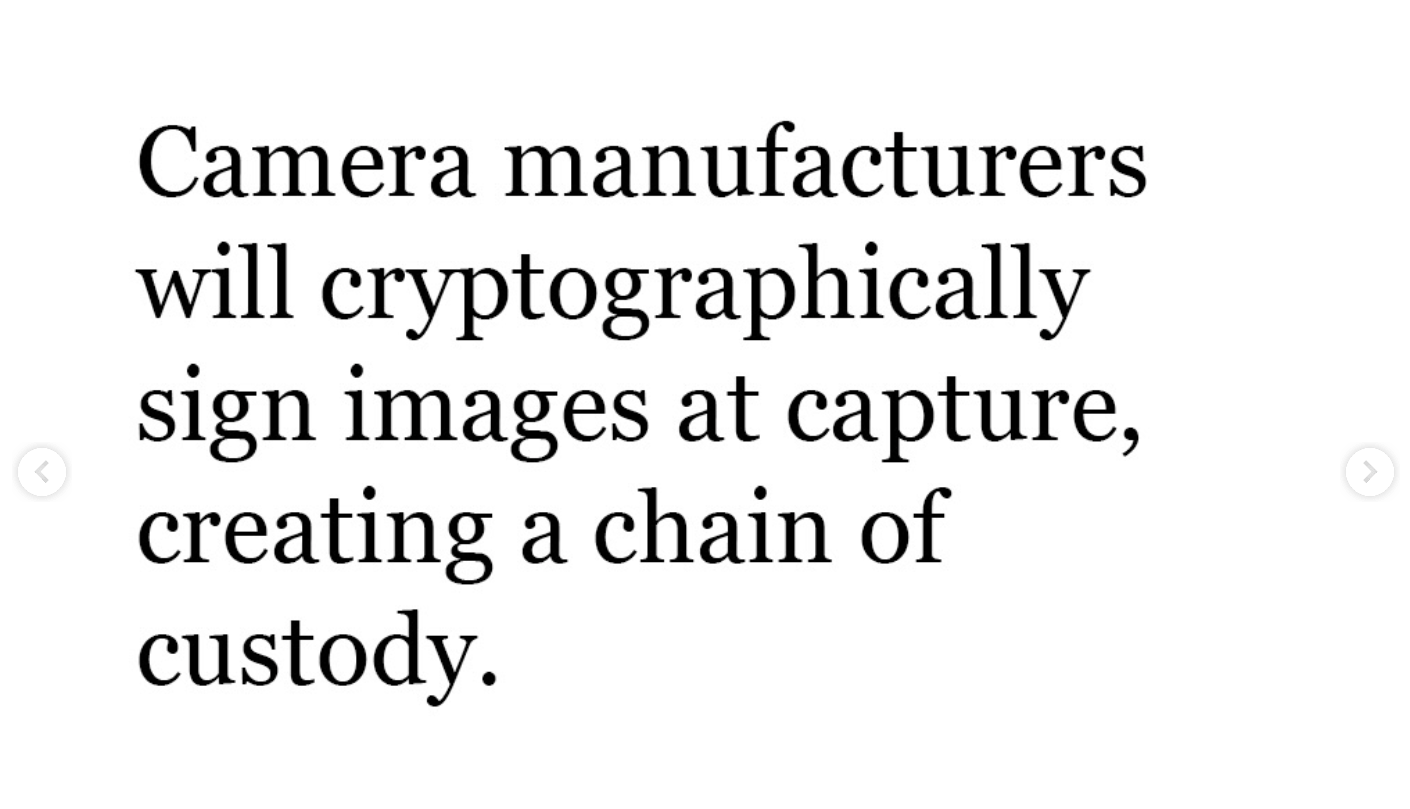
    One of the most important slides in Mosseri’s post for me is this one here:

    I’ve been arguing for years that crypto has an important role to play in a world filled with AI. When nobody knows what is “real” anymore, there’s value in being able to say with finality that, hey, this thing over here is authentic and comes from this source. Social media (web2) showed us that people would rather tie something back to an individual instead of a large faceless brand. AI is disrupting this chain of provenance, but I think crypto will bring us back to it, somehow. Whether Instagram will be a part of it, of course, remains to be seen.

    Cover photo by Jakob Owens on Unsplash

  • My predictions for 2026

    From the Toronto condo turning point to the bursting of the AI bubble

    January 2, 2026 · View original


    The best part about making predictions for a year ahead is that at the end of the year you get to look back with humility on what you were thinking at the time and realize how much you missed and how different things turned out.

    So, what might happen in 2026?

    Condominium development in Toronto: I think 2026 will be an important turning point year. If I keep saying this, at some point I’ll be right, right? 2026 is the first year where we will start to see new condominium completions from the last cycle fall off significantly. Last year (2025), we were projecting nearly 32,000 condominium home completions. This year, it’s projected to drop to ~17,487, with 2027 falling off even further as we head to almost no new supply (based on the current pipeline). What I think this means is that the first half of 2026 will still be painful as the market absorbs new inventory and the inventory from 2025 (including unsold units, units in default, and other scenarios), but that things will start to stabilize and feel better toward the end of 2026 and into 2027. New supply will now be delivering below the 10-year average for the first time in many years. – Purpose-built rental development in Toronto: The story since the condominium market turned in 2022 has been the flip to rental. But not all developers and sites can make this switch and, as I have argued before, the numbers suggest that it won’t be enough to offset our dwindling new condominium supply. That said, I think rental rates will remain soft throughout 2026. The supply crunch we’re headed toward will need a bit more time to be felt by the market. In the meantime, we will see the highly-amenitized purpose-built rental model fail. The strategy of using over-the-top amenities to drive high rents will finally fall apart in the current market environment. In its place will be a flight to value: boring rental models that offer a quality housing experience at reasonable prices. – Boutique end-user projects: In markets like Toronto and Vancouver, where the development landscape remains unfavourable, we will see a continued focus on smaller projects and projects catering exclusively to end-users. This demand segment is the most resilient and this re-orientation will help the next development cycle start on more solid footing. – Foreign buyer ban: The Canadian federal government will relax the foreign buyer ban (which is set to expire on January 1, 2027) and allow foreigners to buy pre-construction homes. There are already rumblings about this so I acknowledge this isn’t that bold a prediction. But beyond just relaxing the ban, I think government will start actively courting foreign capital to help solve our housing needs. – AI bubble: 2026 will be the year that the AI bubble bursts. Not because AI isn’t powerful tech that will continue to change the world, but because we are, in the words of investor Howard Marks, in an “inflection bubble.” This is different from a fake bubble like Tulip Mania where there was ultimately no underlying reason for tulips to be valued so highly. An inflection bubble is where we get the direction right (AI is a big deal), but the magnitude wrong (shit, we overspent on CapEx). Not every AI company can and will survive. There will only be a select few once the dust settles. And since AI seems to be what’s driving the market these days, I think the market will close the end of this year down (measured as the performance of the S&P 500). – Continued AI adoption: That said, AI will continue to change the way we all live and work. While this is going to put some people out of a job, my bias is an optimistic one in that new technologies tend to create new opportunities and generally grow the overall economy. However, I think that at least two enormous internet-type shifts are underway. One, AI is creating a massive productivity leverage for the people and firms that know how to harness it and, two, the backend of the global financial market is moving “onchain.” These are profound shifts that I, unfortunately, think will lead to even more social and political division in the short term. A government somewhere in the world will respond with a universal basic income. – AI bubble impact on real estate: An AI bubble bursting will generally help the real estate market as investors look for returns somewhere else, with the exception of the data center market. It will also create downward pressure on interest rates (which, in the US, remain the highest they have been since the Great Recession in 2008). As we know, lower rates help boost the values of highly-levered assets like real estate. – AR/VR/AI for design and construction coordination: I was blown away the first time I tried Apple Vision Pro. It’s a magical experience. But it has failed as a consumer product and who knows what Apple will launch next. Regardless, this year we will see clear use cases emerge for AR, VR, and smart glasses. I’d like to see the problems of design and construction coordination get immediately solved because they’re massive and costly and they have yet to be solved. – Mainstream tokenization: In yesterday’s post, I spoke about the lack of a breakout consumer-facing web3 app in 2025 (with honourable mention going to the Base app). But perhaps one of the big stories of last year was stablecoins entering the mainstream. Most people now agree they have achieved product-market fit. This is crypto solving real problems (cheap/fast cross-border remittances, payments, etc) with users not needing to think or care about the underlying blockchain technology. In 2026, we will see a noteworthy office building or apartment building get tokenized on the Ethereum blockchain. – Autonomous vehicles: Last year, I predicted that autonomous vehicles were going to have a year, and it certainly felt that way. This year will be the first year that I ride in one. I came close on a layover in San Francisco in December. I considered leaving the airport and taking one to Apple Park. But I would have been cutting it too close. In 2026, we will see an insurer refuse to cover a human driver for the first time, marking a clear global shift toward autonomy. Already, none of us should be driving cars anymore looking at current safety data. – Polycentric world: Some have argued that 2025 marked the end of globalization. I’m not sure that is accurate. I think it marked the end of the US-led post-war world order and the acceleration of a more polycentric world order. It was the start of greater US insularity. In 2026, Canada will start to see the benefits of this shift. What it is doing is shaking us out of complacency and forcing us to look east to Europe and west to Asia, as opposed to just south to the US.

    What are your predictions for the year ahead?

  • Happy New Year

    A review of my 2025 predictions

    January 1, 2026 · View original


    Happy New Year! And welcome to another year of this daily blog. (In August of this year, we’ll enter the 14th year of this daily practice.)

    Exactly a year ago, I published a post talking about what might happen in 2025. It was last year’s prediction post. Today, let’s see how I did.

    – Real estate development: I admitted that I had been overly optimistic in terms of how soon the market would reset (specifically Toronto). But I did still argue that 2025 would be an important turning point in terms of people capitulating and more legacy assets/deals getting reset. I think we did start to see this. We looked at a number of receivership sites and came across many instances where a landowner would take 40-50% of what they paid. The problem is that the market still hasn’t fully reset and we’re still in the midst of absorbing our current housing supply pipeline. So while it sounds nice to buy something for $0.40 on the dollar, what do you then do with it? – Return-to-office: I said that we would see the average weekly occupancy index in downtown Toronto reach 90% by the end of 2025 (it was 73% when I wrote the post a year ago). As of November 2025, it was 82%. Not quite. – Autonomous vehicles: I reversed my position (relative to the prior year) and said that autonomous vehicles are way further along than most people thought, at least at the time. And boy, was 2025 a great year for Waymo. It feels like they’re now in scaling mode. – EU carbon permits: A year ago, they were priced at €71.98 per tonne of carbon dioxide, compared to an all-time high of €105.73 in February of 2023. I guessed that they’d be between €90 and €100 by the end of 2025. Right now they’re at €87.28. – Crypto: I thought that 2025 would be a good year for crypto given the MAGA movement’s support for it. For a while, it seemed like that would be the case. But if I look at the price of Ethereum, it’s down 15.21% year-to-date. So not what I predicted. But I continued to dollar-cost average. – Web3: I went on to predict that we would see a breakout web3 consumer app in 2025. I also mentioned that I was impressed by NFT marketplaces like Rodeo. Well, Rodeo has gone on to mostly die and I’m not sure it would be fair to say that there was anything that crossed over into the mainstream. I’m going to give myself a zero for this one. But if I had to pick something, I would say that Coinbase’s “Base App” represents meaningful progress. Base continues to dominate the Ethereum Layer 2 market. It’s fast and cheap.

    I wish you all a healthy, prosperous, and fulfilling 2026.

    Cover photo by Jamie Fenn on Unsplash

  • The in-between space

    December 31, 2025 · View original


    I’m a big fan of the period between Christmas and when most of the world gets back to work in the New Year. It’s the only time of year that I know of where the email firehose shuts off, the social permission to do “nothing” turns on, and the world generally quiets down.

    I know that not everyone gets this time off. We all have different jobs. Earlier in my career, I used to always work these days between Christmas and the New Year because I couldn’t spare the vacation days. But if you are fortunate enough to have it off, it’s a unique time of the year.

    It’s a time for family and friends, and a good time for vacations that aren’t riddled with email and work anxiety. But it’s also a time that creates space for the mind to wander, and for me, it gives me a creative burst of energy.

    I’ve been trying to think of the best way to describe this feeling, and it truly feels like “mental space.” When work is “on,” it simply crowds out everything else. But a more accurate neuroscientific definition would be that we’re simply engaging different parts of our brains.

    Supposedly, when the mind is given “space” to wander — which is also referred to as wakeful rest — we engage a system in our brain known as the Default Mode Network. This network is thought to serve several different functions, including forming the basis for the self, thinking about others, remembering past events, and imagining possible future events. Generally, this makes it very good at connecting the dots, so to speak.

    The counterpart network is our Executive Control Network. This part of our brain is most active during focused, demanding, and goal-oriented tasks — so work.

    These two networks are also thought to be inversely correlated, meaning when one activates, the other often shuts down. But not always and not entirely. A 2018 research article by Roger E. Beaty et al. found that highly creative people have a unique brain “wiring” that allows these different neural networks to work together, rather than in opposition.

    What this suggests to me, as a cognitive neuroscience layperson, is that engaging our different brain networks is good for us. Sometimes it’s good to turn down executive control and give some space to default mode.

    And I find that this time of year is a perfect time to do just that.

    Cover photo by Milad Fakurian on Unsplash

  • Why rents crashed in Austin but not Miami

    December 30, 2025 · View original


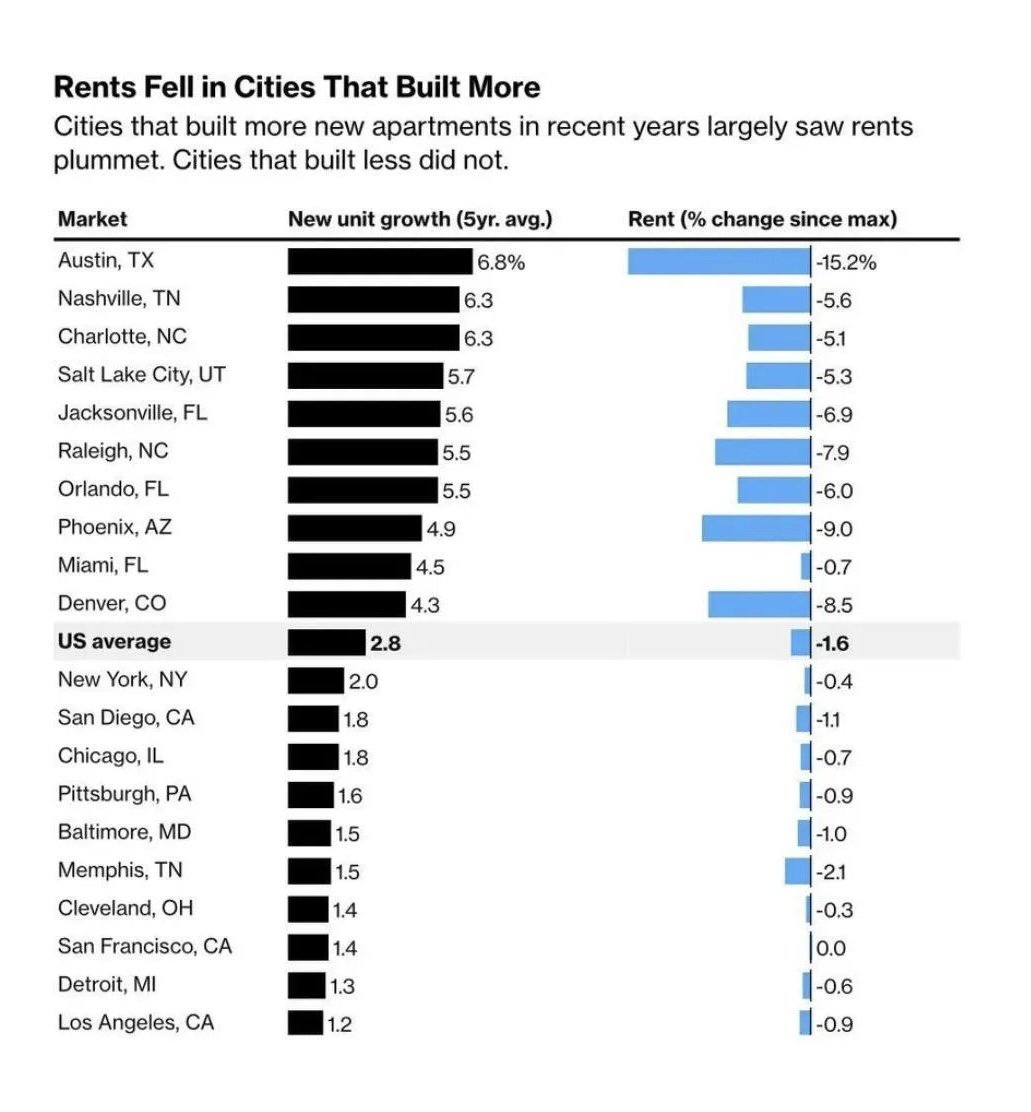
    One of the big housing stories of this year was that Austin has built a lot of new apartments and it is now causing rents to fall precipitously — by as much as 22%. The market is working.

    But as we also talk about on this blog, the benefits of new “luxury” housing don’t just apply to those who can afford it. Since real estate development happens on the margin — in other words, it’s based on the feasibility of the next unit of housing supply, not an average for the market — new market-rate housing typically needs to cater to the top end of the market. Otherwise, it wouldn’t be economically feasible to build it.

    However, study after study also shows that the delivery of any new housing in a city broadly tempers rents, including in a city’s oldest housing stock. This is true in virtually all cities:

    The above chart is from this recent Bloomberg article, talking about how “luxury apartments are bringing rents down.” But if you look closely, there is one city on this chart that appears to be an outlier: Miami.

    Despite adding a respectable number of homes, rents have not fallen as much as you might expect given the figures for the other cities on this list. The intuitive explanation is likely that Miami is in the midst of experiencing an extraordinary wealth transfer.

    For the five-year period through to 2022, it was estimated that some 30,000 New Yorkers with combined annual incomes of $9.2 billion moved to Miami-Dade and Palm Beach counties. It’s also an important capital safe haven for Latin America.

    I vividly remember looking at condo listings in Miami in 2008 and thinking, “Damn, this is cheap!” I even tried to find a job there after grad school, but at that time, it was no place for a new real estate developer. My best bet would have been something in loan workouts.

    Who could have predicted such an incredible transformation? It isn’t the third most important global city in the US according to the numbers, but it certainly has a lot of momentum right now. In this instance, new supply does not appear to be more than offsetting demand.

    Cover photo by Valeriia Neganova on Unsplash

  • The world has a new biggest city

    The UN’s 2025 World Urbanization Prospects report has reshuffled the global rankings, placing Jakarta at the top

    December 29, 2025 · View original


    It’s not always as straightforward as it may seem to measure the size of a city or urban region.

    There’s the problem of which urban boundary to use. And then once you’ve landed on that, there’s the additional problem of estimating how many people live within it. This can be particularly challenging when it comes to informal settlements, where there isn’t reliable population data.

    The most common approach is to use the continuous built-up area as the urban agglomeration, as opposed to any sort of “city proper” boundaries. And this is exactly what the United Nations has done in its latest World Urbanization Prospects report.

    Here, they have fundamentally revised their measurement methodology by using a new, so-called harmonized geospatial approach. If you’d like to nerd out on the specifics, you can do that here.

    But one of the key takeaways is that this new methodology has resulted in a reordering of the world’s largest urban agglomerations. At the top is now Jakarta, followed by Dhaka:

    Previously, Tokyo was thought to be the world’s most populous megacity, but it has dropped down to 3rd in this new report. And by 2050, it is forecasted to drop even further to 7th place:

    As we spoke about yesterday, the world’s economic center of gravity is rapidly shifting toward Asia. And that shows up in these charts.

    I have a strong desire to visit the largest cities in the world. It’s fascinating to see how such large urban clusters manage to organize themselves. There are always systems that naturally emerge to make things work, even if it feels chaotic on the surface.

    I’ve only been to 3 cities from the 2025 chart, so I have my work cut out for me.

    Cover photo by Rifki Kurniawan on Unsplash

  • Sticky cities, shifting world

    December 28, 2025 · View original


    Canadian geographer Mario Polèse’s book, The Wealth and Poverty of Regions: Why Cities Matter, is not new. It was originally published in 2010. But it’s perhaps a good follow-up to yesterday’s post about the untethering of wealth. Here’s an excerpt from a review of the book by Jeb Brugmann:

    > All cities, Polèse explains, share the same basic economic causes and effects. These are economies of localization (i.e., locating activities close together) and of urbanization (i.e., clustering lots of diverse activities together at scale). Polèse shows how these urban economies—usefully distinguished and defined in detail as economies of scale, proximity, diversity and concentration—combine with unique natural features and resource endowments, technology and infrastructure investments, national boundaries and market controls, and historical events to create quintessentially local and unique places. Every time he explains the status of another place—New York, London, Chicago, Paris, Montreal, the northern Mexico border, the North American west coast—he demonstrates again how the source code of geography combines with specific local and historical conditions to create a momentum of wealth or poverty.

    The rich may have the means to tax-optimize through physical mobility, but the draw to established urban clusters remains strong, which is why it can be a challenge to stay away from them for more than 183 days. There is a “stickiness” to established cities that is the result of momentum and compounding over centuries.

    Still, nothing is guaranteed, and there’s only so much that can be done if you’re swimming against a global landscape that is shifting away from you. Geography does matter. And today, the world’s economic center of gravity is rapidly shifting toward Asia. This is good for some cities and bad for others.

    Cover photo by Zhu Hongzhi on Unsplash

  • The great untethering of wealth

    December 27, 2025 · View original


    One of the themes we cover on this blog is the importance of place in a world where people are becoming increasingly untethered. While I’m a firm believer that great local places have enduring value, this does not mean that technology isn’t driving greater fluidity in the way people live, work, play, and optimize their taxes.

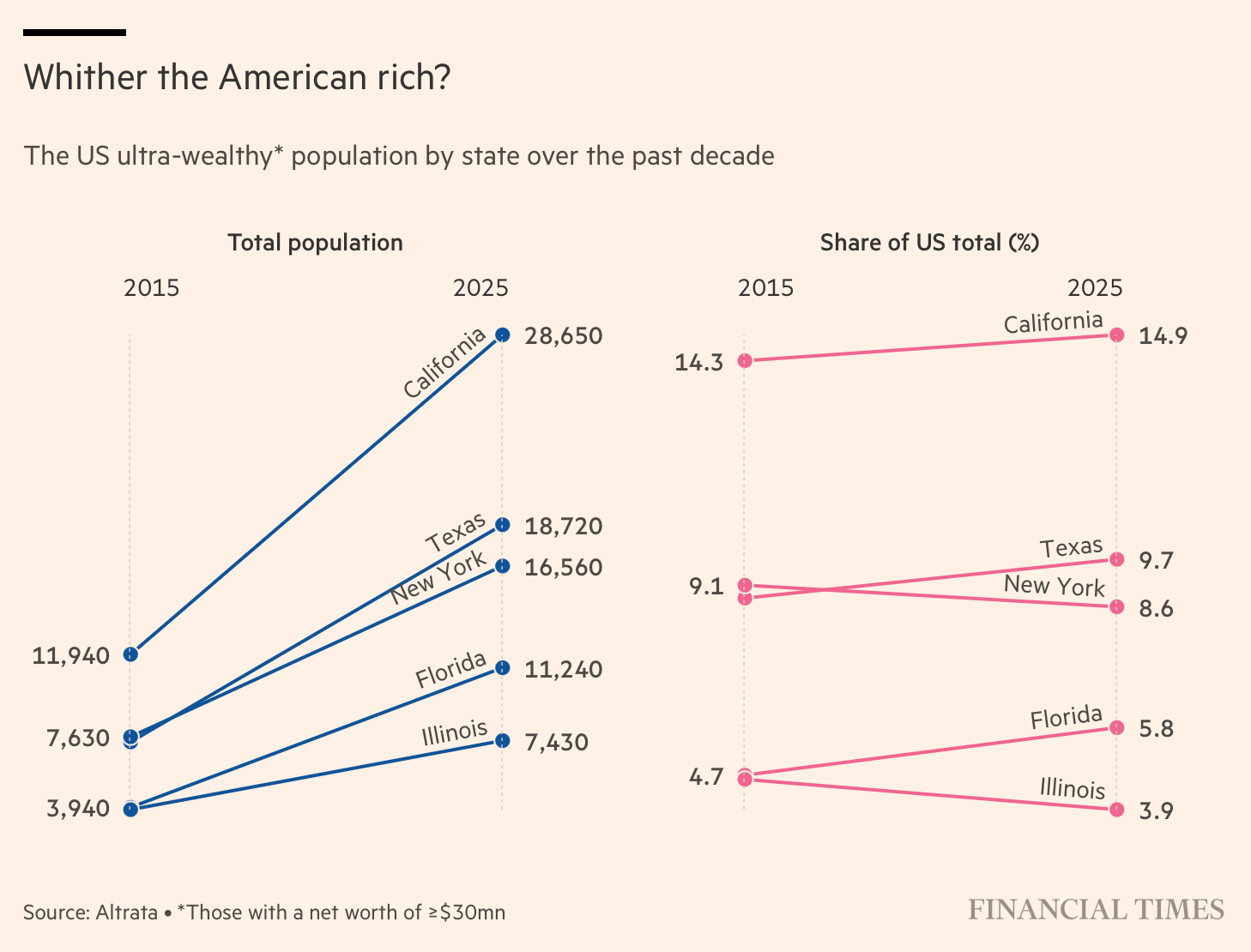
    Over the last decade, the population of ultra-wealthy Americans (those with a net worth greater than or equal to $30 million) has risen noticeably in two states: Texas and Florida. California, a high-tax state, still dominates; however, Texas has overtaken New York, and Florida has overtaken Illinois. Notably, both Texas and Florida have no state income tax — they also have warmer weather than New York and Illinois.

    As we have talked about before, there’s a longstanding migration trend in the US toward sun, urban sprawl, and lower taxes. But it’s not always as clear-cut as a rich person fully relocating to a lower-tax jurisdiction and completely severing ties. The enduring value of place means that many people still travel back and forth to meet whatever personal or professional obligations they might have.

    And today, there are apps, such as TaxBird, that will meticulously track the number of days you spend (or your phone spends) in each jurisdiction to ensure you don’t cross any important residency thresholds.

    The global standard is the 183-day rule (or roughly half a year). In many or most cases, if you are physically present in a place for more than 50% of the year, you are automatically considered a resident for tax purposes. But it’s not always this simple, so check with your tax advisor. Regardless, the untethering of life and work is surely allowing more people to tax-optimize in this way.

    None of this is surprising.

    As Charlie Munger used to say, “Show me the incentive, and I’ll show you the outcome.” But now we need to think about the longer-term ramifications for colder, higher-tax jurisdictions as capital and tax revenue continue to be siphoned off, not only to Texas and Florida, but to Dubai, Singapore, Hong Kong, Switzerland, Monaco and other places.

    Cover photo by Colin Lloyd on Unsplash

  • Where Americans flew in 2025

    The top United Airlines international destinations by US state

    December 26, 2025 · View original


    Whether you live in North Dakota or Texas, there’s a reasonable chance that when you travel internationally, you enjoy going to Cancun. Or perhaps you fly into Cancun and then go to a neighboring town like Tulum. United Airlines just released the following map showing the most-booked international destinations from every state for passengers traveling on United Airlines between January and October 2025. The top three destinations are London, Cancun, and Tokyo:

    First, it’s important to keep in mind that this data only includes people flying on United; it doesn’t capture all international air travel. Second, maps like this are necessarily going to be influenced by an airline’s biggest hubs. In the case of United, its hub-and-spoke model relies on major airports and routes like San Francisco-Tokyo and Newark-Heathrow.

    Still, specific destinations appear on this map for a reason. Cancun is the number one “vacation” airport for Americans, which is an incredible success story, because it wasn’t a place until the 1970s. Prior to Cancun, Acapulco was Mexico’s top resort destination, but it was becoming constrained, and the government needed a replacement conduit for extracting US dollars from the American middle class. So, they developed Cancun.

    The popularity of Tokyo is likely partly a result of a weaker yen, in addition to being an important Asian hub and an incredible place to visit. According to the Japan National Tourism Organization (JNTO), over 2.7 million Americans visited the country in 2024 — a 33% year-over-year increase and a 58% increase compared to 2019.

    The country also saw 3.7 million international visitors in January 2025, which is the highest ever for a single month. Countries like the US and Canada also set all-time records for January arrivals. Part of this, I’m sure, has to do with Japan’s legendary “Japow.” I was part of this year’s cohort, and I’ve never seen so much snow as I did on the island of Hokkaido.

    There are also very specific one-off relationships that appear on United’s map. The number one destination for the state of Arizona is, for example, Taipei. And this is being driven by a semiconductor boom, specifically Taiwan Semiconductor Manufacturing Company’s direct investment in the state. At the time, it was heralded as “the largest foreign direct investment in a greenfield project in American history.”

    So, there’s a lot that can be gleaned from a map like this. If we were to zoom out and look at all international air travel, we would likely see some reordering. I suspect Paris would jump ahead of airports like Vancouver, given its hub status for other airlines. But it’s unlikely you’d see a completely different list. Americans fly east to London, south to Cancun, west to Tokyo, and north to Toronto. These are the primary hub airports.

    Cover photo by Yu Kato on Unsplash