Daily insights for city builders, delivered every morning at 6 AM ET. I’m Brandon Donnelly — a Toronto-based real estate developer and founder of Globizen. I’ve been writing here since 2013.

Month: June 2026

  • Why the amenity arms race is failing Maslow’s hierarchy of needs

    June 19, 2026 · View original


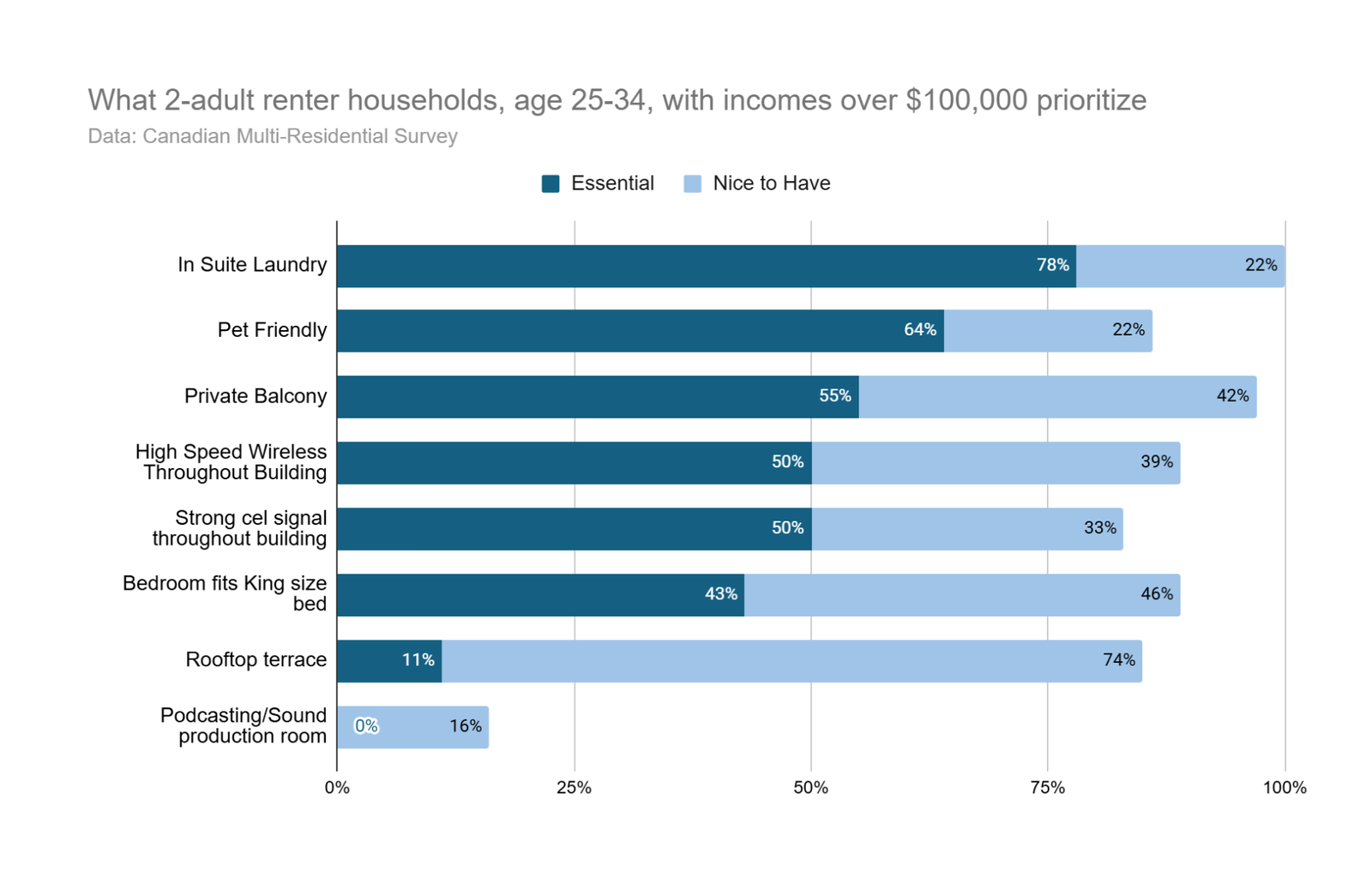
    I came across these survey results in a guest column by Wendy Waters in Connect CRE Canada called, “What Will Attract Young Professionals to a New Rental-Apartment Building?” If I ignore the typo in “strong cel [sic] signal” and just look at the results, many of them are intuitively obvious. The vast majority of renters believe that in-suite laundry is essential, and it’s the number-one want in this survey.

    Pet-friendly is also not surprising given that pets are going to outnumber kids in most new purpose-built rental apartment buildings. And, of course, people want connectivity. I interpret high-speed wireless and strong cell signal throughout the building to specifically mean the common areas. Presumably, 100% of people want internet and cell signal within their apartments.

    At the same time, there are some other interesting results. For example, 55% of respondents (in this segment) said that a private balcony is essential and 97% said it was either essential or a nice-to-have.

    There’s a common debate in developer boardrooms about whether private outdoor spaces are essential to sell or lease an apartment and there are certainly rental developers who abstain from them altogether. But tenants seem to like them a lot, at least according to this survey. And a “nice-to-have” is still something that helps with leasing.

    People also seem to want a king-size bed. Whether they’d be willing to pay for the additional space is a separate matter. There is always an affordability and willingness to pay dimension to surveys. I mean, who wouldn’t like more? But a larger primary bedroom appears on this list and, right now, there’s a growing sense in the market that buyers and tenants want livable spaces over things like podcasting rooms and ski simulators.

    From a Maslow’s hierarchy of needs perspective, this seems to make sense. People want their physiological needs — such as a comfy bed — solved first, and then they’ll worry about finding self-actualization in their new podcast.


    Cover photo by Lotus Design N Print on Unsplash

    Chart via Connect Canada CRE

  • It’s not immoral to be a billionaire

    June 18, 2026 · View original


    Elon Musk is now a trillionaire, SpaceX has a valuation that can only be explained — wait, it can’t be explained — and some people think it’s immoral for people to be able to become billionaires and now trillionaires. I don’t care for Elon, but I certainly don’t have a problem with people creating lots of wealth for themselves. In fact, I think it’s the outcome we want, provided we do the things necessary to maintain a healthy middle class.

    Nevertheless, there are people who believe you cannot earn a billion dollars without bad behavior. I’d like to think that nobody really believes this and they have simply recognized it makes for good politics or some other self-serving purpose, but maybe I’m wrong.

    Paul Graham recently responded to this argument with an essay called “How to Earn a Billion Dollars.” With the experience of funding and investing in about 6,500 companies under his belt, he puts it very simply: The most common way to earn a billion dollars is to start a startup that many people like, and then have it grow very quickly for a period of time.

    He provides some math:

    > If your revenues grow at 15% a month, how much more will you be making 5 years from now? To calculate that, we need to find 1.15 to the 60th power (since 5 years is 60 months). So go to Google again and this time type 1.15^60. The answer should be about 4384. Meaning in 5 years your startup will be making 4384 times as much. If you’re currently making ten thousand a month, in five years you’ll be making about 44 million a month, or 526 million a year. And at that point, if you own as much of the company as founders typically do, you will be a billionaire.

    He then goes on to argue that a key founder trait is, in fact, the opposite of exploitation:

    > There are other ways to get rich than by starting startups. Some of those do require you to exploit people. But startups are the most common way to become really rich, and if you want to start a successful startup, the key is not exploitation but empathy. What do users really want? What could you do for them that would make their lives dramatically better? That kind of empathy is what we look for in founders, and what we cultivate in the ones we accept [at Y Combinator].

    If you’re interested, here’s the full essay.


    Cover photo by Josh Hild on Unsplash

  • Will Waymo finally convince us to sell our cars?

    June 17, 2026 · View original


    Waymo just launched a new $29.99-per-month “Premier” service in a select few of its cities. The member benefits include priority pickups, 10% cash back (sometimes more during busy times), early access to new Waymo cities, and flexible cancellations (up to five per month). Generally speaking, it feels pretty similar to Uber One, except it’s 3x the cost. But if you spend more than $300 per month on Waymo trips, then the 10% cash back does pay for the service. We’re now also talking about autonomous vehicles. Will that make a difference?

    One of the early promises of Uber was that it was going to disrupt car ownership. People would just ride-hail. But as far as I can tell, that has not happened at scale. In the case of autonomous vehicles, one of the early promises was that if you took out the labour-cost component of ride hailing (i.e., the driver), you could then make rides really cheap and that would induce demand. But that too has not been the case thus far. In fact, riders seem to be willing to pay a premium to be in the car alone. This premium appears to be reflected in the price of Waymo Premier.

    Where we got it wrong with Uber is that it ended up replacing taxis, not car ownership. But will autonomy and a nicer car experience change this? I like my car because I picked it, I use it to get where I have to go, and I store some of my stuff in it (including a fancy new car seat). But broadly speaking, I hate driving. If Waymo could fulfill my needs for, say, C$300/month, it would be in my economic interest to switch. I would have a very high willingness to pay if this is what I were replacing.

    Changing consumer behaviour is hard, especially when we’ve built entire cities around a particular mode of transport. But sometimes products and services have seemingly subtle differences that surprise us in the way that the market responds to them. Will that be the case with Waymo? We shall see.

  • Housing delivery is a “many-things” problem

    June 16, 2026 · View original


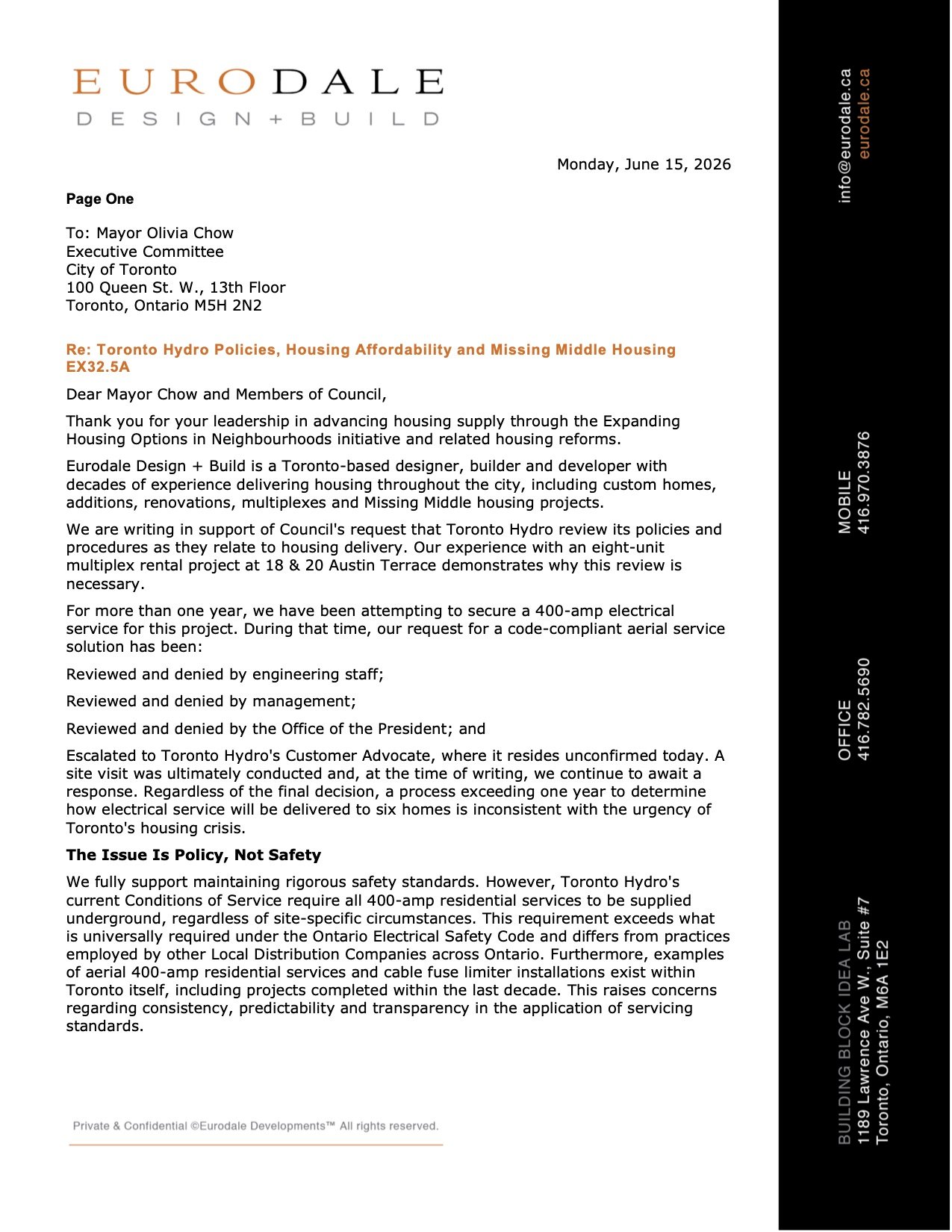
    We talk a lot around here about the obstacles to missing middle housing and one of the key themes is that it’s not a singular problem, it’s a “many-things” problem. It’s zoning, single-stair code requirements, elevators, environmental policy, servicing, and so much more. So we need to treat it like a multidisciplinary problem and collectively chip away at the barriers.

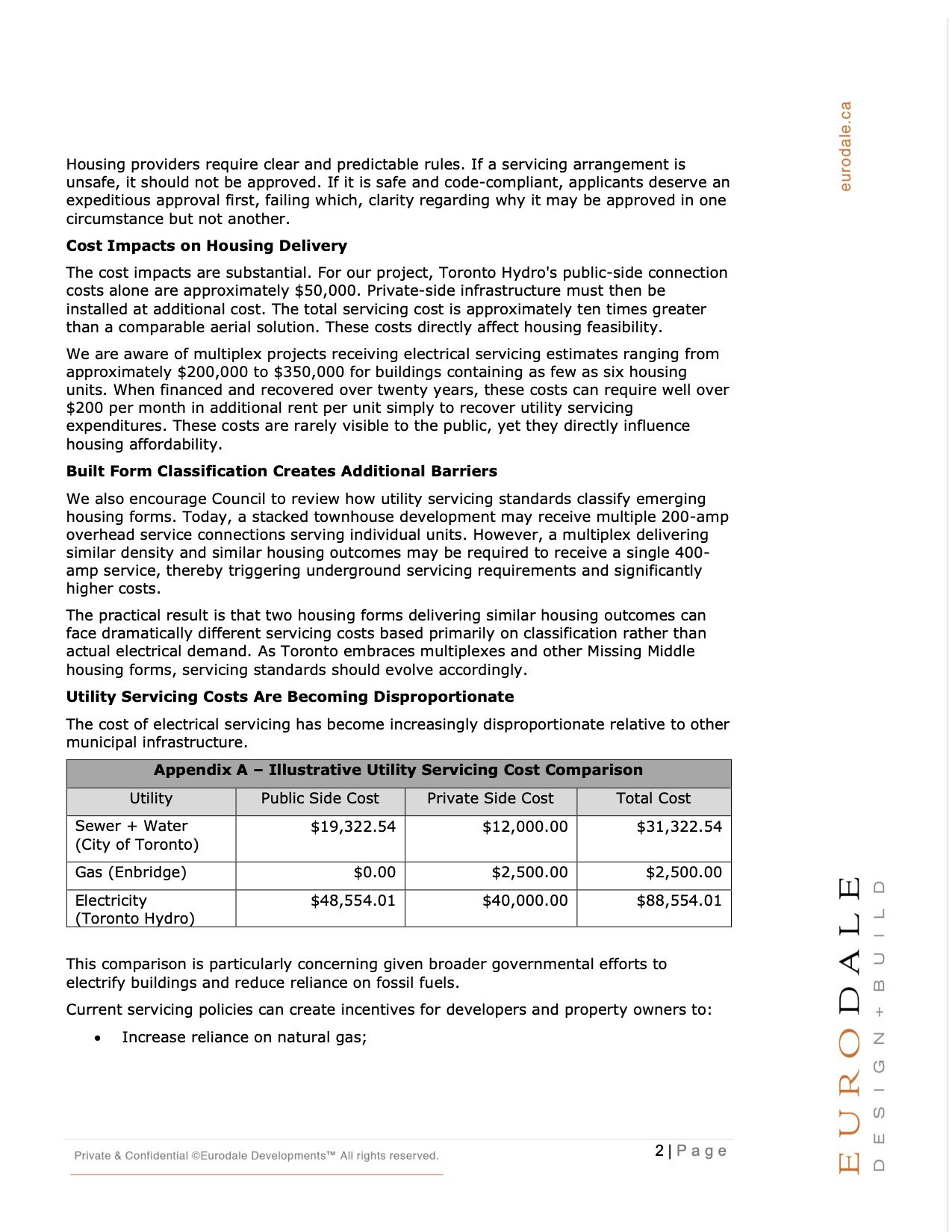
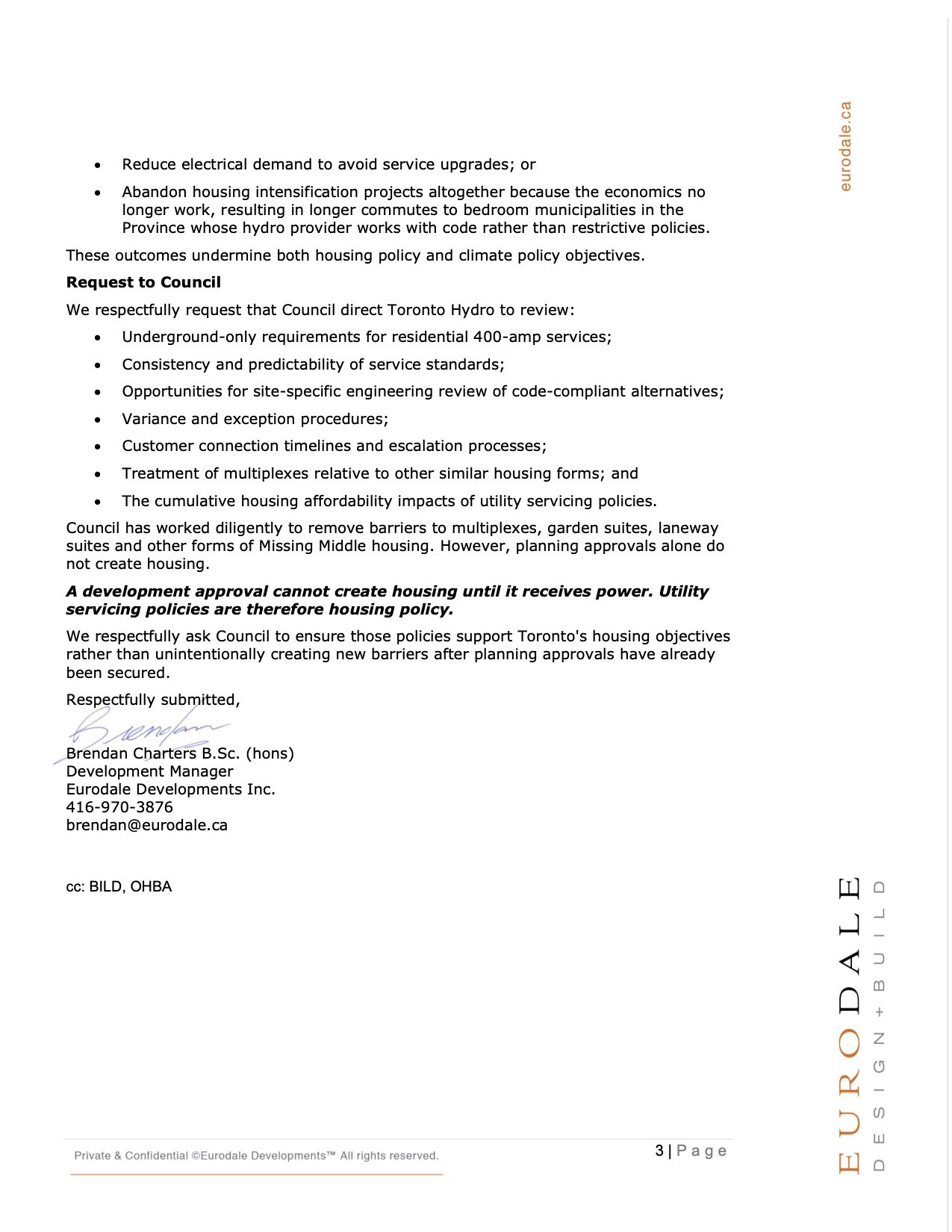
    Today, let’s focus on one important item on the list: servicing. My friend Brendan Charters from Eurodale forwarded me a letter that he submitted to City Council this week concerning Toronto Hydro policies. It does a great job outlining the issues, the impact on housing delivery, and the potential costs that new housing projects must bear. So I thought I would share it verbatim here on the blog.

    The costs outlined in the letter below are just one example of the direct and indirect costs (time value of money) that get added onto every new home in the city, provided the new home even gets built. There are also too many instances of housing projects that never get off the ground because the costs are deemed too great right from the outset.

    For those of you who are in the industry, or who just care about this issue, here’s the agenda item. The City is hoping that the industry will use this opportunity to clearly articulate the challenges they have had with Toronto Hydro when it comes to multiplexes and housing development in general. Here’s your opportunity. Write to the City and share Brendan’s letter. This is how we work to solve our “many-things” problem.


    Photo by Pavel Polansky on Unsplash

  • São Paulo rethinks its legendary war on advertising

    June 15, 2026 · View original


    > São Paulo is a city that’s proud of its scale. A leading entrepreneur tells us that he had returned to São Paulo from living in Paris after he struggled to make it through a grey French February. “Look, Paris is fine if you want to live somewhere provincial and eat cheese but São Paulo is a real city,” he says. Plus, in winter, you can savour 23C temperatures and big blue skies.

    The above is an excerpt from a recent Monocle article covering 10 observations about São Paulo. I have only been to Brazil once, and it was to visit Rio de Janeiro. But since then, I have had São Paulo high on my list. This is partially because I’m fascinated by Brazil and partially because I love big cities — and São Paulo is one of the biggest and most frenetic.

    But one of the areas where, in recent history, it has not been frenetic is signage. In 2007 a new municipal law was put into effect called the Clean City Law (or Lei Cidade Limpa). The law was simple: It introduced a near-total ban on billboards and public advertising, while imposing strict storefront limits on signage.

    In the first year of the law, the city collected nearly C$30 million in fines and then, seemingly overnight, the city transformed itself from a wild west of signage into an ad-free megacity. The results were fascinating. Historic buildings that had been entombed by ads were suddenly rediscovered. Architecture became front and center.

    But interestingly enough, the city is now looking to relax these laws to a certain extent and allow four buildings at the intersection of Avenidas São João and Ipiranga to be covered with LED panels and displays, akin to those in New York’s Times Square or Tokyo’s Shibuya Crossing. Here’s the promo video.

    YouTube video

    If you watch the video, you’ll see that it says something along the lines of “the world’s largest cities have all transformed their streets into living experiences.” It then shows clips of New York, London, Doha, and others that all have similar LED screens and brightly illuminated buildings. In other words: All the best cities are doing it, so we need to do it too.

    There are naturally some people who like São Paulo the way it is today. But regardless, it raises an interesting question: Are these kinds of highly-visual urban displays just a new form of advertising, or are they something else, something more elevated? And is it really table stakes for the largest global cities to have something like it?


    Cover photo by Thandy Yung on Unsplash

  • Cities are now consumer products

    June 14, 2026 · View original


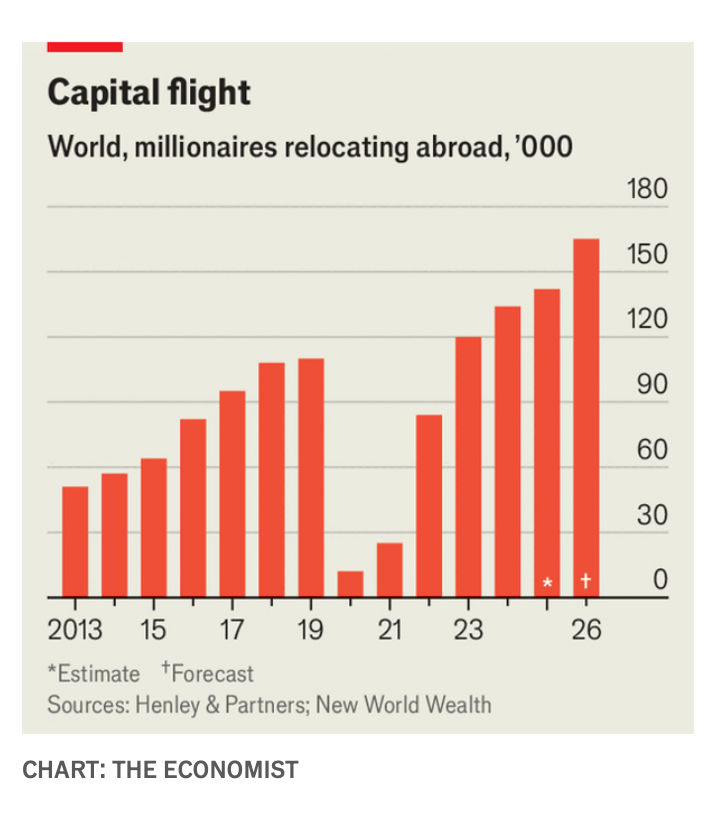
    We keep hearing that wealthy people increasingly want to live in cities like Miami. The weather is warm and taxes are lower. But it’s important to keep in mind that this is part of a larger trend. In 2024, it was estimated that approximately 128,000 millionaires would relocate abroad. Last year, the number was more than 140,000. And this year, the number is expected to top 165,000. According to Henley & Partners, this represents “the largest voluntary transfer of private capital in modern history.”

    People and their capital are now more mobile than ever. And the result is that from Miami to Milan, something interesting has happened: cities have become consumer products that compete based on what they can offer their customers. Up until this year, Dubai seemed to have the strongest offering for millionaires, but we’ll see how the Iran war impacts that going forward. As another example, the US remains a magnet for talent and capital, but:

    > …the biggest shift is in America—home to more than a third of the world’s people worth $30m or more, according to Knight Frank, a property firm. “The US has gone from a blip to the primary market,” says Ronald Klasko, a lawyer in Philadelphia. > > He says that most clients are interested in moving to Europe, because they are concerned about America’s political direction, want an alternative residency or want to be able to travel without an American passport.

    Anecdotally, I can also say that I was speaking with a luxury real estate agent in Toronto last week and she told me that her biggest client segment by far right now is wealthy Canadians who have been living in the US for many years or even decades and have now decided to move back home. Take that for what it’s worth.

    Of course, treating cities as transactional consumer products as opposed to deeply rooted places has its drawbacks. Global wealth migration can detach real estate values from the local economy and create banal districts for people with weak local connections. But I don’t think these two things need to be mutually exclusive. Cities can and should be both global and local.

    The reality today is that cities cannot take their tax bases for granted. Talent and capital are more mobile than ever before. If they don’t like your product, they’ll shop around for another one.


    Cover photo by Avi Werde on Unsplash

    Capital flight chart from The Economist

  • Congestion pricing solves traffic, but what about road safety?

    June 13, 2026 · View original


    Okay, so, we know that New York’s congestion pricing in lower Manhattan is doing exactly what it’s supposed to do. It has reduced traffic congestion and average drive times, improved air quality, increased public transit ridership, and continues to generate lots of money for the city.

    Because of this, a majority of New Yorkers now say they want congestion pricing to continue, despite many vehemently objecting to it before its enactment. It is, in fact, a car-friendly policy. It makes driving faster and easier by reducing congestion.

    But here’s another way to look at its effects. A recent study by the Columbia University Mailman School of Public Health (in partnership with the Yale School of Public Health) found that, at the highest level, the program is also helping road safety. Car crashes have declined since the program began.

    But this is for overall crashes. Interestingly enough, the results are less obvious when looking specifically at injury and fatal crashes. One possible explanation for this is that congestion pricing is, you know, working. Cars are able to drive faster! And since I would imagine that vehicle speed is correlated with injury severity, this makes sense.

    So, congestion pricing won’t solve all of your city-building problems. It will, however, solve a great number of them. Which city will be bold enough to step up next?


    Cover photo by Stian Skevig on Unsplash

  • A new global landmark in Toronto

    June 12, 2026 · View original


    Now that One Delisle is nearing its final height, the team hired Jacob Côté Photography to go out and capture some progress photos of the site. If you’d like to take a look, they’re posted over on Globizen’s blog journal. My absolute favourite is the twilight-hour shot with the light blue sky and view toward downtown and the lake. It’s the kind of shot that reminds me why I love Toronto.

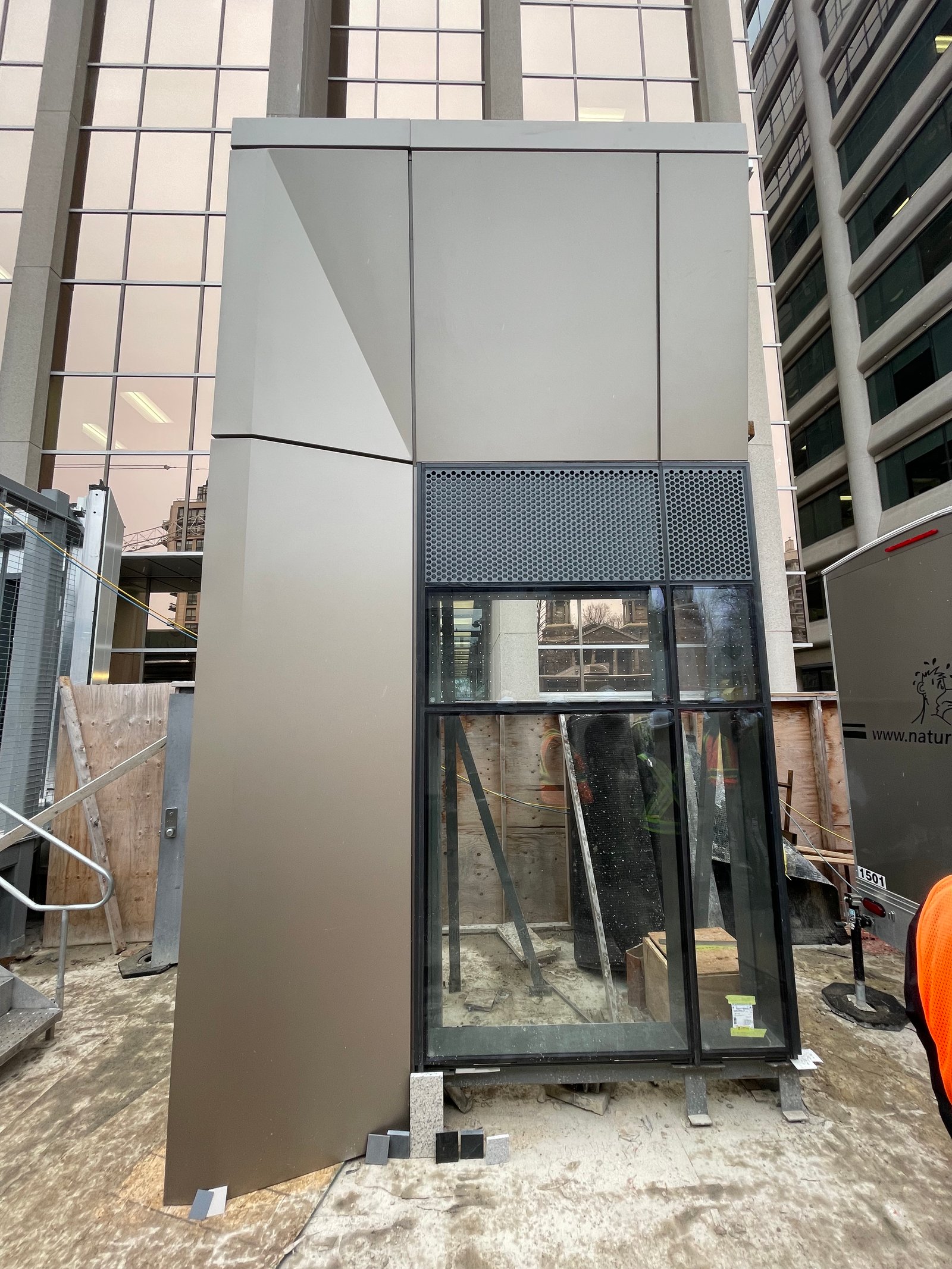
    In other news, the structural backup wall is now underway along the Yonge Street retail frontage. This structure will allow for the reinstatement of the Art Deco facade that was dismantled, catalogued, and stored off-site since the start of construction. Following this, the remainder of the ground floor will be clad in curtain wall (pictured below).

    The structural steel for the top of the building, or what we internally call the “architectural crown,” was also recently delivered to site. This structure will frame a two-storey volume at the top of the building, conceal the mechanical penthouse, and serve as the building’s last important architectural move. Watch for it this summer.

    Lastly, we welcomed a select number of brokers to site this week to tour our recently completed model suites. If you have clients you’d like to bring to site or if you yourself are interested, I would encourage you to reach out to the team to book a private site tour. Email [sales@onedelisle.com](mailto:sales@onedelisle.com) or phone 416-551-4520.

  • Where “luxury” home sales are rising and falling

    June 11, 2026 · View original
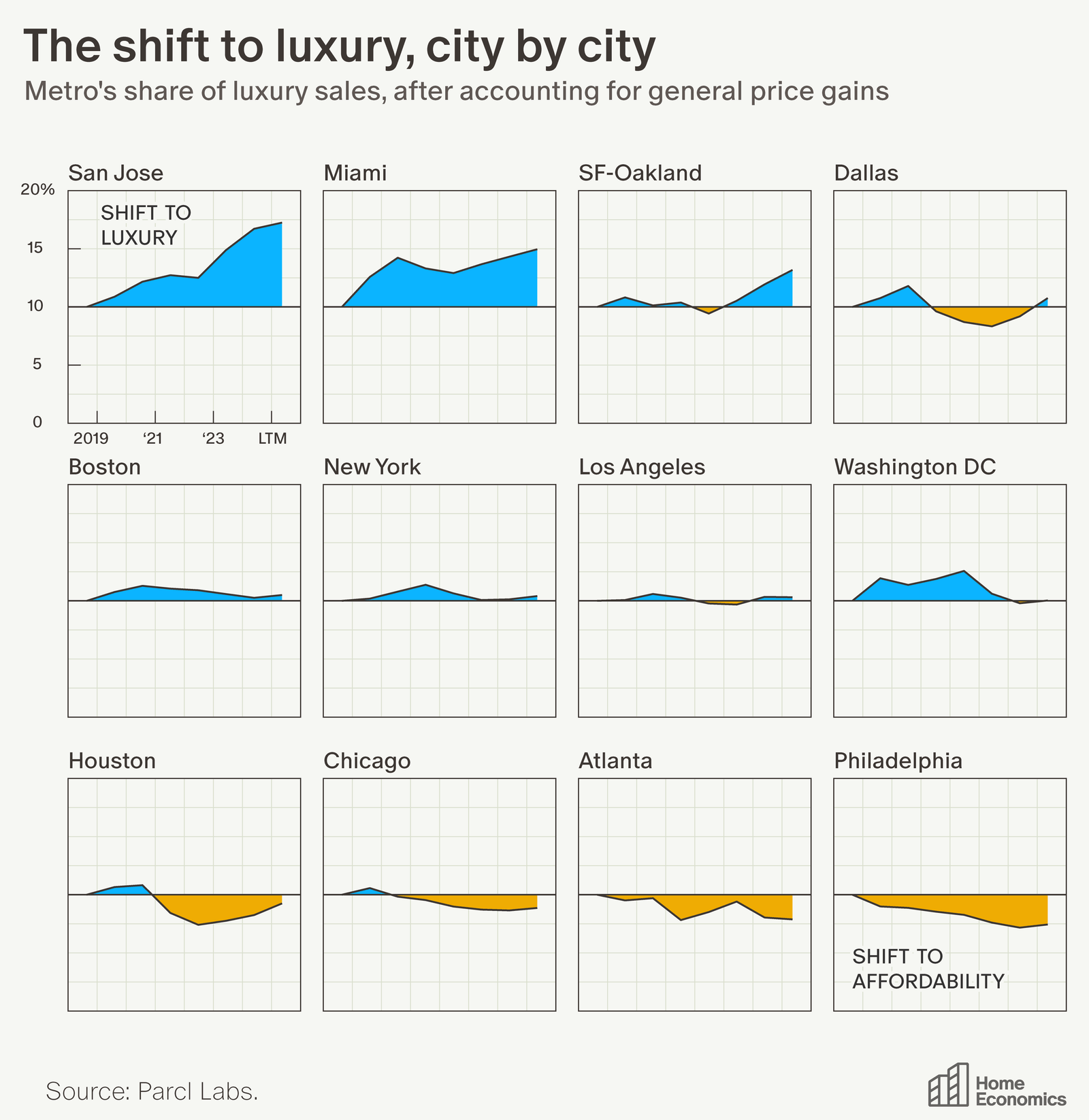

    Aziz Sunderji of Home Economics has come up with an interesting way of measuring luxury home sales. He starts by identifying the top-decile price in 2019 for a collection of metro areas (i.e., the top 10% of all home sales in a given market).

    This means that if the top 10% of homes in a city sold for $1 million or more, then $1 million is the threshold for a home to be considered “luxury.”

    But to prevent general market inflation from skewing things over time, he then adjusts this luxury threshold according to how the entire market performed. For instance, if average home prices have increased by 30% since 2019, then the luxury threshold also increases by 30%. In our example, it is now $1.3 million.

    Now what?

    By definition, in 2019, exactly 10% of sales in a given market were deemed to be luxury. But because the luxury threshold moves in tandem with the general market, Aziz is then able to see if the luxury segment grew or shrank in a particular market.

    If, for example, only 4% of home sales are now above the new trended luxury benchmark, well then this indicates a shift toward affordability, as opposed to luxury. To be considered luxury today, a home’s value has to have grown faster than the average home in that market.

    The result is the above chart, which shows three luxury outliers, and two in particular: San Jose and Miami. This illustrates that so-called “K-shaped” economy.


    Cover photo by Charlie Lederer on Unsplash

    Charts from [Home Economics](Aziz%20Sunderji%20of%20Home%20Economics%20has%20come%20up%20with%20an%20interesting%20way%20of%20measuring%20luxury%20home%20sales.%20He%20starts%20by%20identifying%20the%20top-decile%20price%20in%202019%20for%20a%20collection%20of%20metro%20areas%20(i.e.,%20the%20top%2010%%20of%20all%20home%20sales%20in%20a%20given%20market).%20%20%20This%20means%20that%20if%20the%20top%2010%%20of%20homes%20in%20a%20city%20sold%20for%20$1%20million%20or%20more,%20then%20$1%20million%20is%20the%20threshold%20for%20a%20home%20to%20be%20considered%20″luxury.”%20%20%20But%20to%20prevent%20general%20market%20inflation%20from%20skewing%20things%20over%20time,%20he%20then%20adjusts%20this%20luxury%20threshold%20according%20to%20how%20the%20entire%20market%20performed.%20For%20instance,%20if%20average%20home%20prices%20increased%20by%2030%%20since%202019,%20then%20the%20luxury%20threshold%20also%20increases%20by%2030%.%20In%20our%20example,%20it%20would%20now%20be%20$1.3%20million.%20%20%20Now%20what?%20%20%20By%20definition,%20in%202019,%20exactly%2010%%20of%20sales%20in%20a%20given%20market%20were%20deemed%20to%20be%20luxury.%20But%20because%20the%20luxury%20threshold%20moves%20in%20tandem%20with%20the%20general%20market,%20Aziz%20is%20then%20able%20to%20see%20if%20the%20luxury%20segment%20grew%20or%20shrank%20in%20a%20particular%20market.%20%20%20If,%20for%20example,%20only%204%%20of%20home%20sales%20are%20now%20above%20the%20new%20trended%20luxury%20benchmark,%20well%20then%20this%20indicates%20a%20shift%20toward%20affordability,%20as%20opposed%20to%20luxury.%20To%20be%20considered%20luxury%20today,%20a%20home’s%20value%20has%20to%20grow%20faster%20than%20the%20average%20home%20in%20that%20market.%20%20The%20result%20is%20the%20above%20chart,%20which%20shows%20three%20luxury%20outliers,%20and%20two%20in%20particular:%20San%20Jose%20and%20Miami.%20This%20illustrates%20that%20so-called%20″K-shaped”%20economy.)