Daily insights for city builders, delivered every morning at 6 AM ET. I’m Brandon Donnelly — a Toronto-based real estate developer and founder of Globizen. I’ve been writing here since 2013.

Month: June 2026

  • Our cars are outgrowing our cities

    June 30, 2026 · View original


    Now that a car seat lives permanently in the backseat of my car and I have learned how much it compresses the passenger seat in front of it, I have on more than one occasion thought to myself, “I guess this is why people feel the need to buy bigger cars.” And the data shows this is true: cars generally keep getting bigger.

    A brand-new report from Transport & Environment found that over the last 25 years in the EU, the UK, and Norway, the average newly-sold car has increased in length by 1.2 cm per year, in height by 0.5 cm per year, and in width by 0.5 cm per year.
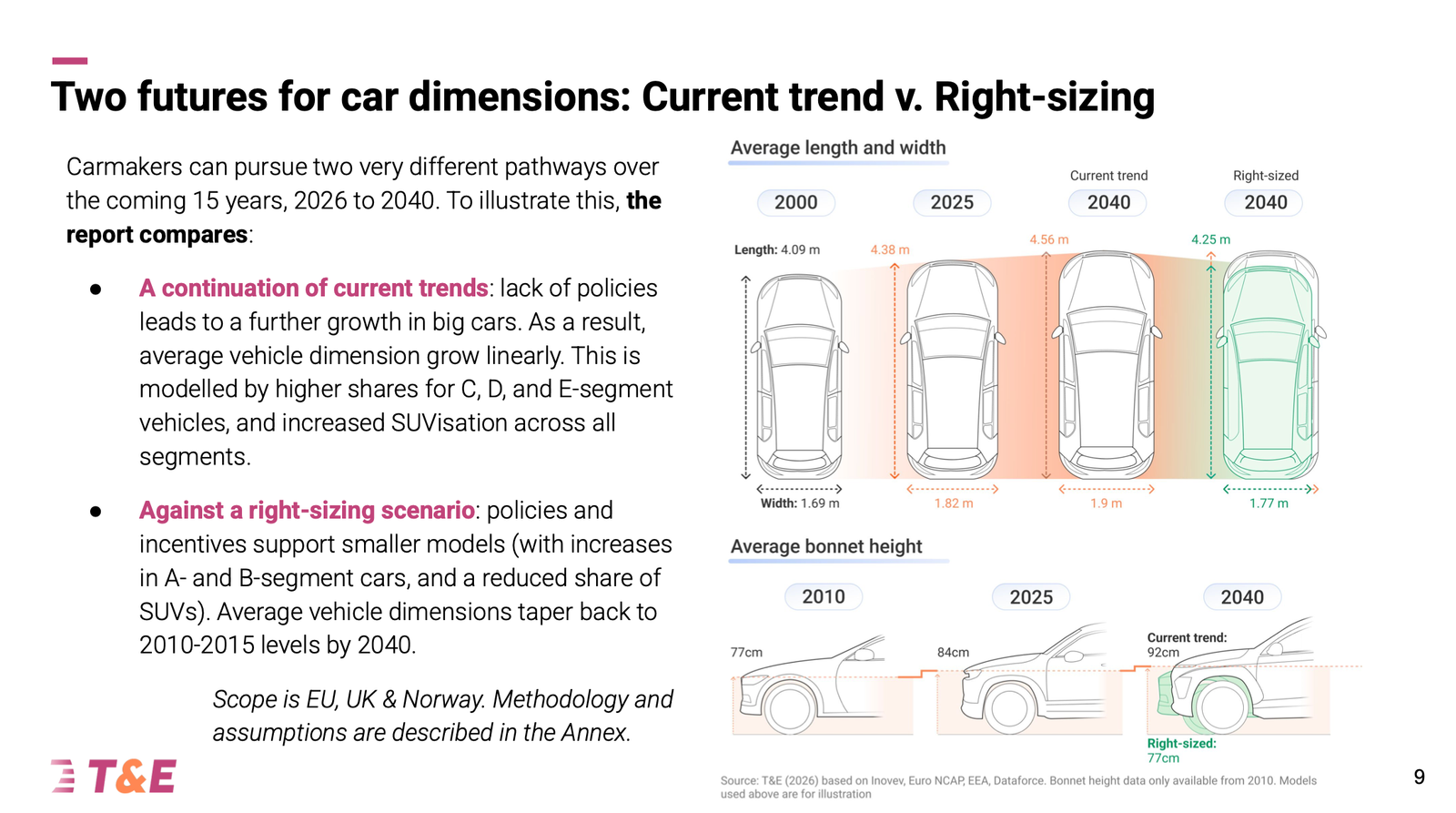
    But it’s not necessarily because buyers are looking to fit more kids and car seats. Average household sizes have fallen in the US, so it’s similar to housing: people are having fewer kids and, therefore, want to consume bigger homes (and cars). My cursory understanding is that there tends to be some gamesmanship with car sizes and emissions targets, but I do also think it’s a case of consumers just wanting bigger and better.

    For those of us who deal in the built environment, this is an important trend to consider because larger cars (1) tend to kill more pedestrians and (2) take up more space in our cities. The report estimates that, if current trends continue, European cities could lose between 8.5 and 14% of their on-street parking spaces by 2040.
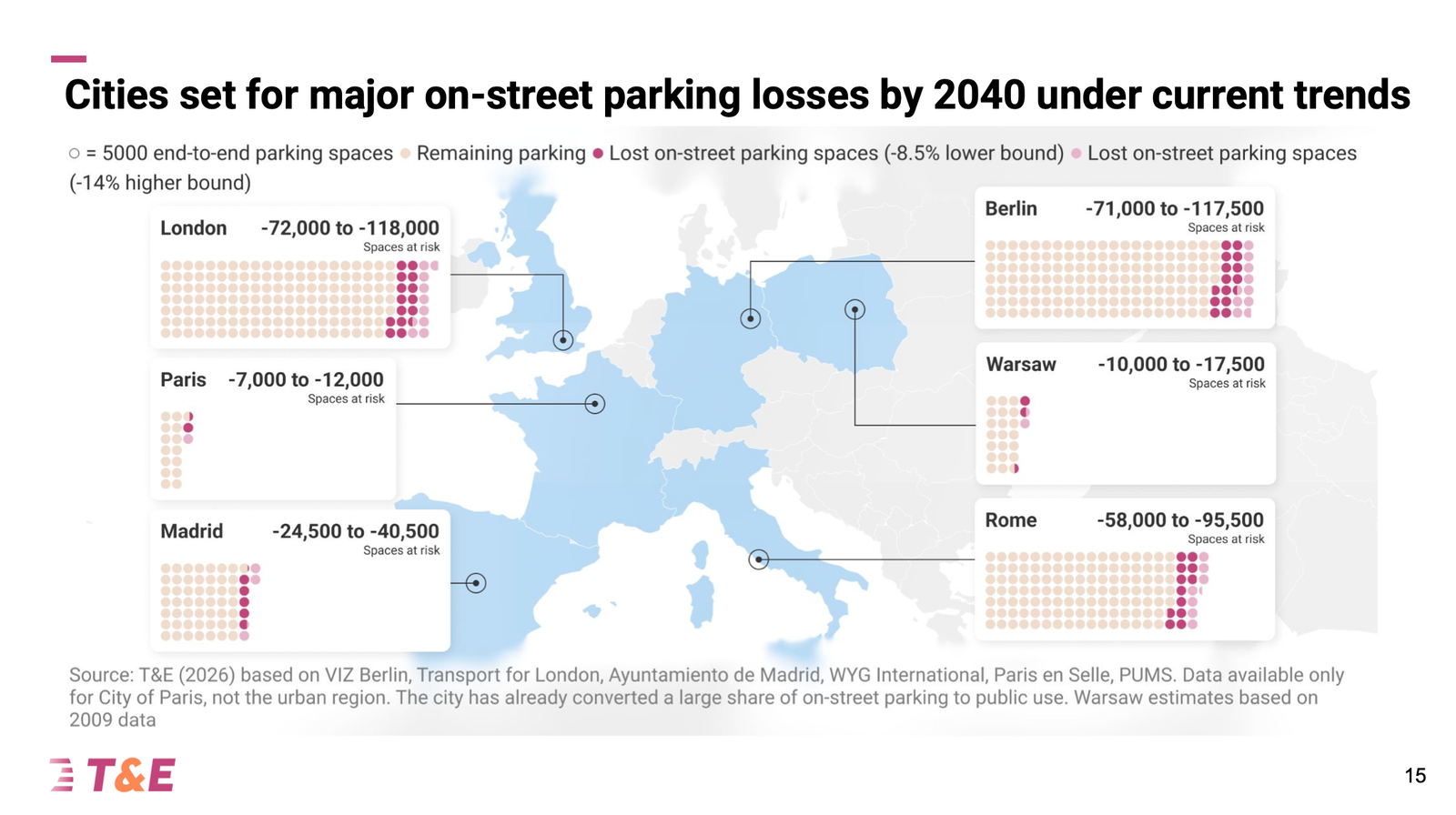
    Small marginal changes of only a few centimetres may not seem material on an individual basis, but when you layer on pedestrian deaths, urban parking constraints and traffic congestion, it only strengthens the case for the Tokyo model of urbanism.


    Cover photo by Oleksandr Voloshchenko on Unsplash

    Slides from Transport & Environment

  • Tokyo proves that futuristic megaprojects can still feel human

    June 29, 2026 · View original


    It’s that time of year again. Monocle just released its annual survey of the most liveable cities in the world.

    If you’re a regular follower of the magazine and/or its quality-of-life survey, you’ll know that North American cities don’t generally fare well in this ranking. This year, the only one to appear is Vancouver. You’ll also know that there are some usual suspects that appear near the top (here comes the spoiler). This year’s top city is Tokyo.

    One of its standout features, yet again, is its liveability and orderliness despite being one of the largest urban regions in the world. But there’s also talk about some of its grandiose city-building initiatives, one of which includes the new Takanawa Gateway City.

    The 13-hectare (32-acre) development is a transformation of a former rail yard in south Tokyo into what is being called a futuristic “global gateway.” The megaproject includes retail, office, hotel, residential, and cultural uses, plus a 1.1-kilometre elevated pedestrian promenade that stitches it all together.

    There are also autonomous mobility devices called “iino” that actively roam the district and offer pedestrians free, futuristic rides. Here’s a video and an image from JapanStation:

    We talk a lot on this blog about Tokyo’s granular, small-scale urbanism. But obviously the city also builds big, though it’s not exactly what you’d find in other cities. For one thing, the development is vertical in a way that is difficult to achieve outside of cities like Tokyo.

    Here’s a comprehensive walking tour of the district. At 42:02, you’ll see a rooftop public space that is extremely well used, especially given that the development only recently opened. I also find it remarkable that so many people in the video have taken their shoes off to use the free, public foot bath.

    Could you imagine doing that in your city? It’s perhaps a perfect example of how Tokyo miraculously pulls off being both big and liveable.


    Cover photo by Tsuyoshi Kozu on Unsplash

  • Why Canada should want to renovate 24 Sussex Drive

    June 28, 2026 · View original


    24 Sussex Drive in Ottawa is technically the official residence of the Prime Minister of Canada. However, the last time it was used for this purpose was in 2015 by Stephen Harper. When Justin Trudeau took office, he opted to live at Rideau Cottage because of the house’s current state of disrepair. In 2021, the National Capital Commission listed the property as being in “critical condition,” and the following year it was officially closed for “health and safety reasons,” including a rat infestation. Since then, the 35-room, 12,000-square-foot house has had its interiors stripped down and has sat there in an uninhabitable state.

    The political reasons for doing so are obvious. Going back to the 1950s when it was first used as a residence, no Prime Minister has wanted to spend taxpayer money on what effectively amounts to a house reno for themselves. And so the status quo has persisted. But then last Friday, Prime Minister Mark Carney announced that the house will finally be renovated by way of (1) a design competition and (2) private donations. Importantly, only individuals will be able to donate (no corporations), all donations will be made public, and no single donation can exceed 10% of the total project cost.

    Not surprisingly, opposition leader Pierre Poilievre responded by arguing that renovating 24 Sussex should absolutely not be a government priority while Canadians face a housing and overall affordability crisis. My view is that it makes a lot of sense to have an official prime ministerial residence that is actually habitable by human beings. I also think that Build Canada raises an interesting point about this: What does it say about Canada that we have not been able to achieve this for one of our national symbols?

    Excerpt from Build Canada:

    > In countries with confident, reasonably secure national identities, the maintenance of official institutions isn’t a political risk, it’s an expectation. Nobody asks the French president to apologize for maintaining the Élysée. Nobody expects the British prime minister to crowdfund Chequers. These are national institutions, and their upkeep is understood as a basic obligation of government. Citizens in those countries would be more alarmed by neglect than by expenditure. Even in the United States, the concern over what Donald Trump is doing to the White House and the National Mall stems from the fact that these things are seen as belonging to all Americans as a meaningful part of their national symbolism. The fact that Canadian politicians spent decades calculating that voters would punish them for fixing 24 Sussex reveals something very disturbing about how this country sees its own symbols and institutions.

    Raising money from private donors is the obvious hack to try and make this politically palatable. But all of this remains a fascinating design and political problem. What should 24 Sussex be? The Élysée Palace is 118,000 square feet of lavish opulence on 3.7 acres, and the White House is 55,000 square feet on 18 acres, excluding the wings and Trump’s gold Home Depot decorations. Should 24 Sussex be something equally impressive and internationally significant? Then maybe it would appear in movies and get blown up by alien invaders from Mars. We have 5.3 acres to work with here.

    Alternatively, the government could be frugal stewards of Canadian taxpayer money and either leave the house vacant (or maybe the Ottawa rats still live there?) or opt for a simple interior renovation using only materials and finishes readily available from the local Home Hardware store. We could hire a guy with a dog and a van from the neighbourhood and make it as cheap as possible to ensure that no Canadian gets too bothered. Yeah, I suppose we could do that, but let’s not forget that architecture is always a reflection of the zeitgeist of the time and what a society values the most.

    What do Canadians value the most?


    Cover photo by Robbie Palmer on Unsplash

  • Why transit networks built for 9-5 commuting are failing

    June 27, 2026 · View original


    As we know, many cities have not seen their transit ridership levels rebound to pre-pandemic levels (2019). This is true in the San Francisco Bay Area, where ridership levels are hovering around 70%. But it is not true in Paris, where things have more or less returned to where they were, albeit with a different demand profile throughout the week.

    As far as I can tell, the determining factor seems to be whether a city has a network designed for 9-5 commuting or whether the entire city is generally oriented around transit. If a city is in the latter camp, demand has naturally proven to be more resilient.

    It is tempting to want to use 2019 as the benchmark for comparison, but Jarrett Walker makes a good point in this recent post: “When are we going to stop describing our ridership as a percentage of pre-COVID?” His point is that our cities have permanently changed, and so it’s time to set goals and benchmarks based on today’s reality.

    Many transit networks, particularly in North America, were designed to concentrate peak demand into a singular central business district. That is not happening in the same way anymore, and we are seeing an increase in new riders at different times. For example, Walker also points out that a number of transit agencies have seen weekend ridership exceed 2019 levels.

    I have argued before that cities like Toronto are starting to plan for a post-car future. This is the only way we know how to solve traffic congestion, but it requires new land use patterns and a grid transit network, as opposed to a CBD funnel. In assessing their performance, cities will need to decide if this is their goal, or if they’re content to focus on the past.


    Cover photo by Emma on Unsplash

  • Developer bailout or opportunistic acquisition strategy?

    June 26, 2026 · View original


    It’s never a good political look to be seen as helping out, or worse, bailing out developers. Developers are about as popular as cyclists who ride through red lights.

    Last week, the feds and the BC government botched this housing announcement when they offered minimal details and said that they would step in to buy vacant condos and turn them into affordable housing. According to CMHC, there are around 4,376 completed condominiums sitting vacant in Metro Vancouver.

    The reaction to the announcement was immediate: This is the government overtaxing the housing industry into a crisis, and then turning around and giving it a bailout.

    Since then, BC Premier David Eby has acknowledged that maybe they should have worked out more of the details before going public. He also clarified that this is about buying “distressed condos” below replacement cost. No developer will, in theory at least, profit from this program.

    My knee-jerk reaction is that the private sector should be left to sort itself out unless you believe the answer is “yes” to one or both of the following questions: (1) Is government intervention necessary to prevent systemic risk and contagion in the market, and/or (2) Should our governments be in the business of owning affordable housing?

    I’ll leave it to you all to form your own opinions.


    Cover photo by Albert Stoynov on Unsplash

  • Toronto announces 40-60% reduction in development charges

    June 25, 2026 · View original


    This week, the band got together to announce a development charge reduction program here in Toronto. Basically the way it works is that the City is receiving “up to $1.5 billion for eligible housing-enabling infrastructure projects” and this, in turn, will allow the city to reduce its reliance on DCs and lower them by 40-60% (depending on the housing type) between 2026 and 2029.

    40% reduction:

    – Studio and one-bedroom apartments – Multi-unit homes

    60% reduction:

    – Single and semi-detached homes – Apartments and multi-unit homes with two or more bedrooms – Dwelling rooms

    The provincial and federal framework requires cities to maintain the lower rates for at least three years. So if everything passes this year, it will expire in 2029. My assumption is that you’ll need to have submitted a Site Plan Control application within this time period to lock-in these rates, but as always, you’re going to want to consult with your planner and planning lawyer.

    While this is certainly positive for housing, it is not a long-term, sustainable solution. The federal and provincial governments had to step in because the infrastructure funding model clearly isn’t working for cities, and they’re having to overtax new housing as a result. Let’s not stop here.


    Cover photo by Patrick Tomasso on Unsplash

  • The return to end-users in Toronto’s condo market

    June 24, 2026 · View original


    As we all try to figure out what the future of the condominium market looks like in Toronto, it might be helpful to consider the forms it has taken over the years. When our nascent condominium market started to emerge in the 1990s, it solved a clear problem: it was an affordable solution for first-time buyers. It was a way to buy a place, build equity, and then trade up to a single-family house.

    Because of this use case, it was also true that pre-construction condominiums typically sold at a discount relative to resales. This was because buyers wanted to be compensated for the time they had to wait to move in and the risk of buying something off a plan.

    As the market grew and evolved (and the cost of constructing new housing rose), this pricing dynamic flipped, and pre-construction condominiums started to be priced at a premium relative to resales. The narrative, then, was that new condos were newer and nicer relative to older stock.

    But more importantly, it was also because the buyer profile shifted more toward investors, and therefore, the problem to be solved also changed. Investors, as we spoke about here, started to view the timeline to occupancy as a feature rather than a bug. It meant more time for the unit to appreciate and more time for rents to grow.

    This market largely disappeared in 2022, and so now the industry has returned to focusing on end-users. But Toronto is a different, more urban city than it was in the 1990s. Somewhere around 95% of the new housing built in the city is now multi-unit housing. The Baby Boomer generation is also starting to age out of staircases and low-rise houses.

    Today, at this very moment, the pre-construction market is trying to address a new problem: large, luxury suites for wealthy buyers. It’s the most fertile segment of the market. But how deep is this buyer pool? And what does it tell us about the next condominium cycle? The only thing we know with any certainty right now is that we’re seeing a return to end-users.


    Cover photo by Nano Do on Unsplash

  • How a Napoleonic wine tax created Paris’s favorite swim spot

    June 23, 2026 · View original


    Paris is experiencing a heatwave at the moment and so my social feeds are naturally filled with people dressed as Spider-Man jumping into the Canal Saint-Martin. First and foremost, it’s great to see so many people swimming in an urban body of water. I think this is quickly becoming table stakes for cities, which is why, last year, Globizen became a signatory to the Swimmable Cities Alliance.

    Though, to be fair, many or most urban bodies of water, including the Canal Saint-Martin, are clean sometimes, and less clean at other times. It depends on the precipitation levels and whether any combined sewers have backed up. But today, it’s clean and Parisians are enjoying themselves.

    Now, here’s a quick history lesson. The Canal Saint-Martin was initially constructed as a freshwater solution to poor drinking water and overall sanitation concerns in the centre of Paris. Napoleon I ordered the construction of the 4.6 km canal connecting the Canal de l’Ourcq to the River Seine in 1802 and funded it with a new wine tax (of course). Construction lasted until 1825.

    By the 1860s, Napoleon III and his urban planner, Baron Haussmann, had started their large-scale overhaul of Paris, and Haussmann viewed the canal as an inconvenient feature getting in the way of his preferred urban design. So he buried nearly half of the canal underneath a massive, vaulted brick tunnel. This continues to exist today, and one of these days I’d love to do a boat tour through it.

    By the 1960s, boat traffic had dwindled on the canal and urban planners at the time proposed what urban planners at the time proposed, which was to fill it all in and create a four-lane highway. As I understand it, the French equivalent of Jane Jacobs wasn’t there to stop such a project from going ahead; it was instead simply an issue of finances.

    Whatever the case, it gave the canal and surrounding area the opportunity to transform from a gritty industrial relic into the trendy Parisian bobo district that it is today. Like many aspects of the modern city, utility and industry are giving way to leisure and lifestyle. This would have been impossible to predict at the start of the 19th century, and it could have very easily turned out differently.


    Cover photo via Wikipedia

  • Why Toronto needs more unfussy fabric buildings

    June 22, 2026 · View original


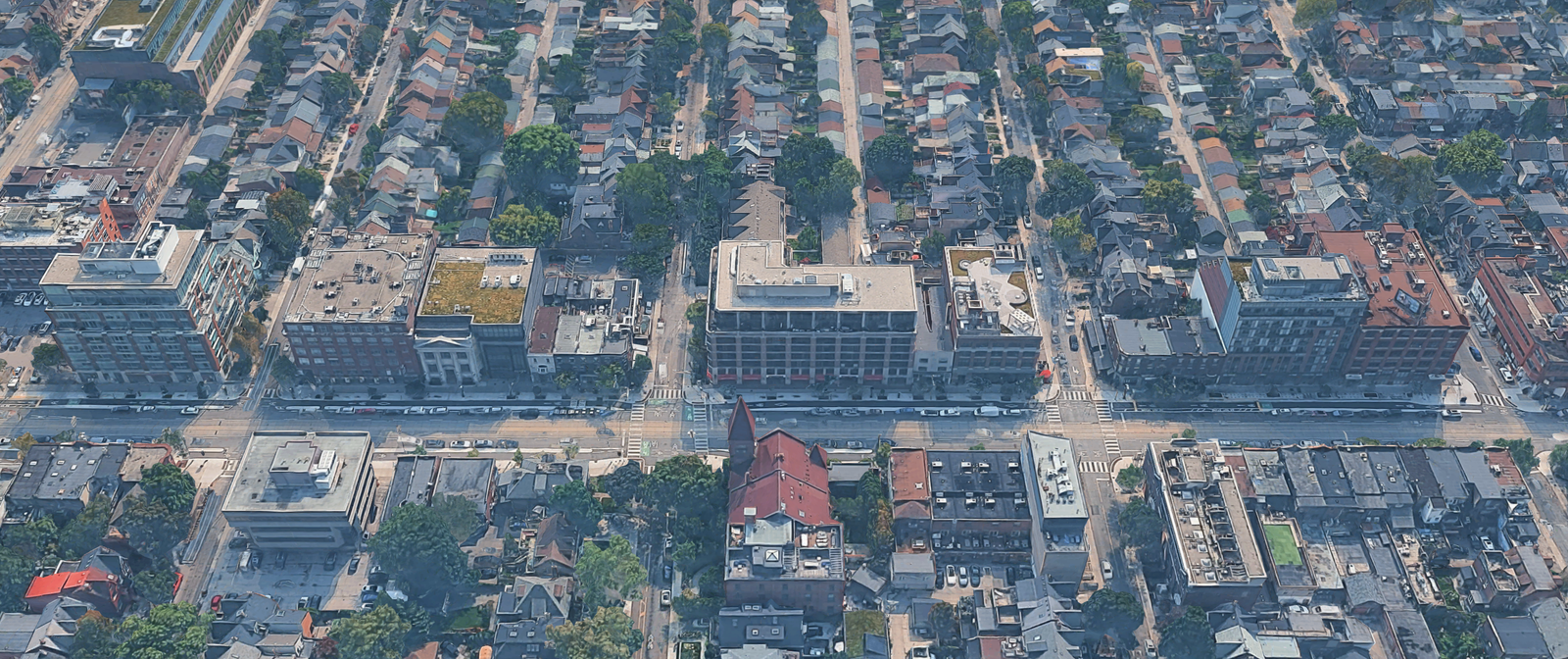
    This is a stretch of College Street (here in Toronto) that I find particularly nice. It’s the stretch running west of Bathurst Street to Manning Avenue. What makes it relatively unique is that it’s a bit wider than our typical downtown Toronto main street (it’s 30m versus the typical 20m) and the buildings are of a scale and height that go beyond the typical 2-3 storey mixed-use structures you’ll find all across the city. The extra street width also allows for a nice dedicated cycle track. The result is an urban grandeur that I notice every single time I pass through it.

    Now, some of the buildings (and retained facades) are older stock, and some of the buildings are more recent builds. So one could argue, “Hey, this is a built form that Toronto has been building successfully for centuries.” But the fact that it stands out to me suggests that it still isn’t pervasive enough. Wouldn’t it be nice if Toronto had more streets like this? Perhaps there are some lessons if we look to the past.

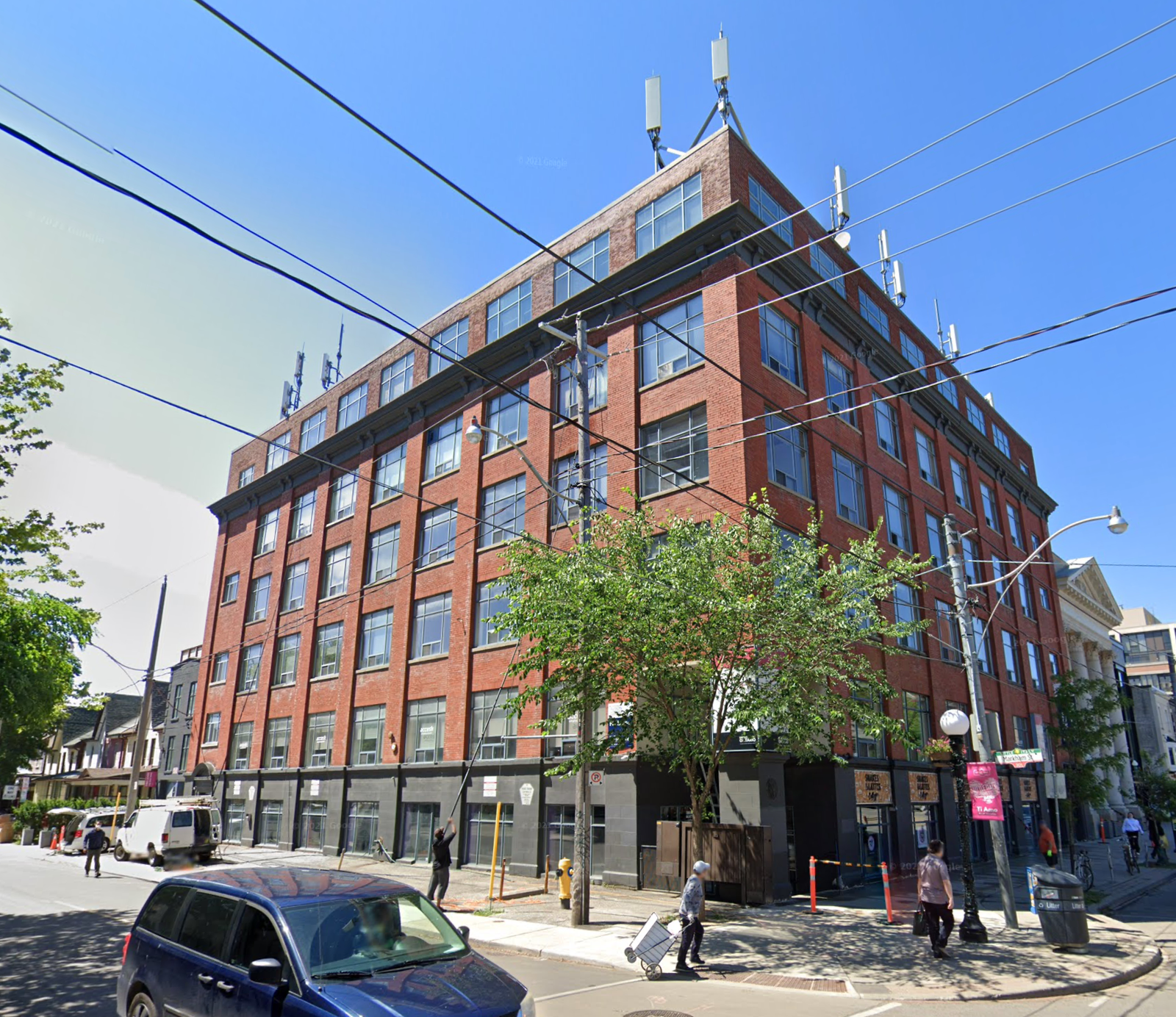
    At the southwest corner of College and Markham sits an old brick-and-beam office building that was (according to this source) designed by Frank R. Cowan and built between 1913 and 1914 to house clothing workshops and space for the Pedlar People Company, a decorative sheet metal manufacturer. For some further history, in 1929 the building was sold for $140,000 (about C$2.5 million in today’s dollars) and, at some point in its history, a 6th floor was added on top of the building.

    But more important for this discussion is that it is another example of a building built before Toronto had modern zoning. This was a utility building. It was built lot line to lot line, with no setbacks or stepbacks. What Toronto cared about most at that time was whether the building would catch fire and set the block ablaze, not whether it met urban design guidelines. And yet, here we are over a century later and we have urban nerds like me talking about the nice street wall it creates.

    The important question for today is how we might best unleash a similar market response along Toronto’s major avenues. They may not be for clothing workshops and sheet metal manufacturers, but we have other needs, such as housing, that could be satisfied with similarly unfussy fabric buildings. Ironically, we have policies that now support 6-storey buildings that are roughly of this ilk, but we are not yet seeing a market response at scale.

    History tells us that the solution is less complexity and greater simplicity.


    Aerial and street view image from Google Maps

  • The hidden financial reality of ending condo pre-sales

    June 21, 2026 · View original


    Over the years on this blog, we have spoken many times about what Pouyan Safapour, president of Devron Developments, wrote about in this recent Maclean’s article: the method of pre-selling condominiums (which is what we customarily do in Toronto) biases the market toward investor buyers and smaller, more cost-effective suites.

    Unlike end-user buyers, investors have generally viewed waiting three to five years for their condominium to be complete as a feature in recent years, rather than a bug. It has meant asset appreciation without having to carry or actually manage the property.

    The pre-sale model works very well for a number of other reasons, too. Firstly, by pre-selling, developers minimize market risk for both themselves and the construction lender. Now you have contracted revenue to take out the construction loan at the end, as opposed to building on “spec” and hoping the market will be there, which may or may not be the case.

    It’s also an equity-efficient model for developers. Banks are able to offer higher LTVs because of the contracted revenue, and insured purchaser deposits can be used as a source of funds for the project, reducing the amount of required equity.

    But it is certainly true that many, perhaps even most, end-users would prefer to buy when the building is complete. So how might we reorient the model to better cater to these homebuyers? This is especially relevant in today’s market, where end-user buyers have overtaken investors.

    In the current framework, there are a couple of things that can be done. Developers can just build smaller projects. This minimizes the window between pre-sale and completion. Another option is to segment the project between homes that will sell quickly upfront (and fulfill lender pre-sale requirements) and homes that are geared more toward end-users but won’t sell until later. In this case, you’re trying to sell enough to start construction, and you’re building the balance on “spec.”

    Changing the entire financing model requires a lot more work. Removing pre-sales means more market risk and more required equity (unless these risks somehow get shifted by the government). If this happens, then there’s a reasonable argument that we would see far fewer condominiums getting built, even if the ones that do get built are better suited to end-users.

    There are developers in Toronto today that do not believe the investor pre-sale market is coming back, or at least not coming back anytime soon. If that ends up being the case, and I’m not sure it will be, then market participants, whoever they might be, will be forced to meet this demand in one of two ways: building more rental housing (which is by definition on “spec”) or getting better at delivering end-user condominiums.


    Cover photo by Fernando Strabuli on Unsplash