Daily insights for city builders, delivered every morning at 6 AM ET. I’m Brandon Donnelly — a Toronto-based real estate developer and founder of Globizen. I’ve been writing here since 2013.

Month: March 2026

  • When’s the bottom?

    March 11, 2026 · View original


    Howard Chai recently reported in the Globe and Mail on the number of “distressed” commercial real estate transactions that Canada has seen over the last few years:

    – 2023: 119 transactions totalling $767 million – 2024: 191 transactions totalling more than $1.5 billion – 2025: 252 transactions totalling more than $1.42 billion

    These numbers are from Altus Group and they, importantly, only include sales involving a court proceeding. They do not include properties sold at a loss because of financial distress or any other such scenarios. This means that the actual amount of “distress” in the market is certainly greater. We’re all just holding on.

    The hardest-hit asset class is, not surprisingly, development land. This makes sense because the value of development land is mostly binary right now. Either you can do something productive with it (in which case there’s value) or you can’t, and it’s illiquid. Land is risky. It just doesn’t seem that way when the market is hot.

    The theme of the article is that the situation is likely to get worse before it gets better. Jeremiah Shamess of Colliers is cited as saying he thinks we will see the “emergence of a bottom” late this year or early into 2027. He must have read my annual predictions post in January, where I argued the same.

    These periods of time always suck for everyone involved. But as is always the case in markets, the faster we deal with the pain, the faster we’ll get to the other side. Failure is an essential part of capitalism. As many have said: “Capitalism without bankruptcy is like Christianity without hell.”


    Cover photo by Damian Kravchuk on Unsplash

  • The urban inhale

    March 10, 2026 · View original


    I saw Paul Graham write this week that “Cities inhale and exhale each generation. People move to cities in their 20s in search of colleagues and mates, move back out to raise their kids, and then when their kids are in their 20s, they return.”

    I don’t like it being presented in such a single-minded way, but there is, of course, a lot of truth to this remark, particularly for North American cities. It’s basically the “dumbbell” housing demand profile that we in the industry often talk about.

    Whether you believe this is an innate housing preference, a deeply-rooted cultural bias, a fundamental truth about the optimal way to raise children, or the result of poor land-use decisions, it is a common housing outcome and, in some cities, the de facto housing outcome. But again, it is not universally the case.

    This is a semi-regular topic on this blog, but I’ve been thinking about it more now that Bianca and I are about to graduate to being urban parents. In fact, now that it has become known, we’ve started getting some questions: “So, do you think you will move to a house?” (We live in an apartment condominium.) And sometimes it’s not even a question; it’s a flat-out assumption: “Once you move to a house…”

    I wasn’t aware that this was a prerequisite. Little do they know that I spend my free time fantasizing about apartment renovations in Paris, Tokyo, and Rio de Janeiro.

    I’m sure that our thinking will evolve over time, but to a meaningful extent, I would classify us as being typologically agnostic, and instead resolute on a particular kind of urban context. What matters most to us is that we remain in a city where we can walk or bike to things, where a car is not an absolute necessity, and where exciting and cultured things take place from time to time.

    I’m not sure what definition of “city” Paul had in mind when he was talking about people leaving it. Did he mean downtowns? Are the inner suburbs within a city an acceptable geography? I don’t know, but I can confidently say that leaving the city is the last thing on our minds right now.

    Maybe that will change. Or maybe it won’t.


    Cover photo by Henry Ren on Unsplash

  • When autonomy is a solution to the wrong urban problem

    March 9, 2026 · View original


    If you have a long, painful, soul-crushing commute, Tesla has a solution for you: Full Self-Driving (their autonomous, but still supervised, self-driving technology). And it makes sense that Tesla would position its product in this way. A great deal of our built environment (the vast majority of it in some geographies) has been designed around the car. We are dependent. And this is an obvious solution to its negatives.

    To be clear, I’m excited about autonomy, which is why it’s a frequent topic on this blog. But the urbanist in me can’t help but think that positioning it in this way is in some ways a solution to the wrong problem. Here’s an alternative solution: live and work in a walkable, transit-oriented community.

    Imagine, for instance, pitching this Tesla positioning to a Tokyoite. Tokyo is reported to have the highest railway modal split in the world. According to some measurements, only something like 12% of trips in the city are done by car. So if you said, “FSD is the solution to your long and boring commute. Now you can just sit, relax, read a book, do work, or play on your phone!” it wouldn’t be a stretch to imagine Tokyoites saying that they already do this on a train.

    Of course, Tokyo is a unique place, and there are lots of car-dependent cities where there is simply no other practical option. I also recognize that housing attainability is a major driver of sprawl. In these cases, FSD represents a meaningful quality-of-life upgrade.

    Again, I support this happening, but at the same time, I worry about it placating us into thinking that we’ve solved one of the major negatives of urban sprawl. Yes, you have to sit in a car for two hours each day, but now you’re not actually driving. Isn’t that, like, so much better? In a best-case scenario, we maintain the status quo when it comes to our built environment. And in the worst-case scenario, it leads to even more sprawl.

    This is an open question that we have on this blog: To what extent will self-driving cars increase our willingness to commute? Historically, new mobility technologies have promoted urban sprawl because they allowed us to travel greater distances in the same amount of time. Consider streetcar suburbs and then our car-oriented suburbs.

    A big part of the AV argument is not that they will solve traffic congestion (they won’t); it’s that they will make your commute suck a lot less, and in an even rosier scenario, become a kind of “third space” where people work, relax, or whatever. This, in turn, will make sprawl more widely palatable.

    But the more I think about this, the less I believe it. Marchetti’s Constant tells us that humans have generally maintained a consistent “time budget” for commuting irrespective of the technology being used. Will this time really be different?

    On the flip side, there are many who would argue that urban sprawl is a natural market outcome. Not everyone wants the “utopian, socially-engineered dream” that urbanists and YIMBYs like me want. And this is a fair response. I believe in individual freedoms. Give people housing options (we’re very bad at this) and let them choose where they want to live.

    But we should acknowledge the tradeoffs. Traffic congestion is a clear byproduct of urban sprawl and land-use patterns that leave no other practical option for getting around. Complaining about traffic is complaining about sprawl. One more lane or cars that drive themselves have not been shown to change this relationship.

    Sprawl also contributes to greater loneliness and declines in happiness. In 2000, Robert Putnam argued in his book, Bowling Alone: The Collapse and Revival of American Community, that, roughly speaking, every 10 minutes of additional travel time leads to a 10% reduction in social connections. We spend less time with our families, friends, and communities.

    There’s little doubt that self-driving cars will make commutes more tolerable. But perhaps that’s not ambitious enough.


    Cover photo by HONG FENG on Unsplash

  • The happiness recession

    March 8, 2026 · View original


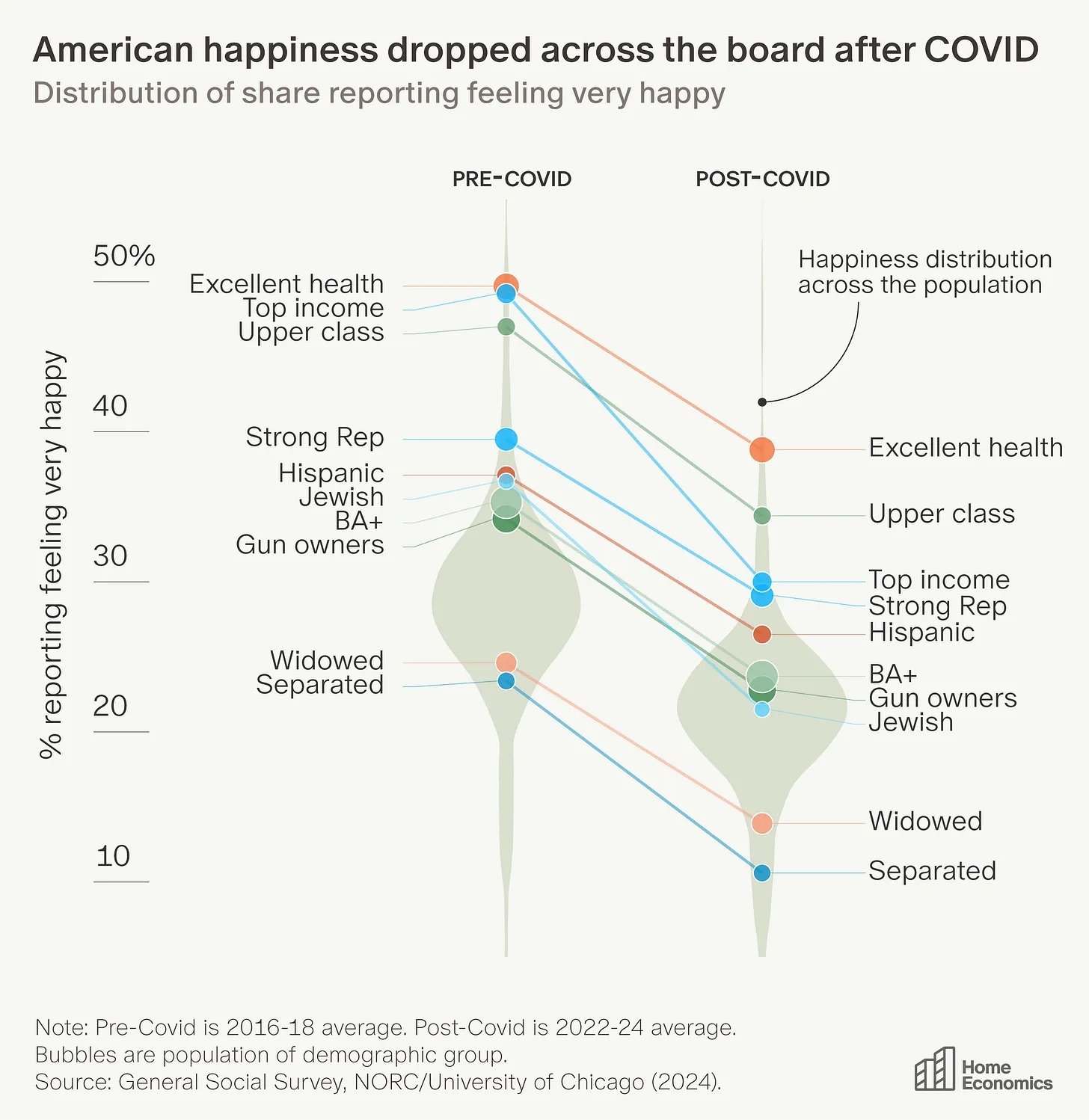
    The fact that we still refer to things as pre- and post-COVID shows just how impactful this period of time was in our lives. What initially seemed like house arrest for only a few weeks ended up having a lasting impact. One of those impacts appears to be happiness. In a recent post by Aziz Sunderji, who is the author of Home Economics (you should subscribe), he shared this chart:

    The data is taken from the General Social Survey. What it shows is the shift in the “very happy” group of Americans, and the ten demographic groups that experienced the biggest declines in reported happiness. Overall, the share of Americans reporting to be “very happy” has dropped from 29% before COVID (2016-18) to 22% in our post-COVID world (2022-24).

    The biggest decline is among those who make the most money and were previously quite happy. Top earners went from 49% reporting they were “very happy” to 30%. On the other end of the spectrum, the unhappiest people moved the least. If you were unhappy before, chances are you have a similar level of unhappiness today. All of this is problematic.

    This is an important societal problem to solve, and I’m not going to come close to doing that in today’s pithy blog post. But I did want to point out two things (the latter of which is the key takeaway in Aziz’s post).

    First, I think it’s important to note that at the top of this chart are those with “excellent health.” The older I get, the more I have come to realize that the greatest luxury in life is our health. If you don’t have your health, nothing else matters. This probably seems obvious, but it remains a real challenge in our increasingly sedentary world.

    Second, Aziz notes that the groups that held up the best in terms of happiness all shared one trait: social connection. Interacting with other humans and your friends is good for your mental health!

    Of course, the problem is that we are designing our cities and our economies in the opposite direction. Call it “sedentary isolation.” AI is a powerful multiplier that allows us to do and produce more while we sit at our desks. And autonomous vehicles are in the process of making long, painful commutes more enjoyable. Now you have more time to sit and stare at a screen while a car drives you!

    This is not to say that I’m against these new technologies. I’m not. But driving or not, I don’t want to sit in an AV for hours each day. There are real individual and collective costs to social isolation and car-dependent land-use patterns. Let’s not forget the simple merits of living in a walkable neighbourhood and socializing with friends, in person.


    Cover photo by Ryan Searle on Unsplash

    Chart from Aziz Sunderji, “The Great Happiness Compression,” Home Economics.

  • Come cycle with us in support of brain health

    March 7, 2026 · View original


    Regular readers of this blog might remember that last “summer” (it was still chilly), I biked for brain health here in Toronto.

    I rode 75 km, raised $3,800, and helped Multiplex Construction Canada raise over $14,000, with 100% of these donations going directly to the Baycrest Foundation to fund work related to dementia, Alzheimer’s, and other brain-related illnesses.

    This summer I’ll be riding again on Sunday, May 31, 2026, except with a few changes:

    – They’ve moved the starting location to the Aga Khan Museum (architecture by the Pritzker Prize-winning Japanese architect Fumihiko Maki). – They’ve increased the longest circuit to 90 km. – We’ve created our own Globizen team! If we’re feeling really ambitious, maybe we’ll even create our own cycling bibs. (This strikes me as a low probability scenario.)

    If you’re up for it, I would encourage you to join our team and ride for brain health. Alternatively, you can always just participate with your wallet.

    Full disclosure caveat: Bianca and I are expecting our first child (a girl) in June. This ride is closeish to the due date, creating at a minimum three possible scenarios for the day:

    – Scenario one is that she is not yet born on May 31 and I ride as one would expect. – Scenario two is that she is born early, and I then spend this Sunday morning at home in some kind of sleep-deprived state. (Or, the “vibe” is that I should probably stay home.) – And I suppose scenario three is that I don’t finish the ride and I end up at the hospital in head-to-toe lycra, clicking and clacking around in my cycling shoes.

    Scenarios one and two feel more optimal, in my humble opinion.


    Cover photo: Len Abelman (Principal at WZMH Architects) and me completing the Bike for Brain Health end-of-summer follow-up ride in September 2025.

  • The illiquidity advantage

    March 6, 2026 · View original


    Conventional wisdom suggests that if you’re going to invest $10 million into an illiquid real estate investment that will not bear delicious fruit for 7 to 10 years, you may want to be compensated for the illiquid nature of your commitment. In other words, there’s an “illiquidity premium.” Flexibility is worth something. If you can get the same return and have the flexibility to get your money back when you want it, isn’t that better? I don’t know; maybe that’s not always the case. Here’s an excerpt from a clever article written by Cliff Asness, founder of AQR Capital Management, where he argues the reverse:

    > If people get that PE [private equity] is truly volatile but you just don’t see it, what’s all the excitement about? Well, big time multi-year illiquidity and its oft-accompanying pricing opacity may actually be a feature not a bug! Liquid, accurately priced investments let you know precisely how volatile they are and they smack you in the face with it. What if many investors actually realize that this accurate and timely information will make them worse investors as they’ll use that liquidity to panic and redeem at the worst times? What if illiquid, very infrequently and inaccurately priced investments made them better investors as essentially it allows them to ignore such investments given low measured volatility and very modest paper drawdowns?

    Perhaps another way to think about illiquid private investments is that they kind of force you to think more like Warren Buffett. He has so many great lines to this effect: “If you aren’t willing to own a stock for 10 years, don’t even think about owning it for 10 minutes.” And: “The stock market is a device for transferring money from the impatient to the patient.” He has also written over the years about how a tolerance for short-term volatility can improve long-term prospects. So, behaving in this way, it would seem, is generally good for making money.

    The problem — and this is really Cliff’s more precise argument — is that the majority of people simply aren’t good at being like Warren Buffett. We’re impatient and emotional. That’s why he’s so remarkable. His approach certainly sounds simple, but it’s clearly not so easy. Illiquidity can help with this. It removes the fraught thinking part and might actually protect you from your own thoughts and emotions.


    Cover photo by Maxim Hopman on Unsplash

  • Construction is about to begin on the new Tour Montparnasse

    March 5, 2026 · View original


    At the end of this month, the last tenants will vacate the Tour Montparnasse in Paris to make way for its renovation. Nouvelle AOM, a collective of architects formed to respond to the project’s international design competition, first won the commission back in 2017. And initially, the plan was to complete the renovation in time for the Paris Olympics in 2024.

    But that time came and went, as it does, and now construction is starting this year. Nouvelle AOM, which includes Franklin Azzi Architecture, ChartierDalix Architectes, and Hardel Le Bihan Architectes, is in charge of the tower. And Renzo Piano Building Workshop is in charge of redesigning the commercial podium at the tower’s base.

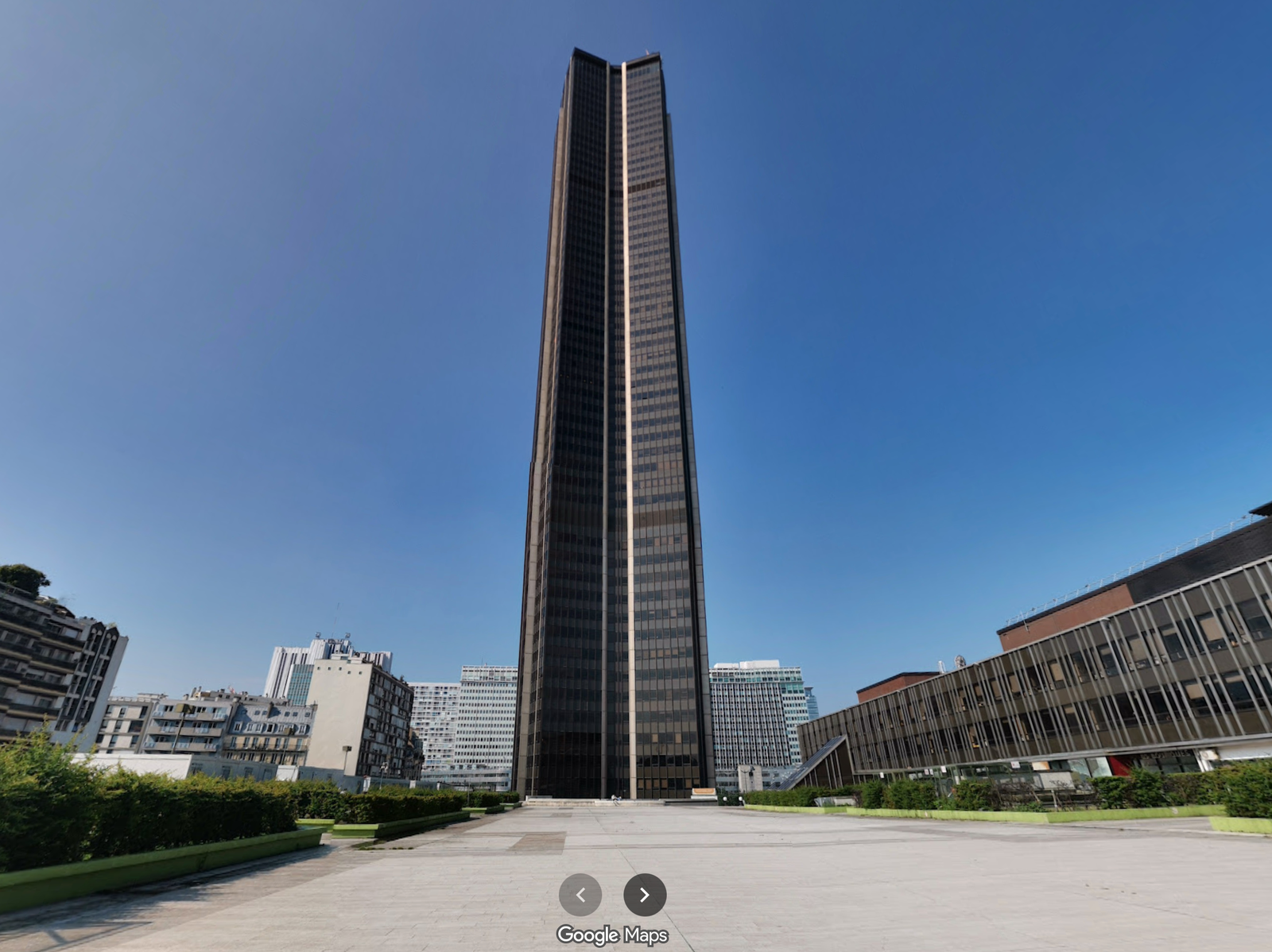
    We’ve spoken about the Tour Montparnasse many times over the years on the blog (here, here, and here). Parisians customarily hate it, and after visiting it in 2023, I can confirm that it’s desperately in need of a renovation, and that the ground plane experience is abysmal at best. It is of that era where grandiose “slab-based planning” was going to elevate us beyond the pathologies of fine-grained urbanism.

    Here’s a Google image from atop the site’s enormous podium:

    What’s interesting about the design from Renzo Piano is that it will reuse a lot of the structure that’s already in place. The plan is to carefully open up the site, stitch it back together with the surrounding urban context, and then build up from there. Importantly, at the centre of the project will be a large, planted piazza that is intended to become a new civic space for the community.

    The project renovations are expected to last until “at least 2030.” So, we have several years until we’ll know if it’s an urban and financial success. But my prediction is that this project will positively transform how Parisians think about the Tour Montparnasse, and maybe how they think about tall buildings.

    The tower itself will, of course, need to be beautiful. It’s a highly visible object. There’s only a trifecta of buildings and structures inside Paris proper that exceed 150 meters in height: the Eiffel Tower, Tour Montparnasse, and the Tour Triangle (Herzog & de Meuron), which is currently under construction and expected to finish this year. In this case, architecture is not irrelevant.

    But it is the ground plane experience that will ultimately revitalize the area and demonstrate that tall buildings can be good urban neighbours, even in a sea of Haussmannian mid-rise buildings. I’ve said before that the reconfiguration of the podium is arguably the project’s most crucial design move.

    Get it right and you’ll see what happens.


    Cover photo by Luxigon via Nouvelle AOM

    Aerial and street view photos from Google

    Model photos from Renzo Piano Building Workshop

  • Parkview Mountain House featured in Monocle

    March 4, 2026 · View original


    The March issue of Monocle just dropped, debuting a new format called the Monocle 100. It’s a list of the people, places, and things worth knowing about. And in the middle of it is something called the Monocle Property Survey, which was deliberately timed to coincide with MIPIM, the massive real estate conference that takes place every March in Cannes.

    As a quick aside, our team contemplated going to MIPIM this year in search of both friends and money, but then we thought to ourselves: Why bother going to the South of France when we have Toronto in the middle of March to enjoy?

    The first thing the Property Survey does is give a rare nod to developers: While architects often nab all the credit for building our cities, streets and homes, it’s actually developers who should get much of the kudos (and blame, in some instances). Because it’s usually developers — small, large, private, state-funded — that must secure land, raise capital and take risks.” It almost feels weird hearing somebody say something positive about our kind.

    But even better, the survey includes a full page on our unique creative residency program at Parkview Mountain House (Park City, Utah):

    A big thanks to the Monocle team for the feature. If you’re in Toronto and would like to pickup a copy of this month’s issue, visit their shop in Little Italy at 776 College Street. And if you’d like to learn more about PMH, including our creative residency program, visit pmhpc.com.

  • Fewer stops, faster transit

    March 3, 2026 · View original


    “The problem with buses,” writes transportation planner Nithin Vejendla in Work in Progress, “is that they are slow.” The same thing could also be said about other surface transit routes like Toronto’s streetcars, including some of our new lines. Now, there are lots of ways to speed up surface routes. Dedicated lanes and signal priority are two obvious ones. But an even simpler one is to just get rid of some stops!

    North American cities tend to be plagued by too many transit stops. I think we do it because more stops sounds better than fewer stops. It creates the illusion of servicing more people. But too many stops can make routes painfully slow, by increasing dwell times. According to Nithin, buses in the US spend about 20% of their time just stopping and then starting again. Obviously the more stops you have, the worse this downtime gets.

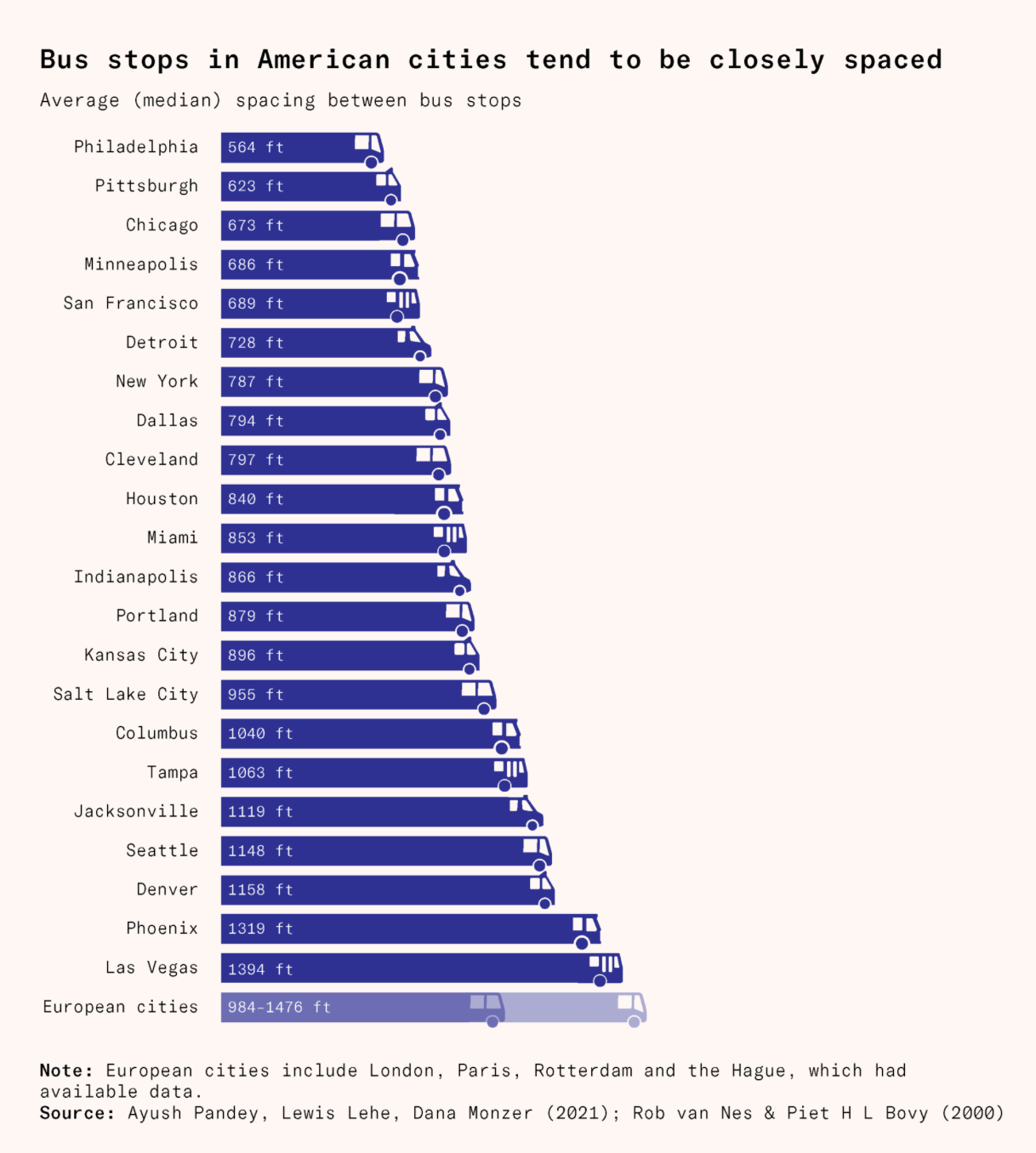
    Here’s the average spacing between bus stops for various US cities taken from the above article:

    If I convert some of these numbers into the system of measurement used by the rest of the planet, you’ll find the following average stop spacings:

    – 172 m in Philadelphia – 205 m in Chicago – 210 m in San Francisco – 240 m in New York – 260 m in Miami – 350 m in Seattle – 425 m in Las Vegas

    European cities tend to have wider stop spacing, somewhere closer to 300–450 m. And as a further point of comparison, AI tells me that the current average streetcar stop spacing in Toronto is about 250 m, but that the official target for both streetcars and local buses is between 300–400 m. This is better. 400 m is a 5-minute walk. And if you’re on the transit corridor, it means you’ll never have to walk more than 200 m, or 2-3 minutes, to the next stop.

    Consolidating stops has been shown not to have a meaningful impact on coverage area, but the benefits are significant. To give just one example, Los Angeles saw its operating speeds increase by 29% and its ridership grow by 33% on the Wilshire/Whittier Metro Rapid corridor by doing exactly this. So, if you’re looking for a way to speed up your surface routes, one starting point would be to just do less.


    Cover photo by Renato on Unsplash

  • Are AVs about to disrupt the disruptor?

    March 2, 2026 · View original


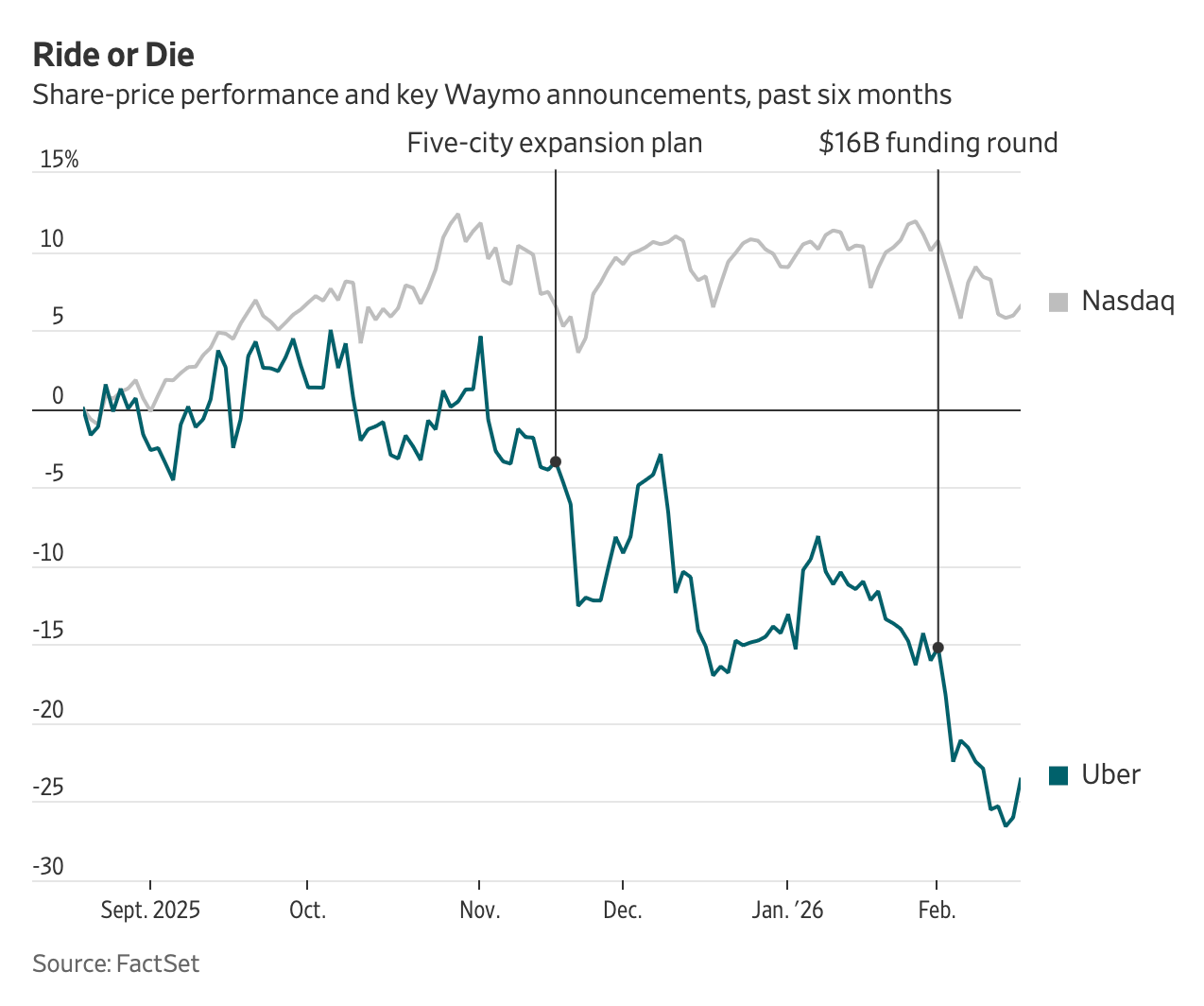
    It seems like just yesterday that people were protesting Uber for disrupting the traditional taxi business. Now the question has become: are AVs about to disrupt Uber?

    Over the last six months, Uber’s stock price has declined nearly 19%. At the time of writing this post, its market cap is around $155 billion, compared to Waymo’s private market valuation of $126 billion (though I’m sure many would argue this is a wee bit high).

    The market seems to think that self-driving cars are a two-horse race between Waymo and Tesla. If this is true, what role will Uber play?

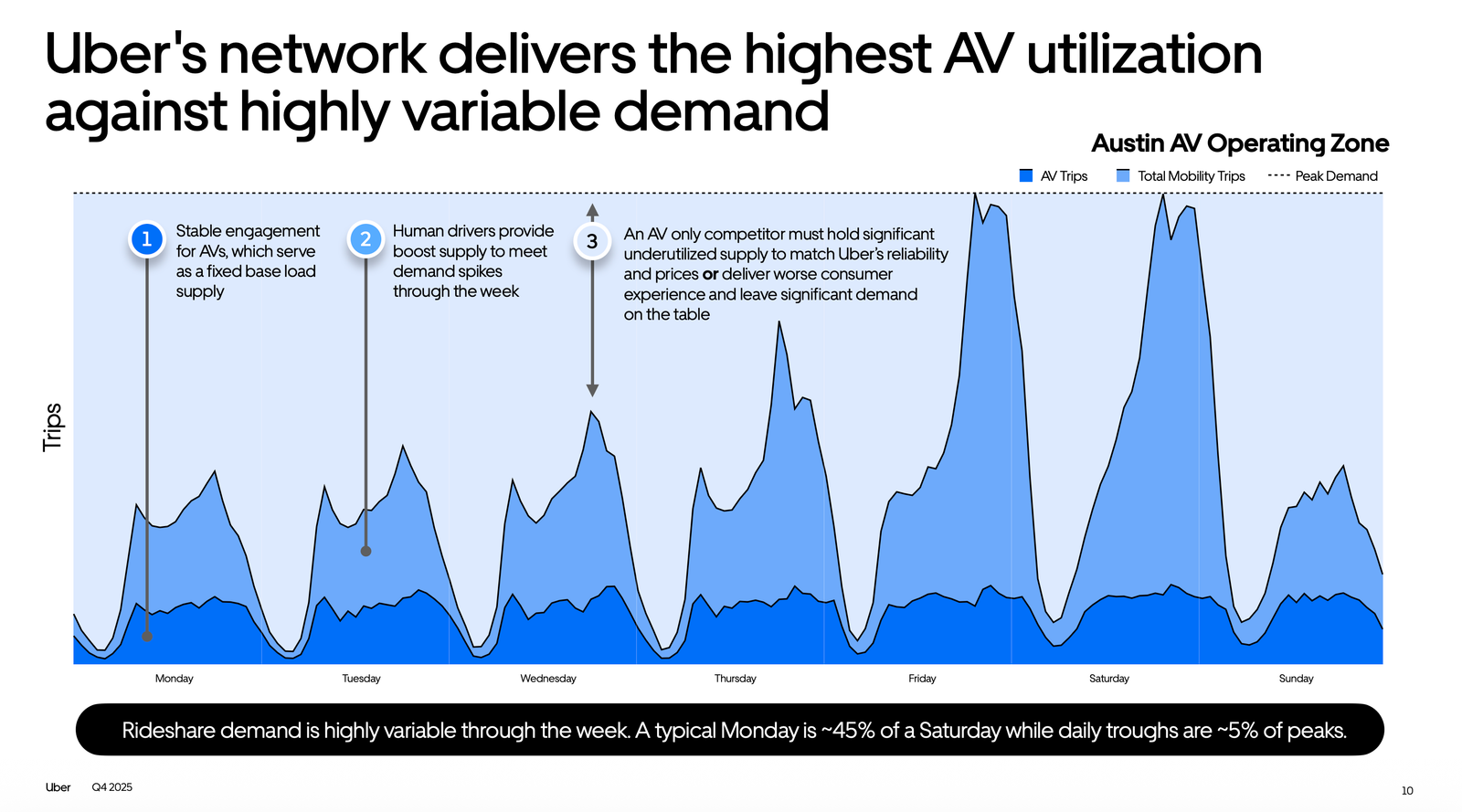
    Uber has naturally tried to assuage concerns. Alongside their Q4 2025 earnings, they published a 13-page “spotlight” on AVs, where they argued, don’t worry, everything is fine:

    > AVs will change how trips are supplied, but not how demand is aggregated. History suggests that over time as supply fragments and technology commoditizes, the platform that can bring the highest utilization to assets, and superior reliability to customers, will capture a large share of value. That is the role Uber is set up to play.

    One of the arguments for this is that rideshare demand is highly variable throughout a week. A typical Monday can be less than half of a Saturday night, and daily troughs can decline to something like 5% of peaks.

    So, if you try and service this demand variability with only AVs, you’re going to have a lot of underutilized vehicles during off-peak times. This makes sense to me right now, but I’m not certain it will persist or always matter as the space evolves.

    When Uber sold its AV division in 2020, I understood why (to try and reach profitability), but it always felt a little unsettling to me. AVs were very clearly the future — are you sure you want to sell this off?

    Now I suspect they’ll have to re-enter in a meaningful way. They’re going to need to do it as long as the market continues to believe the current narrative.

    I use Uber on a regular basis, but I already have the Waymo app on my phone (I downloaded it on a long layover in SFO where I contemplated a joy ride). As soon as rides become available in Toronto at reasonable prices, I wouldn’t think twice about switching.


    Cover photo by clement proust on Unsplash

    Stock graph from the WSJ

    Demand chart from Uber Q4 2025 Earnings — Autonomous Vehicles Spotlight