
ParagraphParagraph

2025 Paragraph Technologies Inc

PopularTrendingPrivacyTermsHome

Arweave TX

Cover photo

The happiness recession

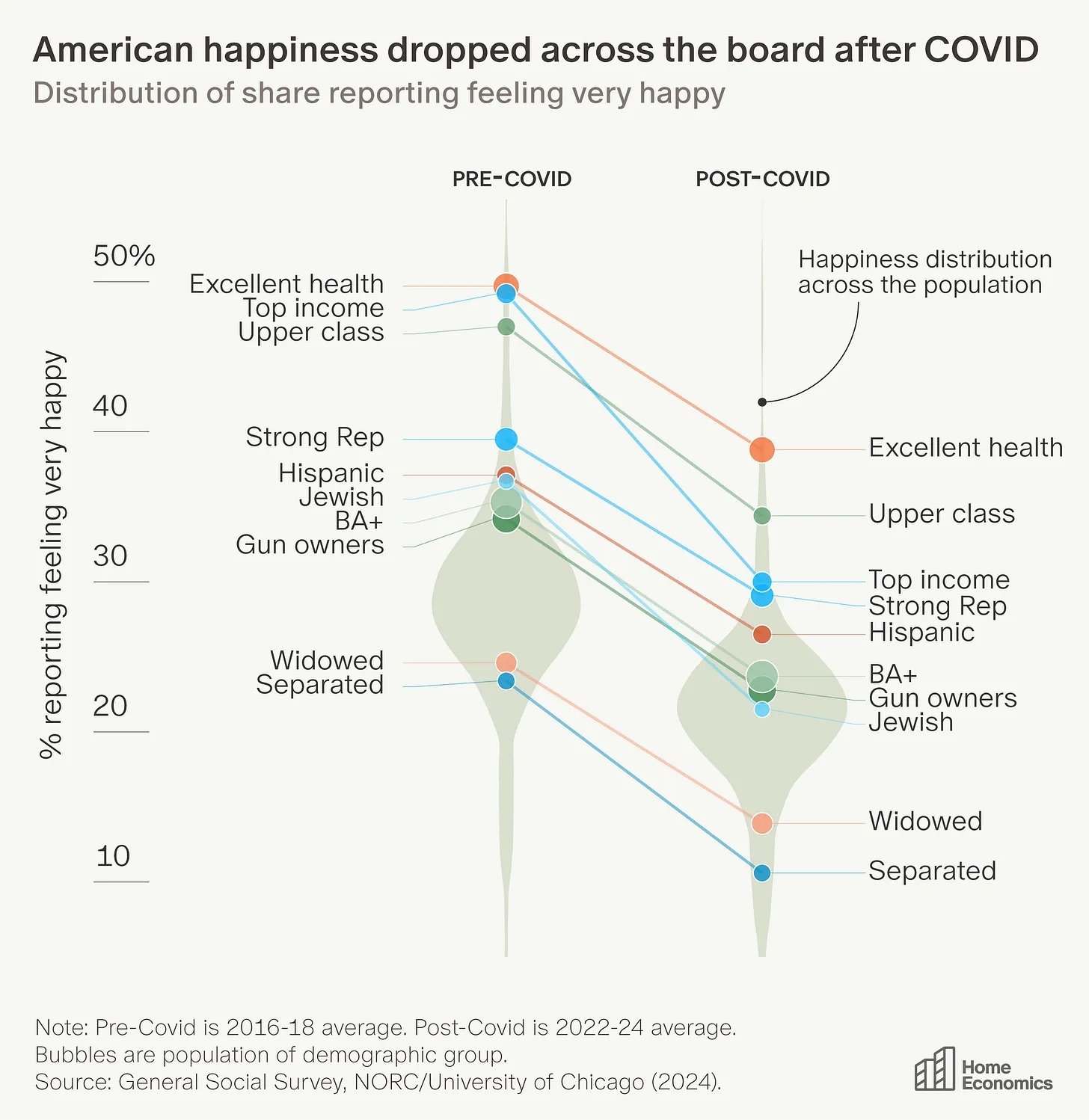
The fact that we still refer to things as pre- and post-COVID shows just how impactful this period of time was in our lives. What initially seemed like house arrest for only a few weeks ended up having a lasting impact. One of those impacts appears to be happiness. In a recent post by Aziz Sunderji, who is the author of Home Economics (you should subscribe), he shared this chart:
post image
Cover photo

The happiness recession

The fact that we still refer to things as pre- and post-COVID shows just how impactful this period of time was in our lives. What initially seemed like house arrest for only a few weeks ended up having a lasting impact. One of those impacts appears to be happiness. In a recent post by Aziz Sunderji, who is the author of Home Economics (you should subscribe), he shared this chart:

post image

The data is taken from the General Social Survey. What it shows is the shift in the "very happy" group of Americans, and the ten demographic groups that experienced the biggest declines in reported happiness. Overall, the share of Americans reporting to be "very happy" has dropped from 29% before COVID (2016-18) to 22% in our post-COVID world (2022-24).

The biggest decline is among those who make the most money and were previously quite happy. Top earners went from 49% reporting they were "very happy" to 30%. On the other end of the spectrum, the unhappiest people moved the least. If you were unhappy before, chances are you have a similar level of unhappiness today. All of this is problematic.

This is an important societal problem to solve, and I'm not going to come close to doing that in today's pithy blog post. But I did want to point out two things (the latter of which is the key takeaway in Aziz's post).

First, I think it's important to note that at the top of this chart are those with "excellent health." The older I get, the more I have come to realize that the greatest luxury in life is our health. If you don't have your health, nothing else matters. This probably seems obvious, but it remains a real challenge in our increasingly sedentary world.

Second, Aziz notes that the groups that held up the best in terms of happiness all shared one trait: social connection. Interacting with other humans and your friends is good for your mental health!

Of course, the problem is that we are designing our cities and our economies in the opposite direction. Call it "sedentary isolation." AI is a powerful multiplier that allows us to do and produce more while we sit at our desks. And autonomous vehicles are in the process of making long, painful commutes more enjoyable. Now you have more time to sit and stare at a screen while a car drives you!

This is not to say that I'm against these new technologies. I'm not. But driving or not, I don't want to sit in an AV for hours each day. There are real individual and collective costs to social isolation and car-dependent land-use patterns. Let's not forget the simple merits of living in a walkable neighbourhood and socializing with friends, in person.


2025 Paragraph Technologies Inc

PopularTrendingPrivacyTermsHome

The data is taken from the General Social Survey. What it shows is the shift in the "very happy" group of Americans, and the ten demographic groups that experienced the biggest declines in reported happiness. Overall, the share of Americans reporting to be "very happy" has dropped from 29% before COVID (2016-18) to 22% in our post-COVID world (2022-24).

The biggest decline is among those who make the most money and were previously quite happy. Top earners went from 49% reporting they were "very happy" to 30%. On the other end of the spectrum, the unhappiest people moved the least. If you were unhappy before, chances are you have a similar level of unhappiness today. All of this is problematic.

This is an important societal problem to solve, and I'm not going to come close to doing that in today's pithy blog post. But I did want to point out two things (the latter of which is the key takeaway in Aziz's post).

First, I think it's important to note that at the top of this chart are those with "excellent health." The older I get, the more I have come to realize that the greatest luxury in life is our health. If you don't have your health, nothing else matters. This probably seems obvious, but it remains a real challenge in our increasingly sedentary world.

Second, Aziz notes that the groups that held up the best in terms of happiness all shared one trait: social connection. Interacting with other humans and your friends is good for your mental health!

Of course, the problem is that we are designing our cities and our economies in the opposite direction. Call it "sedentary isolation." AI is a powerful multiplier that allows us to do and produce more while we sit at our desks. And autonomous vehicles are in the process of making long, painful commutes more enjoyable. Now you have more time to sit and stare at a screen while a car drives you!

This is not to say that I'm against these new technologies. I'm not. But driving or not, I don't want to sit in an AV for hours each day. There are real individual and collective costs to social isolation and car-dependent land-use patterns. Let's not forget the simple merits of living in a walkable neighbourhood and socializing with friends, in person.


Arweave TX

Cover photo by Ryan Searle on Unsplash

Chart from Aziz Sunderji, "The Great Happiness Compression," Home Economics.

Cover photo by Ryan Searle on Unsplash

Chart from Aziz Sunderji, "The Great Happiness Compression," Home Economics.

happiness
home-economics
aziz-sunderji
urbanism
walkable
communities
social-interaction
happiness
home-economics
aziz-sunderji
urbanism
walkable
communities
social-interaction

Arweave TX

93W2XjhaikqxJFG634DlDps8QoyUDJDUSYdsfmUk0gk

Arweave TX

93W2XjhaikqxJFG634DlDps8QoyUDJDUSYdsfmUk0gk
Brandon Donnelly

Subscribe to Brandon Donnelly

Brandon Donnelly

Subscribe to Brandon Donnelly

Support Brandon Donnelly

The happiness recession
Brandon DonnellyBrandon Donnelly

The happiness recession

Support Brandon Donnelly

The happiness recession
Brandon DonnellyBrandon Donnelly

The happiness recession

Search...Ctrl+K
Search...Ctrl+K

Brandon Donnelly

Brandon Donnelly

More from Brandon Donnelly

Cover image for Canada must become a global superpower
Blog iconBrandon Donnelly
Mar 17

Canada must become a global superpower

The silver lining to the US starting a trade war with Canada and regularly threatening annexation is that it has forced this country out of complacency. Indeed, I'm hard pressed to remember a time, at least in my lifetime, when patriotism and nationalism has united so much of Canada. According to a recent survey by Angus Reid, the percentage of Canadians expressing a "deep emotional attachment" to the country jumped from 49% in December 2024 to 59% in February 2025. And as further evidence of...

Cover image for The bank robbery capital of the world
Blog iconBrandon Donnelly
Dec 22

The bank robbery capital of the world

Between 1985 and 1995, Los Angeles' retail bank branches were robbed some 17,106 times. In 1992, which was the the city's worst year for robberies, the number was 2,641. This roughly translated into about one bank robbery every 45 minutes of each banking day. All of this, according to this CrimeReads piece by Peter Houlahan, gave Los Angeles the dubious title of "The Bank Robbery Capital of the World" during this time period. So what caused this? Well according to Peter it was facil...

More from Brandon Donnelly

Cover image for Canada must become a global superpower
Blog iconBrandon Donnelly
Mar 17

Canada must become a global superpower

The silver lining to the US starting a trade war with Canada and regularly threatening annexation is that it has forced this country out of complacency. Indeed, I'm hard pressed to remember a time, at least in my lifetime, when patriotism and nationalism has united so much of Canada. According to a recent survey by Angus Reid, the percentage of Canadians expressing a "deep emotional attachment" to the country jumped from 49% in December 2024 to 59% in February 2025. And as further evidence of...

Cover image for The bank robbery capital of the world
Blog iconBrandon Donnelly
Dec 22

The bank robbery capital of the world

Between 1985 and 1995, Los Angeles' retail bank branches were robbed some 17,106 times. In 1992, which was the the city's worst year for robberies, the number was 2,641. This roughly translated into about one bank robbery every 45 minutes of each banking day. All of this, according to this CrimeReads piece by Peter Houlahan, gave Los Angeles the dubious title of "The Bank Robbery Capital of the World" during this time period. So what caused this? Well according to Peter it was facil...

T
Blog iconBrandon Donnelly
Jun 26

The story behind those pixelated video game mosaics in Paris

If you've ever been to Paris, you've probably noticed the small pixelated art pieces that are scattered all around the city on buildings and various other hard surfaces. Or maybe you haven't seen or noticed them in Paris, but you've seen similarly pixelated mosaics in one of the other 79 cities around the world where they can be found. Or maybe you have no idea what I'm talking about right now. Huh? Here's an example from Bolivia (click here if you can't see...

T
Blog iconBrandon Donnelly
Jun 26

The story behind those pixelated video game mosaics in Paris

If you've ever been to Paris, you've probably noticed the small pixelated art pieces that are scattered all around the city on buildings and various other hard surfaces. Or maybe you haven't seen or noticed them in Paris, but you've seen similarly pixelated mosaics in one of the other 79 cities around the world where they can be found. Or maybe you have no idea what I'm talking about right now. Huh? Here's an example from Bolivia (click here if you can't see...

View more
View more
Subscribe
Subscribe
Subscribe
Subscribe

>4.2K subscribers

>4.2K subscribers

No comments yet

No comments yet

Share Dialog

Share Dialog

Brandon Donnelly

2 min read·March 8, 2026

Brandon Donnelly

2 min read·March 8, 2026