Daily insights for city builders, delivered every morning at 6 AM ET. I’m Brandon Donnelly — a Toronto-based real estate developer and founder of Globizen. I’ve been writing here since 2013.
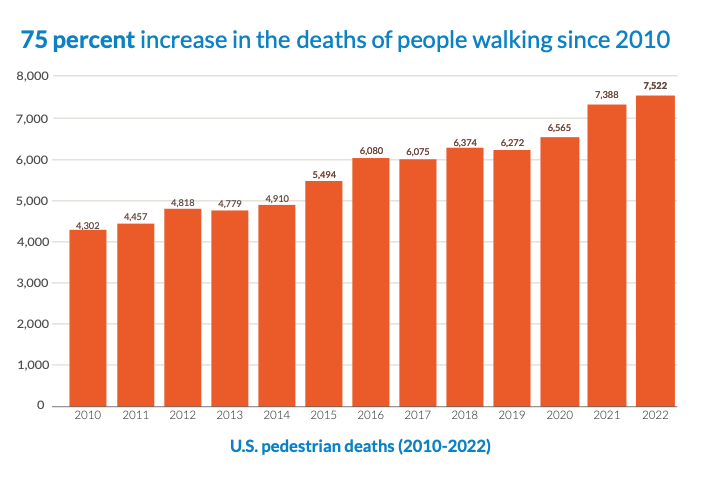
This is a shocking report from Smart Growth America on traffic fatalities in the US. Since 2010, the number of pedestrians struck and killed has increased by almost 75%. As of 2022, this number sat at just over 7,500 fatalities per year:
Here are also the top 20 most deadly metro areas:
Not surprisingly, these hot spots tend to be in the south, as opposed to in older northern cities. And that’s because these tend to be car-oriented places. As the name of the report suggests, they are “dangerous by design.” If you optimize for cars, it means you’re making trade-offs in other places.
On this blog, we often talk about city building in the context of doing things to help improve a city — whether that be a development project, a new public art mural, or an interesting local business. These interventions help to build a city. But even more specifically, the term has, for many, come to mean building up a city in a positive way.
But there is another way to think about city building. You can think of it in terms of building actual new cities. We’ve spoken about some of these before, namely this one in California and this odd one in Saudi Arabia. But apparently it is becoming more common. According to The Economist, the world is now building more new cities than it has in the last 80 or so years:
Egypt’s “New Administrative Capital” is part of a rush of city-building. Firms and governments are planning more settlements than at any time in the post-war period, with many already under construction. Ninety-one cities have been announced in the past decade, with 15 in the past year alone. In addition to its new capital in the north, Egypt is building five other cities, with plans for dozens more. India is considering eight urban hubs. Outside Baghdad, Iraq, workers have just broken ground on the first of five settlements.
In some cases, it is being done as a solution to urban congestion. If this city is too expensive and unaffordable, just create a new one. This appears to be part of the idea with the above city outside of San Francisco. Of course, new cities can also be created for ideological reasons, or for political purposes, which was the case with Brazil’s capital city, Brasilia.
Here, the idea was to move the federal capital away from the country’s populated southeast region to a more geographically neutral location in the middle of the country. It also turns out that seeding a new city with government institutions is a good way to get one of these started. Existing cities do, after all, benefit from network effects.
History points to characteristics shared by successful projects. State institutions can help anchor cities, as Brasília (in Brazil) and Chandigarh (in India) showed in the 20th century. Although both have had problems, people in Brazil and India are voting with their feet. Brasília’s population is growing at 1.2% a year, more than double the national average. Chandigarh, a state capital, is now India’s fourth-richest region on a per-person basis.
But putting money, ego, and ideology aside, when does it actually make sense to start a new city in lieu of just expanding (or addressing the problems in) the one(s) you’ve already got? Population size can’t be the only factor in determining whether a city is “full”, because Tokyo seems to do just fine as the largest metropolitan area in the world.
If it hasn’t already been done, I think this would make for an interesting research project. Until then, there’s this (paywalled) Economist article.
This is an aerial photo of the construction site at One Delisle:
Currently, we are on hold and waiting to pour a number of columns on the ground floor because the city has not yet issued our above-grade building permit. And the reason the city has not issued our above-grade building permit is because we have not yet conveyed our parkland dedication land to the city. Frustratingly though, we have been ready to convey this land for over a year! We simply need the city to allow us to give them this free land. To date, we have meticulously documented at least 3-pages of follow-ups and back-and-forth emails as we try our best to do this.
I’ve been doing this long enough that this isn’t surprising or unusual. But it remains deeply maddening. Younger people on the team can’t believe that this is par for the course. On top of this, the city continues to charge interest on the fees that are payable upon issuance of the first above-grade building permit. The result is an insane dynamic where the city can delay things as long as it wants and then charge us, and all other developers, interest on its own delays! I mean, is it any wonder that housing keeps getting more expensive in this city?
During the last mayoral election, some candidates were quick to promise that, if elected, the city itself would start building affordable housing. This, I’m sure, sounded good to most. Toronto needs more affordable homes. But for all of us involved in the building of buildings, it was frankly impossible to imagine. If the city takes this long to accept free land from developers, how could it possibly build anything?
Studio Libeskind has a recently completed project in Brooklyn that looks like it was designed by Studio Libeskind. It has angled facades and, judging by the comments on Dezeen, its design is polarizing. But it is an affordable housing project for seniors, and it does have a large atrium in the middle of it.
Atria are a bit of a unique feature in multi-family housing (at least in this part of the world). For better or for worse, the gold standard has become the double-loaded corridor. And that’s because it’s “efficient.” It helps you maximize the amount of rentable or saleable area to gross construction area.
Here in Toronto, a typical efficiency — calculated as the net saleable/rentable area divided by the gross construction area — would be somewhere between 75-80%. Though many factors can affect this percentage, such as the amount of amenity space in the building.
There is certainly the option of just building a less efficient building, but then it means you’ll likely need to increase the price of the homes to compensate for this loss in efficiency.
This is the trade-off that is often made with smaller suites. More and smaller suites usually translate into more corridor space (i.e. a lower overall efficiency). But it may make sense to do this if you think your smaller suites will generate more revenue on a per square foot basis.
Off the top of my head, I can only think of two residential building in Toronto with an atrium. And that’s 71 Front Street East in the St. Lawrence and “The Atrium” at 650 Queens Quay West. The latter is pretty neat inside. The last time I checked, it even had fake palms.
In the case of both The Atrium and Libeskind’s Brooklyn project, the atria result in single-loaded corridors. (I’m not sure how 71 Front was designed.) Here’s what Libeskind’s project looks like:
The obvious advantage of this condition is that you get natural light into the corridors, whereas with a typical double-loaded corridor you don’t. But again, the disadvantage of this design is that you only have apartments on one side, instead of both sides.
In this case, the thermal envelope of the building is the outside face of each corridor (atrium side). This means the corridors are interior or conditioned spaces.
Another option would be to create open-air corridors, like in this example from Montreal. This creates corridors exposed to the elements, but now you’ve reduced your overall energy consumption (less space to heat/cool) and you’ve created the possibility of double-aspect units.
Personally, I’m a fan of atria and courtyards in residential buildings. But for the reasons we just talked about, they’re not that common. My sense is that they’re far more common in commercial buildings. John Portman, for instance, made a name for himself designing and developing hotels around them.
What are your thoughts, though? Would you pay a premium to live in a residential building with a nice atrium? I bet some of you would if it meant an improved suite design, such as more windows and more natural light.
One of the important things that I remember them drilling into our heads in business school was about how to write a business memo. This might not seem like a big deal, but it is. Emails, decks, and recommendations are ubiquitous in business.
I remember three main points.
One, use clear and concise writing. If you can use fewer words, do that. Two, be decisive. In fact, they used to tell us that being decisively wrong was always better than being vaguely correct. And three, be as quantitative as possible.
If you can replace words with numbers, you should do that. For example, instead of saying that something recently increased significantly, it is far more effective to say that something increased by 27% over the last 18 days.
I was reminded of this earlier today when I came across this:
Supposedly, it is what Amazon used to tell its employees back in 2018. I don’t know the source, but the tips sound right and make sense. Be concise. Use data. Eliminate weasel words. And make sure you’re communicating a “what”. In other words, be decisive.
I spent three years living in Philadelphia for grad school and one of the things that I appreciated the most was its walkability. I walked and took transit everywhere. Much of this has to do with the grid system that was laid out for the city in the 17th century. But there are also lots of more recent developments that help to reinforce this fabric.
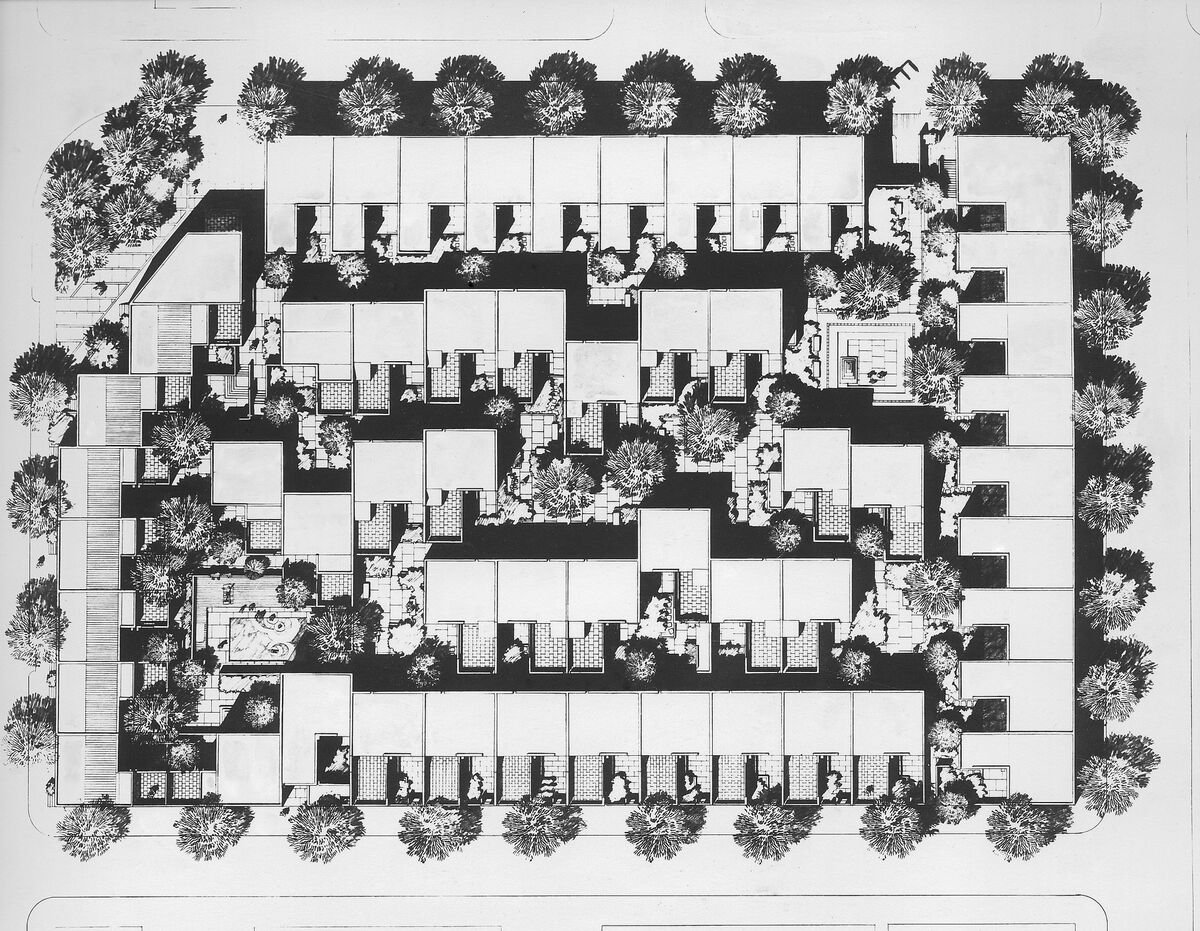
CityLab, for example, just published this article on Penn’s Landing Square, which is a housing complex in Philadelphia’s Society Hill neighborhood. Built in 1970 and designed by Canadian-American architect Louis Sauer, the modernist complex occupies an entire 2.37-acre block and contains an assortment of 118 low-rise homes, many of which are connected through small interior laneways.
In addition to its handsome architecture, what is noteworthy about Penn’s Landing Square is that its site plan makes it quite a dense low-rise development. At 118 homes, this translates into just under 50 units per acre. CityLab estimates that this means the development holds about 174 people per acre (~412 people total), which would make it more dense than Stuyvesant Town in New York (~158 persons per acre).
However, this is based on the assumption that there are almost 3.5 people living in each of these homes. While generally large, I don’t know if this is the case. It would be higher than the average US household size. But regardless, from a unit per acre standpoint, it remains a great example of dense, family-oriented, and grade-related housing.
For fun, let’s compare this to a more intense form of infill development. Our Junction House project, for instance, contains 151 homes and sits on a 0.48-acre piece of land. This translates into about 315 units per acre. I don’t know off hand the average number of occupants per household, but I reckon that, given our larger average suite size, we should be on the higher end compared to most mid-rise condominiums. So I would say that we are probably 400+ people per acre.
It’s unfair to compare a single development to an entire neighborhood, such as Stuyvesant Town. Circulation and other open spaces will necessarily pull down your average density. But these individual development examples do speak for themselves. There are many parts of North America where you might find 1 home or a handful of homes per acre of land. At Penn’s Landing Square, this number is 50 units per acre. And at Junction House, it’s 315 units per acre.
At the beginning of this month, the Government of Canada issued this direction, setting out the requirement for all public servants to be “in the workplace” at least three days per week. To ensure some flexibility, it also specified that it didn’t have to be exactly this schedule. But the intent was that public servants would need to spend a minimum of 60% of their regular schedules, in the workplace, whether measured on a weekly or monthly basis.
Immediately, the Public Service Alliance of Canada reacted and said that it would be filing “unfair labor practice” complaints: “We will be using every recourse we have available to fight this mandate,” PSAC national president Chris Aylward said, arguing that the surprise policy update was “anti-worker” and “fundamentally breaks the trust of workers and unions with the Trudeau government.”
Now, I understand that there are a whole host of legal considerations with a mandate like this. If remote work has, for example, become an implied term of these employment relationships, then it might be difficult for any employer to call these people back. Thankfully, I am not a lawyer. And so I don’t think this way. It is probably also the case that I’m now in my middle adulthood and have old school views on this topic.
Because in my mind, this is the government saying, “hey everyone who works for us, we’d like you to come into the office at least three days a week so that we can work together as a team, collaborate, and hopefully innovate.” And this is employees saying, “no way, that’s totally unfair! How dare you demand we come into the office that much?” Like, since when did going into work become such a problem?
At the same time, Canada is suffering from an existential productivity problem. This country has seen no productivity growth in recent years. And if you compare us to other developed countries, we are near the bottom. Even France — which is stereotypically famous for its relaxed work culture and its ban on after-work emails — is more productive than were are!
This needs to change or we will remain a deeply troubled country. And like everything, it’s going to require work.
Since the 1940s, the US has been adding roughly 9 million new homeowning households about every 10 years. This, after all, is a fundamental component of the American Dream. But Aziz Sunderji — who writes over at Home Economics — has recently been arguing that this 80-year boom is now at an inflection point. And it is largely because the rate of population growth in the US is now declining. Here’s his chart, which uses data from the US Census Bureau and the World Bank:
In fact, for the first time ever, the Census Bureau is now forecasting the US population to start declining. The current forecast has its population reaching a high of 370 million in 2080 and then declining to 366 million by 2100. But even before these far off dates, organic growth is expected to turn negative in less than 15 years (see above). So yeah, it makes sense that this would impact the real estate sector.
Resonance Consultancy, which is a placemaking firm that we have spoken about before on the blog, is working on a new America’s Best Cities report. And as part of this, they’ve been surveying Americans about which cities they would most like to live in and visit. The result is a list of the most “desirable” US cities that looks like this:
New York
Miami
Los Angeles
Las Vegas
San Diego
Chicago
Seattle
San Francisco
Houston
Denver
The long and the short of it seems to be that people generally want to live in the places where they like to travel. But what’s interesting is that if you look at the US cities that have actually grown the most in absolute numbers over the last few years (specifically April 2020 to July 2023), the list transforms into this:
Dallas (+462,639)
Houston (+360,649)
Phoenix (+219,008)
Atlanta (+200,414)
Austin (+189,896)
Tampa (+167,672)
San Antonio (+145,884)
Charlotte (+144,767)
Orlando (+144,542)
Jacksonville (+107,396)
The only city that shows up on both is Houston.
What this suggests is that cities very much have brands. And when you ask people where they’d ideally like to live, they think of the sexiest ones. Places like New York, Miami, Los Angeles, and so on. But it when it comes to actually moving somewhere and paying for a home, there are clearly other realities to consider — the most important of which is probably affordability.
I just joined Warpcast. You can find my profile, here.
At first glance, Warpcast is going to look a lot like X. But instead of tweets, you cast. There are also various topic channels, similar to how Reddit works. But the most important difference is that Warpcast is a client for the Farcaster protocol, which is a social network built on Ethereum. This means that it is a decentralized social network.
You won’t see of any this if you decide to sign up. All of the esoteric crypto things are hidden in the background. But it’s there. And it ultimately means that, as a user, you get to own your online identity and whatever content and following you create. Meaning, you can take it with you if you decide you no longer want to use Warpcast and instead want to access the network through another client.
It also means that software developers now have a real incentive to build things on top of the protocol, because unlike with a centralized service like X, they can be confident that they won’t get the rug pulled out from underneath them. And herein lies the feature that will ultimately lead to an enormous amount of new ideas and innovation.
In real estate terms, you can think of developing on top of a centralized service like building within a theme park owned by a single company. The theme park might want you to build on their land, right now, but if at some point it no longer suits their business needs, they can always change the game on you.
On the other hand, building in a city on land you own outright is a lot like developing on top of a decentralized service. Sure, you need roads and municipal infrastructure to service your land (think of these like the above protocol), but you generally don’t need to worry that the city might wake up one day and remove all of this important infrastructure. It’s a given. And that’s a fundamental difference, even if the buildings might look the same in the end.
Venture capitalist Fred Wilson once explained it in this way, “don’t be a Google bitch, don’t be a Facebook bitch, and don’t be a Twitter bitch. Be your own bitch.” What he meant by this is that if you build on someone else’s land, then you’re opening yourself up to being their bitch. What you want to be is your own bitch. And similar to how our cities work, this is the potential of decentralized services.
As I write this post, I currently have 6 followers on Warpcast. If you’d like to be number 7, you can follow me here.