Daily insights for city builders, delivered every morning at 6 AM ET. I’m Brandon Donnelly — a Toronto-based real estate developer and founder of Globizen. I’ve been writing here since 2013.

Tag: YIMBY

  • Destructive development?

    Planner Sean Hertel shared this (embedded above) on Twitter over the weekend. It is a lawn sign from Toronto’s Junction neighborhood that is calling for a stop to demolishing family houses for high rises.

    From what I can tell, this law sign is trying to communicate a few key messages.

    One, high-rises are monstrous beings that enjoy praying on innocent low-rise houses and squashing them with their feet, and sometimes their asymmetric hands.

    Two, it is mostly impossible to conceive of a world in Toronto where families live in high-rises and don’t live in grade-related housing with a backyard.

    And three, there is little value in building more, rather than less, housing in order to help with affordability concerns. Perhaps the thinking is that it needs to be low-rise affordable housing, or nothing.

    With all of this said, let’s do a little thought exercise today on the blog.

    Let’s for a second assume that there aren’t any high-rises proposed in the Junction; only European-scaled mid-rise buildings that sit on the area’s main avenues and back onto low-rise single-family neighborhoods. Let’s also assume that these buildings will be sculpted in complete deference to their rear neighbors so that things like shadows are minimized.

    Let’s assume that more housing is better than less housing.

    Finally, let’s assume that, get this, noble families may actually be able to live in mid-rise and high-rise buildings. And that there are already many successful examples of this taking place in the city, such as over here in CityPlace.

    What key messages would this lawn sign be then communicating?

  • Sensible, balanced, affordable, and livable

    I just discovered a new alliance of non-partisan, non-profit resident and ratepayer groups in the Greater Toronto Area that have come together in opposition of what they see as “unregulated overdevelopment and the lack of sensible growth vision for the GTA.” If you’d like to read through their public letter to the Premier of Ontario, Doug Ford, you can do that over here.

    In it you will learn that the Toronto region is vying desperately for the title of the most densely populated place on earth by trying to compete with already established locales like the slums of Mumbai and Monk Kok in Hong Kong. One has to admire ambition.

    But what is not clear to me is what exactly “sensible, balanced, affordable, and livable developments” should look like. Should we quash our low-rise “Neighbourhood” designations (the majority of our land area) and instead blanket the region with mid-rise buildings similar to Paris? This is one option and, by the way, Paris is far denser than Toronto (relevant reading here and here).

    Or should we maintain our low-rise “Neighbourhoods” exactly as they are and simply reduce overall housing supply by limiting height and/or density at our transit stations? Is this the ask? I’m not sure. But this is a good question for city builders: What should sensible, balanced, affordable, and livable development look like? Is the 33-storey building that I live in sensible?

  • Ontario proposes target of 1.5 million new homes over the next 10 years

    Yesterday I wrote about our housing doom loop.

    Today, the province of Ontario responded (maybe not to my post) by publishing this Housing Affordability Task Force report. In it, are 55 recommendations to improve overall housing supply across the province, with the end goal of adding 1.5 million homes over the next 10 years.

    I’m still making my way through the report, but the recommendations can basically be grouped into these five main buckets (taken verbatim from this press release):

    • Make changes to planning policies and zoning to allow for greater density and increase the variety of housing.
    • Reduce and streamline urban design rules to lower costs of development.
    • Depoliticize the approvals process to address NIMBYism and cut red tape to speed up housing.
    • Prevent abuse of the appeal process and address the backlog at the Ontario Land Tribunal by prioritizing cases that increase housing.
    • Align efforts between all levels of government to incentivize more housing.

    Reform is badly needed. And I have gone on and on and on and on over the years about a number of the problems associated with how we build new homes and how we expect them to suddenly become more affordable.

    Still, I think that most of the general public would be shocked to learn how long things take, how complicated we have decided to make land use approvals, and how a single person with a vested interested in seeing no development can hold up the delivery of thousands of new homes.

    Progress is measured in years and decades. Months simply evaporate while you wait for the next PDF document to grant you access to some other labyrinthian planning hurdle. It doesn’t need to be this way.

  • Creating change

    I was reading about a proposed development earlier today (it doesn’t really matter which one for this story) and I immediately thought to myself, “wow, this is a beautiful development. I like what they’ve done here.” The project happens to be by one of my favorite architects in the city. Sadly though, we have yet to work with them on any of our projects.

    I then decided to read the comment section of the article. There were dozens and dozens of comments and virtually all of them were negative and against the development. What is, of course, clear is that we all have different beliefs. We all see things differently. And that’s part of the reason why creating any sort of change is usually so difficult.

    But if you think about it, so much of our world resolves around change. If we want to address climate change, we are going to need to make changes. If we want to improve housing affordability, we are going to need to make changes. If we want to build more inclusive and economically prosperous cities, we are going to need to make changes.

    The challenge with all of this change is that we have inertia working against us. Case in point: I’m sure that most of us have been in a meeting at one point or another when a decision was made purely based on what was done the last time around. We did X. So let’s do X again. Why change? Probably a safe bet.

    Seth Godin once said that, “if you do anything that matters, it means you’re trying to change something.” He was talking about the world of marketing. But I believe that there’s a universal truth to this. Change unlocks potential.

  • Rich people and single-family zoning

    This is a chart from Abundant Housing LA (a YIMBY group), via City Observatory, showing the relationship between median household income and single-family zoning across the 88 cities that make up L.A. County. On average, about 80% of the land in the County is zoned for single-family housing. This is also true for Los Angeles, which is not surprisingly its biggest city. What is pretty clear from this chart is that the richest areas tend to have a higher percentage of single-family homes. If you read Anthony Dedousis’ post, you’ll also see that the housing tends to be more expensive (makes sense) and that the homeownership rates are higher in these single-family areas. One obvious takeaway is that it shows you how clearly we are dividing our cities. Zoning is regulation. And here we are seeing some of the socioeconomic implications. But I’m curious if this relationship would be as strong in other cities around the world and at different scales (i.e. neighborhood levels). When it’s made available (not all cities have this much space), how universal is this pull toward single-family housing?

  • The good in change

    This deserves a blog post. Below is a great tweet by Jason Thorne. Jason leads the department of planning and economic development at the City of Hamilton, where, full disclosure, we have a development project.

    https://twitter.com/JasonThorne_RPP/status/1169749295299538944?s=20

    I have said this many times before on the blog, but the challenge with most “community engagement” is that cities typically hear from the people who disagree. Those voices are then taken as representative.

    My gut tells me that we need to make it easier for people to agree. We need to reduce the barriers. Some will take the time to write a thoughtful letter. But most won’t.

  • And we’re back

    Welcome to 2019.

    I am currently in transit and catching up on some internet reading and email on my way back to Toronto.

    At this time of year it is, of course, common to reminisce (or lament) about what happened over the last year, as well prognosticate what may come.

    Over the last few years, I have done a bit of that on the blog. But I clearly didn’t do that this year while in Brazil (and away from any semblance of a workspace).

    So here’s what others have been writing and thinking about over the holidays:

    – 2018’s tech trends and tribulations in 14 charts. RecodeLink

    – 2018 was the year of the YIMBY. CityLab. Link

    – A cool girl’s guide to Toronto. Vogue. Link

    – Amazon’s annual Christmas press release. Link

    – Best travel posts of 2018. Design Milk. Link

    – Here’s (Almost) Everything Wall Street Expects in 2019. Bloomberg. Link

    – Here’s what to expect in cybersecurity in 2019. TechCrunch. Link

    – Naive to hope Toronto can change in 2019? That means we have work to do. Shawn Micallef. Link 

    – The 10 largest US venture rounds of 2019. TechCrunch. Link

    – What is going to happen in 2019. Fred Wilson. Link

    – Will a recession hit in 2019? Alan Murray. Link

    – Year in search 2018. Google. Link

  • Frontier city

    Opposition to new development is nothing new in this city. In fact, it’s the norm in almost all cities, regardless of how big or small the project might be.

    But the battle happening right now in Toronto with respect to the proposed 8 storey condominium project at 321 Davenport Road is certainly taking things to the next level. All over 16 units.

    Some of the most recognized names in this city have their hat in the ring and virtually every media outlet has covered the topic. See here, here, here, and here, for a small taste.

    Just this evening I saw that Shawn Micallef (yes camp) had sent a copy of his recent book to Margaret Atwood (no camp) in the hopes that she would read it and better appreciate why it behooves our neighborhoods to move past this “village mentality.”

    If you haven’t yet read it, it’s called Frontier City: Toronto on the Verge of Greatness. I’ve just moved it to the top of my reading pile. I hope more folks do the same.

  • Positivity at a public meeting

    I’ve been reading the blog 5 Kids 1 Condo for, I think, about a year now. It’s written by Adrian Crook who is a single dad of 5 kids, living in a 2 bedroom condo in downtown Vancouver. And his blog is about just that.

    A few days ago he posted a video of himself speaking at a public meeting in support of a new purpose-built rental building at 18th and Commercial Drive in Vancouver. The proposal includes 110 secured market rental units; 37% of which will be 2 or 3 bedroom apartments. (More information on the project, here.)

    It’s rare to see people come out in support of a project at a public meeting. Usually people only show up when they’re grouchy and upset. So today I’d like to share his speech (click here if you can’t see the video below).

    [youtube https://www.youtube.com/watch?v=q-ENWu__HdM?rel=0&w=560&h=315]

    I’m curious to know what was shouted right at the beginning after he said that he was in favor of the proposal. I listened a few times but couldn’t figure it out. 

    In any event, Adrian’s speech touches on a number of important points that transcend this specific development proposal and that are relevant to many of the topics that we discuss here on this blog.

  • Sprawling, but affordable

    The Wall Street Journal recently published an interesting article that ties in nicely with two of my recent posts. My post about North American population growth and my post about the San Francisco pro-development group known as BARF.

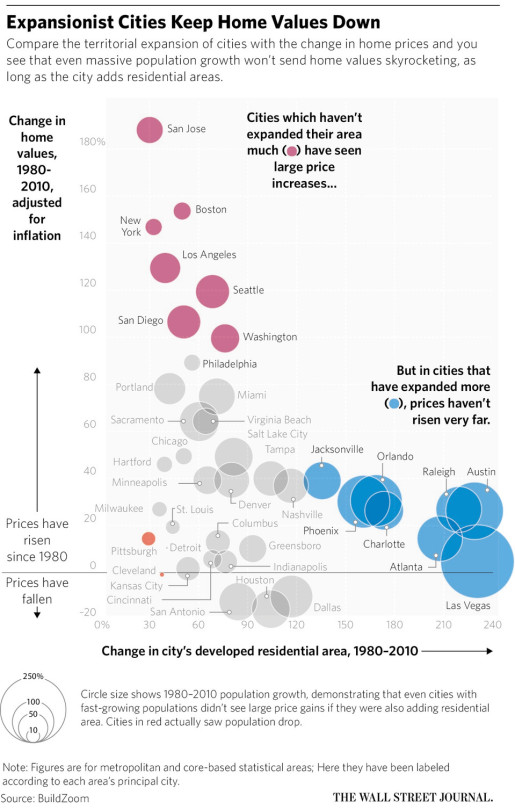
    The WSJ article is about the growing divide between affordable and expensive cities in the US. And the argument is that expansionist, or sprawling, cities are better at suppressing home values and maintaining affordability:

    “The developed residential area in Atlanta, for example, grew by 208% from 1980 to 2010 and real home values grew by 14%. In contrast, in the San Francisco-San Jose area, developed residential land grew by just 30%, while homes values grew by 188%.”

    Now, here’s a chart saying that same thing:

    The reality is that greenfield development (suburban sprawl) generally has far fewer barriers to development than urban infill development. So I’m not surprised to see cities like Las Vegas, Atlanta, and Phoenix clustered towards the bottom right.

    At the same time though, I’m obviously not convinced that sprawl is an optimal outcome. I think there are other costs not reflected in the chart above. So what’s the best solution here, assuming we want to build inclusive mixed-income cities?