
Daily insights for city builders, delivered every morning at 6 AM ET. I’m Brandon Donnelly — a Toronto-based real estate developer and founder of Globizen. I’ve been writing here since 2013.

Tag: washington dc

  • Are startups causing inequality?

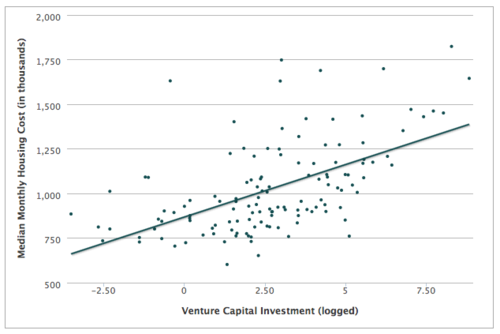
    Earlier this week Richard Florida published on article on CityLab talking about the relationship between tech innovation (in cities) and inequality. Specifically, the article deals with the correlation between venture capital investment and a variety of factors, such as monthly housing costs, wage and income inequality, and so on.

    The intent of the piece was to address the growing backlash against tech workers – in places like San Francisco – who have become the symbol for the growing gap between the rich and poor.

    The strongest correlation appears to exist between venture capital investment and housing costs. As the amount of venture capital goes up, so do housing costs – which probably shouldn’t surprise you. The rich start outbidding the poor for housing. Note: The two outlying dots at the top right, in the graph below, are Silicon Valley and San Francisco.
    image

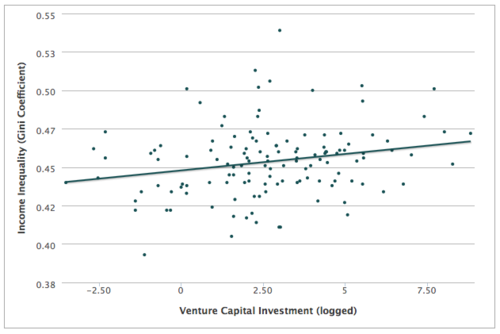
    But when it comes to inequality, the relationship isn’t so clear. For wage inequality, there seems to be a relationship. But for the broader income inequality measure, the relationship is fairly weak. Here’s the graph:
    image

    So this is not as black and white as it might seem. Regardless, Florida ends the piece with the following statement (that I think is spot on):

    It’s time to stop pointing fingers and get on with the far more important task of harnessing the urban tech revolution to create a new urban middle class and a more inclusive urbanism—one in which many more workers and residents can participate, and one from which many more can benefit.

    The answer is not to stop innovating. That would be counterproductive. We should be be encouraging innovation, but at the same time figuring out how best to harness it for society as a whole.

    Tomorrow, I’ll touch a bit more on how we might go about doing that. I have a post planned that I think will tie in really nicely to this discussion. So stay tuned.
  • Top 10 (US) cities for young smart people

    image

    I’m always on the lookout for great websites and communities dedicated to cities. And today, thanks to a friend of mine, I found a new one called City Observatory. It’s my new favorite site for city geeks.

    They describe themselves as a “data-driven platform for sharing, analyzing and discussing the success of cities.” As soon as I read that, I immediately subscribed. I’m a big believer in using data to elevate the discussions happening around our cities and to cut through the bullshit.

    I’m looking forward to digging into more of their articles, but I did already take a look at the first report they published, which is called: “The Young and Restless and the Nation’s Cities”. Click here to download the PDF.

    What the report talks about is a demographic group that they refer to as “Young and Restless”, and which they define as being 25-34 years old and having a 4-year degree. And they focus on this group because they see it as critical to driving local economic development.

    They’re the next generation who are going to start those companies and drive growth and innovation. And since the data shows that as people age, they become less willing to relocate (which intuitively makes sense), cities today are quickly realizing that they need to capture this group of smart people while they’re still restless (i.e. mobile).

    So if this is important, which cities (in the US) are winning right now? Here are the top 10 cities via City Observatory:

    1. Washington D.C. 8.1%
    2. San Francisco 7.6%
    3. Boston/Cambridge 7.6%
    4. San Jose 7.5%
    5. Denver 7.5%
    6. Austin 7.0%
    7. New York 6.6%
    8. Minneapolis 6.6%
    9. Raleigh 6.5%
    10. Seattle 6.1%

    The percentage represents the portion of the population that’s 25-34 years old and has a 4-year degree. I’ve just listed the cities here, but in reality they reference the entire metro areas.

    Do any of the cities on this list surprise you? None are surprises for me. It’s more or less what I would have expected to see, except maybe for the absence of Chicago (it’s 12th according to this ranking).

    Is your city doing enough to capture this group?

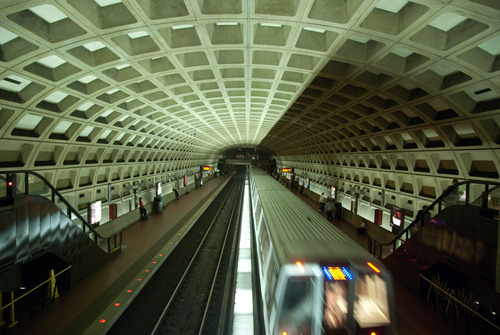
    Image: Flickr

  • Pop-up housing (it’s not what you think it is)

    image

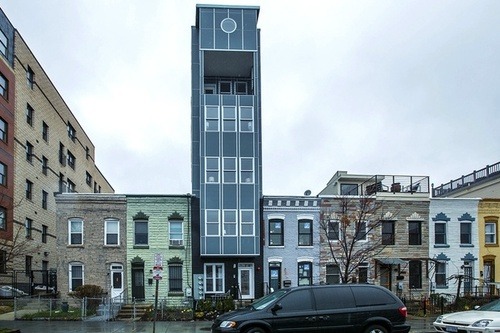
    You were probably expecting some kind of temporary housing solution. Because that’s certainly what I was thinking when Big Ben Myers tweeted me this article yesterday. But it turns out that in D.C., “pop-up housing” has come to mean what you see in the above photo – a pencil thin house rising amongst a bunch of low-rise rowhouses.

    Local bloggers are calling it a “middle finger to taste and scale”, but it’s happening because of what appears to be a real housing supply shortgage in the District. And it’s been said to be hurting not only housing affordability, but also exacerbating income inequality. 

    However, it’s become a threeway debate. You have people worried about aesthetics, local homeowners and residents worried about their own interests, and you have people worried about the overall health of the housing market. As I’ve argued before here on ATC, too much protectionism is often a bad thing for housing markets.

    But policy makers in the District appear to be responding in exactly that way, by clamping down on pop-up housing, as well as on accessory dwellings such as nanny flats (which I’m assuming are similar to what we would call laneway houses here in Toronto).

    I can certainly understand the concerns, but I think that cities need to find that fine line between preservation and growth. Because banning pop-up housing is only addressing the symptom. It doesn’t address the underlying cause, which, in this case, seems to be a housing market in search of more housing options.

    Update: This post was updated to give credit to Big Ben Myers for the article.

    Image: Washington Fine Properties via Citylab

  • The 2013 Anholt-GfK City Brands Index

    When most people think of brands, I suspect that they think of companies, products and services. But what about the brand of your city? As cities continue to compete for talent in the global economy, brand is becoming a hugely important differentiator.

    I just stumbled upon the Anholt-GfK City Brands Index and here’s their 2013 ranking:

    1. London
    2. Sydney
    3. Paris
    4. New York
    5. Rome
    6. Washington D.C.
    7. Los Angeles
    8. Toronto
    9. Vienna
    10. Melbourne

    The study looks at 6 key dimensions: presence, place, pre-requisites, people, pulse and potential.

    What do you think of the above list?

    Here’s a bit more information on how the index was prepared:

    “The Anholt-GfK Roper City Brands Index measures the image of 50 cities based on more than 50 questions related to perceptions of their Presence, Place, Pre-requisite, People, Pulse and Potential.  For the 2013 study, a total of 5,144 interviews were conducted in Australia, Brazil, China, France, Germany, India, Russia, South Korea, the United Kingdom and the United States.  Adults age 18 or over who are online are interviewed in each country.  Using the most up-to-date online population parameters, the achieved sample in each country has been weighted to reflect key demographic characteristics including age, gender, and education of the online population in that country.  Fieldwork was conducted from May 8th to May 23rd, 2013.”