Daily insights for city builders, delivered every morning at 6 AM ET. I’m Brandon Donnelly — a Toronto-based real estate developer and founder of Globizen. I’ve been writing here since 2013.

Tag: washington dc

  • Toward the childless city

    There is a common narrative that, when it comes time to start a family and have kids, you should probably consider moving to the suburbs. Sure, you’ll have a painful commute, but you’ll get more space for your money, and maybe you’ll end up with better kids.

    I don’t know, obviously not everyone agrees with this. I certainly don’t.

    But it is something that commonly happens and, in many cities, it is now happening more often. Here is a map from the Centre for London showing the change in the proportion of households with at least one dependent child from 2001 to 2021:

    A darker borough means that it lost households with at least one child. And a lighter borough means that it gained more kids. Why this is concerning is that it means the trendline is toward more, and not less, childless cities. Here’s an excerpt from a recent FT article:

    A future with dwindling numbers of children is one many cities, including San Francisco, Seattle and Washington DC, are grappling with. In Hong Kong, for every adult over 65 there are, to put it crudely, 0.7 children, and in Tokyo it is even fewer (0.5).

    Of course, this is not a new phenomenon. And we know the main drivers:

    Randal Cremer is one of several planned primary school closures and mergers in inner London triggered by low birth rates, families moving away because of expensive childcare, Brexit, and parents re-evaluating their lives during the pandemic. The biggest factor, says Riley, is that “housing is just becoming unaffordable”. Philip Glanville, mayor of Hackney, calls it “the acute affordability crisis”.

    So how do we start to solve this? Here are a few ideas that we recently talked about on the blog, but it is by no means an exhaustive list. In my opinion, this is a problematic trend that deserves a lot more attention. Because cities are at their best when they work for everyone — from the young to the old.

  • US public transit ridership since March 2020

    Consider the following stat: 65% of all transit trips across the US in 2019 came from just 6 metro areas: New York, Boston, Chicago, San Francisco, Washington, DC, and Philadelphia. Not surprisingly, these are all places with dense and walkable urban centers. In other words, they have built environments that are conducive to the use of public transportation.

    While we know that more people working from home has been bad for transit and that agencies across the world are facing deep holes in their budget, I continue to come back to two things. One, we have not yet reached a post-pandemic equilibrium. We are still making our way back to the office. And two, the single most important thing when it comes to transit ridership is land use.

    If we want more people to take transit, then we need to build our cities accordingly. That means streets people actually want to walk on, and a lot more density.

  • Micromobility ridership in the US from 2010 to 2021

    The National Association of City Transportation Officials (NACTO) has just published this report on shared micro mobility in the US from 2010 to 2021. And it’s a good look at how this space has evolved over the years. According to the report, the first modern North American bike share system was installed in Montréal in 2009 and the first in the US was in 2010. Though a quick Google search has Washington DC claiming this title in 2008.

    Whatever the case may be, bike share ridership started somewhere around 321k per year in the US and trip volume is now close to 50 million per year. Electric scooters also joined the mix in 2018, and 2019 was a banner year for this mode of transportation. The report suggests this was due to cheap VC money subsidizing these rides. Electric scooters have seen their average trip cost 2x between 2018 ($3.50) and 2021 ($7), despite the average trip distance remaining more or less flat (1.3 to 1.2 miles).

    Naturally, the pandemic was bad for shared mobility. But it is interesting to see how much this space has rebounded and how resilient it seems to be. Prior to the pandemic, bike share usage had clear morning and evening peaks, coinciding with people commuting to work. Since then, we have seen a shift to both a wider range of trips (i.e. to do things like get groceries) and more trips throughout the day.

    To download a full copy of the report, click here.

  • Toward more multi-family housing

    This recent article by Brookings is a good reminder of the all too important link between land use policies/patterns and GHG emissions. Because electric vehicles are cool and all, but they’re still not as efficient as just walking around and/or taking transit.

    As has been argued before on this blog, we need to not only electrify our transport network, but we also need to change how we get around. And probably the best way to encourage a modal shift, is to plan and build our cities differently. Something that is simple, but not easy.

    It also turns out that people who live in multi-family buildings tend to consume less energy (on a per capita basis) than those in single-family houses. So there are numerous benefits to encouraging denser housing on top of transit and within mixed-used communities.

    With all of this in mind, here are some interesting charts from the above Brookings article.

    This first one shows new housing permits in the metro areas of Atlanta, Chicago, and Washington DC, according to their urban, suburban, or exurban status. Here, Chicago is an outlier, with the “urban core” (defined as Cook County) now making up about half of all new housing.

    If you look at the entire study period, the number is less. The urban core accounted for about one-third of new housing permits in Chicago, and only 15% of permits in Atlanta and DC. But in all cases, housing permits in the urban core have been increasing since the 2008 financial crisis.

    But here’s the other thing. Looking at these next two charts, there appears to be a clear trendline toward more urban housing typologies. The first of these next two is showing single-family housing permits as a percentage of all new housing. And the second is structure type over time.

    Atlanta is still building mostly single-family housing, but less of it. And based on these charts, Chicago has already passed its inflection point. DC is not far off. Every city region is of course going to be different, but it does look like there is some kind of broader housing shift underway.

  • The Canadian Dream

    This has become a frequently reported topic, but here’s a recent article from Wired talking about tech workers living out the American Dream — in Canada. The story is pretty simple. Immigrants are smart and work hard. Canada has a system in place that privileges newcomers who are young and smart. And this has become a boon for our largest city and for the country. Here are two excerpts from the article:

    But there’s a new global winner: Canada, and particularly Toronto. Since 2013, the tech scene there has grown faster than in any other North American city. In 2017, Toronto added more tech jobs than Seattle, the San Francisco Bay Area, and Washington, DC, combined; in 2018 (the most recent year for which numbers are available), the city was second only to the Bay Area in new tech jobs. Toronto is so crammed with immigrants that nearly 50 percent of all residents were born outside the country.

    Canada’s immigration policy is hardly warm and fuzzy. On the contrary, it’s icily calculating. The government loves educated, elite newcomers, because they help propel the economy, says immigration lawyer Peter Rekai, but it wants them young, so they won’t drain the public health care system. Their parents are much less welcome.

    In the first quarter of this year, international migration accounted for 82.3% of Canada’s population growth. And at the beginning of this year, Ottawa was planning for up to 370,000 new permanent residents. It is highly unlikely that we hit that number given our current health crisis, but I have no doubts in my mind that we will hit it in the very near term. And when we do, it will be a good thing for Toronto.

  • Raising kids in the city

    This week, Matthew Yglesias of Vox makes the case for raising kids in the city. Spoiler: Driving sucks. Cities have lots to do. And parks can be better than lawns. However, he also talks about why this proposition is becoming increasingly difficult for many families. Here are a couple of excerpts:

    Now the father of a 4-year-old son, I live in Washington, DC, a city that is, mercifully, marginally more affordable than New York, and I wouldn’t want to raise a family any place other than the city.

    But unfortunately, families are disappearing from American cities even as city living in general has become fashionable again for those who can afford it.

    Children cost money. And they take up space. And urban space has become much more expensive — repelling growing families. This suits the proclivities of smug suburbanites just fine, but as someone who grew up in a big city in the 1980s and 1990s when city living was both less fashionable and more affordable, it seems like a tragedy to me.

    I didn’t grow up in the city. Though, I spent time in apartments and other higher density housing. And I don’t have kids. But I find this topic interesting. It’s also an important one. I don’t believe that the childless city is a good thing.

    For the full article, click here.

  • Bill Gates on tech and climate change

    Bill Gates recently spoke with David Rubenstein at the Economic Club of Washington, D.C. Full video, here.

    The bit that got a lot of attention is his admission that Microsoft should have dominated in mobile (in lieu of Android). The core competencies were all there and the company was in investing in mobile at the time.

    The technology discussions in general are interesting, but I also really enjoyed hearing about his efforts to address climate change. He spends a good chunk of time talking about that. Strongly recommend. (Related link: Breakthrough Energy.)

    On a somewhat unrelated note, this is also the first time I’ve seen every question and answer neatly transcribed below a video. This makes it very easy to find the parts that may be of interest. All video discussions should have this.

  • Case study: 9-unit infill rental development in DC

    This is an interesting ULI case study about a 9-unit infill rental development in Washington, DC called Oslo (click here if you can’t see the video below):

    [youtube https://www.youtube.com/watch?v=G8FfT6UREuc?rel=0&w=560&h=315]

    The units are a mix of 3-bedroom and 4-bedroom apartments. The target market is recent graduates and millennials who might otherwise be sharing (”group living”) in a townhouse or single-family home to save on rent.

    Another notable aspect of this project is the fact that the previous building was a legal non-conforming 9-unit apartment building. In other words, the current zoning wouldn’t allow it today. So to preserve their zoning status, they had to figure out a clever workaround during construction.

    A project exactly like this – where you’re replacing an existing apartment building – probably wouldn’t be possible in Toronto because of our rental housing demolition and conversion bylaw. 

    But I wanted to share it because I am sure that many of you, including those outside of this city, will appreciate it as a good example of low-rise infill development.

  • Fluted glass curtain wall

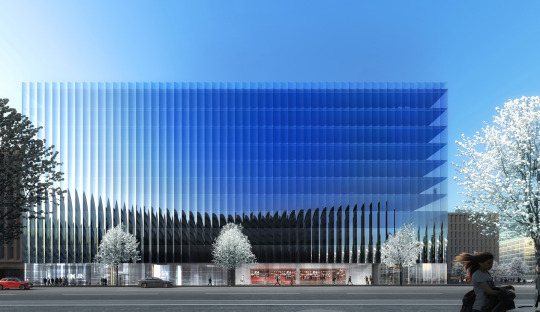
    New York architecture firm REX is working on a new office building in Washington DC that will incorporate a beautiful fluted glass facade. Here’s a rendering of what it is intended to look like:

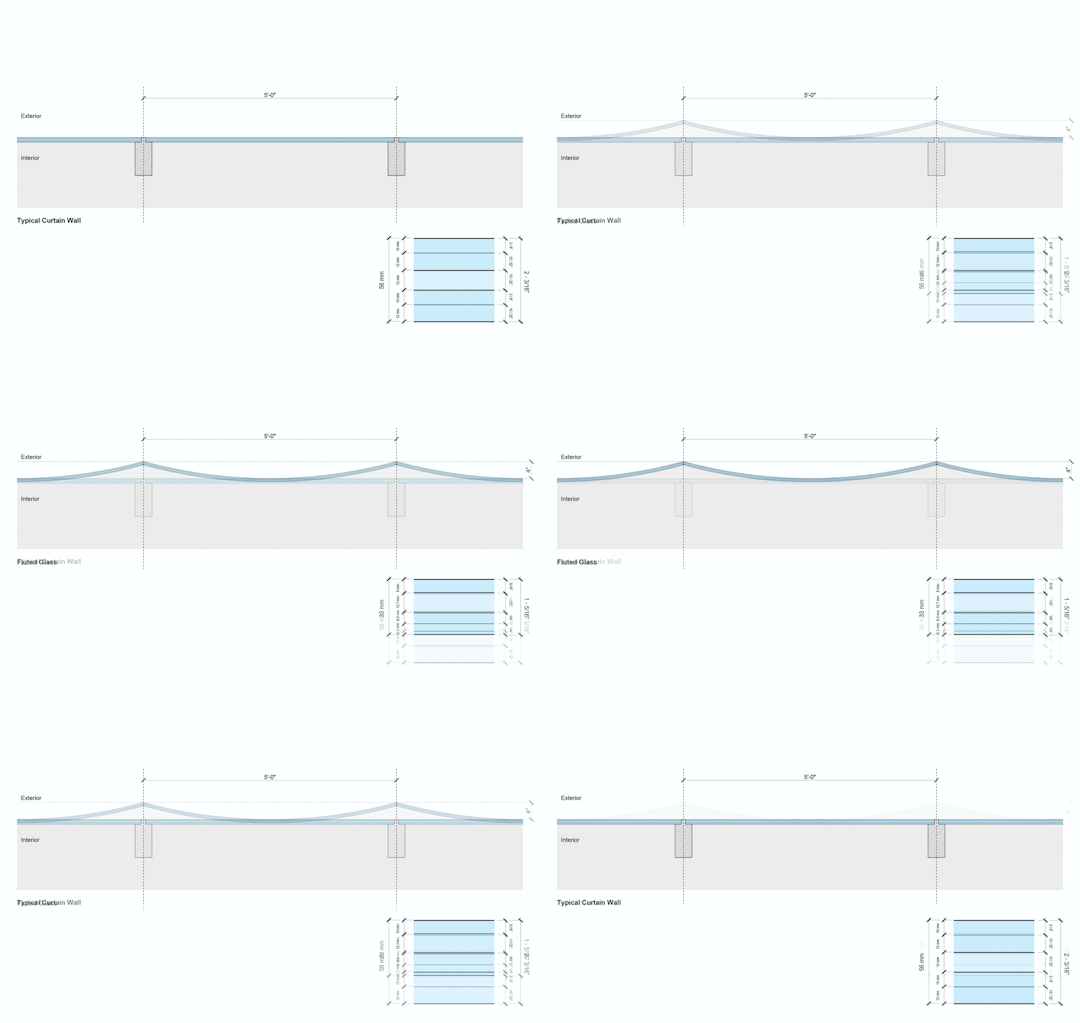
    Here’s what that looks like in plan (it’s a GIF that should show typical curtain wall vs. proposed fluted glass):

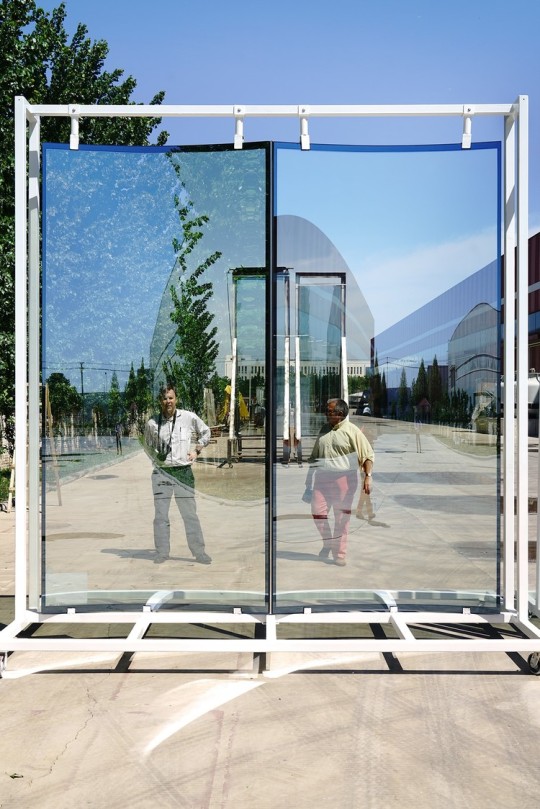
    Here’s a photo of the 1:1 mockup:

    And here’s a description from the architect:

    The façade’s approximately nine hundred identical, insulated-glass panels—3.2 m tall by 1.5 m wide (11’-6” tall by 5’-0” wide)—are subtly curved to a 2.9 m (9’-6”) radius through a heat roller tempering process. The curve yields structural efficiency, which meets wind load requirements and enables a thinner monolithic outer lite than normal, providing greater transparency. 

    Because of the curve’s inherent rigidity in compression, only the top and bottom edges of the panels are supported from the floor slabs, while the mullionless vertical edges are flush-glazed for a minimalist aesthetic that improves sight lines, while gaining usable floor area.

    They are working in collaboration with Front Inc., which if you haven’t heard of, you should check out. They are a design/engineering consultancy that specializes in facades and building envelopes. They work with many of the big name starchitects. The developer of the project is Tishman Speyer.

    It’s worth noting that part of the impetus for the fluted glass facade was to try and innovate within the confines of DC’s draconian zoning – which mandates that no building can be taller than 130 feet. Because of this, developers and architects are usually forced to build out to the allowable area, leaving little room for architectural variation. 

    But in this case, the fluted glass removed the need for thick mullions and also allowed them to extend out beyond the lot area by 4 inches every 5 feet (the curves are considered “architectural features”). So this move has created both architectural variation and more rentable area.

    It doesn’t appear that the building will have any operable windows, but other than that, I think it promises to be quite beautiful. What do you think?

    All images from REX.

  • First crowdfunded real estate project opens in D.C.

    Want further evidence that technology and the internet are going to dramatically transform many “non-tech” industries such as real estate? 

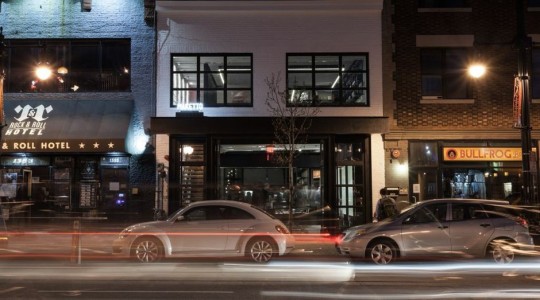
    Take a look at 1351 H Street NE in Washington D.C (pictured above). It houses a hybrid retail store and restaurant and is probably the first truly crowdfunded real estate project.

    The project was completed using a platform called Fundrise, which I’ve written about before here on Architect This City. Their vision is to completely democratize real estate investment by removing middlepeople and outdated regulations that restrict who and how people can invest in real estate.

    To accomplish this, the founders of Fundrise went out in 2011 and bought the building located at 1351 H Street NE for $825,000. The goal was for it to act as their proof of concept. 

    They then spent a significant amount of time and money figuring out how to make it legal for small and local investors to participate in the project (as opposed to just accredited investors). It was ultimately done through a “local public offering” filed with the SEC.

    So how does it work?

    In the case of 1351 H Street NE, they first went out to the local community and asked them what they wanted to see. That’s how they ended up with a unique retail store / restaurant. It’s what the community wanted.

    Once this was established, they went out and issued 3,250 shares and crowdfunded $325,000 from 175 local investors. This was for an ownership share in both the building and the future business. The average investment amount was $2,000, but people were able to invest as little as $100.

    This is an incredible accomplishment. It takes real estate investment and development to a local level and really empowers small entrepreneurs to start businesses that may have been previously unfundable by traditional sources.

    I don’t know what you think, but I think this is the beginning of a powerful transformation. Many of the structures that are currently in place were formed at a time when it wouldn’t have been practical to crowdsource ideas and crowdfund money. But now that is very possible. It was just done.

    Image: Maketto