Daily insights for city builders, delivered every morning at 6 AM ET. I’m Brandon Donnelly — a Toronto-based real estate developer and founder of Globizen. I’ve been writing here since 2013.

Tag: video

  • [Video] Gang of Four

    Scott Galloway, professor of Marketing and Brand Strategy at NYU Stern, recently delivered a presentation on the Gang of Four: Apple, Amazon, Facebook, and Google. These dominant companies are also often referred to as the “Four Horsemen.”

    The video is about 16 minutes long and I would highly recommend that you give it a watch.

    It’ll be like drinking from a firehose, but there are so many fascinating takeaways. You’ll also quickly discover how far reaching the societal impacts of these companies have been and will likely be in the future.

    If you can’t see the video below, click here.

    [youtube https://www.youtube.com/watch?v=jfjg0kGQFBY?rel=0&w=560&h=315]

  • The search for perfection

    Two of my favorite things are snowboarding and cities. 

    So the 4K GoPro video below, called Japan Snow – The Search for Perfection, really does it for me. 

    The video is the journey of two GoPro athletes as they go from Tokyo to Hakuba (a village near Nagano, host of the 1998 Winter Olympics) to the northern island of Hokkaido in search of untracked powder. If you’re a snowboarder or skier, you’ll of course appreciate that journey.

    For you urbanists, the city shots are incredible. I also love how they describe Tokyo as a “sophisticated web of innovation and tradition.” I often describe Tokyo in a similar way, but I like their wording better.

    Make sure you full screen this video and turn on your sound. It’s about 14 minutes short. Enjoy.

    [youtube https://www.youtube.com/watch?v=tXpXHoDKL64?rel=0&w=560&h=315]

  • [Video] The Skyline Forum: Architect or Developer?

    I recently had a discussion with Ben Stevens about architecture and real estate development for his video blog, The Skyline Forum. I’ve posted about his blog before because I think it’s a great idea and a great forum for the industry. I sure hope he keeps it up.

    Here’s what we talked about in Ben’s words:

    “In Episode 6, I caught up with Brandon Donnelly of the very popular blog Architect This City. Brandon has degrees in both architecture and real estate development and as such has a unique perspective on the two disciplines. In this episode, I was interested to hear about the rationale behind his decision to pursue development over architecture, his definition of “real estate developer,” and his suggestions for pursuing the kind of work in real estate development which he does (currently in Toronto). It was a great conversation and confirmed for me a lot of things I’d learned through reading his fantastic blog.”

    And here’s the video discussion:

    [youtube https://www.youtube.com/watch?v=_-o_gT9czfM&w=560&h=315]

    A big thanks to Ben for inviting me to participate – he has chatted with some big names. As a published author himself, I also appreciated him encouraging me to write a book. I’ve been thinking about doing that. Oh, and a big thanks to my mom for providing the Christmas poinsettia that ended up being prominently featured in the background 😉

    I haven’t watched the full video yet, but one thing is clear: I’m quite the hand talker.

  • Vancouver never plays itself

    There’s something powerful about seeing/hearing cities being depicted in film, TV, and other kinds of pop culture. It creates familiarity and does a lot to drive the brand of that place.

    But how often are you just seeing one city disguised to look like another? Actually quite often.

    Here’s an interesting video that talks about how the 3rd largest film production city in North America never actually plays itself.

    [youtube https://www.youtube.com/watch?v=ojm74VGsZBU?rel=0&w=560&h=315]

    I know that there are real economic benefits to being a cheap place to film movies, but I would love to see Canadian cities play themselves. There are also big benefits to that.

    Thanks to Scott Bonjukian at The Urbanist for sharing the above video this morning.

  • The relationship between architecture and film

    There has always been a strong relationship between architecture and film. Next to actually being there, video is one of the best ways to experience architecture.

    And that’s because space is not static. A big part of how we experience space has to do with what it feels like as you move through it.

    For example, American architect Frank Lloyd Wright was notorious for his sprawling horizontal houses and low ceiling heights. In his Fallingwater House (which is stunning), I swear that my head was rubbing on the ceiling in certain rooms (I’m 6’3").

    But he did this to purposefully create a feeling of compression. Because then as you exited the room (in this case to go outside onto a terrace) the feeling of openness and expansion is all that more powerful. The contrast creates awareness.

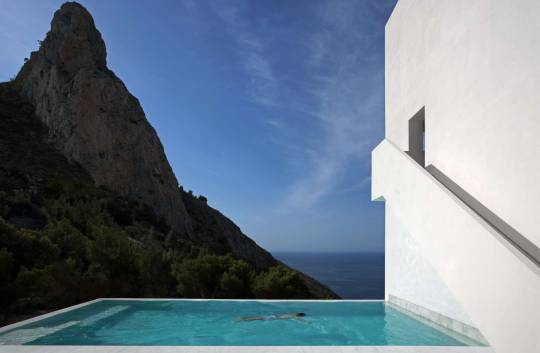
    In honor of the cinematic nature of architecture, below is a magnificent video of the Casa del Acantilado (House on the Cliff) by Fran Silvestre Arquitectos. Pay attention to the sliding planes and framed views throughout.

    The image shown at the top of this post is from Architizer.

    [vimeo 52162380 w=500 h=281]

    Casa del Acantilado | House on the Cliff by Fran Silvestre Arquitectos from Fran Silvestre Arquitectos on Vimeo.

  • Laneways and ravines

    Solitude by Lionel Linton on 500px.com

    https://500px.com/embed.js

    I have a new mission for this summer: To explore more of Toronto’s ravines.

    Last week I had a fascinating conversation with Steve Heuchert of the Toronto and Region Conservation Authority (TRCA). Most developers in this city would probably cringe when they hear those words. Because often when the TRCA gets involved it means your project is about to get more complicated.

    But if you take a step back and look at the larger city building equation, our ravines are a remarkable and unique feature of the Toronto area landscape.

    And unless you live near one or are fortunate enough to have a home that backs onto one, I suspect that for many of us this city’s ravines are a somewhat forgotten layer of the urban fabric. We drive by them. We pass through them on the subway. But they don’t really register in the way that they should.

    And so if you think about it, our ravines actually share many similarities with our laneways (alleys). We know they exist, but we could be doing a lot more to truly celebrate and integrate them into the rest of the city. They are missed opportunities.

    The challenge with our ravines though is finding the right balance between preservation and increased usage. But this isn’t something that a great landscape architect couldn’t help solve.

    So today’s thoughts are: How do we increase ravine awareness? How do we improve access and expand their uses? How might we craft our ravines to become an interconnected open, green, and cultural network within the city? And how do we better position the ravines as part of Toronto’s overall city brand?

    If you’re interested in this topic, check out this talk that Steve Heuchert did last year. It was part of an event that Megan Torza of DTAH organized called RavinePortal.

  • How Melbourne reinvented itself one block at a time [Video]

    https://500px.com/embed.js

    Melbourne is famous in urbanist circles for the revitalization of its central area. In 1992, 40% of the buildings were empty above the first floor and only 5 (yes five) residents actually lived in the core. Everyone had fled to the suburbs and the city had hollowed out.

    Today, there are over 29,000 residents in the central area and Melbourne has become revered around the world for its vibrant public spaces and innovative laneway repurposing. 

    Here’s a quick 11 minute video that explains how they did it (via The Urbanist). Click here if you can’t see it below.

    [vimeo 131396094 w=500 h=281]

    What is clear from the video is that it took a lot of work convincing property owners and getting them to buy into the vision. Being able to repurpose the laneways often meant punching through blank walls at the base of buildings. And so there was pushback.

    Here in Toronto I’ve heard people say that we’re not Melbourne and we shouldn’t expect to have similar kinds of urban spaces. Well guess what, neither was Melbourne in the 1980s and 1990s. It was a dying city. But they made it happen.

  • Fun Friday: Everyone’s Upstairs Neighbors

    This week has not been a good week for Toronto city builders. So I think a Fun Friday post is in order to lighten things up around here. (I’m stealing the idea of a Fun Friday post from Fred Wilson’s technology blog – he has been doing them for years).

    Here’s a short comedy sketch called, Everyone’s Upstairs Neighbors. If you’ve ever lived with a noisy neighbor above you, this will all make perfect sense to you and I think you’ll find it hilarious. Click here if you can’t see the video below.

    [youtube https://www.youtube.com/watch?v=4IRB0sxw-YU?rel=0&w=560&h=315]

  • W57 — A new hybrid building typology

    image

    We’ve been talking about a lot of heavy topics here on Architect This City lately. Everything from the contentious Gardiner Expressway East to minimum population densities to density creep. 

    So today I thought we could talk about something a bit more fun: architecture.

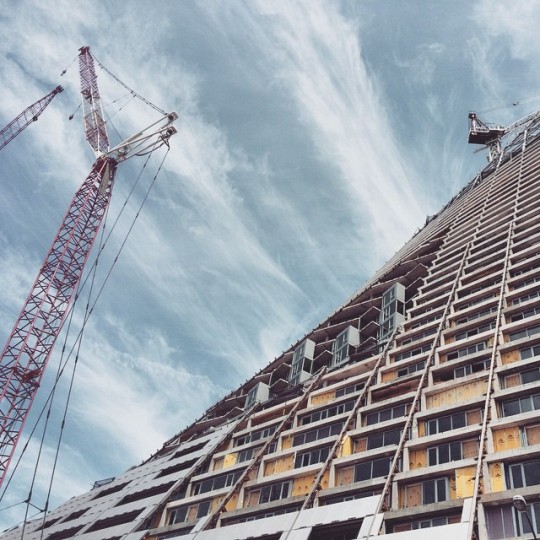
    When I was in New York last weekend, one of the buildings that was on my must-see list was the now under construction West 57th Street by Danish architect Bjarke Ingels. See photo above. (It also happens to be at the exact location where the West Side Highway transitions from elevated to surface boulevard.)

    This is supposedly the first North American project for Bjarke Ingels (he also has a project in Vancouver now). And if you’re a regular reader of this blog, you’ll know that I’m a fan of his work. His diagrams and storytelling ability were a big inspiration for me when I was in architecture school.

    The concept behind the project was to create a new hybrid building typology, one that is a cross between the typical European perimeter block building and the North American skyscraper. And the result is pretty wild.

    Here’s a video in case you aren’t familiar with the project. Click here if you can’t see it below.

    [youtube https://www.youtube.com/watch?v=_0JbTbOm_iQ?rel=0&w=560&h=315]

    I think it’s a really exciting project. What are your thoughts?

  • Dubai time-lapse video

    I’ve only been to Dubai once. I had a lot of fun, but it’s not my favorite city in the world. That’s largely because I tend not to be drawn to cities where you feel like you need to drive in order to properly experience it.

    But boy, this time-lapse video sure makes the city look cool. Click here if you can’t see the video below.

    [youtube https://www.youtube.com/watch?v=zGtz_GOA79w?rel=0&w=560&h=315]