Daily insights for city builders, delivered every morning at 6 AM ET. I’m Brandon Donnelly — a Toronto-based real estate developer and founder of Globizen. I’ve been writing here since 2013.

Tag: video

  • Knowledge is more important than space

    I don’t always agree with economist Edward Glaeser, but I really enjoyed the talk that he gave at the Vancouver Urban Forum back in 2012 (at least part 2 of it). I came across it on Twitter today and, since it only has about 300 views, I figured that some of you also haven’t seen it.

    The argument he makes is that knowledge and education are the bedrock of cities. And since we continue to cluster in cities, despite all of our technological advances, knowledge is clearly more important than space. One of the ways he defines cities is by their lack of space and the closeness of the people.

    Of course, this isn’t anything new. If you’ve read his book Triumph of the City, you’ve heard all of this before. But that didn’t stop me from enjoying his talk. It’s a great overview of declining transportation costs, locational advantages, agglomeration economies, the importance of urban density, the impact of small and large firms in a city, and so on.

    I also really liked this idea that knowledge is worth more than space. So if you have 20 minutes and you want to get geared up about cities, have a watch.

    Click here if you can’t see the video below.

    [youtube https://www.youtube.com/watch?v=zg7aITkTNe8?rel=0&w=560&h=315]

  • 70 years of LA

    The New Yorker recently published an interesting split-screen video tour of the same streets in downtown LA in the 1940s and today. 

    They have done a great job pairing up the same views and also panning in such a way that the middle divider seems to magically transport you 70 years.

    Here it is:

    [youtube https://www.youtube.com/watch?v=WIHfmisMLOY?rel=0&w=560&h=315]

    If you can’t see the video above, click here.

    In some cases (okay, many cases), I couldn’t help but feel like 1940s LA was far more urban and engaging. What did you think?

  • The back-end of our cities

    I love cities. We all love cities right now. 

    Everyone, for good reason, seems to be fixated on both people returning to cities (like those narcissistic Millennials) and people urbanizing for the very first time. This latter scenario is happening rapidly across the developing world and in many cases – but not all cases – it is helping to lift people out of extreme poverty.

    But by most measures, urban areas represent only about 2-3% of the world’s land area, despite housing over 50% of our population. So here’s an interesting thought for this morning: What is happening and what will happen with the remaining 97-98%?

    In this recent talk by architect Rem Koolhaas, he attempts to dissect the future of living, loving, and working through the lens of architecture. However, he starts by saying that architecture is, in fact, too slow to properly capture the zeitgeist of any time period. It is, “an unbelievably slow art.” That said, Koolhaas has a remarkable ability to identify what is happening (see Delirious New York) and then call it out in a way that you probably haven’t thought about. 

    In the above talk, he hones in on the impact of Silicon Valley – certainly the spirit of our time – on the rural landscape outside of our cities. Interestingly enough, he also talks about how the tech industry has begun to borrow terminology from architecture in order to describe itself.

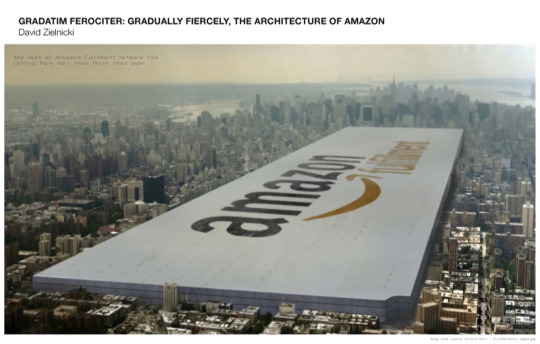
    Screenshot from the video:
    image

    Despite their ethereal appearance, technology giants still have large physical footprints for servers, production, logistics, and so on. But there’s no reason – or way – to accommodate them inside of our cities and so they cluster outside, in the 97-98% areas. These are places like the Tahoe-Reno Industrial Center, which is the home of Tesla’s new Gigafactory.

    Because of sheer scale and because there’s no need for them to possess much in the way of humanistic qualities, these are spaces which are void of architecture, urbanism, and, in some cases, a light spectrum beyond what is absolutely necessary for the specific function of the building (discussed in the video).

    Of course, the periphery has long serviced the core. But Koolhaas’ thinking has, as it often does, made me consider this phenomenon in a slightly different way. He paints a picture of a spiky world where we are all crammed into sensor and app-driven cities (the front-end), all of which are then powered by big mechanistic boxes that many of us may be naive to (the back-end). In some ways it feels like the Matrix. What we see and experience could just be the tip of the iceberg.

    Architecture may be unbearably slow, but as a society we have always built what matters to us most at the time. At one point it was places of worship. But today, at least for part of our landscape, it is boxes not intended for us to really experience. Maybe that’s not really architecture. Maybe it is simply the back-end for our cities.

  • Positivity at a public meeting

    I’ve been reading the blog 5 Kids 1 Condo for, I think, about a year now. It’s written by Adrian Crook who is a single dad of 5 kids, living in a 2 bedroom condo in downtown Vancouver. And his blog is about just that.

    A few days ago he posted a video of himself speaking at a public meeting in support of a new purpose-built rental building at 18th and Commercial Drive in Vancouver. The proposal includes 110 secured market rental units; 37% of which will be 2 or 3 bedroom apartments. (More information on the project, here.)

    It’s rare to see people come out in support of a project at a public meeting. Usually people only show up when they’re grouchy and upset. So today I’d like to share his speech (click here if you can’t see the video below).

    [youtube https://www.youtube.com/watch?v=q-ENWu__HdM?rel=0&w=560&h=315]

    I’m curious to know what was shouted right at the beginning after he said that he was in favor of the proposal. I listened a few times but couldn’t figure it out. 

    In any event, Adrian’s speech touches on a number of important points that transcend this specific development proposal and that are relevant to many of the topics that we discuss here on this blog.

  • World after capital

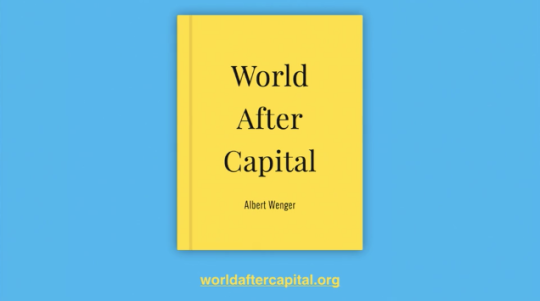
    Albert Wenger is currently in the process of writing a book called World After Capital. The book isn’t finished yet. It still exists in a crude rough draft form. But already he has made it freely available online. You’re also welcome to comment and contribute to the book as he works on it.

    Why has he done it this way? 

    Because this format of publishing is in line with where he believes the world is heading. He believes we are headed towards a world where new forms of surplus – brought about by technological innovation – will create greater levels of freedom: economic freedom, informational freedom, and psychological freedom.

    His overall thesis is that the world has been moving through a series of scarcities. As hunter and gathers, the scarcity was food. In our agricultural period, we learned how to create food surpluses (which freed up more of our time), but it then produced land scarcity. Once the industrial revolution hit we once again freed up more of our time through surpluses, but then the scarcity became centered around capital. We also started to negatively impact the environment. Today, as we clearly move away from the industrial economy towards a knowledge and information economy, Albert believes the new scarcity is attention. (I wrote a related post about a month ago.)

    If you’re interested in this topic and don’t feel like diving into his book, I suggest you watch this 23 minute presentation by Albert Wenger. I watched it this morning and he talks about everything I mention above. 

    Here’s one of his slides that I felt was important to share:

    Why it’s interesting to think about this shift is because there will inevitably be positive and negative outcomes associated with it; there will inevitably be groups who, probably because of self-interest, would rather cling to the past; and because there are pressing global issues that we need to be focusing our attention on – issues such as climate change.

    I can’t help but wonder about all the ways this shift could reverberate through the economy and our cities. Earlier this week I wrote a post about architecture as a tool for capital. But with our current fixation on “starchitecture”, one could argue that we have already transformed architecture into a new tool – a tool for grabbing attention. If you believe that attention is the new scarcity, then this makes perfect sense.

  • The birthplace of techno

    Detroit has been called the birthplace of techno. Beginning in the early 1980s – when the city was well in decline – the Detroit techno sound started to emerge, thanks to musicians such as Juan Atkins, Derrick May, and Kevin Saunderson. 

    Chicago had house music. And Detroit had techno music – among, of course, many other musical genres. But what I find fascinating about Detroit techno, in particular, was how it really reflected the ethos of post-industrial Detroit. It was high-tech. It was about machines. And it was obsessed with the future.

    Below is a clip from a 1996 French documentary called Universal Techno. Even if you’re not into electronic music, I think you should at least watch the segment starting at 1:40. I love how Derrick May talks about Detroit, and what should be this balance between the past and the future. It really reflects my own views on city building.

    [youtube https://www.youtube.com/watch?v=RSX_r0u3uzE?rel=0&w=420&h=315]

    If you can’t see the video, click here.

    I’m thinking about Detroit and its music because I’m headed there during Memorial Day weekend for the annual Movement Electronic Music Festival. It has been about 2 years since I was last in Detroit and so I’m excited to see the city in full swing.

  • The Social Life of Small Urban Spaces

    “It is difficult to design a space that will not attract people. What is remarkable is how often this has been accomplished.” -William Whyte

    In 1980, the sociologist and urbanist William Whyte published a revolutionary book called The Social Life of Small Urban Spaces

    The ambition was to discover why some urban plazas are successful and why many others fail. And to do that, he went out and studied urban plazas throughout New York using video and simple observation, such as head counting.

    His work has been hugely influential for architects, designers, and other urbanists. But if you think about how often we fail at creating urban spaces that actually attract people, I think it’s worthwhile revising what Whyte discovered way back in the 70s and 80s.

    Some of the principles – such as providing places to sit – are dead simple and intuitive. But again, a lot of urban spaces suck. So we’re clearly not doing it.

    The other thing I feel we often forget is that it’s not just the space itself that matters, it’s also the urban fabric around it. The Seagram Building in New York plays a central role in Whyte’s work as an example of a successful urban plaza. 

    But we can’t forget that Mies van der Rohe’s simple gesture of setting the tower back from the street is strengthened by the remaining urban fabric and the activity along Park Avenue. The plaza acts as a kind of release.

    Alongside the book, Whyte also published a 60 minute video. If you’ve never seen it, I highly recommend you watch it when you get a chance. Click here if you can’t see the video below.

    [youtube https://www.youtube.com/watch?v=MjxXTsHgc8g&w=420&h=315]

    To close out this post, I thought it would be fun if everyone shared their favorite public urban space in the comment section. It can be in your city or it could just be a place you’ve visited.

    To kick things off, I’m going to go with with a space that’s close to home: Berczy Park. It has lots of places to sit, including movable chairs. There’s a great water feature. And it’s well connected to the rest of the area and surrounding streets. I often sit there during lunch or when I just want to think.

    It’s also in the midst of a revitalization and I’m excited to see that come together.

  • Snowboarding, vlogs, Cape Town, and marketing

    This morning, instead of my usual routine of writing alongside a cup of coffee, I decided to finally edit all of the skiing and snowboarding footage that I took last month in Park City, Utah. Click here for the final cut.

    Compared to the video we did for Jackson Hole, I don’t like the selfie perspective as much. It doesn’t show enough of the person. This time we used the Go Pro 3-way arm, but in Jackson we used a plastic tube that I think was used for a beer funnel before that. Next year we’ll go back to that.

    Video is a lot of fun and I would love to figure out a way to incorporate more of it into this blog. But that’s a far bigger time commitment and I am not prepared to allocate resources to that. I write every day. That’s my thing.

    I am, however, not ignorant to what’s happening in the world of video blogging. And I think there are lots of opportunities for businesses who have the resources to allocate towards projects like this.

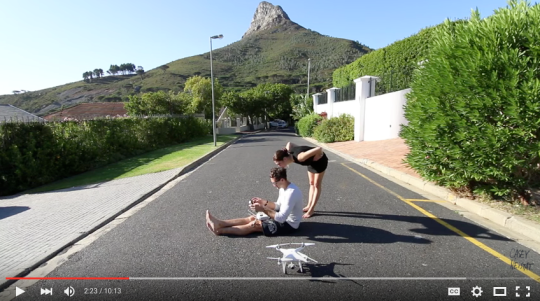
    Take for instance this vlog by New York video guy Casey Neistat. It’s probably the best piece of marketing that the Phantom 4 drone could have asked for. It’s authentic. I watched it and now I want one. Take my money. 

    (Note to city geeks: It’s worth watching just for the drone aerials of Cape Town, South Africa.)

    To my knowledge, I don’t think people are doing anything like this in the real estate business. But eventually it will happen. Because people are becoming increasingly immune to your typical marketing pieces.

  • How things could be

    I have about 15 minutes before I need to head out for dinner, so I’m afraid that there won’t be much of an ATC post today. It has been a busy week.

    But given that this week was Bjarke Ingels’ talk in Toronto and many of us are pretty excited about his King West project, I thought I would share a video where he sketches and talks about architecture. Click here if you can’t see it below.

    [youtube https://www.youtube.com/watch?v=cIsIKv1lFZw?rel=0&w=560&h=315]

    I love the idea that architecture is about imagining how things could be. That’s how I feel about both architecture and real estate development.

  • Mr. Robinson — Architect as Developer

    I first learned about the work of Jonathan Segal back when I was in architecture school. And he was somebody I immediately admired. 

    At the time, I was struggling to figure out where I wanted to position myself between architecture and real estate development, and he was somebody who had seemingly figured it all out: he simply merged the two.

    For those of you who are unfamiliar with Jonathan Segal, he has made a name for himself by being a pioneer of the “Architect as Developer” business model. That is, he acts as both the architect and the developer/client.

    This business model isn’t going to suit everyone, but I suspect that we’ll see more of it in the future.

    Of course, it doesn’t just have to be an architect acting as a developer. It could also be an architect and a developer joining forces or some other permutation. Whatever the case may be, design and innovation are central to business today and that’s why I think this model will only become more relevant.

    Below is a short 3 ½ minute video about Segal’s latest project, called Mr. Robinson. It is located in San Diego. If you can’t see the video below, click here.

    [vimeo 155403927 w=500 h=211]

    If you’d like to see the typical floor plans or rent one of the apartments (they start at $2,400/month), click here.

    Now I’d be curious to hear your thoughts. Do you like the project?