Daily insights for city builders, delivered every morning at 6 AM ET. I’m Brandon Donnelly — a Toronto-based real estate developer and founder of Globizen. I’ve been writing here since 2013.

Tag: venture capital

  • The WeWork of vacation rentals

    The word on the street is that Sonder — the marketplace for vacation rentals and competitor to Airbnb — is close to finalizing a $200 million investment round that would value the company at $1 billion.

    I first wrote about Sonder back in 2016 after I met someone from their business development team here in Toronto. I have yet to stay in a Sonder, but I’ve looked at their rentals a few times.

    One of the main differences between Sonder and Airbnb is that the former head leases their rental supply. And they do this by trying to go higher up on the food chain and partner with developers and real estate operators.

    In this regard, they are similar to WeWork. And it allows them to sit somewhere in between Airbnb and a conventional hotel. The supply is distributed, but the service offering is more consistent.

    Of course, this arguably makes their business model slower (they have to negotiate leases) and more costly (they’re committing to fixed costs). So it becomes a question of: How valuable is that consistent service offering?

    Lately when I travel, I’ve been trending more toward hotels, as opposed to Airbnb-like rentals. I like the experiences that many hotels are now focused on creating and I like knowing that if my flight arrives late (in a place like Brazil), I’ll be able to get into my room.

    I guess consistency does matter.

    Photo by Spencer Watson on Unsplash

  • The artificial intelligence bias

    Machine learning is one of the most important trends in tech right now. But like anything new, it naturally raises a number of important questions and concerns. Benedict Evan’s most recent blog post provides a good explanation of what he refers to as the artificial intelligence bias. Here are a couple of excerpts that I found interesting.

    What machine learning does:

    With machine learning, we don’t use hand-written rules to recognise X or Y. Instead, we take a thousand examples of X and a thousand examples of Y, and we get the computer to build a model based on statistical analysis of those examples. Then we can give that model a new data point and it says, with a given degree of accuracy, whether it fits example set X or example set Y. Machine learning uses data to generate a model, rather than a human being writing the model. This produces startlingly good results, particularly for recognition or pattern-finding problems, and this is the reason why the whole tech industry is being remade around machine learning.

    The rub:

    However, there’s a catch. In the real world, your thousand (or hundred thousand, or million) examples of X and Y also contain A, B, J, L, O, R, and P. Those may not be evenly distributed, and they may be prominent enough that the system pays more attention to L and R than it does to X.

    What AI isn’t:

    I often think that the term ‘artificial intelligence’ is deeply unhelpful in conversations like this. It creates the largely false impression that we have actually created, well, intelligence – that we are somehow on a path to HAL 9000 or Skynet – towards something that actually understands. We aren’t.

    The conclusion:

    Hence, it is completely false to say that ‘AI is maths, so it cannot be biased’. But it is equally false to say that ML is ‘inherently biased’. ML finds patterns in data – what patterns depends on the data, and the data is up to us, and what we do with it is up to us. Machine learning is much better at doing certain things than people, just as a dog is much better at finding drugs than people, but you wouldn’t convict someone on a dog’s evidence. And dogs are much more intelligent than any machine learning.

    Photo by Ales Nesetril on Unsplash

  • IPOs and home prices

    Fred Wilson made an interesting remark in his recent post about the current “IPO bonanza” that is taking place in the tech space. He is, of course, talking about the recent IPO of Lyft, the recent S-1 filings from Pinterest and others, and the expected filings from Uber, Airbnb, and so on.

    After listing the benefits of going public, he went on to say that this bonanza will surely also mean that it is going to become even more unaffordable in the Bay Area. Part of this is perhaps self-serving, since he operates a VC firm out of NYC. (Take your money and move to NYC.)

    But the data suggests that there is truth to this.

    When Twitter when public in 2013, it was estimated that it created some 1,600 millionaires. This is great for the local startup ecosystem as many of these beneficiaries could go on to found their own companies and create a whole new batch of jobs. The money gets recycled.

    But what does it do to the local housing market — especially a supply-constrained one like that of the Bay Area where it is difficult to build?

    In 2018, Barney Hartman-Glaser, Mark Thibodeau, and Jiro Yoshida penned a paper called, Cash to Spend: IPO Wealth and House Prices. In it, they looked at the impact of IPOs on local home prices in California from 1993 through to 2017.

    What they found, among other things, was a “positive and significant association between local house price changes and firms going public.” The price increases were also found to be the greatest the closer you get to the headquarters of the firm that just went public.

    If you’d like to download a copy of the paper, you can do that here.

  • Electric scooter startup Lime raises $310 million series D round

    Earlier this month it was announced that the on-demand electric scooter and bike startup, Lime, had closed a $310 million series D round. This values the 18-month old company at around $2.4 billion and brings its total raise to $867.1 million. For comparison, Bird — its main competitor — has raised around $400 million.

    These numbers should tell you about the kind of growth that the “micromobility” startup is seeing. They are now in 15 countries and its riders have taken over 34 million trips. In the last 7 months alone, the company reports that it has seen a 5.5x increase in ridership. They are seen as an affordable last-mile solution. Supposedly 1/3 of its users report an income of less than $50,000 per year.

    Lime entered the Canadian market last fall via Waterloo. They have yet to expand anywhere else, though I suspect we’ll see them in Toronto this spring/summer. One of the barriers is that their scooters (with airless tires) aren’t equipped to deal with snow, so they currently pack them up during the winter months.

    This is in addition to the regulatory challenges they are facing in cities all around the world. But like Uber, I am sure there is a compromise to be had.

  • Real estate startup Knock raises $400 million

    I have been writing about the real estate startup Opendoor for many years here on the blog. Another promising startup in this space is Knock, and today it was announced that they just raised a $400 million Series B round (led by Foundry Group).

    They share some similarities with Opendoor, but they are also different in that their focus is on home trade-ins. They tell you what your current home is worth, help you find a new home, and then coordinate “a seamless swap.” For more on how they work, go here.

    One of the ways in which they are similar to Opendoor is that they front the cash for new home purchases. In the case of Opendoor, they buy your home with the plan of selling it in the future. And with Knock, they buy your home with the understanding that your old home will get sold.

    It is certainly a more capital intensive model compared to the way that home sales are handled today. But many investors are clearly betting that it is exactly what is needed to change the status quo. 

    (Credit to Jeremiah Shamess for sharing the above news with me today.)

  • And we’re back

    Welcome to 2019.

    I am currently in transit and catching up on some internet reading and email on my way back to Toronto.

    At this time of year it is, of course, common to reminisce (or lament) about what happened over the last year, as well prognosticate what may come.

    Over the last few years, I have done a bit of that on the blog. But I clearly didn’t do that this year while in Brazil (and away from any semblance of a workspace).

    So here’s what others have been writing and thinking about over the holidays:

    – 2018’s tech trends and tribulations in 14 charts. RecodeLink

    – 2018 was the year of the YIMBY. CityLab. Link

    – A cool girl’s guide to Toronto. Vogue. Link

    – Amazon’s annual Christmas press release. Link

    – Best travel posts of 2018. Design Milk. Link

    – Here’s (Almost) Everything Wall Street Expects in 2019. Bloomberg. Link

    – Here’s what to expect in cybersecurity in 2019. TechCrunch. Link

    – Naive to hope Toronto can change in 2019? That means we have work to do. Shawn Micallef. Link 

    – The 10 largest US venture rounds of 2019. TechCrunch. Link

    – What is going to happen in 2019. Fred Wilson. Link

    – Will a recession hit in 2019? Alan Murray. Link

    – Year in search 2018. Google. Link

  • Evolution of online marketplaces

    I have written a lot about Opendoor over the past few years because it is one of the most promising “proptech” startups in operation today and I am obviously very interested in the impact of tech on the real estate industry. 

    I also have a fascination with online marketplaces. From the Greek agora to today’s mobile apps, the exchange of goods and services is a fundamental human activity. Uber, Alibaba, Instacart, Airbnb, Amazon, and Kickstarter are all marketplaces. I think sometimes people forget that.

    Andrew Chen, who is a general partner with the venture firm Andreessen Horowitz, recently published an essay on the future of online marketplaces, where he argued that what’s next is a reinvention of the $10 trillion service economy.

    Andrew posits that the internet has brought about 4 eras of marketplaces. They are:

    1. The Listings Era (1990s)
    2. The Unbundled Craigslist Era (2000s)
    3. The “Uber for X” Era (2009-)
    4. The Managed Marketplace Era (Mid-2010s)

    The listing era birthed marketplaces that were essentially online versions of the things that already existed offline. Craigslist, for example, simply took the classified section and put it on the internet.

    Over time, these online marketplaces began to focus on specific verticals (the unbundling of Craiglist) and they started to introduce services and features that were native to the internet and later to mobile. Uber obviously only works when everyone has a smartphone.

    Today we are living in the era of what Andrew calls the managed marketplace. Opendoor – to get back to the first paragraph of this post – is a managed marketplace. Instead of just connecting homeowners with buyers, they take on specific steps of the value chain. They buy and fix up the homes themselves.

    So what’s next? 

    Supposedly it is regulated services (2018-?). As of 2015, it was estimated that about 26% of employed people in the US carried some sort of license. These are healthcare practitioners, architects, engineers, real estate agents, financial advisors, trades people, and so on.

    And the argument is that a lot of how we regulate services today is a result of us creating them before the internet. We needed licenses and certifications to signal to us who was qualified and who was not. But now we have technology to help us do that, which is why this could be the next great era of online marketplaces.

  • The next 20 years

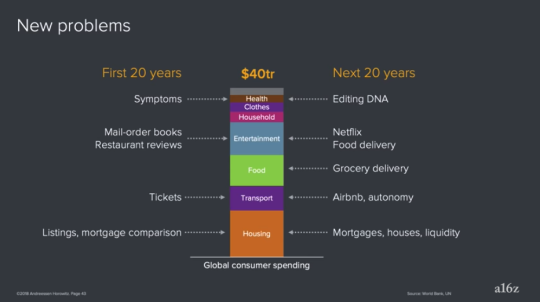
    image

    Above is a screenshot from a presentation about the future of tech that Benedict Evans gave last week at venture capital firm a16z’s annual conference. And below is a video of the talk. If you can’t see it, click here.

    [youtube https://www.youtube.com/watch?v=RF5VIwDYIJk&w=560&h=315]

    The talk is positioned as “the end of the beginning.” In other words, here is where the internet and smartphones have taken us, but that’s just the beginning. Quote: “We used to do apartment listings [online] and now Opendoor will buy your home.”

    It’s only 24 minutes and well worth a watch.

  • Tech and the North American office market

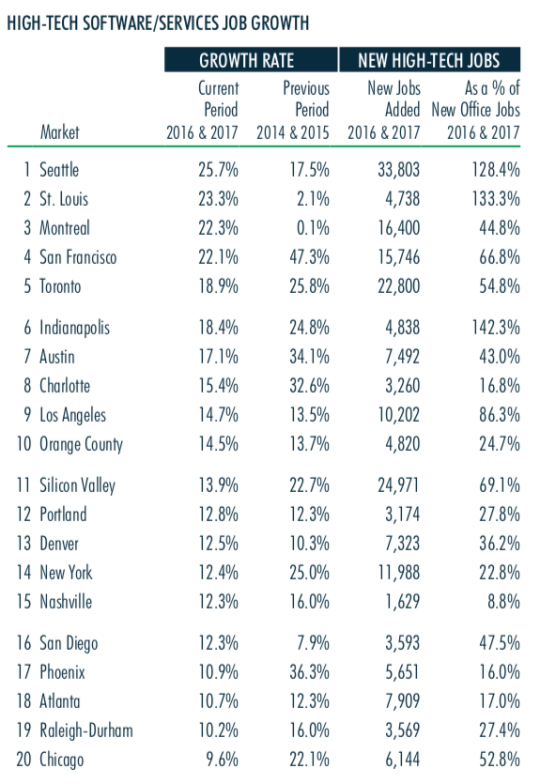
    CBRE recently published this report looking at the impact of the “high-tech software/services industry” on the North American office market. 

    Here are a few highlights:

    – Since 2010, tech has created ~1.1 million jobs in the US at an annual growth rate that is 3x the national average.

    – Seattle currently has the fastest tech job growth in North America. This is the first time in 7 years that San Francisco hasn’t been at the top of their list.

    – Silicon Valley, Toronto, New York, and Los Angeles all added more than 10,000 tech jobs from 2016 to 2017.

    – The biggest “momentum markets”, relying on 2016 and 2017 data, are Montreal, St. Louis, and Seattle.

    – Over the past two years (Q2-2016 to Q2-2018), Atlanta, Los Angeles, Orange County, Seattle, and Portland have all seen double-digit rent growth.

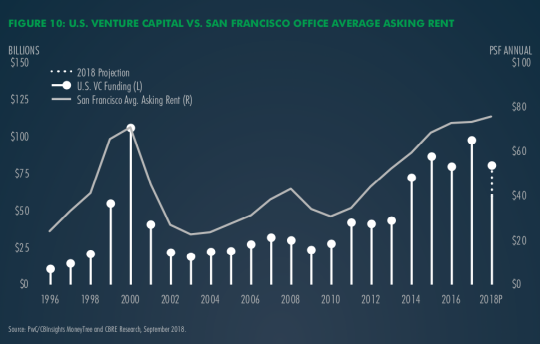
    One figure that also stood out for me was this one here showing the relationship between US venture capital investment and the average asking rent for office space in San Francisco.

    If you’d like to download the full report, click here. You’ll need to sign up for an account with CBRE, but it’s free to do that.

  • Create things people love

    I just finished listening to this podcast about venture capital and consumer products. One of the underlying questions is whether we are currently in a “consumer downturn.” Rebecca Kaden of Union Square Ventures (USV) talks about the importance of “platform shifts” for venture returns. These are moments where a new technology hits the marketplace and there’s a corresponding mass consumer adoption. When and where will that next shift occur? Maybe it’ll be in real estate.

    I like the discussions at 10:00 and 13:50. The first deals with the importance of non-paid customer acquisition strategies for consumer products. Rather than relying on bought attention, you really need organic growth strategies, which is often an indication that people are passionate about your product. This is arguably more important when you’re fundamentally reliant on massive growth/scale, but whether we’re talking about software or a home, I still believe it’s paramount. Create things people love.

    The second point is about commerce, Amazon, and how USV avoids investing in companies that are unlikely to ever win against Bezos. Kaden’s position is that Amazon’s advantage is and has been more executional than structural. They are simply really good at doing things better. But Amazon wins at logistics, speed, and value. They are not as focused on experience, entertainment, and discovery. And people still want that.

    I’ll stop there. If you can’t see the podcast below, click here.

    [soundcloud url=”https://api.soundcloud.com/tracks/507691569″ params=”color=#ff5500&auto_play=false&hide_related=false&show_comments=true&show_user=true&show_reposts=false&show_teaser=true&visual=true” width=”100%” height=”300″ iframe=”true” /]