Daily insights for city builders, delivered every morning at 6 AM ET. I’m Brandon Donnelly — a Toronto-based real estate developer and founder of Globizen. I’ve been writing here since 2013.

Tag: venture capital

  • The rise of proptech

    A friend of mine flipped me this New York Times article today talking about the rapidly growing interest in proptech and about Opendoor – a topic and a company that I have written about many times before on the blog.

    Here’s a snippet about proptech:

    The hauls are part of a race by investors to pour money into technology for real estate, or what Silicon Valley now calls proptech. Having watched tech start-ups upend old-line industries like taxis and hotels, venture capitalists are casting about for the next area to be infused with software and data. Many have homed in on real estate as a big opportunity because parts of the industry — like pricing, mortgages and building management — have been slow to adopt software that could make business more efficient.

    On the Opendoor front, which is the largest/most valuable company in the proptech category, they have now raised over $1 billion. By the end of this year they plan to be in 22 cities across the United States.

    Interestingly enough, they have started experimenting with other business models, beyond just buying and flipping homes. They now circumvent agents and sell some homes directly to customers.

    But Eric Wu, the CEO of Opendoor, believes that you can’t automate proper advice and so that will remain. The role of agents is simply about to shift from “administration” to that of “advisory”.

    I have been arguing for years that the home buying and selling process is ripe for change. And what we are seeing today is really the start of that.

    According to the NY Times, real estate tech startups raised $3.4 billion in funding last year. Some firms, such as Fifth Wall Ventures, are entirely dedicated to the space.

    This is money betting on change.

    Photo by Grant Lemons on Unsplash

  • A more distributed startup geography

    The Economist recently argued that Silicon Valley’s innovation hegemony is waning and that it is a product of two factors: there appears to be more innovation happening elsewhere (good news), but that innovation in general also seems to be harder to achieve (bad news). Here is an excerpt from the article:

    Other cities are rising in relative importance as a result. The Kauffman Foundation, a non-profit group that tracks entrepreneurship, now ranks the Miami-Fort Lauderdale area first for startup activity in America, based on the density of startups and new entrepreneurs. Mr Thiel is moving to Los Angeles, which has a vibrant tech scene. Phoenix and Pittsburgh have become hubs for autonomous vehicles; New York for media startups; London for fintech; Shenzhen for hardware. None of these places can match the Valley on its own; between them, they point to a world in which innovation is more distributed.

    Part of the problem, of course, is rising costs in the Bay Area. Everything from the cost of living to the cost of operating a business. The article cites a recent survey where nearly half of all respondents said they are planning to leave the Bay Area in the next few years. This is up from 34% only two years ago.

    I don’t doubt that rising costs are causing some people to look to other cities, as well as other countries in the case of draconian visa policies. But I am suspect of the claim that we’ve heat peak “innovation” – however you want to define that.

  • Is Tesla the new iPhone?

    image

    Benedict Evans just published a great post on his blog about “Tesla, software and disruption.” I recommend a full read. In it, he tries to answer whether Tesla is really “the new iPhone” and if it will be as disruptive to the car landscape as some/many people think.

    In his line of thinking, electric (as opposed to an ICE vehicle) feels a lot more like a sustaining innovation, rather than a disruptive innovation. In other words, it something that incumbents will be able to incorporate. So it will not change the “basis of competition.”

    The more critical aspect is instead autonomy. Here are two snippets from the piece:

    All of this takes us to autonomy. Electric is compelling but will probably be a commodity, whereas Tesla’s improvements on top of electric may not be commodities but are not necessarily decisive. Autonomy changes the world in profound ways (I wrote about this here), and it’s a fundamentally new technology that doesn’t look at all like a commodity. And Tesla is doing this, too. Sort of.

    In this competition, Tesla’s thesis is that the data it can collect from its cars will give it a crucial advantage. The only reason that anyone is interested in autonomy today is that the emergence of machine learning (ML) in the last 5 years probably gives us a way to make it work. Machine learning, in turn, is about extracting patterns from large amounts of data, and then matching things against those patterns. So how much data do you have?

    But even if we are to all agree that autonomy is the “disruptive innovation”, it is not yet clear who will get there first. Maybe it is Tesla. Maybe it is Waymo. Regardless, many or most people seem to agree that it will arrive in 202x.

    Image: Tesla

  • Winner take all

    We have talked a lot on this blog about the concentration of economic activity in global cities. Here is an old post about a paper called “winner-take-all-cities”, which documents the overrepresentation of talent, economic activity, innovation, and wealth creation in a select number of alpha cities.

    But this same phenomenon is playing out in a myriad of different ways. Aaron Renn calls this the “superstar effect” and has been writing about it for years. Another more recent example is this post by Richard Kerby called: Where did you go to school?

    Kerby looked at where venture capitalists in the US went to school and discovered that around 40% of them have gone to one of two schools: Stanford or Harvard. His argument is that not only is the venture capital industry lacking in gender and racial diversity, but it’s also lacking in cognitive diversity.

    My point with this post, though, is one of hyper-concentration. Tech is a dominant force in today’s economy. And in 2017, nearly 45% of all venture capital investment in the US went to companies located in the Bay Area – meaning San Francisco and San Jose.

    So here is an example of a select number of schools training a select number of minds that then go on to invest in a select number of cities. Fred Wilson, who is a venture capitalist, has a good response to this problem of diversity in the VC industry.

    But, of course, this is bigger than just the VC business.

  • Learning about O-zones

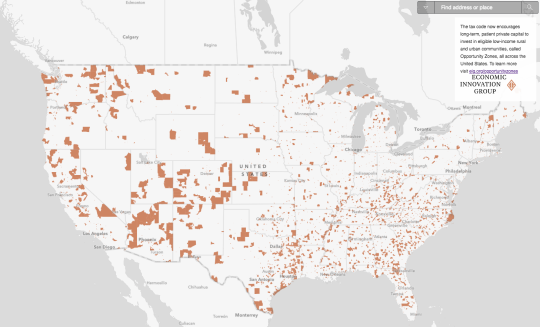
    I spent this evening reading about Opportunity Zones, or “O-zones”, in the United States. 

    For a census tract to become an O-zone, it has to have a poverty rate of 20% or higher, or the median household income has to be less than 80% of the surrounding area. Governors are also only able to designate 25% of their eligible census tracts.

    Here is a map of the areas that have been designated as Opportunity Zones.

    image

    Here is how these O-zones work. (All excerpts taken from this Forbes article.)

    The law’s engine is a new breed of financial product, the opportunity fund, that offers investors a trifecta of attractive tax breaks. Here’s how it works. Investors who sell assets have 180 days to plow their taxable capital gains into an approved opportunity fund, which must hold 90% of its assets in Opportunity Zone projects. To put money to work fast, the law requires that the funds invest all of their cash within some specified time frame. (The Treasury Department is still deciding on that and other crucial details.) Tax on the original reinvested gain isn’t due until 2026, and the taxable gain is cut by 15%. Meanwhile the new opportunity investment grows tax-free, like a Roth IRA, provided it’s held for at least ten years. (If it’s sold earlier, it can be rolled into another opportunity fund and remain tax-free.)

    Here is how it could get the real estate industry to take action.

    For real estate developers, O-zones offer cheap real estate and unlimited, untaxed upside if a neighborhood takes off. Developers must do more than stash cash in crumbling property. To qualify for tax perks, they must make swift and significant upgrades (at least equal to the cost of the initial purchase). With real estate projects come new office buildings, industrial districts, restaurants and affordable housing—all of which can lay the groundwork for an economic boom. “The real estate aspect is a great catalyst to attract new businesses,” says AOL founder Steve Case, an early supporter of the O-zone initiative, whose Rise of the Rest Fund invests in backwater areas. “But it’s the startups that will be the real job creators.”

    And here is how it could influence where new businesses decide to locate.

    “If Facebook could have chosen to locate itself in an Opportunity Zone, like the Tenderloin in San Francisco, the investors would’ve paid no capital gains on their equity,” says Parker, who presumably would have been one of the big winners. The promise of mega-returns could send VCs, investment banks and private equity firms scrambling to launch their own opportunity funds to create incubators, scour second cities for overlooked talent or move portfolio companies into O-zones. “It wouldn’t surprise me if a lot of Silicon Valley VCs started to tell founders, ‘We’d like you to go over the bridge to Oakland, or we’d like you to go to Stockton,’” Parker says.

    If you’d like to learn more about Opportunity Zones, check out the Forbes article.

  • Why confidence is so important in ______

    Those of you who are regular readers of this blog know that I like to incorporate tech into the topics I cover here and that I follow a lot of venture capitalists. 

    Well, I was reading Mark Suster’s recent post on why confidence is so important in (venture capital) fund raising and immediately thought that this audience may also find it interesting.

    Maybe you’re trying to raise money for a real estate development project. Maybe you’re trying to start a small business. Or maybe you’re just interested in human psychology.

    Here’s an excerpt from the post:

    But confidence is CRITICAL in fund raising. Investors are human and humans want what they can’t have and what they perceive other people want. It’s human nature — just read Cialdini and others on this topic. We don’t think we work that way, we do. If you don’t act in demand, people will subconsciously know you’re not in demand.

    It reminds me of one of my favorite lines from one of my favorite movies (which I have posted before on this blog):

    “Now the trick is that we gotta look like we don’t need this shit and they give us the shit for free.“ –Mike Peters

    There’s a lot of truth to that.

  • In defense of the gig economy

    Bill Gurley – who by the way is an investor in Uber – has an interesting piece up on his blog about the thing he loves most about Uber. It is the ability for the network to level load on its own. And here’s what he means by that:

    In spite of all the ink that journalists, analysts, and pundits have spilled on Uber over the years, no mainstream article has focused on what I consider to be the most elegant feature of this now ubiquitous, high growth global service — no driver-partner is ever told where or when to work. This is quite remarkable — an entire global network miraculously “level loads” on its own. Driver-partners unilaterally decide when they want to work and where they want to work. The flip side is also true — they have unlimited freedom to choose when they do NOT want to work. Despite the complete lack of a “driver-partner schedule” this system delivers pick-up times that are less than 5 minutes (in most US cities (with populations over 25K) and in 412 cities in 55 other countries. The Uber network, along with Mr. Smith’s invisible hand, is able to elegantly match supply and demand, without the “schedules” and “shifts” that are the norm in most every other industry.

    When surveyed, most people seem to prefer a job where they set their own schedule and get to be their own boss, compared to a steady 9 to 5 job with benefits and a fixed salary. Assuming that’s true, then this is a feature worth talking about.

  • Two sides of the same bitcoin

    Warren Buffet recently said in a Yahoo Finance interview that when you buy cryptocurrencies you’re not actually investing. Instead, you’re speculating – speculating that “somebody else will come along and pay more money tomorrow.” Investments need to generate a return. And nobody is at all clear on how to value these crypto-assets. This is noteworthy, of course, because it’s Buffet.

    But I thought Fred Wilson wrote a good rebuttal on his blog where he points out that, while, yes, a discounted cash flow model isn’t going to be very useful in helping you determine value in this instance, what we are actually seeing is, “the creation of a new internet, built upon protocols that allow for decentralized networks to form…” We’ve talked about this many times before on the blog.

    So where I stand on this debate is that I agree with both Warren and Fred. I don’t see crypto-assets as something I want to start putting a lot of money into right now because I don’t know how to calculate what the IRR may be. But at the same time, if crypto-assets are creating decentralized infrastructure that will one day power the “new internet”, I am positive this new internet will eventually create businesses that will fit into Warren’s definition of an investment. 

  • Top US metro areas for VC investment

    Below is a list of the US metro areas that saw a billion dollars or more in venture capital investment last year (2017). It is taken from a recent CityLab article by Richard Florida where he talks about the “geographic inequality of high-tech venture capital.”

    image

    It’s worth noting that San Francisco – not San Jose (Silicon Valley) – is at the top of the list with nearly 1/3 of the US total last year. It’s also interesting to note that when you look at each metro’s share of the total change from 2006-2017 (the chart below), you get Los Angeles now punching above San Jose. 

    image

    Florida also gets into which economic and demographic variables seem to be associated with higher levels of venture capital investment. For the rest of the article, click here