Daily insights for city builders, delivered every morning at 6 AM ET. I’m Brandon Donnelly — a Toronto-based real estate developer and founder of Globizen. I’ve been writing here since 2013.

Tag: urbanism

  • rain gravity heat cold

    image

    Today I got a copy of rain gravity heat cold. It’s a book by the Toronto-based architecture firm superkül and it’s meant to celebrate their first 10 years of practice. 

    The book itself was put together by Blok Design. Blok has also done a new – yet to be rolled out – identity for superkül. (Definitely worth a click through.)

    One thing I wanted to highlight from the foreword of the book (written by Kiel Moe) is this line: “Great design does not respond to a static sense of context but rather perhaps transforms its flaws into assets and certainly amplifies the potential of site.”

    We often talk about contextual architecture. That is, architecture which responds to and is sensitive to its surroundings. But here’s the idea that responding is, in fact, not enough. The ambition should be “amplification of site through design.” 

    I like that a lot.

    If you’d like a copy of the book, it can be found on Amazon, at the University of Toronto bookstore, as well as, I’m sure, other places.

  • Ecodesign for cities and suburbs

    Larry Beasley and Jonathan Barnett are about to start teaching a free online course through the University of British Columbia edX called: Ecodesign for Cities and Suburbs. It starts April 4, 2017 and runs for 6 weeks.

    Here’s what you’ll learn (taken verbatim from edx.org):

    • The principles of ecodesign and why it is important as a response to the current disorganized urban growth model
    • Ways to adapt to a changing climate, and ways to mitigate climate change locally
    • Policies to balance auto and airplane transportation with walking, cycling, transit and high-speed rail
    • Ways of designing urban and suburban regulations to make cities more livable and environmentally compatible
    • Strategies for designing and managing the public realm, plus innovative arrangements and processes for implementing ecodesign

    The course is geared toward urbanists from all over the world and so the case studies will be global in nature. You can also participate as actively or passively as you’d like. Though, if you’d like to get a certificate, then you need to fully participate.

    What immediately stood out for me was the focus on both cities and suburbs. In many ways the suburbs are a more challenging problem to solve. So I hope there’s a good amount of focus on that context.

    Beasley was formerly co-director of planning at the City of Vancouver and Barnett is a professor of city and regional planning at the University of Pennsylvania (my alma mater). It should be an interesting course.

  • Collective action problem

    I like this excerpt from City Observatory:

    “More broadly, this paper reminds us of the salience of stigma to neighborhood development. Once a neighborhood acquires a reputation in the collective local consciousness for being a place that is risky, declining, crime-ridden or unattractive, it may be difficult or impossible to get a first-mover to take the necessary investment that could turn things around. The collective action problem is that no one individual will move ahead with investment because they fear (rationally) that others won’t, based on an area’s reputation. A big part of overcoming this is some action that changes a neighborhood’s reputation and people’s expectations, so that they’re willing to undertake investment, which then becomes a self-fulfilling prophecy.”

    It’s taken from an article called: Getting to critical mass in Detroit. The article itself is a response to some of the criticism circulating around that Detroit’s rebound is lopsided toward downtown. But Joe Cortright argues

    (rightly)

    that this is indeed the way to go about it. Concentrate efforts. Establish a critical mass. And then expand from there.

    What I like about the above excerpt is that it’s a reminder that optics, storytelling, and identity all have an important role to play in city building. It’s also a reminder that momentum can develop in either direction and that neighborhood reputation’s can get exaggerated.

  • Landowner vs. city

    In my BARED post with Michael Cooper he described real estate development as being one of the most creative things you can do because of all of the constraints that one has to deal with. This certainly feels true on many days.

    A lot of these constraints also create competing tensions. One example is the tension between what landowners want and what the city may want.

    The value of development land is dependent on what you can build on it. It is, in theory at least, the residual claimant once you factor in all of your other development costs. But in a competitive land market, owners will naturally have high expectations around what their land is worth. And telling them about the intricacies of your residual claimant Excel model will fall on deaf ears if the output doesn’t match their expectations. They see what other land is selling for – even if the land use policies are entirely different – and they want the same or more.

    So to make the math work, it often becomes about density. In practice, many financial models are probably working in the opposite direction to what I described above: here’s how much money the landowner needs to sell; now let’s figure out if we can get enough density to make this work.

    Of course, the challenge with this approach is that you naturally start to push up against a ceiling with respect to density. Landowner wants more density. City wants less density. If I ever ran a development model today where this wasn’t the case, I would instinctively worry that my model wasn’t working properly.

    And therein lies the tension: how can I give this landowner the money that she/he wants, but at the same time satisfy the city and the community, and build enough density such that the project doesn’t lose money? For the time being, ignore the archaeological dig that will need to be done on the site and the creek running underneath it that is going to add $2 million to your underground costs.

    This is where you have to get creative. One potential solution is try and make the price dependent on achieved density. But not all landowners will go for this and sometimes the price spread is so great that even a density bonus isn’t going to close the gap.

    I like to believe that there’s always a creative solution to every problem. Try and make it work. Don’t give up. But the reality is that in many cases the land just isn’t worth the asking price and you’re going to need to walk away. That can be sad, but it can also be the smart thing to do.


  • Big cities, small cities, and automation

    It’s fine to talk about the importance of big cities in today’s world, but there’s another side of this coin to consider. What happens to the towns and smaller cities who aren’t guiding the global economy?

    Here is an interesting snippet from the NY Times that recently caught my attention:

    As one of my college professors recently told me about higher education, “The sociological role we play is to suck talent out of small towns and redistribute it to big cities.” There have always been regional and class inequalities in our society, but the data tells us that we’re living through a unique period of segregation.

    If you combine the above with the fact that a significant number of jobs are likely to be automated in the near term, one has to wonder what the world is going to look like assuming the status quo continues.

  • Top 10 city regions by GDP (and comparable countries)

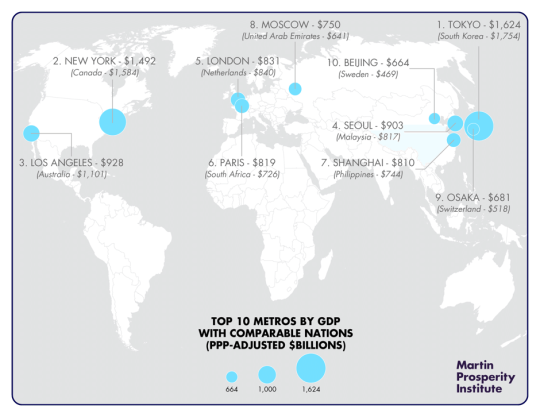
    Below is a mapping (by Taylor Blake of the Martin Prosperity Institute) of the top 10 metro economies in the world by GDP at purchasing power parity. In brackets, is a country with a comparable GDP.

    Tokyo is the world’s largest metro economy with ~$1.6 trillion in GDP. This is greater than the GDP of all of Canada. New York City is number 2 with ~$1.5 trillion in GDP, which is only slightly less than Canada.

    The point of all of this – which Richard Florida argues here – is that the global economy is, today, powered by metropolitan areas. And yet our governance structures do not reflect this new reality.

    Here’s an excerpt from Florida’s article:

    “Cities really are the new power centers of the global economy—the platforms for innovation, entrepreneurship, and economic growth. But when it comes to fiscal and political power, they remain beholden to increasingly anachronistic and backward-looking nation-states, which has become distressingly obvious with the rise of Trumpism in the United States and populism around the world.”

    Florida has been arguing this for years and I’ve really gotten behind it. The above chart is a good reminder just how big and wealthy some cities have become in today’s economy. 

  • We’re still on road pricing

    The New York Times recently argued that self-driving cars can’t cure traffic, but that economics can. Here is the key soundbite:

    “Maybe autonomous cars will be different from other capacity expansions,” Mr. Turner said. “But of the things we have observed so far, the only thing that really drives down travel times is pricing.”

    The argument here is that capacity expansions – such as additional lanes – never solve the problem of gridlock. Yes lane widening projects increase capacity, but the latent demand is so strong that the problem never gets solved. Even in places like Houston.

    We talked a lot about this phenomenon on the blog a few years ago when Toronto was embroiled in debate over the Gardiner Expressway East. But it’s interesting to think about self-driving cars as simply another incremental capacity expansion.

    I have no doubt that this technology will make more efficient use of our roads. Carpooling will be a lot easier – as is already the case. Cars will be able to drive closer together. We’ll be able to stop abrupt breaking and swift land changes, which actually create systemic traffic problems for everybody else.  And the list goes on.

    But there will still be limits to how many people can be efficiently moved on a particular strip of road. Exactly how there are limits to how many people can be efficiently moved via a particular subway tunnel, streetcar line, and so on.

    So if latent demand continues to outstrip available capacity, which has historically been the case, then we are once again back to the politically unpopular idea of pricing away congestion. As much as people criticize it as regressive, I believe that’s where we’re headed.

  • The views are different here

    Tourism Toronto launched a new campaign this week and with it came a great video that has been making the rounds online. It feels authentic. It actually feels like Toronto. Watch it here if you can’t see it embedded below. 

    [youtube https://www.youtube.com/watch?v=eS_tYWIoZzk?rel=0&w=560&h=315]

    But why exactly is it a successful example of place branding?

    Resonance (place branding consultancy) wrote a post about it and also spoke with Tourism Toronto’s EVP and Chief Marketing Officer. Here’s an interesting excerpt about the two things they wanted to achieve in the campaign/video:

    “The campaign—and certainly this video—is trying to achieve two things,” Andrew Weir, Tourism Toronto’s executive vice president and chief marketing officer, tells Resonance. “First, international visitors tend to think of destinations by country, so we had to connect Toronto to the Canadian story.” He says the sprawling, wild country is still generally known for mountains, forests and wilderness, and Toronto wasn’t connecting to that narrative. Enter the “Canada’s Downtown” identity as a way to both incorporate the destination in a national context and differentiate from it. “Toronto is home of the country’s stock exchange, the center of media, the big sports teams are here, we have the long-run theater productions,” Weir rhymes off. “It is the urban center of Canada.”

    The second objective for the campaign (and one held high throughout the commercial) was to be unabashedly proud of the city’s unique alchemy, diversity and inclusivity.

    “We’ve seen the foundation for local pride laid by people and brands like Drake and the Raptors and we wanted to build on that, to separate ourselves from other cities. We tapped into that energy that’s embedded in Toronto’s identity and sense of place.”

    Pride—and a devotion to inclusivity and openness—jumps off the screen. Given the current political direction towards closed borders and suspicion, the goosebumps pop often while viewing.

    At the end of the day though, I think it comes down to the fact that it feels like it captures the zeitgeist of Toronto. As I said at the beginning of this post, it feels authentic. And good place branding doesn’t invent identity. It takes things that are already latent and then exploits them.

    It’s either that or I just like seeing the Chinese food place I go to at 3am featured in a video.

  • Short term, lasting impact

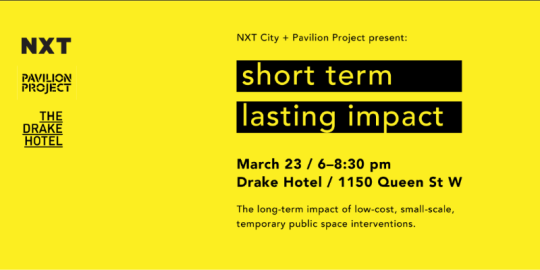
    NXT City and Pavilion Project are hosting an event on March 23, 2017 here in Toronto (at the Drake Hotel) called Short Term, Lasting Impact

    It’s all about how “temporary, low-cost and scalable [urban] interventions” can bring about lasting / meaningful change within our cities.

    Here’s some info on the panelists / topics:

    Matt Rubinoff, Tusk Global // STACKT

    This temporary shipping container market proposes a visionary complex with everything from retail and restaurants to studio spaces and a brewery. What are some of the challenges of bringing an unconventional project to life?

    Rui Pimenta & Layne Hinton, Art Spin // IN/FUTURE ART FESTIVAL

    This art experience reclaimed a beloved Toronto space, transforming it briefly through a multidisciplinary art and music festival. What opportunities can site-specific events bring to celebrate underused spaces?

    Michael McLelland, ERA Architects // PORTLANDS PROJECT

    There are many long-term and competing visions for Toronto’s Portlands. How do we make best use of this prime city site today? How can short-term planning inform a future agenda and create critical cultural space in the near-term?

    I know the folks behind both of these non-profits (NXT City and Pavilion Project), and so I am happy to support this event. Tickets are $10 and can be purchased here.

  • Shareable cities

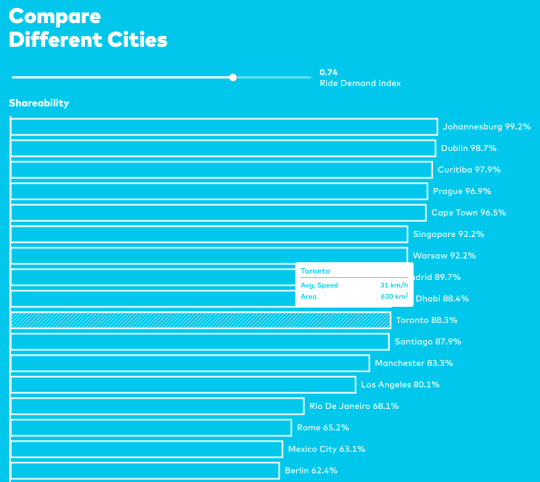
    The MIT Senseable City Lab recently looked at which cities are the most “shareable” when it comes to ride sharing services such as UberPOOL. Their goal was determine what fraction of individual trips (inefficient) could be shared or pooled (more efficient). To do this, they developed a single “shareability curve.” Full research paper, here.

    Not surprisingly, New York City does very well in this analysis. Its shareability is well above 95% for a delta of 5 minutes. That’s because the city has a large population, a small geographic area, enormous density, and lots of taxi traffic. (They used taxi data in their research.)

    But New York City also does very well when it comes to transit ridership. Highest in North America. So it strikes me that the characteristics that make a city “shareable” also apply to transit – which is effectively another form of ride sharing. Might we see the distinction between these 2 forms of mobility blur in the future? I think so.