Daily insights for city builders, delivered every morning at 6 AM ET. I’m Brandon Donnelly — a Toronto-based real estate developer and founder of Globizen. I’ve been writing here since 2013.

Tag: urbanism

  • Toronto real estate is out of control

    You can’t have an Easter dinner in Toronto right now without somebody bringing up the topic of our “crazy” real estate market. 

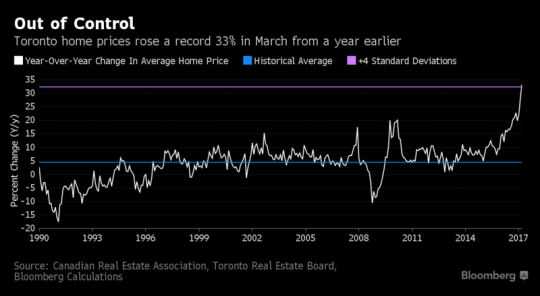
    Below is a chart from Bloomberg showing the year-over-year change in home prices in the Greater Toronto Area since 1990. It also shows the historical average (in blue) and how in March 2017 we hit 4 standard deviations above that. Home prices rose 33% in March compared to a year earlier.
    If I were a realtor, I’d probably tell you that the market is hot hot hot. Now is the time to sell because you’ll get some absurd number above your asking price and now is the time to buy because prices are going nowhere but up. Don’t miss out. 

    I would like to try and be a bit more nuanced than that. Here are 3 thoughts:

    1)

    There’s no question that low rates / cheap money is one of the root causes of the real estate valuations we are seeing today. But frankly I have no idea when or if that will change. There is an interesting argument out there that capital is no longer scarce. Our economy is going through a fundamental shift, which is why real estate is not the only asset class seeing these sorts of valuations and growth figures.

    2)

    There are a number of global factors which are helping to cement Toronto’s position as an alpha global city and destination for human capital. Think Trump, Brexit, and so on. I agree with Richard Florida’s argument that our real estate market will see more – not less – pressure going forward. Here is a snippet from a recent interview with Florida in Toronto Life:

    I think Toronto is going to get an even bigger influx of the creative class. With the rise of Trumpism, more and more people who might otherwise have gone to the United States are going to come to Canada. We’re going to see American tech companies invest more and more in Toronto. And if we think the housing affordability and economic divide we see today is bad, it’s going to grow ever more gaping. 

    3)

    I believe that there are always opportunities in the real estate space, but that you have to be disciplined, focused on fundamentals, and willing to do things that others won’t. What bothers me is when I hear people say things like: “Real estate only goes up. You can never go wrong.” I started my career pre-2008 and lived in both the United States and Ireland. I saw what down looks like.
  • We are all being manipulated by behavioral economics

    Ever notice how whenever you’re taking an Uber the driver usually gets another fare just before he (Uber drivers are overwhelmingly male) is about to drop you off? That’s on purpose.

    Earlier this month the New York Times published an interactive feature describing how Uber uses behavioral economics (or psychological tricks) to encourage its drivers to work longer, take more fares, and so on.

    Here’s a quick sidebar note about behavioral economics from Francesca Gino of Harvard Business School:

    According to the traditional view in economics, we are rational agents, well informed with stable preferences, self-controlled, self-interested, and optimizing. The behavioral perspective takes issue with this view and suggests that we are characterized by fallible judgment and malleable preferences and behaviors, can make mistakes calculating risks, can be impulsive or myopic, and are driven by social desires (e.g., looking good in the eyes of others). In other words, we are simply human.

    And now back to Uber. One tactic they use is goal setting. People are drawn to goals. This translates into driver messages like this one: “You’re $10 away from making $330 in net earnings. Are you sure you want to go offline?”

    But the experiment I found most interesting from the NY Times piece is the one that Lyft completed where it discovered that showing drivers lost/dropped fares was a far more powerful motivator than showing completed rides. In other words: Look at all this money you’re losing out on by not driving!

    This finding is in line with something I’ve written about a few times before on this blog: prospect theory. One of the tenets of this theory is that “losses hurt more than gains feel good.” We, humans, tend to focus more on the former.

    Of course, Uber is not alone in employing behavioral economics. Every app on your phone is being continuously optimized so that it gets as much of your attention as possible. But where is the line between encouragement and manipulation?

    If you’re interested in this topic, check out this HBR article called, Uber Shows How Not to Apply Behavioral Economics.

  • Betting on electric and autonomous

    On Monday, Tesla surpassed GM in market value, making it the most valuable U.S. automaker. It’s also the first time in modern history that this title was held by a car maker not based in Detroit. The gravitational pull to Silicon Valley is immense, today.

    I subscribe to Alan Murray’s CEO Daily newsletter and his overarching comments were as follows: GM sold 10 million cars last year. Tesla sold 76,230 cars (albeit high value cars – my 2 cents). And Tesla lost three quarters of a billion dollars last year. Are we partying like it’s 1999?

    This is an expectations game.

    Elon Musk crafted an electric sports car that was actually cool and Tesla is certainly one of the leaders when it comes to autonomous vehicle technology. If Tesla is the company that transitions our economy to both electric and autonomous vehicles, then is a current market cap > $51 billion justified?

    I don’t know.

    But given how often we talk about electric and autonomous vehicles on this blog (in the context of city building), I thought it would be worthwhile to also talk about where Wall Street is putting its money and placing its bets.

  • Thickets of haphazardly planned condo towers

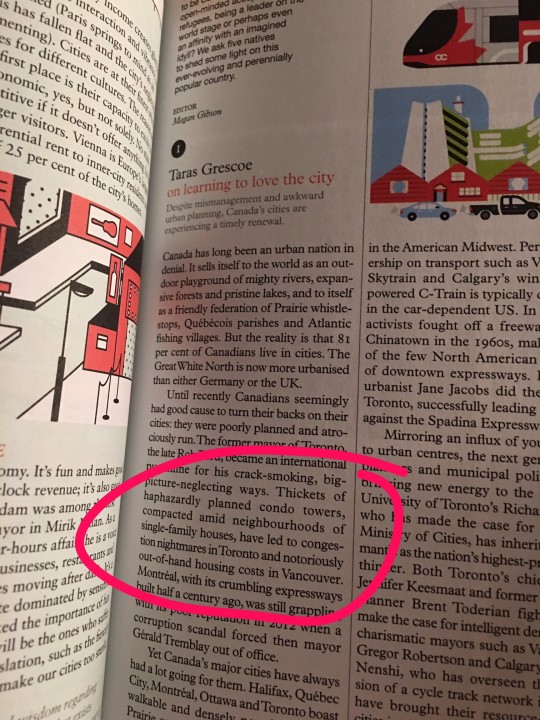
    I couldn’t sleep last night, so I got up and pulled out an old issue of Monocle magazine from my nightstand. I then stumbled upon the following article by Taras Grescoe.

    What really stood out for me was this line:

    “Thickets of haphazardly planned condo towers, compacted amid neighbourhoods of single-family houses, have led to congestion nightmares in Toronto and notoriously out-of-hand housing costs in Vancouver.”

    It bothered me for a few reasons:

    – The frame of reference is the single-family house. It perpetuates the cultural bias that what matters most in cities, like Toronto and Vancouver, is low-rise housing.

    – I don’t get the “haphazardly planned” comment. New tower development has been heavily concentrated in the downtown core, growth centers, along the Yonge subway corridor, and so on. Their built form is also significantly influenced by their relationship to these low-rise “Neighbourhoods.”

    – I believe that building up, as opposed to out, is the way to address congestion nightmares. Though I will concede that our ability to plan and execute on transit in this city is positively deplorable. 

    – How did thickets of condos create an affordability problem in Vancouver? Many factors at play in this city, including a powerful geographic supply constraint.

    Those are just a few of my thoughts from early this morning. What are yours?

  • This river I step in is not the river I stand in

    image

    I was over at the Riverside Bridge yesterday taking photos and I was reminded of Eldon Garnet’s installation called, TIME: AND A CLOCK (1995). 

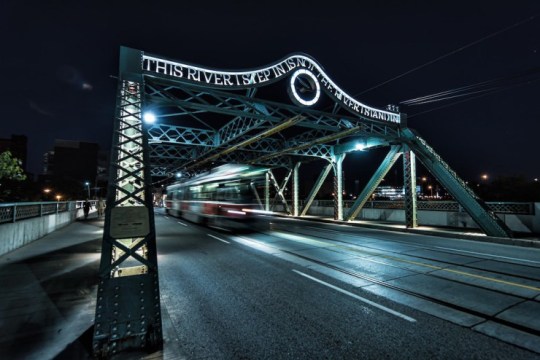
    The work spans a few physical sites, but perhaps the most well known component is the line of text on the west side of the bridge, which reads in 18″ high letters: “This river I step in is not the river I stand in.” (Photo above from Garnet’s website.)

    If you’re from Toronto, you may be already be familiar with this installation. But I love the message and I think it’s an important one. So I thought I would reiterate it here on the blog. 

    The text is derived from the thinking of the Greek philosopher Heraclitus. Its meaning is a simple one: change is fundamental to the universe. 

    Neighborhoods change. Cities change. Industries change. We change. The river you first step into, is not the same river that you’ll be standing in. That initial river has come and gone, replaced by a new river. In the words of Heraclitus, “No man ever steps in the same river twice.”

    As people, organizations and cities age, there can be a tendency to resist change. I believe in fighting that tendency. 

    Because that’s how established rich companies get destroyed by young poor companies. They – the incumbents – underestimate the importance of change. They forget that the river is constantly flowing.

  • Case Study: Chophouse Row, Seattle

    The Urban Land Institute recently published an interesting case study for a project in Seattle called Chophouse Row

    It is the last phase in a series of projects that the developer, Liz Dunn, has been involved with in the neighborhood over the last 16 years.

    This particular project has 25,317 sf of office, 6,379 sf of retail, and 4,795 sf of residential (3 penthouses). It also incorporates a heritage building. Good example of fine-grained urban infill.

    Here is the video (click here if you can’t see it below):

    [youtube https://www.youtube.com/watch?v=_PmAMsWEv98?rel=0&w=560&h=315]

    On a related note, ULI’s 2017 Toronto Symposium is coming up later this month (April 24 – 25, 2017). Here is the program. 80+ speakers. If you’d like to register, you can do that there.

  • Ingressi di Milano

    A new architecture book, called Entryways of Milan, will be released next month that profiles some of the city’s most beautiful residential entryways. There are 144 of them and they are housed in buildings dating from 1920 to 1970. For a sneak peek of the architecture, click here.

    What makes a book like this interesting is that these are private entryways, which means they are spaces that are largely overlooked within a city. They are the spaces that mediate between public (street) and private (residences). The book also dives into things like materials and the art-historical and social significance of each lobby.

    I am now wondering if similar books or photography projects exist for other cities. I think it would be fascinating to compare residential entrance halls across different cities during the same time period. Although the above Milanese lobbies have set the bar pretty high. 

  • The Millennial Dream [Documentary]

    Back in 2015, I was interviewed for a documentary called The Millennial Dream. I then completely forgot about it until somebody tweeted it at me yesterday. So the documentary is out – it was released last year – and you can rent it or buy it on iTunes.

    The documentary calls into question the [North] American Dream. This idea that you just have to work hard, save up, buy a house in the suburbs, pay off your debt, and then everything will be just fine. For many, that dream is quickly disappearing, if it hasn’t already.

    Enter the Millennial Dream. Our economy is changing. Our jobs are changing. Our cities are changing. And by 2020, the Millennial generation is expected to form 50% of the global workforce. What is this generation dreaming about? That is what this documentary is about.

    But I should probably stop here because I haven’t actually seen the film. I could be overselling it. I’ll watch it this weekend and then report back. If you can’t see the trailer embedded below, click here.

    [youtube https://www.youtube.com/watch?v=CVCNXJk2fT8&w=560&h=315]

  • Downstream effects of electric and autonomous vehicles

    I speculate a lot on this blog about what electric and autonomous vehicles will mean for the future of our cities. The reason it’s speculation is because it’s phenomenally difficult to know with any sort of certainty what the downstream effects of these technologies will be.

    I’ve seen some people claim that a car is still a car. That is, all of the same rules will apply even if they’re powered completely by renewals and we manage to make drivers obsolete (5-10 years?). But I fundamentally disagree with this line of thinking. There will be both positive and negative consequences. They are just yet to be seen.

    Benedict Evans recently wrote a post where he started to think about where some of these changes might happen. And so I thought it might be valuable to throw a few of these into the discussion mix. Here are some of his ideas:

    • About half of car maintenance spending in the US goes to things directly related to the internal combustion engine. Electric takes that away.
    • There are about 150,000 gas stations in the US. They go, along with their associated convenience stores, which is where the margins are made. Interestingly enough, more than half of all US tobacco sales happen at gas stations. Where does that go?
    • It is estimated that electric vehicles will increase overall electricity demand by 10-20%. But this could disappear with the battery storage and off-peak power.
    • Globally, about 1 million people die every year from car accidents. In the US, something like 90% of all accidents are thought to be caused by human error and about 1/3 of fatal accidents involve alcohol. Autonomy has the potential to take most of this away. Personally, I think we’ll look back and think about how dangerous driving used to be and wonder how/why we all did it.
    • A complete rethink of parking. This obviously gets talked about a lot. ~14% of LA’s land is thought to be used for parking. My guess is that parking ratios/requirements go way down (we’re already in the 0 to 0.3 per residential unit territory here in Toronto) and parking garages transform into yards for AVs.
    • Autonomous vehicles once again rewrite the retail real estate landscape. Benedict believes they will create more billionaires in real estate and retail than in tech or manufacturing. I like how he describes big box retailing as an arbitrage of land costs, transportation costs, and people’s willingness to drive and park. This point is likely about AVs + e-commerce. See yesterday’s post about Amazon.
    • Finally, his last point is that autonomous vehicles could become a kind of mobile Panopticon. The Panopticon was an institutional building typology conceived of by Jeremy Bentham in the late 18th century. It was based on the idea that inmates could all be monitored by a single watchman, without any of the inmates knowing if they were, in fact, being watched. It was a way of trying to impose strict obedience in prisons, and so on. Since virtually all autonomous vehicles require some sort of computer vision, Benedict argues that they could become the 21st century watchmen. Move over CCTV.

    The other big question is about decentralization. New transportation technologies have consistently promoted greater suburbanization – think streetcar suburbs to car suburbs. The fact that you’ll be able to use your time more productively in an autonomous vehicle is continually floated as an argument for this trend to continue. But I haven’t made up my mind about this one.

    Do you have any other thoughts on the downstream effects of electric and autonomous vehicles?

  • Amazon is just getting started

    image

    The Economist has an article up talking about what a behemoth Amazon has and will continue to become. Here are some interesting stats for you to think about:

    • More than half of every dollar spent online in America now goes to Amazon
    • Amazon’s share price has increased 173% since the beginning of 2015 (12x faster than the S&P 500)
    • With a market capitalization > $400 billion, it is the 5th most valuable company in the world
    • 92% of its value is supposedly being derived from profits expected after 2020 – they are playing the long game
    • Investors believe that revenue will go from $136 billion (2016) to half a trillion over the next decade

    If I can buy something online, instead of in person, I will do it. And that very often leads me to Amazon. In fact, I bought my new camera lens from them last week. Many others seem to be doing the same.

    When I go to a store now it’s because I need something immediately or because I’m looking for a new experience. I want novelty and I want to feel something special when I walk in. That, or I just need groceries.