Daily insights for city builders, delivered every morning at 6 AM ET. I’m Brandon Donnelly — a Toronto-based real estate developer and founder of Globizen. I’ve been writing here since 2013.

Tag: urbanism

  • Big bad developer

    I just stumbled upon an older (2014) article by Oliver Wainwright in the Guardian called, The truth about property developers: how they are exploiting authorities and ruining our cities. In case the title didn’t give it away, it’s a scathing article about the current state of real estate development and city building.

    Here’s an excerpt:

    “Across the country – and especially in superheated London, where stratospheric land values beget accordingly bloated developments – authorities are allowing planning policies to be continually flouted, affordable housing quotas to be waived, height limits breached, the interests of residents endlessly trampled. Places are becoming ever meaner and more divided, as public assets are relentlessly sold off, entire council estates flattened to make room for silos of luxury safe-deposit boxes in the sky. We are replacing homes with investment units, to be sold overseas and never inhabited, substituting community for vacancy. The more we build, the more our cities are emptied, producing dead swathes of zombie town where the lights might never even be switched on.”

    Now, I’m not that familiar with the London market, so I can’t really comment on the dead swathes of zombie town. But I did enjoy the insights into the UK entitlement process.

    At the same time, my overarching thought as I read through the article was that I don’t believe that making money and doing what’s right need to be mutually exclusively. You can do both in development and in business. Making money as a developer does not mean you have to build shitty buildings.

    Part of the development game is managing an endless number of competing tensions. And profitability and responsible city building is just one of them. Of course, you have to want to do the right thing in the first place.

  • An Honest Farewell

    image

    I spent Saturday evening at Honest Ed’s for An Honest Farewell. It was a lot of fun. There were many familiar faces. And it felt very Toronto. See above photo.

    But part of me felt a bit phony pretending to celebrate the end of 68 years of operations. Truth be told, I’m not sure I ever bought anything from Honest Ed’s. Had it turned into a 3 floor super club sooner, perhaps I would have spent a bit more time there over the years.

    To me, Honest Ed’s was great big signage. 

    When I was a kid, my mom used to work on Bathurst Street just north of Bloor and I would go downtown with her early in the morning before school. It would still be dark out and I remember being so captivated by the bright lights of Honest Ed’s. That’s what the city meant to me. Lights. Flash. Excitement. It was where I wanted to be.

    A portion of the signage is being preserved and moved to Yonge and Dundas. But otherwise, this past weekend was the official end of an era. What matters now is the future of Mirvish Village. And the future is exciting.

    I’ll end with an excerpt from a recent Globe and Mail article by Alex Bozikovic:

    “The new development at Mirvish Village, after two years of conversation between developers Westbank, locals and the city, is inching closer to approval, with a new proposal submitted in January to the city. Westbank paid $72-million for the site, a big number, and yet the result is as good as private development gets in Toronto. It features meaningful preservation of heritage buildings, a serious sustainability agenda, and affordable housing – not to mention an architectural and leasing strategy geared at making the place as lively as possible, even a bit weird.”

  • 121 E 22nd

    My friends in New York tell me that if you want to sell a luxury residential building, you need a name brand architect. People care about architecture and it’s part of the buying process: “Oh, it’s a Herzog building.”

    To that end, Toll Brothers City Living just released the following video for their 121 E 22nd project in New York. If you can’t see it below, click here. What’s notable, is that it is OMA’s first full building in New York. So the story is: star architect + first building in the city.

    [youtube https://www.youtube.com/watch?v=dSQq8W8od9g?rel=0&w=560&h=315]

    But there’s more. It’s almost unbelievable that, until now, OMA hadn’t designed and constructed a full building in New York. I reread this Dezeen article 5 times just to make sure I wasn’t missing something.

    So much of Rem Koolhaas’ career (founding partner of OMA) is centered around New York City. In 1978, he published Delirious New York, where he both dissected and celebrated the city’s “culture of congestion.” Oysters at the downtown athletic club, anyone?

    This book was so influential that I bet you’d be hard pressed to find an architect that doesn’t have it in their collection. I have his approximation of New York hanging on my wall. So this was clearly overdue. Kudos Toll Brothers City Living.

    Note: OMA’s New York office is led by Shohei Shigematsu.

  • 3 pilot options for Toronto’s King Street corridor

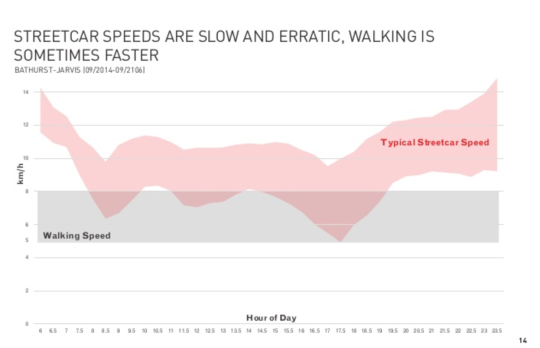
    Anyone who has ridden Toronto’s King streetcar during rush hour can tell you that the service is broken. It’s unreliable. It’s overcrowded. And during peak times it can be faster to walk. Chart below.

    Part of the problem is a misallocation of resources. Only 16% of the people who use the corridor are in cars. And yet 64% of the physical space is allocated to drivers.

    Not surprisingly, this creates a bottleneck for the ~65,000 transit riders who use the service daily. (Busiest surface route in the region.) We are not optimizing for the right variable.

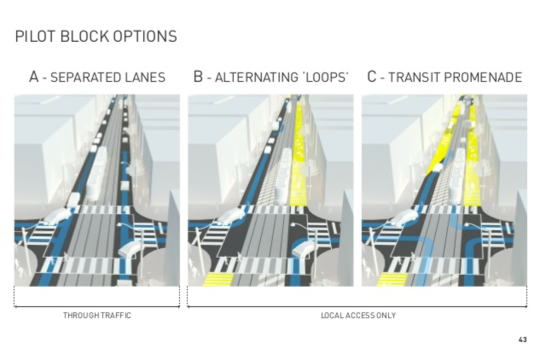
    It’s for this reason that the city is working on a rethink of the corridor. I wrote about this initiative last year, but earlier this week it got a bit more real with the release of the following 3 pilot block options.

    The plan is to launch a pilot sometime this fall (2017). This is good news. 

    If you’d like to go through the full King Street Pilot Study Public Meeting presentation, you can do that by clicking here. The above images were taken from that presentation.

  • America’s urban infrastructure — what to do?

    The Penn Institute for Urban Research recently asked a dozen experts to weigh in on the topic of urban infrastructure in the United States. More specifically: What should the US do? It is a direct response to President Trump’s inauguration speech, where he described America’s infrastructure in terms of “disrepair and decay.”

    The urban experts include Eugénie L. Birch, Saskia Sassen, Susan Wachter, Richard P. Voith, and many others. Richard Voith’s piece is called, Historical Patterns of Infrastructure Funding. (I was his teaching assistant while I was at Penn and I still follow his work.) 

    I found it interesting how infrastructure funding has shifted from the federal level to the local municipal level – especially in the realm of public transit. Given the rise of urban centers, this makes intuitive sense. But Voith also argues that “relying only on local funding of transportation will almost certainly result in an under supply of infrastructure.”

    For the full Expert Voices series, click here. I think many of you will like it.

  • And the award for the tallest building of the year goes to…

    The Guardian recently published an article on vanity height in skyscrapers. What this is referring to is the unoccupied portions of tall buildings which are built purely for vanity reasons – that is, to increase the face height of the building and claim some superlative title.

    Example: 

    The tallest building in the world is currently the Burj Khalifa in Dubai. It’s 828m tall. To put that into perspective, the CN Tower in Toronto is 553m. But according to the Council on Tall Buildings and Urban Habitat, 29% of the Burj Khalifa’s height is actually unoccupied or “vanity space.” In other buildings, such as the Burj al Arab (also in Dubai), the amount of unusable space is as high as 39%. 

    For the purists out there, this of course raises the question of what should should be counted when assessing building height. Should it only be spaces where humans typically inhabit? The CN Tower has a lot of unoccupied space, which is why it is frequently excluded from these sorts of ego rankings. 

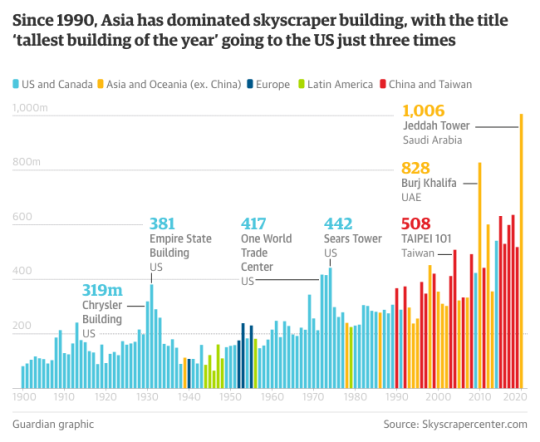
    But semantics aside, this is obviously not a new phenomenon and it’s interesting to think about this race to the sky as a proxy for what’s going on in the world. Below is a chart showing which regions have been able to lay claim to the “tallest building of the year” since 1900. 

    Since 1990, it has been all about Asia and Oceania and China and Taiwan…

  • Form follows parking

    “Form follows function” is a famous axiom of 20th century Modern architecture. It is based on the rational notion that architecture and its associated shapes, geometries, and spaces should be a direct result of their function. 

    It was a way of trying to eliminate the arbitrary ornament that had adorned previous architectural movements. In this case, if it had no function, then it should be stripped away.

    There have been many bastardizations of this pithy statement over time, but one of my favorites is: “form follows parking.” Obviously derogatory, it is this idea that much of the built environment is a result of parking requirements, rather than of more human factors.

    We see this in suburban building typologies (large surface parking lots), but also in urban infill projects where the below grade parking begins to dictate the structural grid and layout of the upper floors. It is, of course, necessary in many cases, but there’s also something subversive about parking having such a lasting impact on the spaces we occupy.

    That said, we know where the trend line is headed when it comes to parking. Streetblogs recently posted an article about the scarcity of parking in Manhattan and cited number of interesting stats.

    Because of the city’s bike-share program (introduced in 2013) and because of all of the bike lanes that have been added in recent years, the city has (rightly) removed approximately 2,330 on-street parking spaces in Manhattan south of 125th Street.

    Here’s another set of stats: 

    In 1998, New York City had about 810 parking lots and garages south of 60th street. Together, they accounted for approximately 112,826 parking spaces. As of last year (2016), the number of lots and garages had dropped to about 643 and the number of parking spaces to approximately 95,000. That’s a decline of about 16%, during a period of when the population of Manhattan grew by more than 100,000 people.

    I would also imagine that these pressures are increasing. So it is quite possible that “form follows parking” could be on its way toward obsolescence. I certainly feel it waning.

  • Driving in the HOT lane

    image

    Joe Cortright of City Observatory recently published an interesting post on HOT lanes (high-occupancy toll lanes) and cited a research paper by Austin Gross (University of Washington) and Daniel Brent (Louisiana State University). The paper looked at the behavioral response of drivers to dynamic HOT lane pricing. 

    They way HOT lanes work is simple: when traffic is light, the price dynamically decreases; when traffic is heavy, the price dynamically increases to ensure a minimum level of service. That is, the price increases until enough cars leave the lane and driving speeds increase to some minimum threshold. In this case, it’s 45 mph.

    The key takeaway from the report is that “value of reliability” appears significantly more important to drivers than “value of time”. Put differently: it’s less about the time I’m wasting in traffic and more about the uncertainty of not knowing when I’m going to arrive at my destination.

    It’s for this reason that HOT lanes are used more frequently in the morning (when you’re running late for that meeting) than in evening (when you’re just on your way home from work). 

    Gross and Brent estimate that the spread is about 7.5x. The typical driver values saving time at about $3 per hour and reliability improvements at about $23 per hour! This is fascinating because we tend to focus a lot on time. But arguably what people really want to buy is greater certainty.

    I can tell you that it’s definitely one of the things that I love about walking to work, or for that matter cycling somewhere. I always know how long it’s going to take.

  • The Canadian Dream (and 5 things that hurt upward mobility)

    image

    About 7.5% of American children born into the bottom quintile of the income distribution will eventually make it into the top one fifth. In the UK this number is about 9%. And in Canada and Denmark, the numbers are 13% and 13.5%, respectively. (The upper bound for these numbers is 20% since you can’t have more than 20% in the top 20% of the income distribution.)

    Because of stats such as these, Freakeconomics recently asked: Is the American Dream really dead? And if so, should it instead be called the Canadian Dream, seeing how it’s more readily obtained.

    Of course, it’s not necessarily as simple as 7.5% vs. 13%. Upward mobility exhibits a lot of regional variation. In the American southeast, the number is closer to 4%. Whereas in the San Francisco Bay Area, the number is up there with Canada and Denmark. However, this phenomenon is so location-specific that even kids growing up in San Francisco are twice as likely to get to the top 20% compared to kids growing up across the bridge in Oakland.

    There’s also a question of spread. Canada and Denmark have less income inequality, meaning you don’t have to travel as far to get to the top of the income distribution. 

    Still, the reality is that it is becoming harder for Americans to climb the socioeconomic ladder. The number of 30-year old Americans who today earn more than their parents is dropping compared to previous decades. So what needs to be done? What is causing this erosion of the American Dream?

    It turns out that city builders have an important role to play in solving this problem. Because where you live – and in particular where you grow up as a kid – matters.

    The Freakeconomics episode examines a study that was done by Raj Chetty, Nathaniel Hendren, and Lawrence Katz, called: The Effects of Exposure to Better Neighborhoods on Children. And their findings were exactly that. Place matters. The study reexamines the findings of a program that was administered in the mid 1990′s in the US called Moving to Opportunity (MTO). This program randomly offered families living in high-poverty neighborhoods the opportunity to move to neighborhoods with far less poverty. 

    Upon initial review, the program was seen as a failure. There were some positive health outcomes, but no meaningful changes in income. But when Chetty and company took another look at the data – now with more time and IRS data on their side – they discovered that the impact was in fact dramatic. Relocated families raised children that earned 30% more, were 27% more likely to go to college, and 30% less likely to be a single parent. The key, however, was that the children had to relocate when they were young (< 13 year olds). The older they got, the less benefit they received from moving, eventually reaching a plateau where there was basically no benefit at all.

    Here are the 5 things that ended up having significance in their findings:

    1. Residential segregation by income and race is bad. Mixed neighborhoods are good. The southeast is filled with segregated cities and that’s one of the reasons why they underperform in this exercise. San Francisco, on the other hand, was far more mixed in the 80′s and 90′s when the kids belonging to this study were growing up. One could debate whether that’s still the case. I guess we’ll find out in a few decades.
    2. Income inequality negatively impacts upward mobility. See The Great Gatsby Curve.
    3. Single parent households seem to have an impact on upward mobility. However, the data suggests that it’s not just about whether the child in question grew up with married parents. The percentage of single parent households in the neighborhood also matters. Because even children in dual parent households in a neighborhood with lots of single parent households, showed muted upward mobility.
    4. Social fabric. Connections to family and friends matter. It’s about having a support network. (Freakeconomics mentions a book called Bowling Alone that is now on my reading list.)
    5. Not surprisingly, the quality of public schools matters.

    All of the stats for this post were taken from this Freakeconomics Radio episode. For me, it is such an important reminder that the way we plan and build our cities can have meaningful and longstanding impacts on the kinds of children we raise.

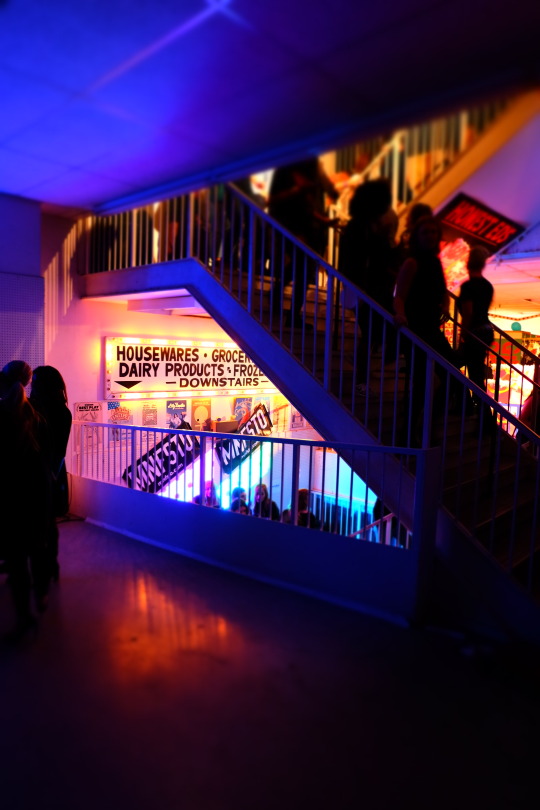
  • I love neon

    “As the manufacture of storefront signage becomes increasingly standardized,” says a circular from Berlin’s Buchstabenmuseum, “the tradition of idiosyncratic signs created by skilled craftspeople, reflecting regional differences and a firm’s unique character, is dying out.”

    The above quote is from this Globe and Mail article talking about the lost art of sign making and about an exhibition that starts today (until January 27) in Montreal at the Media Gallery of Concordia University’s Communication Studies and Journalism Building. It is called Tel Quel / As Is and it is by the Montreal Signs Project.

    Cities all around the world are facing a decline in distinctive local signage, which is not all that different than the decline in regional architecture. We are living in a global village.

    Montreal has responded with the above project. Berlin has responded with the Buchstaben Museum (letter museum). And here in Toronto, Mark Garner of the Downtown Yonge BIA has been trying to convert one of our laneways into a haven for restored Toronto neon signs. Great idea.

    It can be challenging to repurpose old signs. There are often issues of appropriateness and scale. Sometimes a new or renovated building looks good with its old signage. But in other cases – and perhaps more often than not – it wouldn’t. So then what do you do with it?

    Still, it behooves us to try. Signs, like buildings, are a snapshot of a moment in time. They are part of the environment that we create for ourselves. They are part of our history.