Daily insights for city builders, delivered every morning at 6 AM ET. I’m Brandon Donnelly — a Toronto-based real estate developer and founder of Globizen. I’ve been writing here since 2013.

Tag: urban planning

  • The public life data protocol

    The Gehl Institute has just launched (in beta) something called the Public Life Data Protocol. It was developed by the Institute, as well as by Gehl (the practice), the Municipality of Copenhagen, the City of San Francisco, and Seattle’s Department of Transportation.

    The goal of the protocol is to improve the way in which we collect, share, and compare public space information. It is about improving public life in public spaces.

    To do this, they have proposed a series of metrics that measure everything from “posture within the space” to “objects brought into the space.” They also propose spatial metrics that help to analyze public life in relation to its physical context.

    Gehl is a real leader in this space. I commend them on opening up their methodology and working to create “a common language for people data.” Great data will only help us to build more human-centered cities.

    To download a full PDF of the protocol, click here

    Photo by Thaddaeus Lim on Unsplash

  • Thickets of haphazardly planned condo towers

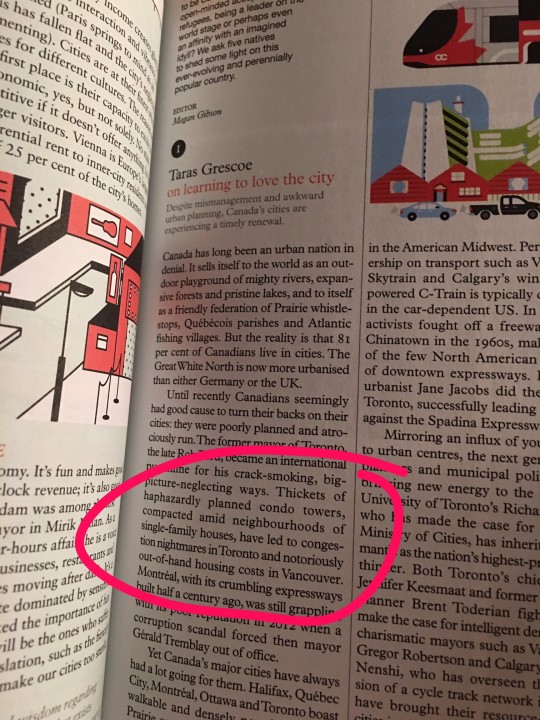
    I couldn’t sleep last night, so I got up and pulled out an old issue of Monocle magazine from my nightstand. I then stumbled upon the following article by Taras Grescoe.

    What really stood out for me was this line:

    “Thickets of haphazardly planned condo towers, compacted amid neighbourhoods of single-family houses, have led to congestion nightmares in Toronto and notoriously out-of-hand housing costs in Vancouver.”

    It bothered me for a few reasons:

    – The frame of reference is the single-family house. It perpetuates the cultural bias that what matters most in cities, like Toronto and Vancouver, is low-rise housing.

    – I don’t get the “haphazardly planned” comment. New tower development has been heavily concentrated in the downtown core, growth centers, along the Yonge subway corridor, and so on. Their built form is also significantly influenced by their relationship to these low-rise “Neighbourhoods.”

    – I believe that building up, as opposed to out, is the way to address congestion nightmares. Though I will concede that our ability to plan and execute on transit in this city is positively deplorable. 

    – How did thickets of condos create an affordability problem in Vancouver? Many factors at play in this city, including a powerful geographic supply constraint.

    Those are just a few of my thoughts from early this morning. What are yours?

  • The suburban Ponzi scheme

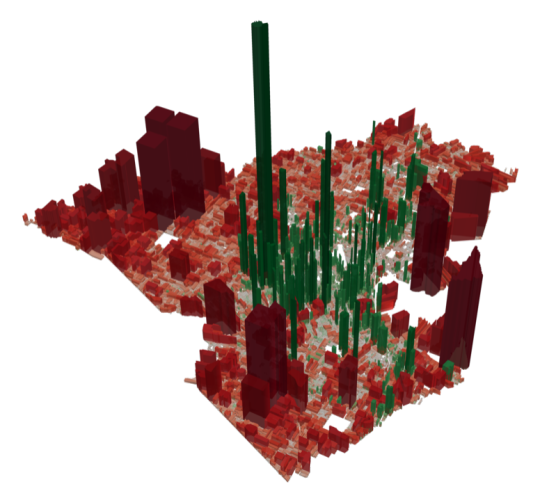
    The following image is a geographic representation of Lafayette, Louisiana’s finances. It is from this excellent article by Charles Marohn.

    What this 3D map shows is the city’s revenues and expenses by land parcel. The green areas are where the city is making a profit (revenues exceed expenses) and the red areas are where the city is operating at a loss (expenses exceed revenues). The height of each extrusion indicates just how much profit is being made and how much loss is being incurred.

    The glaring takeaway from this study is this: not only are post-war land use patterns environmentally unsustainable, but they are also fiscally unsustainable. The tax base is simply not there to pay for the infrastructure that gets built alongside it.

    They – the authors of this study – estimate that the infrastructure revenue gap for the median home in Lafayette is about $8,000 per year (median household income is $41,000). And yet despite this shortfall, it is common to look at infrastructure spending as a desirable economic stimulus.

    The following paragraph really brings this point home:

    “All of the programs and incentives put in place by the federal and state governments to induce higher levels of growth by building more infrastructure has made the city of Lafayette functionally insolvent. Lafayette has collectively made more promises than [it can] keep and it’s not even close. If they operated on accrual accounting – where you account for your long term liabilities – instead of a cash basis – where you don’t – they would have been bankrupt decades ago. This is a pattern we see in every city we’ve examined. It is a byproduct of the American pattern of development we adopted everywhere after World War II.”

    Thank you Daniel for sharing this article with me. 

    If you only read one other thing today (besides my blog), I recommend you read Charles’ article. It’s called: The real reason your city has no money.

  • Lessons on the transforming city

    image

    Last week, Detroit hosted the 24th annual Congress for the New Urbanism. The theme was: The Transforming City. 

    I wasn’t there, but I would have loved to attend. So many interesting things going on, but so little time. Attention is scarce.

    For those of you who also did not attend, below is a copy of a speech that was delivered by Carol Coletta – senior fellow at the Kresge Foundation’s American Cities Practice. I found it on City Observatory

    The speech does a great job of addressing many of the common misconceptions that people have about cities. I can tell you that I heard many of them just this past weekend.

    Also, if you aren’t familiar with The Kresge Foundation, they are a large private philanthropic foundation based in Troy, just outside of Detroit. You might not recognize the name, but Kresge is the K in Kmart.

    And now Carol Coletta…

    ———————————————————

    Could there be a more apt place to observe “The Transforming City” than Detroit?

    On behalf of Rip Rapson and my colleagues at the Kresge Foundation, welcome to Detroit. If you travel to Detroit regularly, as I have over the past 15 years, you see that Detroit changes quickly.

    The speed of change here sometimes takes your breath away.

    How many of you have walked the Detroit Riverfront or ridden the Dequindre Cut?

    Visited the expanding Eastern Market?

    Seen the Q Line construction on Woodward?

    Eaten a meal at Selden Standard or Wright & Company, one of those meals so special that it deserves its own social media channel?

    Walked the streets of downtown or Midtown and discovered Great Lakes Coffee, City Bird, or the El-Moore Lodge?

    Or met Claire Nelson at the Urban Consulate, or any one of Detroit’s arts and civic innovators responsible for some of the most exciting urban work in the country?

    This is the Detroit you can see right outside this theatre.

    But there is another Detroit, one that is harder to see. It’s the Detroit that feels threatened by the pace of change in the city, suspicious of newcomers eager to be part of the change, and wondering when their loyalty to Detroit will be rewarded.

    Such feelings are not unique to Detroit. Every morning my Google Alerts brings a new batch of headlines from around the country detailing the gentrification battles.

    Because “new urbanism” is the butt of some of this criticism, I want to spend the next few minutes unpacking the myths and the realities of gentrification and what those of us who care about great places can do about it.

    First, let me share some numbers.

    In 1970, about eleven hundred urban Census tracts were classified as high poverty.

    By 2010—40 years later—the number of high poverty Census tracts in urban America had increased from 1100 to more than 3,000. (3165)

    The number of people living in those high poverty Census tracts had increased from 5 million to almost 11 million. And the number of poor people in high poverty Census tracts had increased from 2 million to more than 4 million.

    So over a 40-year period, the number of high poverty Census tracts in America’s core cities had tripled, their population had doubled, and the number of poor people in those neighborhoods had doubled.

    Given that record, I’ll bet a lot of people are hoping for a little gentrification– if gentrification means new investment, new housing, new shops without displacement.

    The idea that places might benefit from gentrification runs against the popular narrative. But here’s the really startling fact: only 105 of the eleven hundred Census tracts that were high poverty in 1970 had rebounded to below poverty status by 2010. That’s only ten percent! Over 40 years!

    A similar study of Philadelphia by Pew found almost exactly the same result in that city’s neighborhoods. There, ten times as many poor neighborhoods (164) experienced real declines in income as experienced gentrification since 2000.

    It is the lack of gentrification that we rarely count and never see. The deterioration happens too slowly for us to notice. But it doesn’t mean the deterioration isn’t devastating. In fact, the high poverty neighborhoods of 1970 lost 40 percent of their population in 40 years.

    You could make the case that poor people are displaced from poor neighborhoods because of their poor schools, their lack of jobs, their more chaotic public spaces, their lack of opportunity.

    Understand, this is not the fault of the people who live there. This is a public policy failure.

    But… when a combination of government intervention, philanthropic support, community development, and market forces combine to change a place as quickly as Detroit—even when that change means new residents, new jobs, and new places to live—it also rightfully generates concern.

    See, we are conflicted about change. Many of us wish we could fix place in time.

    But neighborhoods do change. You know that. You change them. And when change results in mixed income neighborhoods—in other words, when we achieve investment without displacement — it’s good for everybody.

    The research on this is quite clear: The ability of people to improve their economic status from one generation to the next is strongly correlated with mixed-income neighborhoods.

    Many of the public policy interventions to achieve economically integrated neighborhoods have supported poor people moving to wealthier neighborhoods. But that is an expensive, slow political slog that is hard to scale.

    But what if we flipped that script? What if… we could lure people with financial options about where they live to disinvested neighborhoods—resulting in the kinds of places that enable opportunity?

    And what if we also made a special effort to insure that the people remaining in low-income neighborhoods—people without options about where they live—what if an extra effort were made to insure they benefited from new people and new investment in their neighborhoods?

    The research tells us that mixed-income neighborhoods benefit poor people naturally. But can we double down to accelerate those benefits?

    Think of it this way: Can we get gentrification with broadly-shared benefits.

    I think so. But it’s not easy. Remember: Only 10 percent of high poverty neighborhoods “gentrified” over the past 40 years. And today we have triple the number of high poverty neighborhoods than we had 40 years ago.

    Clearly, mixed income neighborhoods won’t happen if we don’t work at it.

    So how can we do that?

    First, let’s acknowledge that, for the first time in 50 years, the market is moving in our favor. People (and jobs) are moving to cities. We need to see that as the opportunity it is to get mixed-income neighborhoods and not fear good, thoughtful development.

    That means we can’t let NIMBYs win the day. The same people who complain about high prices also complain when developers show up to build more supply. We have to make the connection between supply and demand for the protesters and the press.

    But attention must be paid to creating more mixed income housing. Our success on this has been mixed, and I’m struck by the comparison on methods used in NYC and in Portland, Oregon’s Pearl District to create more affordable housing in mixed income settings.

    As City Observatory reported today, The City of New York, one of the nation’s hottest housing markets, has had inclusionary zoning for the past 10 years. And over that time, the city has produced an average of 280 units per year for a total of 2800 units.

    In contrast, Portland took a very different approach. Portland used additional property tax revenue from construction in one neighborhood to subsidize affordable housing. Using just a third of such revenues from The Pearl District (along with Low Income Housing Tax Credits), Portland has built more than 2300 units of affordable housing—almost as many units as the much larger New York.

    Portland’s Pearl District is an example of a desirable neighborhood. The cost of desirable neighborhoods goes up. And it is the fear of rising costs, new investment, (and sometimes a changing demographics) that spawned the “just green enough” movement.

    Think about that: Disinvested neighborhoods lack access to parks and quality public space. But wait! Let’s not make it too nice for fear it will attract new investment. That’s craziness born out of legitimate frustration when prices start going up.

    The fact that buyers and renters are willing to pay more for quality neighborhoods means we need to build more of them, not fewer of them.

    How do we do that at scale?

    When Paul Krugman or—the American electorate willing—the next president calls for new investments in infrastructure to stimulate the economy, will we be ready with a plan that defines infrastructure as something more than roads and bridges?

    Why can’t “infrastructure” include new and redesigned parks and libraries, neighborhood community and cultural centers, trails and gardens—a reimagined civic commons? That’s the defining line I want to hear from our next president. I want so many desirable neighborhoods that people will have good choices at all price points.

    The way we live today is changing so fast. We are decoupling and recoupling. We have mothers raising kids alone, and people delaying childbearing—some forever—who want to help. We are sharing jobs, cars and homes. We are retiring later and living longer. And our lives, increasingly, are lived in public.

    We need to ready our cities for these changes. We need to figure out how to revalue what exists and give new life to the material, the buildings, the neighborhoods, the cities and the people we too often discard and write off.

    Equity does not sit in opposition to a thriving, appealing city. It is central to it.

    This is the work of CNU. This is your work. And that’s why I’m happy to be with you here in Detroit to celebrate and learn alongside you this week. Thank you for inviting me.

  • The unbranding of this blog

    You’ve probably noticed that I have removed the Architect This City branding from this blog and gone to just my name. I like to refer to it as unbranding. (Though one could argue that a person’s name is still just another brand.)

    Already I’ve received a few emails from people telling me that they prefer the old look and feel of ATC and that there’s some level of brand equity there. But let me explain my thinking.

    First and foremost, this is a personal blog. I’ve written about that before. And it’s why it’s hosted at brandondonnelly.com. But along the way, as readership grew, I attached a name to it (ATC) and it started to become a kind of pseudo-independent brand. 

    When I would speak at events, people would introduce me as the founder of Architect This City, which always struck me as a bit odd because, again, this is just my personal blog. People also started asking me why I wasn’t turning ATC into some big company and started treating the blog as a media channel. You should see how many press releases I now find in my inbox.

    Of course, these are good “problems” to have. It means my writing is getting out there and I am thrilled about that. But I was starting to feel increasingly uncomfortable with the grey area between a personal and independent brand. I also felt like it was starting to impact my creative writing because I would sometimes wonder if I was going too personal on “Architect This City.”

    To reinforce that point, below is a snippet from a post that Fred Wilson wrote on his blog last summer. His 10+ year old blog has been a huge inspiration for me.

    “There is something about the personal blog, yourname.com, where you control everything and get to do whatever the hell pleases you. There is something about linking to one of those blogs and then saying something. It’s like having a conversation in public with each other. This is how blogging was in the early days. And this is how blogging is today, if you want it to be.”

    So I decided to clarify the brand. I wanted to make it clear that this blog is about my personal musings on city building, among the other things that I’m passionate about. And I wanted it to not pretend to be anything else.

    Ultimately, regular scheduled programming won’t really change for you. The content on this blog is still going to be heavy on city building, real estate development, design, planning and so on. And I will endeavor to create as much value as I can for all of you on a daily basis. (I am humbled by the number of people who now subscribe.) But hopefully it will end up feeling a bit more personal.

    Of course, now there’s the question of what do I do with the ATC brand (and social accounts). Do I let it die or do I spin it off into something else? I’m considering the latter. I’ve been obsessed for years with the idea of crowdsourcing and collecting meaningful real estate and city building activity, so maybe ATC will turn into some kind of open platform for that.

    But for now, I am feeling pretty excited about the unbranding of this blog. Hopefully some of you feel the same way.

  • Have your say in the future of downtown Toronto

    I was recently on a call with someone living in California, but who is originally from Toronto. He told me that every time he comes back to Toronto to visit, it feels like the city has changed, grown, and become even more cosmopolitan.

    That is a great compliment, because every city today is in a competition to remain relevant. Which means that if a city is not changing, evolving, and adapting, then it is falling behind. Competition is fierce and it’s global.

    Toronto is fortunate enough to be experiencing rapid population growth and that is driving a lot of this change. But at the same time, it naturally raises questions about how to best manage and leverage that growth, particularly in areas like the downtown core where a lot of that intensification is happening.

    To that end, the City of Toronto has been working on a three year study called TOcore, that will, among other things, result in a new comprehensive plan for the downtown core. (I’ve blogged about this before and it has come up in the comments a few times.)

    Today, however, marks the start of their public engagement process. And so if you’d like to have your say (there will be implications for developers, architects, and other city builders), you can do that here. There’s an online survey, an email address, events you can attend in person and, of course, a hashtag: #DTadvice.

    But the tool I think is really neat, is their “Favourite Places” map. What it allows you to do is drop pins onto a map of downtown and describe your “Favourite Places” and places that have “Great Potential.” Notice that the focus is on positivity. There’s no pin for “Shitty Places.”

    I have a lot to say, so I’ve been flooding the map with pins. I would be curious, though, to hear what you would like to see happen in downtown Toronto – and so would the TOcore team.

  • The Death and Life of Great Italian Cities

    image

    I am sure that a lot of you know where the title of this post comes from. It’s a riff on one of the most important and influential books in the world of city planning: The Death and Life of Great American Cities by Jane Jacobs (1961).

    But when Jane Jacobs first wrote this book, there was no such thing as smartphones and nobody was “checking-in” to hipster dive bars on Foursquare

    So instead of leveraging big data, her analyses and arguments were based on observation. She walked the streets of New York and Toronto and figured out what made cities thrive and what made cities die. That was her brilliance.

    Today, however, we have data – lots of it. And so recently, a group of researchers set out to test Jane Jacob’s theories using mobile phone data. The study was called, The Death and Life of Great Italian Cities:
    A Mobile Phone Data Perspective
    .

    More specifically, they set out to test the following 4 essential conditions:

    “She [Jane Jacobs] argued that, to promote urban life in large cities, the physical environment should be characterized by diversity at both the district and street level. Diversity, in turn, requires four essential conditions: (i) mixed land uses, that is, districts should serve more than two primary functions, and that would attract people who have different purposes; (ii) small blocks, which promote contact opportunities among people; (iii) buildings diverse in terms of age and form, which make it possible to mix high-rent and low-rent tenants; and (iv) sufficient dense concentration of people and buildings.”

    To accomplish this, the team assembled and studied data from the following sources:

    • Mobile phone activity (specifically internet activity)
    • OpenStreetsMap Data
    • Census Data
    • Land Use Information
    • Infrastructure Data
    • Foursquare Data (Venues API)

    Ultimately, they determined that Jane Jacobs knew what she was talking about. The above conditions are essential to urban vibrancy and they apply to Italian cities, just as they did and do to American cities. But this test was valuable, because the more that we can measure and quantify cities, the better I think we’ll get at creating and promoting urban vitality. 

    Now imagine if you overlaid the findings of their report with residential and commercial rents. I bet you’d also find that there’s a strong business case for urban vitality.

    I’ve heard a number of people say that, eventually, every company will be a software/technology company. And I don’t think we’re far off from that reality. To me, this study feels like an early example of what that might look like for city building.

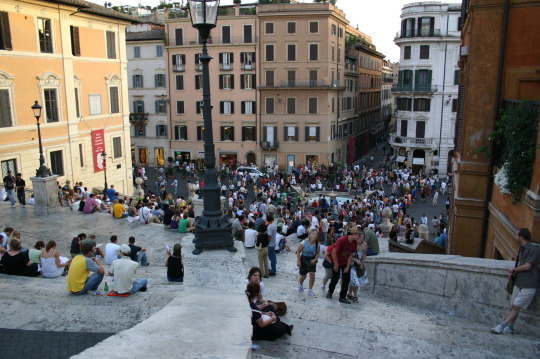
    On a side note, the picture at the top of this post is of the Spanish Steps in Rome. I took it on a weekend trip in 2007. I was living in Dublin at the time.

  • Prerequisites for a successful pedestrian-only street

    image

    A few of us had a really great discussion on Twitter recently about pedestrian-only streets. It was kicked-off by a tweet about Spark Street Mall in Ottawa, which many argue needs a rethink.

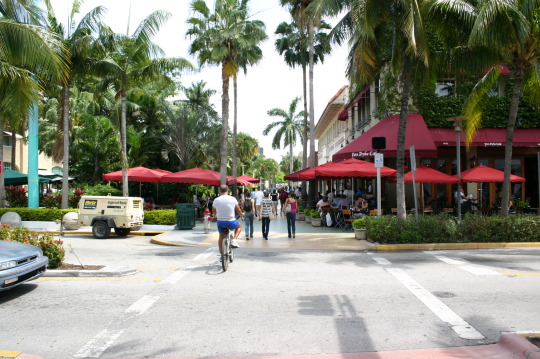
    One of the comments was that a lot of people tend to overvalue their worth. And I will admit that I am probably one of those people. If you’ve ever visited places like Grafton Street in Dublin, Lincoln Road in Miami Beach, or Kensington Market in Toronto on a pedestrian Sunday, you can’t help but think to yourself: why don’t we do more of this? They’re such great places to be.

    But the research suggests that these success stories are few and far between. 

    Below are the key findings from a report that was shared on Twitter during our discussion. It’s by Cole E. Judge and it’s called, The Experiment of American Pedestrian Malls: Trends Analysis, Necessary Indicators for Success and Recommendations for Fresno’s Fulton Mall.

    – Pedestrian malls in the United States have an 89% rate of failure. Most have been removed or repurposed. Only 11% have been successful.

    – Of the 11% successful pedestrian malls, 80% are in areas with populations under 100,000.

    – Certain indicators need to be present for a pedestrian mall to be successful in the United States: near or attached to a major anchor such as a university, situated in close proximity to a beach, designed to be a short length in terms of blocks, in a town/city with a population under 100,000, and/or located in a major tourist location such as Las Vegas or New Orleans.

    – Cities that have embraced the Main Street and Complete Streets models have experienced turn-arounds in their downtowns with more investment, higher occupancy rates and more pedestrian traffic.

    Though the report lists proximity to a beach as helping pedestrian malls, this is more about having a strong anchor than it is about climate – which is a commonly held excuse for why they don’t work. The report cites lots of failed pedestrian malls in California.

    Furthermore, if you look at the list of successful pedestrian malls, about half of them are in colder climates. And if you search the report for the word “weather” it only comes up once. The word “climate” doesn’t come up at all. 

    So I don’t believe that they’re not possible in colder climates. Ski resorts, for example, usually have great pedestrian-only spaces because they have a strong anchor – the mountain.

    But I do agree that pedestrian-only streets aren’t possible everywhere. And the more I think about this topic, the more I agree that we are overvaluing pedestrian-only. I guess that’s why our focus today is more on complete streets.

  • How we perceive commuting

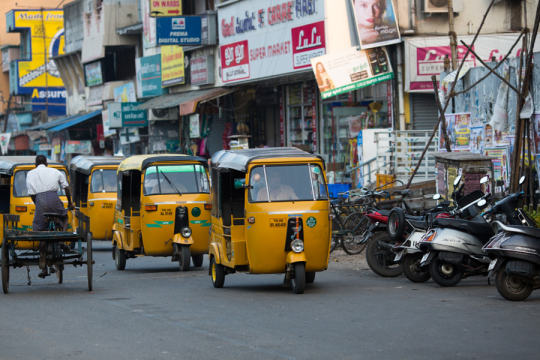
    CHENNAI, INDIA-FEBRUARY 10: Street of Indian city 10, 2013 in Ch by sergemi on 500px.com

    https://500px.com/embed.js

    Wharton real estate professor, Mariaflavia Harari, recently published a paper that looks at the relationship between urban geometry (specifically compactness) and inner city commuting efficiency across 450 cities in India.

    Consistent with previous research done in this space, she finds that people generally prefer compact cities and that they are willing to pay a premium for it. It increases overall welfare. Here’s an excerpt from her paper:

    “My findings are broadly consistent with compact city shape being a consumption
    amenity. All else being equal, more compact cities grow faster. There is also evidence that
    consumers are paying a premium for living in more compact cities, in terms of lower wages and,
    possibly, higher housing rents.”

    So her recommendations for the Indian cities she analyzed was that they should relax land use restrictions to allow for more vertical / compact development and that they should focus on improving urban transport in order to offset some of the negatives externalities associated with sprawl. This is no different than the approach that many cities in the developing world are adopting or looking to adopt.

    One of things that really stood out for me in her paper though is the way people perceive commuting:

    “The loss associated with non-compact
    shape appears to be substantial: a one-standard deviation deterioration in city shape, corresponding
    to a 720 meter increase in the average within-city round-trip, entails a welfare loss
    equivalent to a 5% decrease in income. This is considerably larger than the direct monetary and
    opportunity cost associated to lengthier commutes. Less compact cities also appear to attract
    fewer low-income immigrants, as captured by the share of slum dwellers.”

    What this is saying is that we tend to overvalue the negatives of commuting, beyond the direct costs of gas, insurance, car payments, our time, and so on. We hate it so much that we also want to be compensated for the mental anguish. Here is that same idea said differently:

    The estimated welfare loss from longer commutes appears to be large, relative to the immediate
    time and monetary costs of commuting. This is consistent with the interpretation that
    commuting is perceived as a particularly burdensome activity. The behavioral literature has
    come to similar conclusions, albeit in the context of developed countries. Stutzer and Frey
    (2008) find a large and robust negative relation between commuting time and subjective wellbeing,
    using German data. They estimate that individuals commuting 23 minutes one way
    would have to earn 19 percent more per month, on average, in order to be fully compensated.

    So I guess I’m not the only one who thinks commuting and driving sucks.

  • Guest Post: How We Changed Toronto

    This past summer I participated in a Jane’s Walk here in Toronto, where I was the only speaker to advocate for removing the eastern portion of the Gardiner Expressway.

    After my short talk I was feeling a bit like the black sheep of the group. Either nobody felt the same way as me, or nobody was willing to speak up. Most of the other people there seemed more enamoured by architect Les Klein’s “Green Ribbon” proposal.

    But as I put down the megaphone and began walking to the next stop, a man came up to me. Truthfully, I didn’t know who he was at first, but he reassured me that it was the right thing to do. The Gardiner East should come down.

    Eventually he gave me his business card. On the front it said: John Sewell. And as soon as I saw that I said out loud: “I know this name!”

    John Sewell was a member of Toronto City Council from 1969 to 1984 and was Mayor of Toronto from 1979-1980. Today, he is a Toronto activist and has written dozens of books, mostly relating to urban issues.

    His latest book, released last month, is called: “How We Changed Toronto – The inside story of twelve creative, tumultuous years in civic life, 1969-1980.”

    And today I’m delighted to share a guest post that he has written for Architect This City. The focus of his post below is on the importance of community participation in the planning process and how it was used in this city in the 1970s.

    If you’re a developer, this post might scare you. I think there’s often the perception that communities will generally oppose any sort of development. But there are developers in this city, such as Westbank, which have been taking a more proactive approach to community consultations. And it appears to be working for them. So maybe this is something we should be talking about.

    If you have any thoughts on this, let’s have a discussion in the comment section below. I hope you enjoy the guest post. Thank you again, John.

    _________________________________

    Transportation plans, redevelopment schemes, urban expansion: municipalities address big issues like these in several different ways. A staff report can be requested; consultants can be called in; a competition can be held.

    The device used most successfully by Toronto City Council in the 1970s was a committee of citizens working directly with city staff and council members. It produced enormously successful results, as I recount in my new book `How We Changed Toronto’, but sadly it is rarely used in the 21st century.

    In 1970 City Council appointed a working committee of local residents and several councillors to create a new plan for the Trefann Court Urban Renewal Area, a neighbourhood that had been fighting the city’s plan of demolition for half a dozen years. With the help of a city planner hired specifically for this task, a new plan satisfactory to the different factions in Trefann was hammered out within a few years, then successfully implemented.

    In 1973, when the new Council pondered how to rethink a downtown designated for more office towers, it appointed the Core Area Task Force, a body of community representatives and developers, to give direction to city planners as a new approach to the downtown was devised. The result was the remarkable Central Area Plan which encouraged housing downtown and mixed uses, put an end to windy plazas, and generally created an environment that was active and felt comfortable to anyone on foot.

    In 1974, as Council faced the problem of how it would redevelop 45 acres of wasteland on the edge of the downtown, it appointed a working committee of concerned residents and councillors to give direction to city staff. It’s fair to say that no one had a good idea of how the site should be developed, but the working committee and city staff conceived a brilliant plan which was quickly executed – the first new building was under construction within two years of the working committee being established – and the neighbourhood, now known as St. Lawrence, remains one of the great successes of the latter half of the 20th century.

    From the 1980s onward, City Council has touted the idea of citizen participation, but confined that activity to public hearings on decisions recommended by staff. That generally is the practice today, although open houses have been added, as though showing people plans and getting informal comments is a good way of involving people.

    What’s lost in public hearings and open houses is the creativity that a group of committed, diverse individuals can bring to a problem when they meet together over a number of weeks and months. The members of the group know the local scene but they aren’t experts, so they must be advised by planners and other professionals about the issues they should address, the pitfalls of some options, and the trade-offs available before decisions are taken. It is an open ended process fueled by debates about different opinions, but held together by a common purpose and the realization that those around the table are playing an important role in shaping the direction of the city.

    The working committee that started meeting in Trefann had no clear idea in advance of what the plan it finally arrived at would look like. It was the same with the Central Area Plan, the St. Lawrence community, and the other processes in the 1970s which I touch on in the book. The process that the politicians, staff and residents committed themselves to made all the difference.

    One reason this kind of process is not employed much today is because too many elected figures take an ideological approach. They think they have the answers which they have been elected to implement, rather than to establish ways in which many more minds can be involved in seeking results which are widely agreed on.

    As well, city staff are not seen as independent professional advisors serving the public at large, but as a part of a corps serving the mayor and city councillors. In the 1970s in Toronto there was a clear separation between the politicians and the administration, and there were frequent (and welcome) debates on the floor of City Council between the two factions. Both were there to serve the public although they might have different ideas of how that should be done. This kind of tension was seen as entirely appropriate.

    In Toronto (and probably other cities) the situation is now even more complicated as councillors see themselves not as public servants for a few years, but rather as individuals with a lifetime commitment to holding public office. Too many members of Toronto City Council have been there for more than 15 years, and they fear that taking a principled stand on an important issue might result in the worst of all possible outcomes, their defeat. They decide not to take on the big issues.

    Toronto is currently facing significant problems.  The downtown is being overrun with new tall condo towers, for which the city does not have the infrastructure, and the new housing is not designed to meet the needs of future residents. It is the perfect opportunity for a new look at the Central Area Plan, using the same mechanisms as in the 1970s: a holding bylaw so the new plan won’t be pre-empted by development applications; a citizen-led task force including some councillors, advised by city staff. Who knows what brilliant plan an open ended process can recommend?

    Another problem is money. Toronto does not have enough money to upgrade its transit system or repair the affordable housing it owns, let alone build the new affordable housing it needs. The demands of the mayor that other governments should pay are understandably disregarded. It is time that the city had its own revenue sources, and what better than a citizen led initiative to point the way?

    It’s the same with a plan to build the affordable housing the city needs, to ensure development activity enlivens the near suburbs, to put some restraint on the continued low density subdivisions which are being unrolled far beyond the city’s borders, to restructure the megacity into something which works for the different communities within the city. These challenges all need strong citizen driven processes.

    As I recount in `How We Changed Toronto’, the 1970s really did change Toronto for the better. The city has been coasting ever since on those successes. It is time for renewal, and using the successful mechanisms from forty years ago is something worth doing.

    -John Sewell