Daily insights for city builders, delivered every morning at 6 AM ET. I’m Brandon Donnelly — a Toronto-based real estate developer and founder of Globizen. I’ve been writing here since 2013.

Tag: united states

  • Median household income vs. health insurance costs

    I just came across this chart from Axios, which relies on data from the Federal Reserve Bank of St. Louis and the Kaiser Family Foundation. It compares median household income against the average cost of employer health insurance (in the United States).

    What it is saying is that, after adjusting for inflation, the median household income has only increased by 2% from 1999 to 2017, whereas employer health insurance costs have increased by some 121% over this same time period.

    The takeaway: Rising healthcare costs are believed to be eating away at take-home pay in the US. As of 2017, health insurance costs were estimated to represent about 30% of the average household income. That feels like a big number to me.

  • The world’s top oil producers

    Using data from MarineTraffic (which is definitely worth a click through), the New York Times has created this terrific animation showing the flow of oil tankers from the Persian Gulf to the rest of the world from May 15 to June 15, 2019.

    Here’s a screenshot:

    About 20% of the world’s supply of oil flows through the Strait of Hormuz, a tiny passage located between Iran (north) and the UAE (south). See above.

    The article also has a number of other charts that speak to changing supply and demand patterns. Note the US, China, and Iran.

    Here are the top oil producers (total petroleum liquids) and the top crude oil exporters in 2018 (both are measured in millions of barrels a day):

    And here are the top oil consumers ranked by 2016 data (total consumption of petroleum and other liquids):

    Images/Charts: New York Times

  • Public perception of drone delivery

    Back in 2016, the United States Postal Service published a report on the public perception of drone delivery in the US. This was nearly 3 years after Jeff Bezos announced on 60 Minutes that Amazon was working on a drone delivery service and that it would arrive within the next 5 years (so by 2019). I think USPS was trying to figure out how to be, or appear, more innovative.

    Not surprisingly, the report found that Millennials were significantly more supportive of drone delivery (65%) compared to Baby Boomers (24%), who strongly dislike the idea. Generally, the report indicates that the percentage of people who think it’s a good idea declines with every preceding or older generation. Again, I don’t find this at all surprising.

    But what I did find interesting was that, irrespective of age, respondents were primarily concerned with some sort of “malfunction.” This was at the top of the list. Next in line were concerns around “intentional misuse,” such as drones being used to transport illicit goods or to spy on people and/or property.

    Closer to the bottom of the list was a concern that drone delivery “might make the sky less pleasant to look at.” My own view is that visual clutter and noise pollution are critical problems to address here. There’s talk of “drone highways in the sky”, but how do you really manage the sheer volume of drones that would be needed to service a dense urban environment?

    Photo by Goh Rhy Yan on Unsplash

  • Canada delimits its continental shelf in the Arctic Ocean

    Last week the Government of Canada filed a 2,100-page submission with the United Nation’s Commission on the Limits of the Continental Shelf. Under UN Convention on the Law of the Sea (UNCOLS), states with coastal territory have the exclusive rights to about 370 kilometers beyond their shores in order to conduct economic activity. This includes the exclusive rights to any resources. However, states may also make claims to further extensions underneath the water if they can substantiate them through scientific research. Last week’s submission attempts to do exactly that for an additional 1.2 million square kilometers of sea bed.

    Here is a map from High North News:

    The challenge with all of this is that Norway, Denmark, and Russia all have their own continental shelf claims, and there’s geographic overlap. (The US has not yet ratified their UNCOLS agreement.) So it is unlikely for this to be resolved anytime soon, though all states seem willing to work with the UN. This is a relatively new debate because the North Pole and Arctic Ocean were previously considered neutral territory. But climate change is opening up new economic opportunities (i.e. there’s a lot less ice). That’s worrisome in its own right.

    Click here for the full press release from the Government of Canada.

  • How America uses its land

    Last summer Bloomberg ran a visual essay on how America uses its land. In case some of you missed it, I thought I would share it here today.

    They started by breaking the country down into 6 main land uses. Each square represents about 250,000 acres.

    What likely won’t surprise any of you is that urban areas punch well above their weight:

    Even though urban areas make up just 3.6 percent of the total size of the 48 contiguous states, four in five Americans live, work and play there. With so much of the U.S. population in urban areas, it’s little surprise that these areas contribute an outsize amount to the economy. The 10 most productive metropolitan areas alone contributed to about 40 percent of U.S. GDP in 2016.

    Here’s a further breakdown of the map:

    There is a lot that is interesting here. Note that golf courses made the cut.

  • Dendrochronology of U.S. immigration

    I can’t remember where I found it, but I recently stumbled upon this video simulating the dendrochronology of U.S. immigration from 1830 to 2015. 

    It is part of an ongoing project by Pedro Cruz, John Wihbey, Avni Ghael, and Felipe Shibuya, and is supported by Northeastern University.

    As its name suggests, the video (and broader study) uses the metaphor of a tree (and its growth rings) to explain historical immigration to the U.S. 

    If you can’t see the video below, click here.

    [vimeo 276140430 w=640 h=280]

  • Blue lights on train platforms

    Sadly, Japan has one of the higher suicide rates in the world. According to the World Health Organization, the rate from 2000 to 2016 was about 18.5 deaths per 100,000. The only country in Asia with a higher rate is South Korea. They are at 26.9 deaths per 100,000 (an alarming figure). For comparison, Canada and the US are at 12.5 and 15.3, respectively, which also seem rather high to me.

    I was intrigued to learn today that one of the ways that Japan has been trying to combat this high figure is by installing blue LED lamps on some of its railway platforms. Blue lights have been proven to have a calming effect (compared to white light). And since jumping in front of a train is unfortunately a common suicide method, blue lights were thought to maybe be a cost effective alternative to platform screen doors.

    The first blue station lights were installed on Tokyo’s Yamanote line in 2009. And according to this 2013 study – which looked at the possible impact across 71 train stations in Japan – the introduction of blue lights actually resulted in an 84% decrease in the number of suicides. Further studies also showed that there were no corresponding increases at other non-blue light stations. 

    It is an interesting example of “nudge theory”, but does it get at the root of the problem?

    Photo by Athena Lam on Unsplash

  • Cities are labor markets

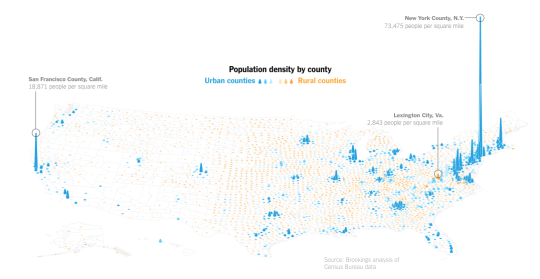
    Eduardo Porter recently published this piece in the New York Times on the “relentless economic decline” of small-town rural America. We often talk about rising income inequality, but the greater concern is the alarming rate of joblessness in many of these communities. Earning less than others is not as bad as earning nothing.

    I think the below map from the article, depicting population density by county, starts to show how uneven the economic landscape is across the US. Porter puts it this way: “This is the inescapable reality of agglomeration, one of the most powerful forces shaping the American economy over the last three decades.”

    image

    But, of course, we don’t really have a solution to this problem. Some are suggesting employment subsidies, such as the earned-income tax credit. While others are suggesting that we need to make it easier to build in the large blue spikes shown above. That way we’ll be able to more affordably accommodate the people who will ultimately need to move from rural to urban.

    While this latter suggestion may seem grim for small-town America, it is perhaps a reminder of what cities really are at their core: Cities are labor markets. They are the places where people come to get a job and make money.

  • The Oklahoma Land Rush of 1889

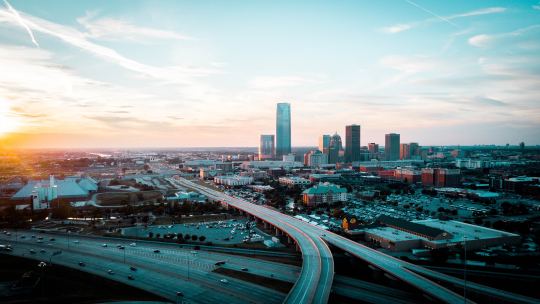
    One of our partners sent me a terrific article last week by Sam Anderson on the founding of Oklahoma City

    I have said this before on the blog, but I am deeply fascinated by the origins of cities because, oftentimes, the story isn’t all that lucid. Why right here? As Anderson points out in his article, usually cities “creep into existence.” 

    But not Oklahoma City:

    Oklahoma City was born in an event called, with extreme dramatic understatement, the Land Run. The Land Run should be called something like “Chaos Explosion Apocalypse Town” or “Reckoning of the DoomSettlers: Clusterfuck on the Prairie.” It should be one of the major events in American history. Dramatizations of it should be projected onto IMAX screens with 3-D explosions, in endless loops, forever. Every time you walk into a mall, you should be accosted by fuzzy-headed Land Run characters shouting, “What is America?!” “What does America even mean?!” Because the Land Run was, even by the standards of this very weird nation, absurd. It was a very bad idea, executed very badly. It would be hard to think of a worse way to start a city. Harper’s Weekly, which had a reporter on the ground, called it “one of the most bizarre and chaotic episodes of town founding in world history.” A century later, the scholar John William Reps reviewed the evidence and concurred. The founding of Oklahoma City, he wrote, was “the most disorderly episode of urban settlement this country, and perhaps the world, has ever witnessed.”

    To learn how Oklahoma City went from a population of 0 to 10,000 in about half a day, check out the full article.

    Photo by Gerson Repreza on Unsplash

  • Learning about O-zones

    I spent this evening reading about Opportunity Zones, or “O-zones”, in the United States. 

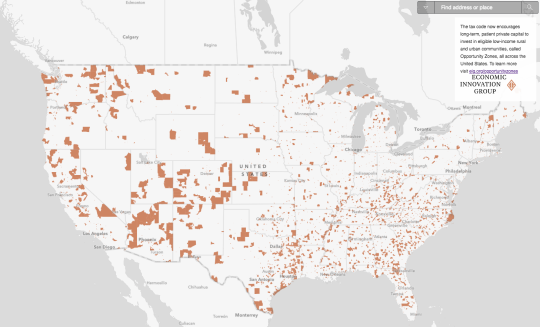
    For a census tract to become an O-zone, it has to have a poverty rate of 20% or higher, or the median household income has to be less than 80% of the surrounding area. Governors are also only able to designate 25% of their eligible census tracts.

    Here is a map of the areas that have been designated as Opportunity Zones.
    image

    Here is how these O-zones work. (All excerpts taken from this Forbes article.)

    The law’s engine is a new breed of financial product, the opportunity fund, that offers investors a trifecta of attractive tax breaks. Here’s how it works. Investors who sell assets have 180 days to plow their taxable capital gains into an approved opportunity fund, which must hold 90% of its assets in Opportunity Zone projects. To put money to work fast, the law requires that the funds invest all of their cash within some specified time frame. (The Treasury Department is still deciding on that and other crucial details.) Tax on the original reinvested gain isn’t due until 2026, and the taxable gain is cut by 15%. Meanwhile the new opportunity investment grows tax-free, like a Roth IRA, provided it’s held for at least ten years. (If it’s sold earlier, it can be rolled into another opportunity fund and remain tax-free.)

    Here is how it could get the real estate industry to take action.

    For real estate developers, O-zones offer cheap real estate and unlimited, untaxed upside if a neighborhood takes off. Developers must do more than stash cash in crumbling property. To qualify for tax perks, they must make swift and significant upgrades (at least equal to the cost of the initial purchase). With real estate projects come new office buildings, industrial districts, restaurants and affordable housing—all of which can lay the groundwork for an economic boom. “The real estate aspect is a great catalyst to attract new businesses,” says AOL founder Steve Case, an early supporter of the O-zone initiative, whose Rise of the Rest Fund invests in backwater areas. “But it’s the startups that will be the real job creators.”

    And here is how it could influence where new businesses decide to locate.

    “If Facebook could have chosen to locate itself in an Opportunity Zone, like the Tenderloin in San Francisco, the investors would’ve paid no capital gains on their equity,” says Parker, who presumably would have been one of the big winners. The promise of mega-returns could send VCs, investment banks and private equity firms scrambling to launch their own opportunity funds to create incubators, scour second cities for overlooked talent or move portfolio companies into O-zones. “It wouldn’t surprise me if a lot of Silicon Valley VCs started to tell founders, ‘We’d like you to go over the bridge to Oakland, or we’d like you to go to Stockton,’” Parker says.

    If you’d like to learn more about Opportunity Zones, check out the Forbes article.