Daily insights for city builders, delivered every morning at 6 AM ET. I’m Brandon Donnelly — a Toronto-based real estate developer and founder of Globizen. I’ve been writing here since 2013.

Tag: $uber

  • Uber Movement

    Uber just announced that it will be providing access to the (anonymized) traffic flow data generated from its over 2 billion rides. This new product is called Uber Movement and the goal is to help cities make better infrastructure decisions. Because indirectly, that also benefits them. 

    Here’s an excerpt from TechCrunch:

    “We don’t plan infrastructure, we don’t plan cities, we’re never going to do that,” explained Uber Product Manager Jordan Gilbertson in a briefing. Not controlling those aspects of Uber’s business means that it must do whatever possible to influence their improvement indirectly, which Movement can certainly help to do. More efficient transportation in a city in general means more efficient Uber service delivery, happier customers and better usage rates.

    You can request access to Uber Movement today. But the service will be made available first to city planners and policymakers, and then to the general public. I would be very curious to see what the data reveals for Toronto, as well as for other cities.

  • Tesla is winning the arms race

    “If we have data, let’s look at data. If all we have are opinions, let’s go with mine.” – Jim Barksdale, former Netscape CEO

    Fred Wilson wrote a post yesterday about Tesla’s data advantage in this self-driving car arms race that we are currently living through. (I found the above quote in the comment section of the post.)

    In their Q3 2016 update, Tesla claims to have logged more than 1.3 billion miles on its vehicles equipped with Autopilot hardware. This is important because the more data it collects – across diverse road and weather conditions – the better the vehicles get at driving without human intervention. As Fred Wilson put it: “more data is better than more software engineers.” So that places Tesla ahead of Google, Uber, GM, et al.

    I spent a lot of time driving over the past week, certainly more than usual, and I couldn’t help but think about how much better it would have been to instead sit in the backseat and read a book (or mindlessly scroll through Instagram).

    I always try and use cruise control on long drives, but unless the road is fairly empty, I find it doesn’t work very well. Everyone is driving at different speeds and so I usually end up having to reset it / adjust it every so often.

    The big question in my mind is still: How does the world look when driving longer distances doesn’t suck so much? What changes when you can get into your / a car (important distinction) at bedtime, fall asleep, and then wake up in a new place?

    A lot, I think.

  • So how’s Uber doing?

    A travel expense management company called Certify recently analyzed over 10 million ground transportation receipts across North America for the 3-month period ending last September (2016). 

    And what they found was that, for the first time ever, Uber and Lyft exceeded traditional taxis and rental cars when it came to business expenses. Uber was at 48% and Lyft was at 4%. So together, these two platforms have more than half of this particular market.

    If you compare this to Certify’s data from the same quarter last year, “ride-hailing services” previously accounted for 34% of receipts, whereas taxis and rental cars were at 22% and 44%, respectively. So Uber is up in a big way.

    This may not be surprising for a lot of you, but I thought it would be valuable to check-in on what the numbers say. 

    I’m hit with two thoughts. Firstly, it’s not a question of mobile apps superseding traditional taxis; it’s a question of one company taking over. And secondly, people seem to be favoring Uber over driving themselves around. I know I’ve been heading in that direction.

    Those are two powerful trends.

  • re:Public + NXT City Night

    On Friday, November 25th, NXT City will be hosting a one-day symposium here in Toronto (re:Public) that brings together some of the top people, projects, and ideas in the world of public spaces. Following that will be an after party (called NXT City Night) that runs from 8pm to very late. 🙂

    Here are some of the organizations that will be represented at the symposium: City of Toronto, Uber, CivicAction, Monocle, Arup, STEPS Initiative, Breather, The Laneway Project, Oxford Properties, as well as many others. It will be a great event.

    For the full speaker list, the agenda, and to buy tickets, click here. There’s an under 35 / student offering for both the symposium during the day and the after party at night. If you attend during the day though, you automatically get a pass to the after-party. I hope to see you there.

    Here’s a time lapse video from NXT City Night (edition 2015). If you can’t see it below, click here.

    [youtube https://www.youtube.com/watch?v=_i6R687sdk0?rel=0&w=560&h=315]

  • Uberpooling your way to cheap rides

    This morning on my way into the office I ran into a friend who lives in my building (downtown). She works in midtown and so I asked her how she gets into the office. She told me that she either takes the subway or an Uber, but that increasingly she has been taking Uber, particularly on the way home.

    We then started talking costs and she told me that what she does is carpool with a friend from work using UberPOOL. They live nearby and so what they do is leave from the same place at night (the office) and then select a midpoint location between their homes for the drop-off. After splitting their portion of the fare, the ride costs her about $3.25.

    As she was telling me this, I couldn’t help but think to myself: Wow, this is massively disruptive to transit. That is the same cost as taking the subway. So why take transit? With the subway, there may be a speed argument in certain instances, but that certainly wouldn’t be the case with some of Toronto’s streetcar lines (such as the King line). It’s faster to walk.

    However, there are obviously geographic limits to how far you can go in an UberPOOL before your costs greatly exceed taking transit. But as Uber and other similar services continue to bring down the price of a ride (eventually the labor cost component will disappear), how big does that area get?

    All of this – including my own mobility patterns – has got me thinking yet again about the role of transit in the city of tomorrow. 

    One segment that continues to be underserved is the regional scale. Here in the Greater Toronto Area, we are working on that by transforming our commuter rail service into a two-way all-day Regional Express Rail service. Today that strikes me as being hugely valuable. And unless driverless vehicles somehow solve our traffic problem, it will likely remain that way.

    I would love to get your thoughts in the comments below.

  • The self-driving car arms race

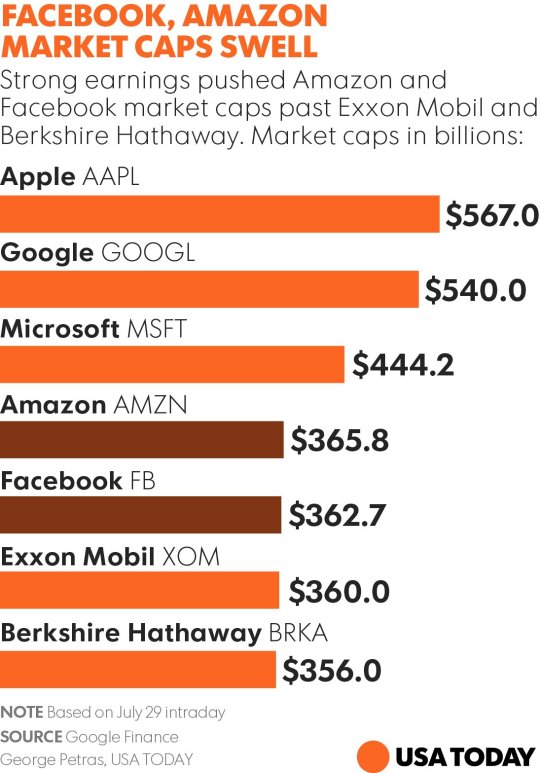
    Earlier this month, I came across the following chart from USA today. 
    image

    It was based on market caps as at July 29 and so the order wouldn’t look quite the same today. Still, here are the largest companies by market cap and the top 5 are US consumer-facing technology firms.

    Remember when it was a big deal that Apple had surpassed Exxon Mobil as the world’s most valuable company?

    We are living in a tech-driven world.

    Then yesterday, I was reading this New York Times article talking about Uber’s acquisition of Otto (a startup focused on self-driving truck technology) and its plans to allow riders in Pittsburgh to summon self-driving vehicles later this month.

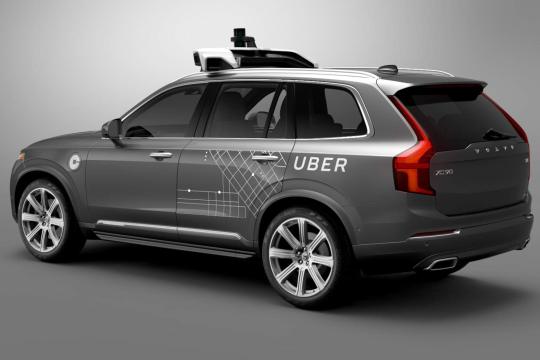
    The vehicle will be a tricked out Volvo:
    image

    These two snippets from the NY Times stood out for me:

    Suddenly, it seems, both Silicon Valley and Detroit are doubling down on their bets for autonomous vehicles. And in what could emerge as a self-driving-car arms race, the players are investing in, or partnering with, or buying outright the specialty companies most focused on the requisite hardware, software and artificial intelligence capabilities.

    “There’s an urgency to our mission about being part of the future,” Travis Kalanick, Uber’s chief executive, said on Thursday in an interview. “This is not a side project. This is existential for us.

    The way it will work in Pittsburgh this summer is that the self-driving Volvos will still arrive with a driver, in addition to a sidekick in the passenger seat taking notes about how the vehicle is performing. But the goal is to start weaning us off of human drivers. These pilot rides will be free to start.

    This is quite possibly the start of a general change in terms of the way cities operate (quote from Bloomberg):

    In the long run, Kalanick says, prices will fall so low that the per-mile cost of travel, even for long trips in rural areas, will be cheaper in a driverless Uber than in a private car. “That could be seen as a threat,” says Volvo Cars CEO Hakan Samuelsson. “We see it as an opportunity.”

    Uber is currently logging about 100 million miles per day. Hopefully it is clear at this point that this is not as simple as ride sharing vs. traditional taxis. Cities who are thinking about it in this way are thinking short-term and missing the bigger picture.

    Companies such as Uber, Tesla, and Google are aiming for a fundamental rethink of urban mobility. There is an arms race going on that I believe will completely eradicate the need for human drivers.

  • Your own 24/7 chauffeur

    image

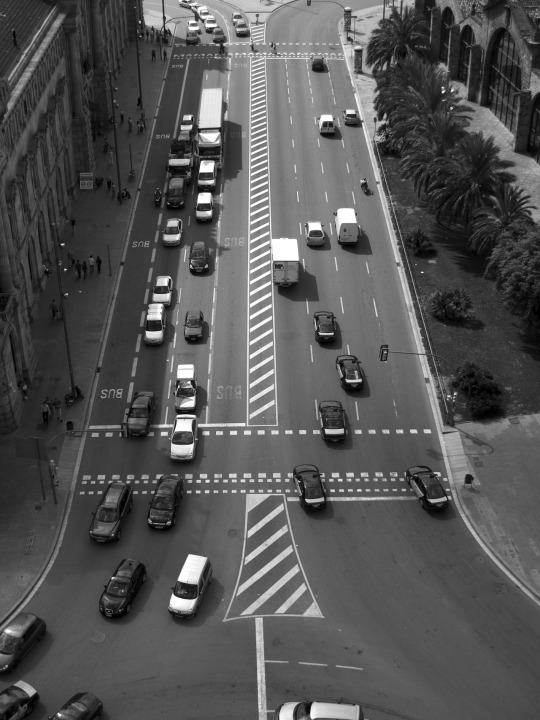
    If you had a free 24/7 chauffeur to drive you anywhere you wanted, do you think that would impact where you lived, worked, and played? 

    Put differently, if you were relieved from actually having to contend with traffic yourself and if you never had to worry about parking and/or drinking and driving, would you be more inclined to live further out of the city to get bigger and cheaper housing?

    This is the question I tried to ask in a Twitter poll this morning:

    //platform.twitter.com/widgets.js

    Personally, I think that this scenario would impact my behaviour, only slightly. I would certainly take advantage of the free chauffeur, but I would not be more inclined to live 1 or maybe even 2 hours of the city.

    Sure, I would be able to get more real estate, but I wouldn’t want to sit in a car every morning – even if I wasn’t the one driving. Maybe I’d be more inclined to have a cottage out of the city, but I can’t imagine a big commute. In my view, minimizing commute times is one of the most effective ways to up your quality of life.

    I’m thinking about all of this because of this TechCrunch article, arguing that technologies such as driverless vehicles and VR (for telecommuting) will soon cause rapid decentralization. This reminds me of what was said during the dot com era. Real estate was out of favor and it was all about tech. 

    Though I am sure that there are technological impacts that you or I cannot foresee right now, I think it’s important to remember that people live in cities for many different reasons. It’s not only for access to a labor market, it’s also for access to a dating market, as well as other things that involve people coming together. I believe that we are inherently social beings. And technology is not going to make that disappear overnight.

    I would be curious to see how you all feel about this topic. Please leave a comment below so we can discuss.

  • Towards car-free living

    Right now, there’s an apartment building in San Francisco that is trying to encourage car-free living by offering residents a $100 per month credit that can be used for Uber and/or for public transit. Prospective residents can even get a $20 credit to go check out the community. (The program is a partnership with Uber.)

    The reason this leasing strategy caught my attention is because we’re at a point where city builders are now trying to recalibrate themselves to this new emerging world. 

    When I was at the Land & Development conference earlier this month, one developer brought up this exact point. He more or less asked: If you’re starting development on a new building today and you’re expecting approvals in 2 or so years and completion in another 3 or 4 years, what do you think the state of cars/driving will be at that point? Should you really be building all that underground parking?

    These are great question. And they highlight one of the challenges of development. It takes a long time to bring new supply to the market and a lot can change during that time period. My sense is that we are pretty clearly seeing downward pressure on driving and car ownership.

    That said, this isn’t the case in every city or in all parts of a particular city. I just got back from a trip to a Detroit where it’s pretty hard to imagine the city being oriented around anything but the car. But in cities like San Francisco and Toronto, car-free living is already a reality for many people and so we need to respond to that.

    How do you see yourself driving, or not driving, in the next 5 to 10 years?

  • How much market share are New York’s yellow cabs losing to Uber?

    Todd W. Schneider recently mined data from the New York City Taxi & Limousine Commission to create a chart summarizing yellow taxi, Uber, and Lyft usage

    The data only runs up until January 2016, but here’s what he found:

    “…yellow taxis provided 60,000 fewer trips per day in January 2016 compared to one year earlier, while Uber provided 70,000 more trips per day over the same time horizon.”

    The Uber data only begins in 2015, but you can still see how quickly it is growing and how yellow taxis are losing market share. Five years ago, yellow taxis were reaching over 500,000 trips per day (a pretty amazing number) and in January of this year they were at about 350,000 trips per day. 

    It also appears that Lyft is struggling to gain traction.

    image

    What’s also great about Todd’s blog post is that he has set it up so that his chart will automatically update as new data becomes available. So if you’re interested in this topic, you should bookmark his post.

  • Getting distribution and how that is changing

    Aaron M. Renn recently published an article in The Washington Post talking about carless cities and driverless cars. It’s an interesting read, but I’m not going to talk about those topics today. So if that’s what you’re looking for, you’ll have to read his piece.

    I do, however, want to focus on one particular aspect of it. 

    In it, he talks about how Tesla is shifting the “locus of power in the auto industry” from Detroit to Silicon Valley and, at the same time, changing the way cars are sold. Tesla sells direct to consumers through its corporate stores, whereas franchise laws in almost every U.S. state mandate that new cars need to be sold through dealers.

    I’m not sure how these laws came to be, but it’s interesting to note yet another example of technology and the internet sparking disintermediation. That is, the removal of middle people, distributors, brokers, and so on. It’s the same thing that is happening as a result of companies like Uber and technologies like Bitcoin.

    I would imagine that lot of these legacy distribution models exist today because it was previously the most efficient option. If you were a car company based in Detroit, a network of local franchisees all across the country working to sell your cars was probably a great thing. But now there are other options, as is the case with many other industries.

    So what’s next? 

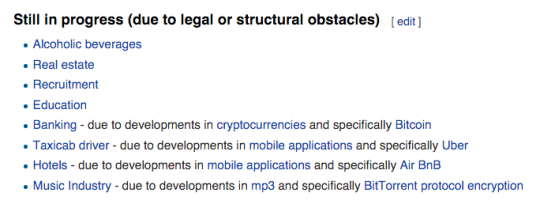
    Wikipedia calls out the following industries as still being in the midst of disintermediation:

    I bet you all know which one I’m watching closely.