Daily insights for city builders, delivered every morning at 6 AM ET. I’m Brandon Donnelly — a Toronto-based real estate developer and founder of Globizen. I’ve been writing here since 2013.

Tag: $uber

  • My new gig…

    image

    So this is interesting.

    Earlier this month, Travis Kalanick – co-founder of Uber and its former CEO – formed a new venture fund called 10100. According to the WSJ, it was funded with his own money after he sold 30% of his position in Uber for a cool $1.4 billion. 

    Ten-one-hundred’s spartan website explains that the goal of the fund is “large-scale job creation, with investments in real estate, ecommerce, and emerging innovation in China and India.” On the non-profit side, the initial focus will be on “education and the future of cities.”

    Then this week, Travis tweeted out “My new gig…” and disclosed that 10100 had entered into an agreement to buy a controlling interest in a real estate holding company called City Storage Systems (CSS) for $150 million. 

    He also announced that he would become CEO.

    The focus of CSS is on the redevelopment of distressed real estate, particularly parking, retail, and industrial assets. He goes on to say: “There are over $10 trillion in these real estate assets that will need to be repurposed for the digital era in the coming years.”

    This whole series of events is a big bet on some significant changes in the real estate space.

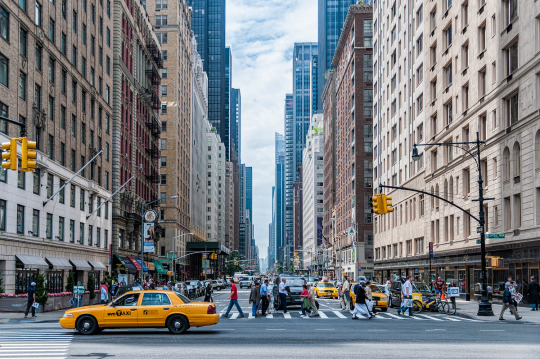
    Photo by Martin Reisch on Unsplash

  • Road pricing for whom?

    New York City is considering a congestion charge for drivers entering Manhattan below 60th street. It is part of Governor Cuomo’s Fix NYC plan. But we all know how difficult these things are to implement.

    Last month, Felix Salmon wrote a piece in Wired where he argued that our cities are dying of traffic congestion and that the cause is ride-hailing services like Uber and Lyft. The solution: A tax on ride-hailing services.

    The article elicited a few reactions, including this one by Charles Komanoff over at Streetblogs and this one by Joe Cortright over at City Observatory. Joe’s message: “The problem isn’t the ride-hailed vehicles, it’s the under-priced street.” 

    Precisely.

    Felix later followed-up with a post on his blog where he clarified that the reason he loves this idea – of taxing ride-hailing companies, not riders – is that it’s far more politically palatable than a blanket tax on all cars. I don’t disagree.

    Which is why I think my idea is something which is eminently politically possible, in contrast to congestion pricing, which has been implemented exactly nowhere in the USA.

    Americans love their cars, and they love the freedom that cars represent, and they hate the idea that they should be taxed for driving their cars. Tolls on roads and bridges are bad enough, but a fee just to drive in to a city?

    That said, I’m with Charles and Joe. 

    Last year, it was reported that roughly 25% of all Uber trips in New York City were UberPool trips. I’m not sure what the number is today, but these are people who are car pooling to get around. That’s generally considered to be a positive thing.

    Are these really the trips we want to be discouraging (and singling out) with a charge simply because we don’t have the moxie to do what is right and makes rational sense?

    Photo by Austin Scherbarth on Unsplash

  • Centralized taxi branding vs. decentralized ride fulfillment

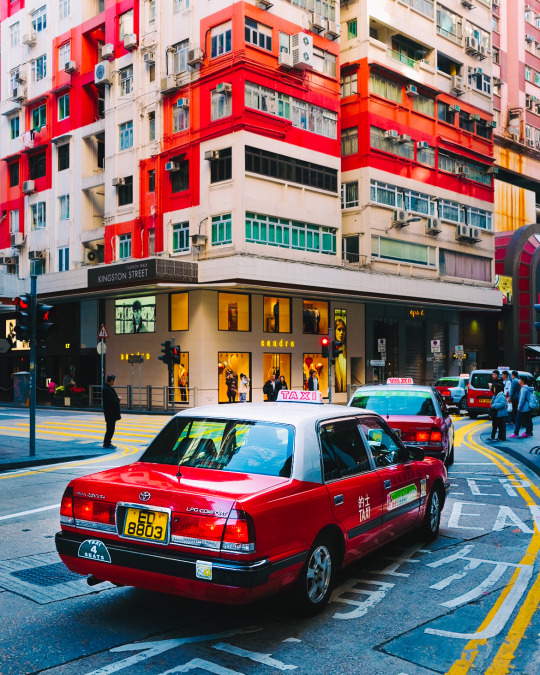
    Back in 2013, when this blog was in its infancy, I argued that Toronto needs a consistent taxi brand. Since nobody was reading the blog at the time, I am sure that most of you have never read this post. I even forgot about it, until last night when I posted this photo of Hong Kong to Instagram:

    It reminded me of the role that taxis play in city branding. This photo is clearly of Hong Kong. But take away the taxis in the foreground and I would really have to think in order to identity it. I would then be searching for street signs and looking to see what side of the road the cars are driving on.

    Now, a few things have changed since 2013. Back then I didn’t have the same appreciation for decentralized ride hailing (Uber and Lyft), though I did have the same distaste for the taxi cartel. And I recognize that there is a tension between centralized taxi branding and a decentralized approach to ride fulfillment. 

    I’m not exactly sure how to solve this problem, but maybe it gets easier with autonomous vehicles and probable changes to the way consumers own, or don’t own cars. I believe it’s important for places and cities to have specificity. If you have any thoughts, please leave a comment below. 

    (I am trying to respond to all comments on this blog, because I’m finding it impossible to respond to all blog related emails. Sorry.)

  • It doesn’t matter what Bitcoin is trading at right now

    Steven Johnson has a terrific piece in New York Times Magazine called: Beyond the Bitcoin Bubble. Here is a snippet:

    The only blockchain project that has crossed over into mainstream recognition so far is Bitcoin, which is in the middle of a speculative bubble that makes the 1990s internet I.P.O. frenzy look like a neighborhood garage sale. 

    But the point of the article, as its title suggests, is to talk about what all of this craziness could mean for the future of the internet and how, in some ways, it could be a return to what the internet was always intended to be.

    The real promise of these new technologies, many of their evangelists believe, lies not in displacing our currencies but in replacing much of what we now think of as the internet, while at the same time returning the online world to a more decentralized and egalitarian system. If you believe the evangelists, the blockchain is the future. But it is also a way of getting back to the internet’s roots.

    Some are calling this new, decentralized internet version 3.0. We are currently living with internet 2.0. Practically speaking though, what could this shift really mean for us?

    One example that is given in the article has to do with urban mobility – a topic that is particularly relevant to this audience. 

    Internet 2.0 has created a winner-take-most economic model. And in the case of mobility – at least in the world of apps – that winner is Uber. But with internet 3.0 and the blockchain, this could be possible:

    Just as GPS gave us a way of discovering and sharing our location, this new protocol would define a simple request: I am here and would like to go there. A distributed ledger might record all its users’ past trips, credit cards, favorite locations — all the metadata that services like Uber or Amazon use to encourage lock-in. Call it, for the sake of argument, the Transit protocol. The standards for sending a Transit request out onto the internet would be entirely open; anyone who wanted to build an app to respond to that request would be free to do so.

    Cities could build Transit apps that allowed taxi drivers to field requests. But so could bike-share collectives, or rickshaw drivers.

    I don’t know about you, but I find this perspective a lot more interesting. I recommend you read Steven’s article. It will help you cut through a lot of the Bitcoin noise.

  • Uber Express POOL is kind of like public transit

    Uber is currently testing a feature in a few neighborhoods in Boston and San Francisco called Uber Express POOL

    Like the regular version of Uber POOL, this is a shared ride. But with Express POOL the app now automatically generates “smart spots” that are easy to drive to and close to the origin and destination of multiple passengers.

    So instead of a direct pick-up and drop-off, you now need to walk a few blocks to one of these dynamically created “smart spots.” In exchange for the added inconvenience, you get 25% off your fare.

    What’s immediately fascinating about this feature is that it further blurs the line between Uber and public transit. These “smart spots” are effectively low-volume and ephemeral transit stops that pop-up based on demand and then disappear.

    It makes the notion of a fixed stop and transit schedule, particularly in low usage areas, seem inefficient. Now imagine if we created some sort of visual marker on the street every time a “smart spot” was emerging based on demand.

    It is clear that Uber is trying to price these rides so that they are competitive with conventional public transit. And there’s no reason that this technology couldn’t also be applied to larger vehicles, such as buses.

    I find this fascinating. And it’s a perfect example of what we talked about in yesterday’s post. This is software and networks being layered on top of the built environment.

  • Toronto’s first Airbnb-friendly condo building

    This week it was announced that the very first condo building in Toronto (and in Canada) has just signed on to Airbnb’s Friendly Buildings Program. The agreement will take effect on November 1, 2017.

    As the name suggests, the program is about bringing greater legitimacy and structure to short-term Airbnb rentals. Here are two key measures from this particular agreement:

    – Building security will now have full transparency with respect to who is hosting and who their guests are at any given time

    – Airbnb will share 5% of the building’s revenue with the condominium corporation (hosts will also need to pay $50/month to cover any additional maintenance costs)

    What’s compelling about the above is that there’s now a bit of a financial incentive for buildings/boards to support Airbnb rentals. 

    At the same time, if something happens, it’ll now be a lot easier to figure out who was responsible and then chargeback any relevant costs. Right now it’s all happening under the radar.

    My view on Airbnb is the same as the one I took (publicly on this blog) on Uber: It’s not going away. Many people clearly want it. An entire building just accepted it. So let’s figure out how to make it work better.

    One regulation that Toronto is currently exploring and that I think will materialize in some form is a limit on short-term rentals when the unit is not your principal residence.

    This is the difference between Airbnb’ing your place when you leave on vacation (or when you have an extra room) and buying a condo strictly as a short-term rental investment.

    It’s interesting to see the evolution of companies like Uber and Airbnb. Both would never have been successful if they started out by first asking for permission. 

    But now they are mature enough that they are being forced to play nice.

  • Should Uber be shut down?

    image

    Last week Travis Kalanick – the cofounder who built Uber into the most highly valued privately held startup in the world – stepped down as chief executive at the request of his investors. This was the culmination of months of controversy related to the company’s toxic corporate culture.

    So what’s next? 

    Benjamin Edelman, associate professor at Harvard Business School, recently argued that this is it for the company: Uber Can’t be Fixed – It’s Time for Regulators to Shut It Down. I discovered the article through a good friend of mine who has felt similarly since the beginning. Uber’s business model is predicated on illegality and that should not be misconstrued as “innovation”.

    I have a few thoughts on this.

    But let me start by saying that this post is not a comment on the company’s corporate culture or its internal practices related to lobbying governments. I have not really been following what’s going on internally and I’ll leave other, more informed, people to comment on those matters.

    With that said, here are 3 thoughts.

    One, shutting down the company feels like an extreme case of throwing out the baby with the bathwater. Lots of companies go through restructuring, assuming that’s needed, without completely capitulating.

    Two, before Uber came along it was still challenging to pay for a taxi in Toronto with a credit card. More often than not the driver would tell you that the machine was broken or ask that you instead pay with cash. At that point, I would have accepted a clunky payment machine mounted to the rear of the front seats as an innovation.

    To say that Uber’s technological innovations were all banal things that its competitors were already about to introduce is downplaying so much of what the company has done outside of its beneficial cost structure. 

    We got perfect information: Where is my car right now? We got full pricing transparency before even accepting a ride: Should I take an Uber or transit or should I drive? We got the ability to get in and out of a taxi without pulling out our wallets: I’ll quickly jump out at this red light. We got dynamic ride pooling and cost sharing: Let’s split this ride 3 ways to bring the fare down. And we got clean cars that didn’t smell.

    Why weren’t any of the incumbent taxi companies do this?

    Three, I fully agree that Uber (unfairly?) benefited from a meaningful cost advantage by operating in the unregulated side of the market. This was a huge boon for the company because, as the data suggests, the demand for taxis is highly elastic.

    But I also believe that the incumbent taxi companies were perpetuating a marketplace that was anything but free enterprise. It ensured that the status quo was maintained and that those who historically benefited from the system continued to benefit from the system.

    Because of this, I’m not sure that we would have seen the innovation that we saw without a company like Uber deciding to operate within a gray area and not ask for permission. Protectionism may have stomped it out. This may be why Hailo – which operated in the regulated side of the taxi marketplace here in Toronto – ultimately wasn’t able to survive.

    Though I suppose you could argue that Hailo’s failure (at least here in Toronto) strengthens the argument that Uber was only able to thrive because of its illegal cost structure. 

    However, it’s important to remember that Uber got its start by actually charging more than traditional taxis. At the outset it didn’t have enough liquidity in its marketplace to compete based on speed and/or price, and so it decided to offer a premium experience. 

    UberX didn’t introduce steep discounts until later on and even today many people will gladly accept surge pricing at multiples of a regular taxi fare. Clearly customers are deriving some other benefits from the app.

    Edelman ends his piece by referencing Napster as an example of another startup that defied legality and was ultimately forced to shut down. Again, shutting Uber down seems extreme to me, but I do agree with his conclusion. Regardless of what happens, the lawful innovations that Uber introduced are here to stay.

    Photo by Carl Joseph on Unsplash

  • We are all being manipulated by behavioral economics

    Ever notice how whenever you’re taking an Uber the driver usually gets another fare just before he (Uber drivers are overwhelmingly male) is about to drop you off? That’s on purpose.

    Earlier this month the New York Times published an interactive feature describing how Uber uses behavioral economics (or psychological tricks) to encourage its drivers to work longer, take more fares, and so on.

    Here’s a quick sidebar note about behavioral economics from Francesca Gino of Harvard Business School:

    According to the traditional view in economics, we are rational agents, well informed with stable preferences, self-controlled, self-interested, and optimizing. The behavioral perspective takes issue with this view and suggests that we are characterized by fallible judgment and malleable preferences and behaviors, can make mistakes calculating risks, can be impulsive or myopic, and are driven by social desires (e.g., looking good in the eyes of others). In other words, we are simply human.

    And now back to Uber. One tactic they use is goal setting. People are drawn to goals. This translates into driver messages like this one: “You’re $10 away from making $330 in net earnings. Are you sure you want to go offline?”

    But the experiment I found most interesting from the NY Times piece is the one that Lyft completed where it discovered that showing drivers lost/dropped fares was a far more powerful motivator than showing completed rides. In other words: Look at all this money you’re losing out on by not driving!

    This finding is in line with something I’ve written about a few times before on this blog: prospect theory. One of the tenets of this theory is that “losses hurt more than gains feel good.” We, humans, tend to focus more on the former.

    Of course, Uber is not alone in employing behavioral economics. Every app on your phone is being continuously optimized so that it gets as much of your attention as possible. But where is the line between encouragement and manipulation?

    If you’re interested in this topic, check out this HBR article called, Uber Shows How Not to Apply Behavioral Economics.

  • Shareable cities

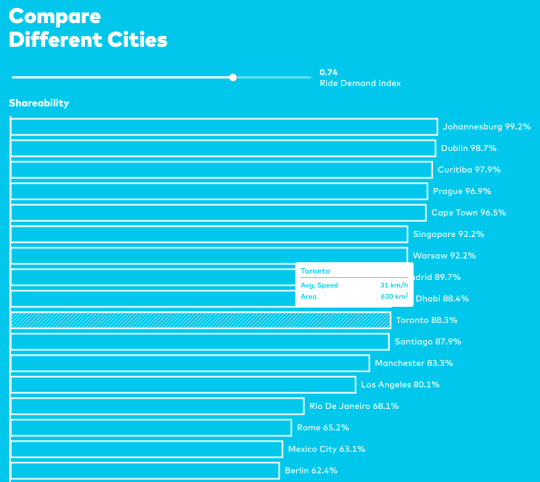
    The MIT Senseable City Lab recently looked at which cities are the most “shareable” when it comes to ride sharing services such as UberPOOL. Their goal was determine what fraction of individual trips (inefficient) could be shared or pooled (more efficient). To do this, they developed a single “shareability curve.” Full research paper, here.

    Not surprisingly, New York City does very well in this analysis. Its shareability is well above 95% for a delta of 5 minutes. That’s because the city has a large population, a small geographic area, enormous density, and lots of taxi traffic. (They used taxi data in their research.)

    But New York City also does very well when it comes to transit ridership. Highest in North America. So it strikes me that the characteristics that make a city “shareable” also apply to transit – which is effectively another form of ride sharing. Might we see the distinction between these 2 forms of mobility blur in the future? I think so.

  • People stay the same

    Andrew Chen recently delivered a keynote at StartCon in Australia called: What’s Next in Growth? You can find his entire talk, here, on his blog. 

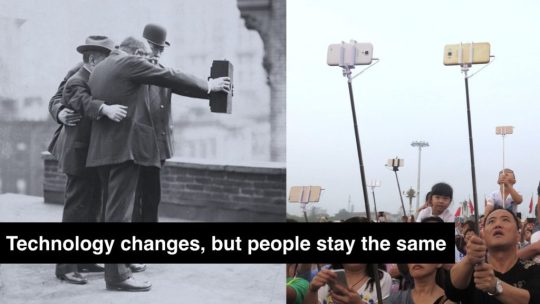
    One of the themes of his talk is that, “technology changes, but people stay the same.” I like that. See above.

    But more specifically, his presentation focuses on 3 techniques for growing businesses and products: customer referrals, viral content, and bootstrapping marketplaces. All of it is interesting, but I’m particularly fascinated by the last one.

    Marketplaces are all around us. Uber is a marketplace that pairs drivers and riders. Bars are a marketplace that try to pair people together. Finding, trading, and transacting (whatever that might mean for the marketplace in question) seems so fundamental to humans. And cities really empower that.

    The challenge with marketplaces is that they’re hard to start. There’s always a chicken-and-egg problem and so one side of the marketplace usually needs to be “hacked” at the beginning.

    Uber is a perfect example of this. At the outset, it didn’t have enough liquidity in its marketplace to compete with incumbent taxis. That is, it took longer to get an Uber than to get a taxi. 

    So instead, the value proposition was not about speed (or cheapness); it was about luxury. Uber was “everyone’s private driver.” That made waiting acceptable. You were getting a different level of service. The first Uber I ever called in Toronto took 20 minutes to get to my place in midtown.

    But obviously as liquidity increased, Uber was able to move downmarket and capture more (most) of the taxi market. Marketplaces are powerful once they get going. Network effects.

    I say all of this because, as many of you know, I have spent a lot of time wondering about the future of real estate marketplaces

    At the same time, I also think that many of these seemingly tech-focused lessons could be applied to cities. Starting an online marketplace is difficult. So is building a new neighborhood from scratch. In the end, it’s always about people.