Daily insights for city builders, delivered every morning at 6 AM ET. I’m Brandon Donnelly — a Toronto-based real estate developer and founder of Globizen. I’ve been writing here since 2013.

Tag: twitter

  • #DeleteFacebook

    Earlier this week I deleted my Facebook account. If we were friends on the service and you can no longer find me, this is the reason why. 

    Part of why I did this certainly had to do with privacy. I read Brian Acton’s (WhatsApp cofounder) account in Forbes this week. And I have been following many of the discussions over the past year:

    Privacy legislation is perhaps the only thing that could pose an existential threat to a business that’s entirely powered by watching and recording what people do at vast scale. And relying on that scale (and its own dark pattern design) to manipulate consent flows to acquire the private data it needs to profit. –Natasha Lomas

    But at the same time, I’m still on and use Instagram and WhatsApp (both Facebook companies), and I use Twitter pretty much every day.

    So I am certainly not in a position to be smug about this decision. Hopefully this post does not come across that way.

    The simple truth is that I had more or less stopped using the service. I had long ago turned off mobile notifications and so it had become more of a hassle than anything else.

    Every now and then I would go on and find notifications and messages that I wasn’t responding to. 

    So it had finally reached a point where I thought to myself: Why keep my data here (by the way, you can download all of your data from the site) and why check it sporadically if I’m not really deriving any value out of it? Simplify.

    I enjoy Instagram because taking photos is one of my primary passions outside of real estate and design. And I enjoy Twitter as a source of news and mostly civil conversation. 

    I am easy to get ahold of. I don’t need Facebook for that. Any of the social links at the top of this page (if you’re reading this post on the web), will get you there.
  • The Hess triangle

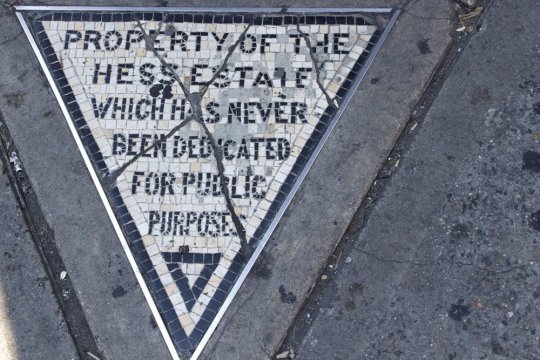
    A friend of mine recently shared this Twitter thread with me. It is by Chaz Hutton. I didn’t know who Chaz was before I read the thread. But I now know that he draws things, sometimes for the New Yorker.

    Chaz’s Twitter thread covers the history behind what was once believed to be the smallest plot of land in New York City. He also positions the story as the “perfect embodiment of New York’s attitude.” Guess what the means.

    The story is about the isosceles triangle pictured above, measuring 25-1/2″ at its base and 27-1/2″ along its sides. It is known as the Hess triangle and it reads: “Property of the Hess Estate which has never been dedicated for public purposes.“

    Click here for the full story.

    Image: Chaz Hutton

  • No is the second best answer

    image

    In addition to email, phone, and text, we live in a world where you can also easily and directly connect with people on LinkedIn, Facebook, Instagram, Twitter, Tumblr, Snapchat, Swarm, WhatsApp, Slack, as well as on many other platforms.

    As much as I love tech, I personally find this exhausting and far too distracting. So early last year I turned off all social media and messaging notifications – on both mobile and desktop – other than on the two platforms that I most commonly use. (Facebook and LinkedIn are not on this shortlist.)

    The result is that I am now missing (and consequently ignoring) a ton of direct messages. But as the saying goes, there’s no such thing as too much information, just poor filters. If you really want to reach me, I am not hard to find. You’re reading my public and daily journal right now.

    Zooming out from social media DMs, I am reminded of one of my all-time favorite Seth Godin posts where he talks about the value in saying no – which is, of course, just another kind of filter:

    No I can’t meet with you, no I can’t sell it to you at this price, no I can’t do this job justice, no I can’t come to your party, no I can’t help you. I’m sorry, but no, I can’t. Not if I want to do the very things that people value my work for.

    No is the foundation that we can build our yes on.

    And nobody should feel bad for saying no. A friend of mine likes to remind me that no is the second best answer. Yes is obviously the best, but a firm no is far better than an indecisive maybe that leaves everyone wondering what to do next.

    I should probably say no more often than I do. But I am working on it. Every now and then I remind myself that there’s huge value in saying no. Today’s post is that reminder and maybe it will be yours too.

    Photo by Kai Pilger on Unsplash

  • Google and Facebook show

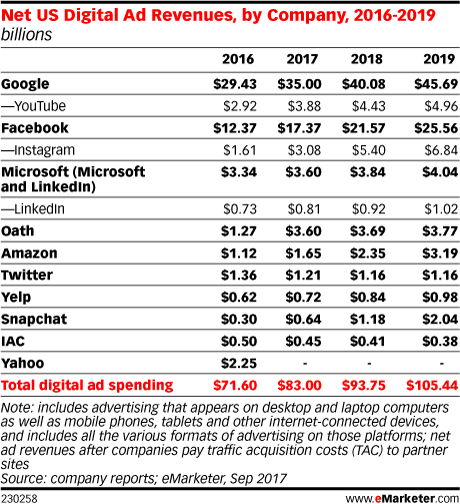
    This morning Fred Wilson posted this chart on his blog:

    image

    What is clear is that when it comes to US digital ad revenue, it’s the Google and Facebook show, followed by everyone else. Microsoft/LinkedIn is a distant third. Fred calls it “the digital advertising duopoly.” And his view is that the tech industry needs to figure out new approaches to monetization that still allow free content to be consumed. 

    I’ve said this before, but Facebook buying Instagram for $1 billion seems like a bargain when you look at a chart like this and you see what they were able to do with the platform. Instagram’s 2018 revenues are projected to be bigger than every other company on the list minus Google but including YouTube.

    Also notable are the flatlining of Twitter and the projected growth of Snapchat. 2017 was a rough year for $SNAP. But it appears that somebody believes they’ll be able to turn things around with their app redesign and reconstituted ad platform. Be that as it may, it’s still the Google and Facebook show – at least for the time being.

  • Great things that happened on transit

    Elon Musk’s apparent distaste for public transit and random strangers prompted a Twitter battle last week. Though for the record, Musk later clarified that he loves trains, most subways and London buses.

    Transit planner Jarrett Walker retorted that Elon’s views are the “essence of elite projection”. What’s good for Elon Musk may not, in fact, be good for the broader society. Elon responded by calling him an idiot.

    All of this prompted Brent Toderian – city planner and former chief planner of Vancouver – to initiate the hashtag: #GreatThingsThatHappenedOnTransit. It then took off and the transit stories started pouring in.

    Not surprisingly, this has been getting a lot of attention. It’s Elon Musk after all. But billionaire celebrities aside, it does serve as a good example of the two sides of this debate.

    Some people seem to think that I am anti-car. I can see why some people might think that, but I am not anti-car. I love nice cars. And I love nice trains. What I value first and foremost is the city. 

    The kind of city you can build on the backbone of transit is very different than the kind of city that gets built around the car. And as a rule of thumb, I prefer the former over the latter.

    But this is not to say that the public transit model is perfect. It’s far from perfect for many reasons. And it can get even more imperfect when we don’t pair it with the right land use policies.

    Deploying heavy rail through low density areas – that are by design inhospitable to car-less humans – will not magically flip the modal split. Public transport alone cannot solve that problem.

    At the same time, if you’re a regular reader of this blog you’ll know that I am enamoured by the possibilities of autonomous electric vehicles. I am not assuming that the “car” of tomorrow will look and perform anything like the car of today.

    Mobility is such an exciting space right now.

  • Attention = money; why the attention economy is broken

    “…the path to profit is to manufacture attention more cheaply than what you get paid for it.” Ev Williams

    A big part of our economy is centered around attention. Some would argue we are living in a de facto attention economy. That is now our scarce resource. There are only so many waking hours in a day and every company and social media platform is fighting for their sliver of your attention.

    However, the irony of the attention economy is that, while it has gotten easier to make and share “content” with the world, the quality of that content matters less than the attention it garners. Because that’s what the system rewards. Whatever you may think about Trump, he has mastered the art of attracting attention.

    Ev Williams – co-founder of Twitter and CEO of Medium – recently wrote a piece on this topic called: Words still matter. It is very much about the mission driving his publishing platform, Medium. Here is an excerpt:

    It’s not that there aren’t journalists, publishers, and thinkers doing great work and putting it out there. But the realities of the attention economy are very tough for those who create things designed for anything but the widest possible (i.e., lowest-common-denominator) audience. For ad-driven sites, the revenue per reader has been dropping for years (while the experience worsens and privacy disintegrates), leaving little room for research, fact checking, or polish… let alone nuance or complexity. The system demands quantity. It demands speed. And it demands little else — except our clicks.

    Their solution is the Medium Partner Program. It is an “open paywall” that allows publishers of great content to lock some of their best content behind a paywall. Their view is that to fix the attention economy, we need to move beyond ad-supported lowest-common-denominator content. 

    This not entirely novel, but they are calling themselves the first “open paywall” platform. I would be curious to hear your thoughts about this in the comment section below. I’ve had a few people suggest to me that I employ a similar approach for this blog. I’m not convinced.

  • 280 characters

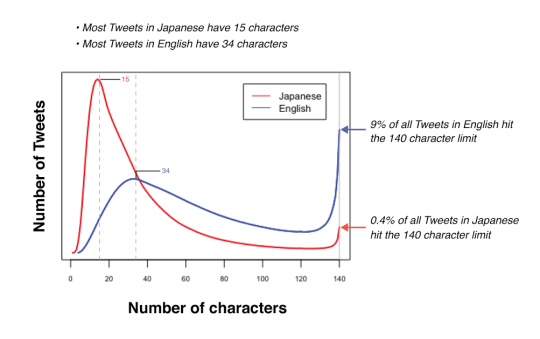
    Twitter is currently experimenting with longer tweets: 280 characters instead of its famous 140.

    One of the reasons they are doing this (besides the obvious goal of getting people to tweet more) is because different languages require a different number of characters in order to get the same message across.

    Here is a graph that Twitter published alongside their announcement:

    image

    I have never really given this any thought (perhaps because I don’t write or speak Japanese), but I find it interesting that Twitter’s arbitrary 140 character limit has been arguably impacting cultures differently. I wonder if there are subtle use case differences because of it.

    The other fascinating thing about this possible change is the backlash that is now mounting from users. People are freaking out, which I suppose some would argue is what most people do on Twitter anyways.

    But a similar thing is happening regarding Instagram after word got out that they were testing a new 4-photo grid (as opposed to the current 3-photo grid). 

    And let’s not forget that there was also a time when Instagram’s square cropped photos would have been considered sacrosanct. Most people have probably already forgotten about that.

    I mention all of this because, though it may seem small, this is actually a big change for Twitter. And change can be hard to accept, even if it doesn’t come in the form of an 8 storey condo building. It can also be hard to stand up when everyone is telling you that what you are doing is stupid.

    Maybe this is stupid, in which case the experiment will prove that out. Maybe it will reveal something positive that nobody could have predicted. Or maybe we’ll all just forget what life was like with only 140 characters.

  • North America’s second city?

    image

    Over the weekend Richard Florida sent out a tweetstorm that compared Toronto and New York City, and made the argument that Toronto’s “incredible diversity, density, and industry mix” is making the city feel a lot more like New York and London compared to any other North American city. 

    He even went so far as to say that, even though it may not be the bigger metro in terms of raw population, Toronto increasingly feels like North America’s second city after NYC. I’m obviously incredibly biased in this discussion, so I would be curious to get your thoughts in the comment section below.

    If you can’t see the embedded tweetstorm below, click here. Regardless, you’ll likely need to click through to see the entire thread.

    //platform.twitter.com/widgets.js

  • This is not right

    I have largely avoided commenting on politics and Trump on this blog, but at this stage it is almost impossible to do that.

    Donations are starting to pile up for the American Civil Liberties Union (ACLU) as the tech community, and many others, begin to respond to Friday’s executive orders. Lyft announced a $1 million contribution to the non-profit group.

    Today, venture capitalist Fred Wilson wrote: Make America Hate Again. And yesterday, his business partner Albert Wenger wrote: Misleading the World on Immigration.

    At 6 AM this morning, Richard Florida started a tweet storm where he argued that “Trump’s immigration insanity” will fundamentally threaten the core of America’s innovation hegemony. 

    (He also argued that Canada, and more specifically Toronto, serve to “gain substantially”, as there will no doubt be a doubling down on tolerance to attract the best talent from around the world.)

    The Canadian tech community penned an open letter to reinforce the message that, here in Canada, diversity is our strength. This echoes similar messages from Prime Minister Justin Trudeau and Mayor John Tory.

    Mass protests have broken out at US airports (links to photos) spanning San Francisco to New York. 

    And I am seeing folks from Toronto offer up their homes (publicly on Twitter) to anyone who might be stranded at Pearson International Airport as a result of the orders. Many have even tweeted out their phone numbers.

    Everywhere I look this weekend I am seeing these sorts of messages. So while I could remain quiet, that doesn’t feel right. And that’s because what is happening is not right.

  • I love work

    I spent this morning drafting the third post in my BARED blog series. First one, here. Second one, here. If any of you would like to be featured next, or know of someone who you think should be featured next, please send me an email or tweet.

    At this point, I need to move onto other things today. But I did want to mention a post that Ev Williams (Blogger, Twitter, Medium…) recently penned where he talks about keeping technology in check and the drain of being always connected.

    Here are two interesting excerpts:

    “I’ve spent the last 20 years breathing and building the internet. So I have a good sense for the benefits of always-available instant access and all it entails. I also have a strong appreciation for the drain being constantly connected can cause on your health and sense of well-being.”

    “Building companies requires a ton of work — and I love work. But I’ve also found that working 24/7 no longer produces the best work product or the best life experience (not that it ever did).”

    This really resonates with me, as I am sure it does for many of you. I like being always connected. I like waking up every morning and writing a blog post. I like saying yes to things. And I, like Ev, love work. 

    But it can be draining when your ambition seems to exceed your body’s ability to keep on going. And when that happens, you no longer produce your best work, which is the whole point. 

    So in the end, I think we all need these little checks and balances. Exercise is number one for me. It is well worth the time it takes. What do you do for balance?