Daily insights for city builders, delivered every morning at 6 AM ET. I’m Brandon Donnelly — a Toronto-based real estate developer and founder of Globizen. I’ve been writing here since 2013.

Tag: twitter

  • Using Clubhouse to talk about real estate and proptech

    Okay, Clubhouse is pretty awesome. I participated in my first discussion room — thanks to my friend Evgeny, who has been a vocal supporter of the platform — and I have now seen the light. The topic was real estate and PropTech. And we hope to do it again.

    It feels a bit like Twitter to me, but obviously with audio and with greater controls and visibility in terms of who can participate inside of a discussion room.

    It also makes perfect sense to me that Twitter is piloting their own version of Clubhouse called Spaces. That feels like a natural extension and something that needs to happen. Perhaps some of the moderation features will also make their way into the rest of Twitter.

    As many of you already know, what makes Clubhouse unique is that the communication is free-flowing and impromptu. You are able to see what topics people are talking about and then jump in and out of those audio rooms, as well as invite people to join a discussion that you may be having.

    All of this makes the communication feel like you’re at a party or in an open office. Over there you can see/hear that someone is talking about the “Pensky file.” If that’s interesting and/or relevant to you, you have the option of jumping into that conversation.

    I wouldn’t be surprised to see some of these features and behaviors translated over into workplace collaboration tools. I think it would be helpful to see what other discussions are taking place within a team or company.

    Maybe if we made things a little more free flowing, we wouldn’t need so many damn Zoom meetings.

  • Finding an audience (on Facebook)

    Social media can be both fun and useful. Over the weekend, we were exploring a few different design options for an address sign at Mackay Laneway House and so I posted this image on Twitter and storied it on Instagram. I got a bunch of responses, as well as some great suggestions. And we ultimately ended up making a small change to the design. That process was both fun and useful. The final design is now out for pricing and production.

    But as we all know, there is also a dark side to social media. The algorithms that power social media have been optimized to amplify whatever drives the most engagement. Oftentimes that means whatever gets people the most enraged. In this recent NY Times article, Stuart A. Thompson and Charlie Warzel make a compelling argument that Facebook has actually been coaxing many Americans into taking more extreme views on the platform — it made them more popular.

    And we’re not talking about extreme views on home address signs.

  • How to get rich (and why talking about money is okay)

    I’ve written about this before on the blog, but one of my qualms about architecture school was that it was too often taboo to talk about business and money. Why? Talking about and understanding the realities of the world doesn’t have to mean that you’re compromising on good design. Constraints are often good for design innovation. Similarly, I’ve always felt that personal finance should feature more prominently in schools at an early age. It should be considered a basic life skill.

    In any event, I came across this tweet thread last night by Naval Ravikant talking about how to get rich (without getting lucky). It’s from 2018, but the lessons — and there are many — obviously haven’t changed. (For those of you who may not be familiar, Naval was the co-founder of AngelList and was an early stage investor in companies like Uber, Twitter, and Opendoor.)

    When you see a headline like this it’s perfectly normal for your bullshit radar to go off. (In fact, it is one of his points.) But this thread is not bullshit. It’s about building wealth. Owning equity instead of renting out your time. Working hard. Taking a long view. Leveraging your time and skills. Understanding compound interest. Partnering with people of integrity. Being accountable. And becoming the best at what you do because you’re pursuing genuine curiosity (among many other great points).

    Here are a couple of his tweets. But I would encourage you to have a full read.

  • The art of the possible

    Architect Sheena Sharp, of Coolearth Architecture, tweeted something interesting out today:

    Improving this would be good. And it is the same gripe that I had with architecture school when I was there. Why is it taboo to talk about money and the market? Why must design exist, in many instances, within a vacuum?

    I can appreciate the value in not always constraining yourself with the status quo. To innovate, you have to stretch. And sometimes, or perhaps oftentimes, the best ideas initially seem dumb. It’s important to have room to experiment and tinker.

    But eventually, reality does matter. Plans that look good on paper, may not be suitable for the market. Constraints are a big part of what makes the city building industry so rewarding. Planning is hard. Building is hard. Getting consensus is hard. It’s all incredibly difficult and you have to be creative.

    The really elegant solutions usually need to weave across and through many different objectives and stakeholders. And so in my view, the more you can empathize with those other constraints, the more elegant your solution will be. Knowing more is good.

  • Protocols, not platforms

    Yesterday, Jack Dorsey published the below tweetstorm about Twitter’s efforts to create a decentralized internet protocol for social media. What does this mean? Think along the lines of the Simple Mail Transfer Protocol (or SMTP). Some, or many, of you may not know what this is, but you almost certainly use it every day. It is fundamental to modern email communication. It is how emails get sent.

    I would encourage you to click through to the entire thread. It all feels very topical. We are living in a world of recommendation algorithms and content designed to “spark controversy and outrage.” Arguably, this is the result of social media companies being platforms (i.e. proprietary systems), as opposed to being based around open protocols. Twitter is trying to change that by funding a team. And that feels like a great — and timely — idea.

    Full disclosure: I own $TWTR.

  • Grinding it out over the long-term

    Fred Wilson’s latest blog post about “grinding” tells the story of how Twitter solved the infamous “fail whale” problem that plagued its platform in the early days. I remember that whale, as I’m sure many of you do as well. It was a problem and, according to Fred, it was a real threat to the business. The solution wasn’t all that sexy; though sexy solutions were attempted. The team just rebuilt everything, piece by piece. And eventually the fail whale problem went away.

    The lessons here go well beyond just this Twitter example (or at least, it triggers something for me). Here’s how Fred ends his post:

    If given a choice between a flashy operator or a grinder, I will take a grinder every time. It is a much higher percentage bet. It requires faith and patience and the results are sometimes hard to see. But if you look at the results from grinding it out over a long enough time frame, you can see the power of that approach.

    This kind of long-term patient thinking can be difficult, especially in an increasingly instantaneous world. We are all drawn to magic solutions, hot stock tips, and new condos that are destined to double in value over the next year. I suppose that’s partially why so many people enjoy playing the lottery, even though the odds of winning big can be as low as 1 in a million.

    Being a grinder is largely a higher percentage bet because you’re taking a longer, more disciplined, view. Warren Buffet has, admittedly, no idea how stocks will behave over the next week or year, just as I have no idea how condo prices in Toronto will behave over the next week or year. Instead, Warren chooses to bet on “The American Tailwind” and I choose to bet on the role of Toronto as a global city.

    Warren first invested in an American business in 1942. He was 11. Over the next 77 years, the S&P 500 would go on to return an average of 11.8% annually. Had he invested in a no-fee index fund and reinvested all dividends, his gain would have been 5,288 for 1. In other words, a $1 million investment would have grown to $5.3 billion on a pre-tax basis. (See: The compound effect.)

    77 years is, of course, a long time. But I am sure you get the point: faith. patience, and tenacity — even when, sometimes, the results can be hard to see. Real estate development is very much that kind of business.

  • IPOs and home prices

    Fred Wilson made an interesting remark in his recent post about the current “IPO bonanza” that is taking place in the tech space. He is, of course, talking about the recent IPO of Lyft, the recent S-1 filings from Pinterest and others, and the expected filings from Uber, Airbnb, and so on.

    After listing the benefits of going public, he went on to say that this bonanza will surely also mean that it is going to become even more unaffordable in the Bay Area. Part of this is perhaps self-serving, since he operates a VC firm out of NYC. (Take your money and move to NYC.)

    But the data suggests that there is truth to this.

    When Twitter when public in 2013, it was estimated that it created some 1,600 millionaires. This is great for the local startup ecosystem as many of these beneficiaries could go on to found their own companies and create a whole new batch of jobs. The money gets recycled.

    But what does it do to the local housing market — especially a supply-constrained one like that of the Bay Area where it is difficult to build?

    In 2018, Barney Hartman-Glaser, Mark Thibodeau, and Jiro Yoshida penned a paper called, Cash to Spend: IPO Wealth and House Prices. In it, they looked at the impact of IPOs on local home prices in California from 1993 through to 2017.

    What they found, among other things, was a “positive and significant association between local house price changes and firms going public.” The price increases were also found to be the greatest the closer you get to the headquarters of the firm that just went public.

    If you’d like to download a copy of the paper, you can do that here.

  • How to manipulate attention

    This Toronto Life article about a 32-year-old who has managed to buy 10 homes in the city is very Toronto Life. At a time where many young people are struggling to afford housing, here is a millennial who has bought 10 of them (albeit with some partners). The underlying message: You’re not working hard enough.

    I am fairly certain Toronto Life writes these sorts of articles because they know they’ll enrage people. As Facebook has taught us over the last few years, getting people pissed off is good for engagement. And engagement is what drives advertising-based businesses.

    Here is an excerpt from a recent Time article by Roger McNamee (a former Facebook advisor):

    One of the best ways to manipulate attention is to appeal to outrage and fear, emotions that increase engagement. Facebook’s algorithms give users what they want, so each person’s News Feed becomes a unique reality, a filter bubble that creates the illusion that most people the user knows believe the same things. Showing users only posts they agree with was good for Facebook’s bottom line, but some research showed it also increased polarization and, as we learned, harmed democracy.

    If you take a look at the Twitter conversations surrounding the above Toronto Life article, you’ll see the reactions you would expect: Troll article. Yeah, but how much debt has he taken on? He had help from wealthy friends. Here’s how a 32-year-old is eroding housing affordability in Toronto.

    I appreciate all of this, but I will never understand the need to shit on other people because of their successes, regardless of whether they are self-made or were born with a competitive advantage. Billionaire isn’t a bad word in my books. I am a first generation real estate developer, but I wouldn’t be at all upset if my great-grandparents had decided that buying land in Toronto was a good idea.

    Here is a guy that moved to Canada for University. Lived in a basement with cockroaches after leaving his first job after school. Took some risks. And saved his money instead of doing bottle service at the club on the weekends. I can respect that.

    But again, these sorts of articles are bound to make a lot of people cranky. And Toronto Life knows that.

    Photo by Tiago Rodrigues on Unsplash

  • Thoughts on California’s wildfires

    What is happening in California right now is both sad and scary. I woke up to these photos in the New York Times. So I spent the morning reading up on wildfires and what causes them. 

    I am sure many of you are thinking: Is climate change doing this?

    It’s important to note that California is designed to burn. The characteristics that make the state a highly desirable place to live – mild winters and hot and dry summers – also make it a highly flammable place.

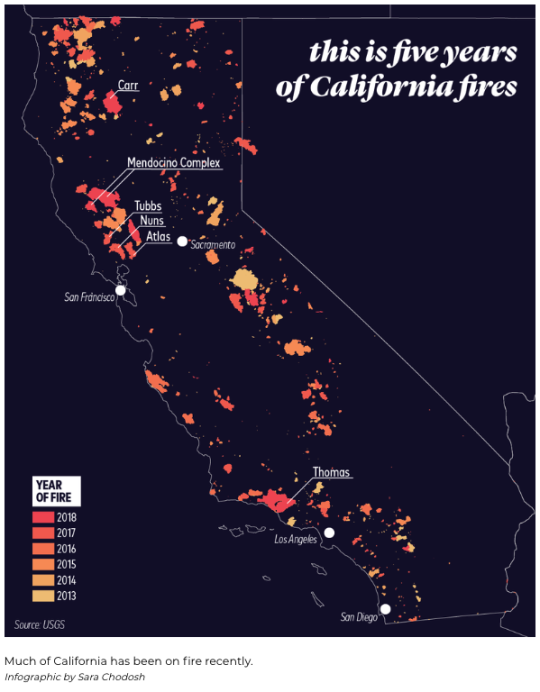
    Below is a map from Popular Science showing how much of California has burned over the last 5 years. Most of California’s hottest fires (13 of the top 20) have occurred since 2000.
    image

    But these naturally occurring fires are actually important for the regeneration of its forests. So one argument is that the current policy of “total fire suppression” is actually partially responsible for this increase in severe wildfires.

    Low-intensity forests aren’t burning like they used to and it is creating more densely packed forests for even larger wildfires. In other words, through our actions we could be exchanging smaller and more frequent fires for bigger and more severe ones.

    The other concern is development. 

    California had a population of about 24 million people in 1980. Today it is closer to 40 million. And much of that growth has occurred outside of existing urban areas (too hard to build). This has meant more people living in suburban and rural areas – adjacent to wildlands.

    Ed Glaeser has repeatedly argued that the best way to respect nature is to actually stay as far away from it as possible. Humans are a destructive species. Living in a dense city is good for the planet.

    Now let’s address the climate change issue.

    Daniel Swain, who is a climate scientist and author of the Weather West blog, published this popular thread on Twitter about a day ago. At the time of writing this post, it had been retweeted and liked over 10,000 times.

    From his perspective as a climate scientist, this is not all about climate change. That’s the wrong question to ask. It’s more complicated and nuanced than that. But climate does indeed act as a “threat multiplier” to the other factors we’ve already discussed.

    Fire season typically begins and ends with rain. When the fall rainy season starts, the fire season ends. One of the biggest risk factors is a dry fall, particularly after a hot and dry summer (or after multiple hot and dry summers, as has been the case in California). 

    Because according to Swain, fall means the start of “offshore wind” season, which can help to stoke these wildfires. 

    Unfortunately, one of the projected outcomes of climate change for California is more precipitation concentrated in the “winter” months, at the expense of precipitation in the shoulder seasons (spring and fall). So that means a longer fire season.

    Swain believes that if Northern California had received close to its typical amount of rain this fall, it is almost certain that this tragedy would have been avoided. 

    That, however, makes me wonder about the relative importance of all the factors we have discussed today.

    For Daniel Swain’s full thread, click here.

  • San Francisco’s tax for the homeless

    Proposition C will be on San Francisco’s ballots this November 6th, 2018. 

    If approved by voters, the following additional taxes would be levied on businesses in order to create a dedicated fund to both support and prevent homelessness in the city:

    For businesses that pay a gross receipts tax, an additional tax of 0.175 percent to 0.690 percent on those gross revenues in San Francisco over $50 million;

    For businesses that pay the administrative office tax, an additional tax of 1.5 percent of their payroll expense in San Francisco.

    Marc Benioff – the founder of Salesforce (which happens to be the city’s largest employer) – has emerged as the lead supporter of Prop C. Between personal and corporate funds, he has contributed almost $8 million to getting this passed.

    But other billionaires in the Bay Area, such as Jack Dorsey of Twitter, have taken a different position, instead siding with Mayor London Breed, who does not support Prop C. 

    If you’re interested in this topic, the New Yorker has a piece called, The Battle of the Big-Tech Titans Over San Francisco’s Tax for the Homeless