Daily insights for city builders, delivered every morning at 6 AM ET. I’m Brandon Donnelly — a Toronto-based real estate developer and founder of Globizen. I’ve been writing here since 2013.

Tag: twitter

  • Some thoughts on how we plan cities

    I came across this discussion on Twitter yesterday about how so many of the spaces we love in cities would not conform to today’s modern city planning practices:

    //platform.twitter.com/widgets.js

    This is a topic I’ve been thinking about lately and so it’s a timely discussion. In fact, I’ll often come across spaces in Toronto where I’ll think to myself: This is a really great space. But it’s highly unlikely that it could be built this way today. Naturally the question then becomes: What does this say about modern city planning?

    City planning is obviously important. But at the same time, we are almost certainly making mistakes and doing things that we will later regret. I say this not because I’m particularly critical of planning today, but because cities are enormously complex entities and it’s difficult to believe that we’ve figured everything out at this point.

    One thing I wonder about is if we aren’t over-planning and being too prescriptive about our cities. Some of you will probably argue the exact opposite. But hear me out.

    Vancouver is a city that has long been considered to be the gold standard in modern city planning. We talk about its podium + tower building typology. We talk about its “gentle density.” And we talk about its great public and recreational spaces, among many other things.

    But when I was there last month having dinner with a friend of mine, she said something to me that stood out. She said: “Brandon, Vancouver is a boring city. If it weren’t for my family being here, I would happily move to Toronto, New York, or somewhere else.”

    Cities are amazing places because they unleash human ingenuity. They allow new and unforeseen things to emerge. The challenge, I think, is to not sterilize that away when we plan and build. And all of us involved in the building of cities are probably guilty of doing that to an extent.
  • A Spanish social media town

    I am a big fan of Twitter.

    I use it more than any other social network and any other app on my phone (according to my battery usage). In fact, I’m such a fan that I recently started buying shares. I don’t own a lot and the Canadian-US exchange is awful right now, but I do plan to continue buying (I like dollar cost averaging).

    Twitter isn’t the darling of Wall Street like Facebook is. And I think the biggest weakness of Twitter is that it’s difficult for new users to really “get it.” Facebook solved this problem early on by recognizing that new users had to connect with X number of friends right away so that they received value immediately and the next time they visited.

    But I digress. That’s not the focus of this post.

    This morning a friend shared a Medium article with me that was written by the Laboratory for Social Machines at MIT. The article is about a small town in Spain called Jun (pronounced “hoon”) that has transitioned to using Twitter as the dominant platform for communication between government and citizens.

    The initiative first launched in 2011 and since then the mayor, José Antonio Rodríguez Salas, has been trying to get every resident onto Twitter. All 3,500 residents are even encouraged to go into the town hall to have their Twitter accounts verified. This way government employees know for sure that they’re dealing with an actual resident of the town.

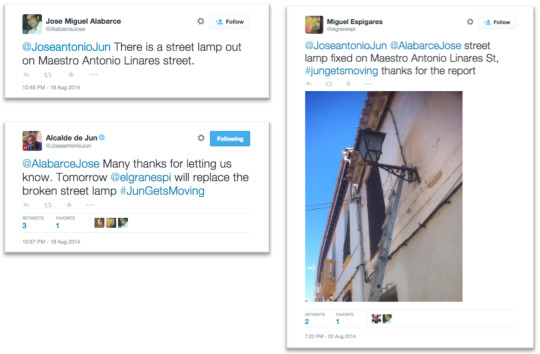
    Here’s a simple example of what this means for government-citizen relations (the folks at MIT translated everything to English):

    image

    In the above example, a citizen tweeted the mayor informing him that a street lamp was out. The mayor then responded, tagged an electrician, and said it would be fixed the following day. Sure enough the electrician went and fixed it the following day, and then tweeted out a photo of the lamp.

    This is great. And Twitter was made for these kinds of interactions. Facebook was not.

    Here in Toronto we have @311Toronto, which I have tweeted many times before with problems and they do respond quickly (far quicker than if you try and call them). But I still think there’s room for us to improve transparency and engagement across the board.

    All of this is a perfect example of how technology and cities are colliding in a big way. In today’s world I really think you need to be able to think across disciplines.

  • Formula for life

    https://500px.com/embed.js

    Earlier this week I somehow stumbled on an old (2012) Medium story by Ev Williams, called, Formula for Entrepreneurial Success. (Ev is the cofounder of Medium, Twitter, and Blogger. He basically invented blogging.)

    His post includes 5 short recommendations, and is obviously aimed at entrepreneurs, but I think the lessons also apply more broadly to life in general. They resonated with me, so I thought they might also resonate with you.

    So whether you’re starting a company, developing a new building, or just living life, here are Ev’s 5 points:

    1. Work with amazing people. Don’t compromise on who you choose to found your company with and hire. Do not put up with ego-centric personalities or downer attitudes.

    2. Take on big challenges. It’s pretty simple: Hard things are valuable; easy things are not so valuable. Reaching the mountaintop is rewarding because it is hard. If it was easy, everybody would do it.

    3. Focus. Say no to most things: Features. People. Partnerships. “Coffees.” Projects. Only a few of them really matter. (Yes, it’s hard to know which.) Don’t get distracted.

    4. Take care of yourself. When you don’t sleep, eat crap, don’t exercise, and are living off adrenaline for too long, your performance suffers. Your decisions suffer. Your company suffers.

    5. Love those close to you. Failure of your company is not failure in life. Failure in your relationships is.

    If I had to pick one of the items from this list, I’d say I struggle the most with focus. It’s not that I can’t focus and complete tasks, it’s that I’m the kind of person who wants to fill every second of the day with something meaningful. And when people email me wanting to go for coffee or help with something, I want to do it.

    But unfortunately, time is a hugely valuable commodity and you have to be selective.

    So surround yourself with amazing people. Don’t be afraid of big challenges and risks. Focus. Eat well and lift weights (my preference). And love the important people in your life.

  • This is a personal blog

    The internet has created an interesting dialogue between personal identities and corporate brands.

    In the pre-internet and pre-blogging days, it was harder for individuals to establish a strong brand and public identity for themselves, unless of course they were somebody famous. The cost of doing so was simply prohibitive. To promote meant print, TV, radio, billboards, and so on.

    But now promoting can mean anything from tweets to writing a blog like this one. And that has opened up the opportunity for anyone to put themselves out there.

    The dialogue, or tension in some cases, is that it becomes a balancing act: what should I be putting out there? Myself, some faceless brand, or a mixture of the two? Brandon Donnelly or Architect This City?

    If you a run a company, you’re probably debating this. Do I create a personal social media account, one for my company, or both? And how do I go about managing both?

    To be clear, this blog is a personal blog. It’s not a business. 

    Some people have suggested I start to allow multiple authors and turn it into more of a platform. But I thought about that and that’s not what I want to do. Which is why I continue to write at brandondonnelly.com (i.e. myname.com). I like that I can send this URL to anyone and they’re able to quickly understand who I am and what I’m about.

    Because what I write about are things that I’m passionate about: cities, design, real estate, technology, and so on. But I also mix in personal things so that I feel as if I’m writing a public journal. There are many benefits to keeping a journal (my 4th grade English teacher Mr. Hoad-Reddick told me so). And that’s really how this whole blog phenomenon started – they were personal places.

    Over time though, blogs evolved to become less personal and more corporate. And I am sure that some of you would rather I keep things strictly business around here.

    But to be honest, my favorite people and brands to follow online are the ones that do make their content personal. Yes, I want to learn new things about interesting topics, but I also enjoy the connection that comes with reading somebody’s personal journal and engaging in discussion with them.

    In fact, I hate it when my Twitter feed becomes nothing but companies tweeting out polished articles and reports. That’s boring. I like seeing real people in my feed. People sharing what they’re doing and how they’re feeling. People being authentic, genuine, and even vulnerable.

    And ultimately I find it makes their non-personal content that much more engaging. You have context. You understand their thought process. You can read between the lines. Those connections are what social media and blogging are really all about.

    So I’m thinking that I’m going to try making this blog a bit more personal and a bit more playful. I hope you enjoy it. And if you don’t, I’m sure you’ll tell me about it in the comments below.

    On that note, I’m off to the gym to lift some weights. Besides blogging, that’s another one of my habits that I need to do on a regular basis in order to feel normal.

  • Towards more publicness

    Back when the commercial internet first started to take off it was uncommon to use your real name online. Instead people relied on usernames and other pseudynoms to represent themselves. I honestly can’t remember what I used in those days, but I’m sure it was something ridiculous.

    Over time though that started to change. 

    Blogging started to take off in the late 1990s. And we started to become more comfortable sharing personal information online. Perhaps the biggest shift though, came with the introduction of Facebook in 2004 (over 10 years ago!). All of a sudden people – young college students initially – started sharing lots of personal information online, including photos of themsleves and their friends.

    But this wasn’t an overnight change. When Facebook first launched, privacy was an important component. It still is, but I would argue that it has become less central given how public a lot of other social media platforms are today. Twitter, for instance, is what it is today largely because of its publicness. 

    For my own social media accounts, I have made every single one of them completely public. From Twitter to Facebook to Instagram to Snapchat, nothing I post to social media is restricted in any way. And I do that because I believe we are headed towards a world with more – not less – openness, transparency and publicness.

    Of course, I’m not just talking about social media and tech. I’m talking about open data in general.

    Earlier this year, the Toronto Real Estate Board clamped down on real estate brokers who were publishing historical sales data online. Citing privacy concerns, TREB ordered them to stop or lose their access to the MLS system. 

    For those of you not from familiar with the Toronto real estate market, historical sales data for homes is not open and published online. You generally need to go through a realtor to get access to this data. Some think this is the right approach. And others think it is antiquated.

    But as I explained above, our conception of what should be private can, and will, evolve over time.

    Here are the details on my home:

    I purchased it in September 2012 for exactly $400,000 (Canadian). It’s a 650 square foot condo in the St. Lawrence Market neighborhood of Toronto. It has one bedroom, a 400 square foot terrace, one parking spot, and 10′ ceilings.

    Sooner or later, I believe this information will be freely available online. But since that’s not the case today, I figured I would just tell you. Sharing this information is not a big deal for me.

  • What do you think of 1 Bloor West? [Poll]

    image

    Over the past few weeks I’ve been running a little experiment on Twitter where I tweet about a new development project in Toronto and I ask people to vote on it. If they like the project, I ask that they retweet (RT) it. And if they don’t like it, I ask that they favorite it (FAV).

    Here’s what it looks like in tweet form:

    As you can see from this experiment, about 69% of the people who participated seemed to be in favor of this project (at least at the time of writing this post). That said, the discussion following this tweet was a lot more negative than I would have expected.

    Somebody also pointed out that in my experiment I’ve created a bias towards supporting the project, since a retweet means the project gets shared, whereas a favorite doesn’t do that. I would argue that the more distribution the better for an accurate consensus, but point taken.

    So today I thought I would do this same experiment here on Architect This City. 

    At the bottom of this post, I’ve featured a comment from myself asking if you support the 1 Bloor West project. If you like the project, I ask that you “up vote” my comment. And if you dislike the project, I ask that you “down vote” it. You can do so by using the up and down arrows towards the bottom left of the comment.

    Hopefully this hack will create a more neutral voting framework. I hope you will participate. If you’re reading this via email, you’ll need to open up the post in your browser by clicking “read more” at the bottom.

    If you’d like to learn more about the project before voting, check out this article from the Globe and Mail. Happy voting!

  • “Great ideas are Obvious in retrospect.”

    Photograph San Francisco Sunset by Nathan Camarillo on 500px

    San Francisco Sunset by Nathan Camarillo on 500px

    The title of this post is a line from a Medium post that Biz Stone wrote back in August 2012. For those of you who might not know, Biz Stone is one of the cofounders of Twitter, as well as the cofounder of something called The Obvious Corporation.

    Obvious is a “company” that I’ve been following on and off for a number of years – I’m fascinated by the model and how it has evolved. It was founded back in 2006 by Biz Stone and Ev Williams (another Twitter cofounder) as a kind of “product lab” for new ideas. But since then it has gone through a number of iterations.

    Though I suspect that most people haven’t heard of Obvious, it was actually the parent company of Twitter before Twitter took off and became independent.

    But even more interesting is the fact that Twitter was actually a side project for a company called Odeo (a failed podcasting startup) that in turn was owned by Obvious. So specifically, Twitter started as a side project of one of the companies within a larger “product lab.” Nobody said innovation was straightforward.

    When Twitter eventually took off, their focus naturally shifted away from Obvious to it. They had a rocket ship of a company to build and run. 

    But in 2011, Ev and Biz, along with Jason Goldman (of Twitter), decided to “reboot Obvious.” The most notable outcome of this reboot has been the creation of writing platform Medium, which I believe still technically sits within Obvious. (Click here if you don’t know what Medium is.)

    Then in December of last year (2014), Ev Williams announced the third chapter of Obvious – now called Obvious Ventures – with this post called: It’s Obvious. Again. In short, they’re a venture capital firm with an approach that they call #worldpositive:

    We’re entrepreneurs. We’ve helped a lot of companies launch, grow, and generate great financial returns. A few of these companies also deliver positive social and environmental benefits with every dollar of revenue they earn. We want to fund and build more of those. That’s what we call #worldpositive venture capital.

    Already they’ve publicly announced investments in 10 companies, one of which I’ve written about before on Architect This City (Flux.io).

    I decided to tell this story today for 3 reasons.

    It shows you how non-linear innovation and careers can be. I love the idea of #worldpositive investing. And finally, because some of the startups that Obvious Ventures has invested in – such as Flux.io and Loup – are directly related to the future of cities.

  • Debating Porter’s plans

    Before going snowboarding this morning, I got into a bit of a heated debate on Twitter about Porter Airlines’ plans to expand the Toronto Island Airport and fly the new Bombardier CS100 from it. The proposal is facing a lot of opposition and, since I’m generally for it, the conversation got a bit lively.

    At one point, I called somebody a NIMBY, which was probably an unproductive thing to do. But I was trying to better understand that person’s position. The argument was that parks (ie. the Toronto Islands) and planes don’t mix and so the proposal is bad. However, since we already have planes operating out of the island today, I wanted to know if what we have today was considered acceptable and, if yes, what the precise concerns are regarding the expansion.

    In other words, I was trying to get a better sense of the threshold in which people start to feel the airport is a detriment to Toronto’s waterfront. Is it already considered a hindrance to waterfront enjoyment (it certainly isn’t for me) or is it a question of increased noise and flight volume bringing it over the edge?

    Today the airport moves over 2 million people a year. So I have a hard time buying the argument that this is only a boutique airport for the elite. Clearly, it’s filling a need in the marketplace. And so I think it would behoove us to figure out how to balance the economic gain with the concerns of urban livability. I hope that we’ll be able to do that.

    What’s your position on Porter’s plans? I would love to hear from you in the comment section below.

  • Data centers and the arctic circle

    I don’t think a lot of people consider the spatial implications of the online world. By this, I’m specifically referring to the massive data centers required to power the internet.

    Earlier this year Facebook opened its first European data center in Sweden, less than 70 miles from the arctic circle. It’s 900,000 square feet. That’s about equivalent to a 102 storey condo tower.

    Behind the virtual worlds we live in – Facebook, Twitter, Tumblr and others – lies nondescript buildings with repeating rows of machines inside them. They’re the complete antithesis of the vibrant lives we pretend to have on the consumer web, but they’re making it all possible. It feels just like the Matrix.

    And there are some interesting shifts taking place in the data center space. Facebook – through its Open Compute Project – now designs its own centers and makes the work available to others, for free. It’s an “open hardware” play that could threaten incumbents in the space such as Dell and Cisco.

    Facebook’s goal is “to build one of the most efficient computing infrastructures at the lowest possible cost.” Their Swedish outpost represents their first self-designed center. And it’s proven to be a highly efficient one.

    While the average data center might use 3 watts to produce 1 watt of computing tower, Facebook’s Swedish center was able to get that ratio down to 1.04 : 1, largely because the colder climate allowed for a dramatic reduction in cooling loads. It makes a ton of a sense.

    I’ve actually thought about this before. Why aren’t more data centers – which have massive cooling requirements – built in colder climates? I just so happen to know of a country with lots of prime arctic circle real estate.

  • Why I decided to start blogging

    New York VC Fred Wilson wrote a blog post yesterday called “Writing It Down.” In it he talks about why he blogs everyday. It’s worth reading. If you’re into tech, you should also read his linked post on Twitter.

    After reading it, I thought I should come clean about something: He’s one of the main reasons I decided to start blogging. I saw what he was doing and I felt inspired. The other reason is that I started blogging for Dirt and really enjoyed it. I’m trying to also do it daily, but so far I haven’t made any public promises on that front. I’d rather under promise and over deliver.

    I’ve been an avid reader of Fred’s blog for awhile now. What I find really powerful is that it has become a mechanism for him to get his thoughts out and into the world and to get feedback on them. Sometimes his posts can be a definitive how-to (such as his MBA Monday lessons) and in other cases it’s clear that he himself isn’t sure of the answer, but that he wants to put it out there for discussion. And I think that’s a great way to be. There’s wisdom in crowds.

    At the same time, when I decided to start blogging personally, I told myself that even if nobody reads my stuff that I’d still be getting value out of it. That’s because writing forces you to think about things to a greater extent than if you, well, just sat and thought about them. I like that.

    However, I do hope that my blog will end up getting read by others because I’m interested in happenstance. I’m interested in the chance that like-minded individuals will read one of my posts about cities and reach out to me, or introduce me to somebody I should meet. 

    When you put yourself out there, I think you also open yourself up to opportunities.