Daily insights for city builders, delivered every morning at 6 AM ET. I’m Brandon Donnelly — a Toronto-based real estate developer and founder of Globizen. I’ve been writing here since 2013.

Tag: tridel

  • Weekend walking tour

    I had a friend — who I know from architecture school — visiting from Detroit for the weekend, so we did a little building tour on Sunday morning.

    This is the elevated (and half-finished) CIBC Square Park that spans over the rail lines leading into Union Station. The benches are beautiful. On the right side of the second photo are also fire pits that are in the process of being setup.

    This is us nerding out (photo credit to Neat B).

    And this is the view looking down Bay Street from the stairs that lead up to the park. We tried to snoop around inside a little but a security guard asked us to leave.

    This is T3 Bayside — a new timber office building going up on the waterfront. Apparently it is the tallest of its kind in North America at the moment. I am also embarrassed to say that I just learned that T3 stands for timber, transit, and technology, and that it is part of a broader office development strategy that Hines is rolling out.

    This is Tridel’s Aquavista. I’m looking forward to the ground floor spaces getting leased up in this area. All of the ingredients seem to be here for a vibrant waterfront community.

    This is the next Aqua-something project. We all assumed that there must be strict umbrella rules in place.

    This is Monde by Moshe Safdie & BDP Quadrangle (architects) and Great Gulf (developer). It kind of reminds me of 56 Leonard Street (New York) from this elevation. I guess I’m not used to seeing it from the south side.

    Finally, this is Sherbourne Common, which is both a park and an important piece of stormwater infrastructure. It treats stormwater before it gets discharged into Lake Ontario and it also helps to reduce poop from flowing into Lake Ontario as a result of combined sewer overflows.

    It’s fun being a tourist in your own city. We should all do it more often. It makes you appreciate what you have.
  • Design makes everything better — architecture as product

    https://dmeb.castos.com/episodes/interview-with-david-wex

    My friend David Wex of Urban Capital Property Group — who I featured in my “BARED” blog series back in 2016 — was recently interviewed by architect Vincent Van den Brink (of Breakhouse) for the firm’s podcast called, Design Makes Everything Better. It’s a great listen and I particularly like the bit around branded vs. opportunistic real estate development. In the case of Urban Capital, David would describe his firm as being a branded developer. They build a specific product and it doesn’t really change when they build across Toronto and in other markets. Expect exposed concrete ceilings and exposed ducts, among other things. If you can’t see the embedded podcast above, you can have a listen over here.

  • Toronto condo market outlook

    BNN Bloomberg just published this article on the Toronto condo market. It is based on a roundtable discussion that was held at their Toronto office last week with Jim Ritchie of Tridel, Jared Menkes of Menkes Developments, Shamez Virani of CentreCourt, and Jane Renwick of Diamond Kilmer Developments.

    The overarching theme is that, after a couple of frenetic record setting years, the market should settle down in 2019, which is likely a good thing. Hopefully that will also temper construction cost inflation. We have been seeing double digit increases over the last few years (hence some of the cancelled projects).

    But as Jared points out, the fundamentals here are still strong and there are a number of supply constraints creating upward pressure on pricing:

    Jared Menkes, executive vice president of high-rise residential at Menkes Developments was unwavering for the future. “There’s a lot of red tape that’s slowing down bringing more product to market,” Menkes said. “I promise you, pricing is going up.”

    For the rest of the article, click here.

  • Photoblog: Sunrise at Ten York

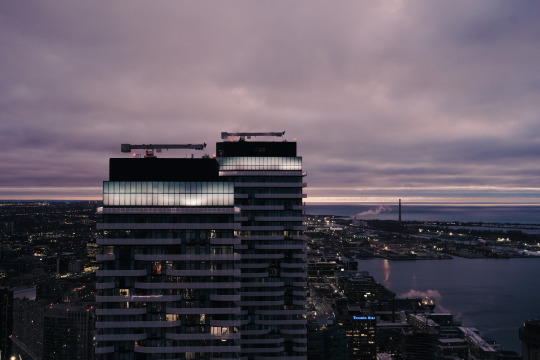
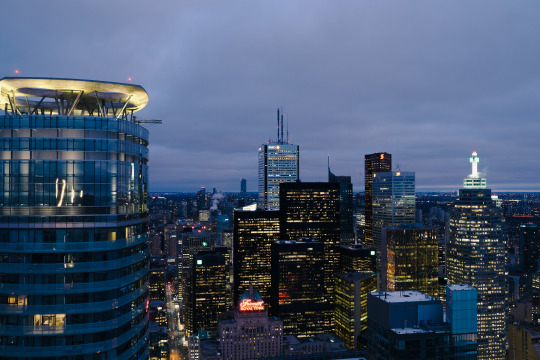
    This morning I watched the sun rise from the the roof of Ten York Condominiums, some 735 feet up. This is what that looked like (the sky initially had a purple hue to it):

    It was cold as all hell, but sometimes you have to work for your photos.

    Some of you may also remember that I wrote about this building a few months ago. Tridel, the developer, is calling the project its first “smart condominium.”

    Regular scheduled programming will resume tomorrow.

  • Tridel unveils smart condominium in South Core

    A few weeks ago, Canadian developer Tridel unveiled its first “smart condominium” at Ten York – a recently completed 69 storey building in the South Core neighborhood of Toronto. Above is an archive photo of the building under construction. I chose this one because its siting between the Gardiner Expressway (left) and Harbour Street (right) is also noteworthy.

    Smart anything is one of those tech buzzwords that is, I know, starting to feel vapid. But Tridel has done some interesting things here with their Tridel Connect platform (a collaboration with SmartONE Solutions). And if you happen to also be in the business of designing and constructing multi-family buildings, I think you’ll find it to be a useful case study.

    At Ten York, you can now use your phone as a key fob. People buzzing up are shown to you on your wall pad so you can confirm identity. The suite entry doors use digital locks, which means you use an access code instead of a key. Additional codes can be created for family and friends or for service providers like dog walkers and cleaners. You’re also given a log of who has come and gone. And of course there’s an automated parcel delivery system.

    If you’d like to see all of the features in the live, I suggest you take a look at the “b-roll video” that was included as part of their press release. Tridel is excellent at implementing new technologies and I know that they frequently reserve test suites in their projects to try some of them out. This is a great thing for the industry and for consumers.

    Image: Tridel

  • Hamilton’s Pier 8

    In December of last year, the City of Hamilton launched an RFP process to find a team (from the list of prequalified bidders) to develop a new urban community at Pier 8 along the waterfront. The ambition is somewhere around 1,500 new residential units and approximately 13,000 square meters of commercial and institutional space.

    That process has narrowed the pool to 4 teams and 1 will ultimately win the exclusive right to develop the new community. Here are the teams, along with a link to their submission materials, including a short video that I understand was a requirement of the RFP.

    – GulfDream (link)

    – Tridel (link)

    – Urban Capital / Core Urban / Milborne Group (link)

    – Waterfront Shores (link)

    This is a super exciting project for Hamilton. So I would encourage you to take a look at the presentation materials. At this point, you only have until Tuesday, April 17, 2018 to provide any comments to the City’s evaluators. If you’d like to view the boards in person, you can do that this Monday and Tuesday in the main lobby of City Hall.

  • Advancing green building technologies, one condo suite at a time

    This evening I had a fascinating conversation with Subhi Alsayed of Tower Labs. If you haven’t yet heard of Tower Labs, I would encourage you to check them out. Here’s their mission statement:

    Our mission is to facilitate the adoption of green building products, technologies and practices through pilot and demonstration projects in highrise buildings; and accelerate the evolution to a low-impact, sustainable urban environment.

    What they do is test out new green building technologies in one-off condominium suites. And since they were founded by both MaRS and Tridel (which is one of, if not the largest condo developer in Toronto), they have plenty of opportunities to do just that.

    This is important because the real estate industry is notoriously slow at innovating. I’ve written about this many times before. Whenever you try and introduce something new, there’s always a lot of change management that goes along with it. The construction trades, to use one example, need to get their heads around it. And until they do, they’re going to charge a premium for it.

    So by creating a one-off test case, everybody gets to see how it works, how it is built, and, most importantly, how it actually performs in the real world.

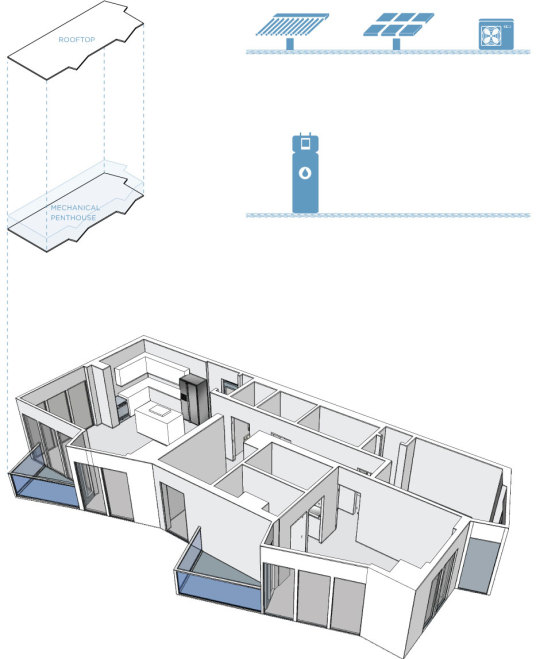
    One of the projects that they’re working on is something called NetZED, which stands for Net Zero Energy Dwelling. As the name suggests, it’s a condominium suite that produces as much energy as it consumes. 

    The way it works is by trading energy. At night when the sun isn’t out and the panels on the roof aren’t able to produce energy, the suite “borrows” electricity from the building. But during the day when the sun is out, the suite powers itself and then returns any borrowed electricity to the building. Click here to learn more about the suite. It’s being built in the Aqualina Condos on Toronto’s waterfront.

    image

    I find all of this incredibly exciting. Not only because they’re working towards a more sustainable future, but also because they’re applying their efforts towards the multi-family building typology (towers). Given that most of the world now lives in cities, this is an important building typology to make even more sustainable.

    Image: Tower Labs

  • 14 CityBuilders come together in support of removing the Gardiner East

    This will probably be my last Gardiner East post before the decision goes to City Council next week on June 10th. But I have such good news that I need to share it with you all.

    This morning 14 “CityBuilders” came together for the first time in support of removing the elevated Gardiner East and replacing it with a surface boulevard. They are real estate developers, investors, and other prominent business leaders in the city. And they sent a letter this morning to every single Toronto City Councillor outlining their position. 

    I can’t tell you how thrilled I am to see this happen, so I’d like to call out each and every member of the CityBuilders. They are (in alphabetical order):

    1. Castlepoint Numa
    2. Cityzen Development Corporation
    3. Context Development
    4. Continental Ventures
    5. Daniels Corporation
    6. Distillery Historical District
    7. Dream Unlimited Corporation
    8. Greybrook Capital and Greybrook Realty Partners
    9. Kerbel Group Inc.
    10. Manulife Real Estate
    11. QQE 162
    12. Streetcar Developments
    13. TAS
    14. Tridel Group of Corporations

    These are some of Toronto’s most important city builders and I am sure this will get the attention of both Mayor John Tory and the rest of City Council.

    If you haven’t yet signed the Gardiner East petition that Stephen and I started, please do so by clicking here.

    Happy Friday 🙂

  • Do homes need to become more of a product?

    Yesterday evening I moderated a panel on innovation in real estate at the Rotman School. The panelists included Subhi Alsayed (Innovation Manager at Tridel); Michael Lio (President of buildABILITY Corporation); Alison Minato (VP of Sustainability at The Minto Group); and Tad Putyra (President and COO, Low Rise Development at Great Gulf).

    Though the general consensus was that the real estate industry is terrible at innovation, it was comforting to hear that a number of both low-rise and high-rise developers are working on and/or towards building “net zero” homes. A net zero home is a home with no net energy consumption. What this means is that the home produces as much as energy as it consumes.

    The general strategy with these homes is to design the building so that it’s as energy efficient as possible (as in R-40 walls and triple-pane glazing) and then use renewable energy sources (such as solar) to fulfill any remaining energy needs. Of course, the next step would be homes that actually produce more energy than they consume so that they become net contributors to a city’s energy grid. But let’s not put the cart before the horse.

    There are a number of challenges to achieving this goal—one of which is on the consumer side. Many of the panelists mentioned that consumers simply don’t care enough about building performance and energy efficiency. Instead of worrying about air tightness, they’re worried about cosmetic things, like granite countertops and hardwood floors. That’s not to say that these pieces aren’t important, but they’re only one aspect of a home.

    So what’s the solution? Do developers and home builders need to get better at consumer education? Or should utility companies be the ones shouldering this responsibility? After all, improving energy performance means lower utility costs.

    One thought that came to mind (and I’m testing this for the first time with the Architect This City community), is that maybe homes need to become more of a product. Today, developers often market projects and communities ahead of themselves. But maybe that’s not the best way to drive innovation within the real estate industry.

    For example, think about how car brands segment the market. When you buy a Mercedes, you expect a certain level of performance and quality. You probably don’t know about every little technological innovation in the car, but you assume that they’re pretty damn good.

    With a new home on the other hand, you’re buying (insert generic name) on the Park or the Residences of (something regal sounding). The developer’s brand is secondary. And maybe that’s the wrong approach. Maybe it’s making consumers believe that the only thing that matters is whether you’re getting stainless steel appliances and granite countertops.

    Maybe consumers need to know whether or not they’re buying from the Mercedes developer or from the Ford Pinto developer. After all, consumers make decisions based on heuristics. They need to be able to say to themselves:

    “This home is $50,000 more, but it’s from the Mercedes developer so I can justify it. I’ll have less problems in the future, I’m sure.”

    Instead, consumers are saying to themselves:

    “This home is $50,000 more. Why is that? They both have stainless steel appliances and granite countertops. I’ll just go for the cheaper one.”

    I refuse to believe that the real estate industry can’t be as innovative as other industries. There’s always a way. We just need to figure it out.

    What are your thoughts?