Daily insights for city builders, delivered every morning at 6 AM ET. I’m Brandon Donnelly — a Toronto-based real estate developer and founder of Globizen. I’ve been writing here since 2013.

Tag: toronto

  • A year in review — 2015 on Architect This City

    Thanks to this blog, it’s pretty easy for me to go back and look at what I was doing and thinking throughout the year. That’s one of the benefits of writing a daily blog/journal. And as is usually the case, 2015 was a year of ups and downs.

    For my annual ski and snowboard trip with the guys, we went to Banff (Alberta) and Revelstoke (BC). But we got stuck with unseasonably warm weather in the west (the opposite of what’s happening this winter) and I got injured on day 3. That put me in the emergency room and knocked me out of snowboarding for the rest of the season – as well as from the gym for a number of months.

    Shortly after that I also got struck with some family health issues. That was pretty scary for a good solid month, but in the end, everything seems to have worked out. What a relief.

    Towards the end of March, I did a brand partnership between Architect This City and Porter Escapes, which brought me to Quebec City for a weekend. That was a lot of fun and gave me the opportunity to be a real flâneur in one of the most interesting cities in Canada.

    In April, I left my real estate development job at TAS and shortly after I joined CAPREIT (TSE: CAR.UN) to help build out their (real estate) development platform. Previously their/our focus had just been on acquiring existing rental assets. But now it is time to build.

    Later this month I also participated in the Toronto filming of a documentary called Waterfront Cities of the World. That was a lot of fun. But come to think of it, I don’t think I ever watched the final video.

    In May, I started lobbying hard for the removal/replacement of the eastern portion of the Gardiner Expressway East here in Toronto. If you’ve been reading this blog since the summer, I am sure you remember this period. With the help of a colleague of mine, I even started a petition that ended up getting presented at City Council.

    But in June, Toronto City Council voted to demolish and then rebuild the elevated expressway along our waterfront. I am still surprised by that. What a shame.

    In July, we (CAPREIT) announced our first joint venture development project. A mixed-use project – 506 rental apartments on top of about 160,000 square feet of retail – in Toronto’s Liberty Village. 

    In August, I went back to Philly to relive my Penn days. I do that every couple of years just to make sure that Bob and Barbara’s is still offering up “The Special.” The Special is a can of PBR and a shot of Jim Bean for $3. It’s famous in Philly, but it always sounds like a far better idea the night before, as opposed to the morning after.

    In this same month I also hit the 2 year mark here on Architect This City. That’s 2 years of getting up every single day and staring at a blank blog post screen and thinking of something insightful to say. 

    The following month on September 11 (I’ll never forget this date), I got laser eye surgery. More specifically, I got custom wavefront LASIK. And today it’s pretty hard to imagine that I used to have to reach for my coke bottle glasses as soon as I woke up every morning.

    Later in September, I also gave a talk at my alma mater, the Rotman School of Management, to a delegation of about 70 urbanists from Portland. It was an honor to be invited alongside rockstars such as Richard Florida and Jennifer Keesmaat.

    In October, I featured a guest post from the former mayor of Toronto, John Sewell. I don’t often do guest posts on my blog, but John had just published a new book and I thought it would be a good way to change things up here. John and I aren’t necessarily on the same page with many urban issues, but we did agree on the Gardiner East.

    For the remainder of October, it was basically just the Jays.

    In November, I spoke at a Product Hunt event focused on real estate + tech. It was incredibly encouraging to see so many entrepreneurs here in Toronto focused on the intersection of real estate and tech. There are lots of opportunities in this space and I am sure that there are many success stories in the making right now. Toronto is the perfect place for real estate + tech innovation.

    And finally, in December, I crossed something off my bucket list and attended Art Basel Miami Beach. I have wanted to go for well over a decade; pretty much since I started studying art history in undergrad. I don’t know what took me so long.

    Oh, I also announced that I was writing a book on becoming a real estate developer. 

    What a year. I can’t wait for 2016. 

    What do you have on your to-do list for next year?

  • Merry Christmas from post-tribe Toronto

    Belfast Christmas Market by Peter Holloway on 500px.com

    https://500px.com/embed.js

    Merry Christmas and/or happy whatever you happen to celebrate around this time of year.

    Hopefully things have slowed down for you all and you’re relaxing with family and friends either at home or somewhere on vacation. I’ll be doing that here in Toronto and making pancakes for breakfast, because that’s what I like to do on Christmas morning.

    If you’re in the market for some long form reading material while you relax, I recommend you check out an article in The Walrus called, After the Troubles. It’s by Toronto-based planner Joe Berridge – who is a partner at Urban Strategies – and it’s the story behind his team’s Belfast City Centre Regeneration Strategy and Investment Plan.

    It’s a fascinating and entertaining read, and there are lots of comparisons between Toronto and Belfast. Here’s a little taste:

    “IT WOULD BE HARD to conceive of two cities more different than Belfast and Toronto. One old world, one new; one grand, one utilitarian; one barely ticking over, one growing like topsy. And of course, one tribal, the other the epitome of post-tribe. Belfast is 96 percent white—forget about Catholic-Protestant, that’s the critical urban statistic. And yet it’s important to remember that Toronto itself was once the largest Orange town in the world. (Wikipedia asserts that every mayor of Toronto since its founding was an Orangeman until Nathan Philips, a wonderful Jewish mayor, was elected in 1954.) Even the current mayor, John Tory, draws his name from a bunch of brigands and royalist cattle thieves in the Irish backcountry.”

    I spent a bit of time in Belfast when I was working in Dublin (2007) and so it was particularly interesting for me to read about his assessment of the city. Like Berridge, I found the city eerily empty during off-peak times. But it’s an architecturally rich city and a fascinating city for urbanists because of all that has happened.

    Though now we are talking about “after the troubles.” Things are progressing. And that strikes me as a positive thought while I make my pancakes on Christmas morning.

  • Coworking, coliving, and an old architecture school project

    Coworking spaces are big business.

    One of the biggest of those companies is WeWork. As of last month (November 2015), the company had raised close to a billion dollars from investors like JPMorgan Chase, Harvard Management, and Benchmark Capital, and was valued at $10 billion. (Remember though, this is in the private not public markets.)

    If you’re unfamiliar with coworking spaces, check out this post from The Spaces. It’s a great demonstration of how beautiful these spaces can be.

    All of this is interesting because it speaks to the changing nature of work. There are a lot of people freelancing, participating in the “online gig economy” and working on new ideas. And in many of these cases, they don’t want or need traditional office space and/or they want the community that many of these coworking spaces afford – both offline and online.

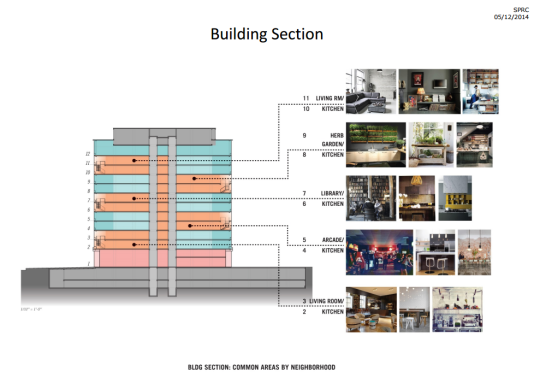
    But it’s not just the office that is changing. It’s also potentially living spaces. Since 2014, WeWork has been talking about their new coliving concept, WeLive. The idea here is to combine smaller living spaces with larger common areas and create an overall live-work community. And they are not the only ones thinking about this.

    Below is a building section of what this might look. It’s from a Vornado Realty presentation. They are working with WeWork to deliver their new WeLive concept in Crystal City, Virginia.

    It’s so interesting to see this concept come to fruition. Back in 2008 when I was in architecture school, I worked with a classmate of mine and designed a modular coliving apartment building. It was called the Philly Flex Dwelling and it worked like this:

    The idea here was to start with standard floor plates and use a structural exoskeleton to minimize interior columns. This way you could insert whatever prefabricated modules you wanted and also re-purpose the structure should you want to change the building’s use in the future. 

    This is not that dissimilar from what was originally proposed for One Bloor West here in Toronto. Though the goal there was column-free retail spaces. 

    The yellow spaces are the shared common areas and the remaining spaces are the residential living “pods.” We also designed a “solar skin” that was perfectly tuned to the building’s orientation and location in Philadelphia. The idea here was to maximize winter sun (for heating) and minimize summer sun (to keep the building cool).

    That was a fun project to work on.

  • 50% of New York City’s population is estimated to be single. Here’s what that means for housing.

    Here in Toronto there’s a push for more family-sized apartments. That’s what the planners want to hear.

    Because the city has been trying to encourage developers to build more of them for years, but the challenge has always been that they didn’t sell or that they took a long time to sell. The market wasn’t ready.

    But as I discussed earlier this week, that is starting to change. I think Toronto is reaching a tipping point where low-rise housing has simply become too expensive and people are starting to look to alternatives, mostly at the mid-rise scale.

    It’s interesting though that something of the opposite appears to be happening in New York. I don’t know enough about the New York new construction market to really comment on overall unit mixes and sizes, but there definitely seems to be a push to create more affordable micro-units.

    Curbed published this last October:

    “…a report currently under public review, called Zoning for Quality and Affordability, recommends relaxing density caps and eliminating the 400-square-foot minimum for studio apartments, thereby creating more housing for single people. Almost 50 percent of the city’s population is estimated to be single, but only seven percent of the housing stock is studios.”

    And just recently, New York completed its first all-micro-unit apartment building called Carmel Place. Rents start at $2,650 per month for a 265 square foot apartment. 

    As a point of reference, that works out to be $10 per square foot per month and more than 3x the highest rents you could reasonably achieve in the more desirable areas of Toronto, today.

    The model suite is 302 square feet and looks like this:

    All of the above photos are via Curbed.

  • Changing Lanes — A fireside chat with Jennifer Keesmaat and Janette Sadik-Khan

    Citi Bike by Pete  on 500px.com

    https://500px.com/embed.js

    When I was in Miami at the beginning of this month I missed an interesting event that I normally would have attended. It was a conversation between the Chief Planner of Toronto, Jennifer Keesmaat, and the former commissioner of the New York City Department of Transportation, Janette Sadik-Khan.

    Sadik-Khan was appointed under the Bloomberg administration and quite famously oversaw a huge number of urban changes in New York. Projects such as the addition of hundreds of kilometers of new bike lanes and the creation of 60 new pedestrian plazas across the city – including the one in Times Square.

    I was bummed I couldn’t attend, but thankfully Keesmaat wrote a post on her blog following the event and the Metcalf Foundation shared videos of the conversation. 

    Here’s a piece that I liked from Keesmaat’s blog post:

    “But she also pointed out that when they demonstrated what could be done, when they quickly mobilized around action, residents clamoured for similar changes in their neighbourhoods. Not surprisingly, this is why her book is called Streetfight – because it is a fight. City building is often the battle of ideologies, and when you’re trying to change the status quo, there is always a significant demographic of the population that is fully committed to maintaining business-as-usual.”

    If you have some time, you can also click here to watch the videos. There’s about an hour and a half worth of video, so you might want to open up a bottle of wine or something.

  • Why multi-family developers are shifting their customer focus

    One aspect of the Toronto housing market that I’ve been paying close attention to is the adoption of multi-family dwellings by both long-term end-users and families. 

    I’ve written about this before (here and here, over a year ago) and have argued that here in Toronto we are at an inflection point. Multi-family dwellings – both rental and condo – are evolving to now target these new customer segments. Whereas previously, the new construction multi-family housing market was heavily geared towards investors and first-buyers. And often it was simply a stepping stone towards a single family home.

    Now, every city and real estate market is different. And I have heard many people in U.S. cities say that Millennials are simply deferring what we saw with previous generations. At the end of the day they (or we, I’m a Millennial) are going to move to the suburbs and buy that car. The current trends we are seeing around city living and reduced driving are just that – short-term current trends.

    But I think it’s worth reiterating: I do not believe that the status quo is what’s happening right now in Toronto. And I’m sure it’s also happening elsewhere. Time and time again I speak to developers in this city who are starting to shift at least some, and in some cases all, of their focus towards end-users, families, and larger units – particularly for new mid-rise product in the “neighborhoods.”

    And if you think about it, this makes perfect sense. 

    The average price of a detached single family house in Toronto is well north of a million dollars. So when a developer brings to market a 1,200 sf family sized apartment at $600 psf ($720,000) or even at $700 psf ($840,000), that home now becomes a relatively “affordable” option in many desirable areas of the city. Particularly if you value location amenities and your time (i.e. shorter commutes) over raw quantity of space. I know I certainly do.

    I know this isn’t going to appeal to everyone. But there is a big market here. Get ready.

    What are you seeing in your city? Let us know in the comment section below.

  • The value of absurdity for innovation (and a story about tacos)

    Vegan tacos by Karolina Wiercigroch on 500px.com

    https://500px.com/embed.js

    “Great ideas alter the power balance in relationships. That’s why great ideas are initially resisted.” –Hugh Macleod

    I have been following the work and writing of designer Tobias van Scheider for quite some time now. If you don’t subscribe to his newsletter and you end up liking this post, you should consider signing up.

    Recently I stumbled upon something he published back in October called “Ignore Everybody”, where he argues that when you’re exploring something new – that could potentially fail – one of the best things you can do is ignore everybody. 

    And that’s because:

    “We have to understand that ideas are by nature very fragile. They’re like little naked babies, unable to protect themselves. If we really believe in a new idea, we have to protect her with great effort. This is difficult, because oftentimes the greatest ideas get killed by the people around us. Executing on a great idea is by nature a lonely path. If everyone would agree with you, the idea is probably not that great anyway.”

    I am incredibly interested in how new things get started and how new ideas thrive. Fostering innovation has become a critical component of city building in today’s world. But sometimes I feel as if we’re thinking too top-down, as opposed to bottom-up. 

    As Tobias rightly points out in his article, lots of great ideas started as stupid little projects. Who would have thought that a teen sexting app with disappearing messages (Snapchat) would become a company worth many billions of dollars?

    It’s for this same reason that Sam Altman of Y Combinator recently wrote that sometimes its better to call your new company a project, rather than a business. When you call it a business you impose all kinds of biases onto it in terms of viable business models, and so on. But when you keep it a “project”, it becomes more acceptable to be experimental.

    As an example of all this, I was fascinated to learn this past weekend about a Toronto-based ad agency called OneMethod. Because as part of their agency they have a division called the MethLab, where the goal is to simply experiment with “absurd ideas.”

    One of those absurd ideas was a social media campaign slash pop-up taco restaurant – remember, they are an ad agency not restauranteurs. It was so grassroots that they ended up having to sell original art work that happened to come with a “free” taco in order to get around all the legal requirements for serving food. Brilliant.

    The idea was so well received that it has grown into a fully fledged restaurant called La Carnita, which today operates across 3 permanent locations and happens to be one of the most popular taco restaurants in Toronto.

    But let me ask you this, if they had instead gone out to investors – as an ad agency wanting to get into the taco business – would they have been able to raise the money for their first physical restaurant? I can imagine this being a lot more difficult.

    On a larger scale, this is exactly what Google is doing with Alphabet. The company was reorganized and rebranded so that they could continue to work on absurd ideas outside of the Google cash cow. If the idea/project takes off, then it becomes a fully fledged company. If it doesn’t, then it gets shut down and something else is tried.

    This is what people and companies are doing today to stay relevant in the innovation race. 

    But in some ways it feels like a battle to allow the absurd to survive. That’s why the best approach might be to just ignore everybody. There’s value in the absurd but maybe you’re the only one who sees it right now.

  • Protect me from what I want

    The title of this post is a line from one of the works of Jenny Holzer. It feels appropriate right now.

    On Wednesday, Toronto saw a large scale anti-Uber protest involving as many as 2,000 taxis. It involved a bunch of taxis driving real slow around downtown, some altercations, and lots of people who want to see Uber completely shut down.

    This, of course, isn’t a new thing for cities. 

    Many cities around the world have seen similar kinds of protests. But many of you will probably also agree that this is not the most effective response from the taxi industry. It casts a negative light on them at a time when people are already switching to Uber for better service. It also ignores the fact that – in my view – Uber ain’t going anywhere.

    I’ve been a vocal supporter of Uber on this blog and I continue to believe that it will continue to prove to be a good thing for both consumers and for cities. In fact, famed startup investor Paul Graham once tweeted that because Uber is so clearly a good thing, you can tell how corrupt a city is by how hard it fights against it. This has become the truism among today’s urbanites.

    At the same time though, I am trying to take a balanced view on this issue, which is what got me thinking about the work of Jenny Holzer. Protect me from what I want. Today, I want Uber. But I am trying to think of where that want might lead me.

    Like a lot of private companies, the goal of Uber is monopoly profits. They would love to control the market. And that’s not a knock against them. It is just business. But I am imagining a market where only Uber exists.

    When I was in Miami last week I switched back and forth between UberX and regular taxis. Because Art Basel was going on, Uber was frequently in surge pricing. Sometimes as high as 4x. So in those cases, I just hailed a regular cab. Thankfully the cabs there are pretty reasonably priced and easily to hail. The driver didn’t ask me if I liked the electronic music playing on the satellite radio, but that’s not a big deal.

    But what if I didn’t have the option of hailing a regular cab? What if Uber was my only option and I had to put up or shut up when prices were 4x? That would be suboptimal in my books.

    So what does this all mean? 

    I am an Uber customer. I do not want and I do not believe it will go away. But I also believe that our public policy should encourage competition in the taxi marketplace. Competition holds people and companies accountable. It means that if you stop creating value, you will go out of business.

    It’s for that reason that I think the taxi lobby is wrong in trying to force Uber to shut down. And it’s for that reason that cities are going to have to work very hard at crafting the right kind of public policy. I am optimistic that Toronto will make that happen. But as we’ve seen today, there will be bumps along the way.

  • Interview with urbanist Richard Florida

    UrbanToronto.ca recently published an extended interview / discussion with urbanist Richard Florida about cities and, in particular, the future of Toronto. What it’s doing wrong. What it’s doing right. And what it should be doing to properly position itself for the future.

    What became clear to me after reading the interview is that Toronto is really at an inflection point. We are transitioning into a much bigger global city and we have yet to fully embrace the city that we are quickly becoming:

    “…the city was—and is—still too dominated by a NIMBYist, faux-progressive left that refuses to engage with having to build a dense, transit-oriented, and inclusive city.”

    The interview is packed with information and it’s definitely worth a read this morning. There’s a lot I agree with, including his views on transit and his positions on the Island Airport and the Gardiner East – which is a topic that is near and dear to me.

    In case you don’t have time to read the full interview, below are 3 excerpts.

    First, on the Gardiner East:

    “There’s also a learning curve to Mayors, and I think they tend to get a better understanding of urbanism over the course of their tenures,” Florida adds, hoping that Tory, self-described as an “ideologue on very few issues,” will make pro-urban decisions as his time in office continues. “For one thing, I really hope that he reverses his decision on the Gardiner,” Florida continues, highlighting Tory’s controversial support for renovating—as opposed to demolishing—the eastern portion of the Gardiner Expressway as an example of especially poor urban policy.

    Second, on the need for a true urban agenda at all levels of government:

    Offering prescriptions for the future, Florida calls for a “virtual moratorium on road-building,” arguing that the perpetuation of an automobile culture hinders a city’s creative capacity, with little exchange of ideas and culture occurring when people are sitting in their cars, and not engaging with life on the street. “The city also needs a more committed Federal partner,” Florida adds, calling for a ’ministry of cities’ to help provide a vision for growth and fund urban infrastructure projects. 

    And third, on the value of Toronto’s openness:

    “A huge reason for the city’s continued success—as we trudge along despite our lack of urban vision and reactionary tendencies—is the fact that we continued to be so open to newcomers, allowing a great deal of global creative energy to be harnessed. It means we can fuck up a lot, but as long as we continue to remain open, we’ll have an important edge.”

    There’s a lot of great discussion fodder here. I would love to hear your thoughts in the comments below.

  • Vancouver approves first laneway apartments in the West End

    It’s no secret that Vancouver is way out in front of Toronto and many other cities when it comes to laneway housing. 

    Good luck trying to get a laneway house approved in Toronto. They’re only allowed under rare circumstances where there is already an existing house in the lane and/or you’re willing to fight it all the way to the province.

    But in Vancouver, it’s a different story. And they’ve even taken it a step further according to this recent Globe and Mail article by Frances Bula. The city recently approved small scale laneway apartments in the West End:

    “The city, which created the possibility for laneway apartments when it approved a new West End plan last year, has approved the first four buildings with 47 units in total. Three are in this particular alley between Nelson and Comox on either side of Cardero, around the corner from Cardero Bottega and Firehall No. 6. Others are in the pipeline. Many more are expected.

    They’re the first of a new kind of infill that planners hope will produce 1,000 new small homes in this popular downtown neighbourhood.”

    Here’s a rendering from the article to give you an idea of what these laneway apartments might look like:

    Readers of this blog have argued that Toronto doesn’t need laneway housing. There’s enough room for intensification elsewhere. 

    But what is clear to me is that Toronto is continuing to build less and less ground-related housing. There’s little to no room for that. And what is left of our low-rise stock is becoming increasingly unaffordable.

    So if we believe that social diversity is important for building a great city – which I do – then I think it behooves us to figure out how to not only increase the supply of new housing, but also increase its diversity. This is something Andrés Duany argued for in yesterday’s video post.

    The biggest hurdle is community opposition. But below is how one of the neighbours in Vancouver responded to the proposed laneway apartments. He gets it.

    “Dean Malone, who lives across the street from one of Mr. Sangha’s three projects, took the trouble to go to city hall to support it because the laneway apartments provide a way of creating new housing that isn’t a tower and isn’t a luxury development.”

    What this also does is allow the private sector to do more before the public sector needs to step in with affordable housing subsidies. I believe that laneway housing will help, but not solve, the affordable housing problem happening in most of our cities. 

    But every little bit helps. And this is one solution that many cities are simply ignoring.