Daily insights for city builders, delivered every morning at 6 AM ET. I’m Brandon Donnelly — a Toronto-based real estate developer and founder of Globizen. I’ve been writing here since 2013.

Tag: toronto

  • Urban change through rapid prototyping

    image

    The Market Street Prototyping Festival is just finishing up in San Francisco. The festival, which is now in its 3rd year, is centered around urban interventions that can be rapidly prototyped and tested. The goal is to discover new ideas that could be used to transform and improve Market Street – the city’s civic spine. It is a joint effort of both the San Francisco Planning Department and the Yerba Buena Center for the Arts.

    Here is a list of all the prototypes. You can “like” projects, but I wish they would have made it easier to filter and see which ones are the most popular.

    One project that I liked is Vote With Your Feet. It consists of two doorways and a single crowdsourced YES/NO question above it. You vote by choosing a doorway. Once you walk through, you are then shown the results. Here’s a Boomerang video of it in action. I like it because it provides a frictionless way to acquire lots of ground-up feedback. Imagine placing something like this at the exit of a busy train station or transforming the existing doors.

    Tactical urbanism can be a great mechanism for investigating and instigating positive change. This is hugely important considering how slow moving and bureaucratic city building can be. It’s not the same format, but NXT City here in Toronto has similar ambitions. They source new ideas for our public spaces from young people. I am thrilled that both of these initiatives exist.

  • The value of urban lighting

    image

    This week I picked up the Philips Hue lighting system. For those of you aren’t familiar with it, it’s a connected home lighting system. All you need are a Philips Bridge (which hooks up to your wireless router); a smartphone; and whatever bulbs, lightstrips and fixtures you want to use with it. It also works seamlessly with the Apple Home app.

    At first I was a bit nervous that it would turn my place into a cheesy nightclub. But as soon as I powered it on and started messing around with the Hue app, I was blown away by the quality of the light and the options. There are settings for reading, to simulate a sunset, and so on. You can schedule routines, such as a bedtime lighting scheme, and you can even color match a photo to find exactly the light you want.

    After playing around a bit, I then sent out an obligatory tweet saying that I was now hooked on and obsessed with the Philips Hue lighting system. Trust me, it’s really cool. My friend Andrew then responded saying that he doesn’t get it. Why would anyone want a color of light besides “white?” To me, this is like asking: Why would anyone want to see a beautiful sunrise or sunset? The sun should just appear or disappear using one consistent color.

    In a city like Toronto where most of us in the winter will wake up when it’s dark and come home from work when it’s dark, I have always believed that we should be more creative and daring with the way we light our city, our buildings, and our public spaces. We don’t want to be kitschy about it, but there’s an opportunity to maximize our darker months and enhance the overall urban experience.

    The CN Tower is a perfect example. Its night lighting has completely changed how we view it and has become a beacon for what is going on in this city. I can see it clearly from my elevator lobby and I always look to see what color it is. I’m not great at picking out when it’s Rett Syndrome Awareness Month, but I can usually tell when there’s a game going on.

    Now my place is certainly not the CN Tower. And there’s only one CN Tower in the world. But that doesn’t mean we can’t get fun and creative in other ways within the shared walls of the public realm. We should do that. Let’s not be so conservative.

    If any of you have great examples of urban lighting, please share it in the comments below. Perhaps we can all use it as inspiration to make a change.

  • The lure of super-places

    image

    If you’re a very talented person, you have two choices: you either move to New York or you move to Silicon Valley. This is the message that Peter Thiel delivered to a conference being held in Chicago earlier this month. Not surprisingly, it pissed a few people off.

    Peter responded by saying that he was simply illustrating the “extreme version” of a metaphor about the impacts of globalization and technology. And while it certainly doesn’t sound very nice if you’re sitting in Chicago, or the countless other fantastic cities between the coasts, I can appreciate what Peter is getting at.

    Saskia Sassen is known for coining the term global city. These are cities which play an important role in the functioning of the global economy. But what has happened, she acknowledges, is an even further concentration of activity within a select few “super-places.”

    Here is an excerpt from a Financial Times article by Simon Kuper (2014) talking about Amsterdam’s position in the world:

    “…a new, higher category of cities may now be emerging: global capitals. Amsterdam has risen but New York, London and Hong Kong have risen faster. The Dutch elite is moving to Amsterdam; but many ambitious Dutch people no longer want to join the Dutch elite. They want to join the global elite. That often requires moving to a global capital.”

    Anecdotally, I can say that almost everyone I know who has left Toronto for an opportunity has moved to New York, Silicon Valley, London, and so on. They have moved up the rank of global cities/capitals.

    So while Peter may not have chosen the right way to deliver this message, I do believe it is a message worth delivering.

  • The Toronto startup ecosystem in numbers

    When I met with all of the lovely folks from Amsterdam last week, one of the things that I mentioned about intensification is that it is almost certainly a contributing factor towards innovation, agglomeration economies, and the overall startup ecosystem here Toronto. 

    I don’t know to what extent, but I feel it happening. And there’s lots of research correlating urban density with innovation. 

    The continued densification of Toronto means it is constantly becoming easier to schedule that morning coffee before going into the office or to pop into that meetup after work. And those sorts of things are hugely valuable in today’s economy.

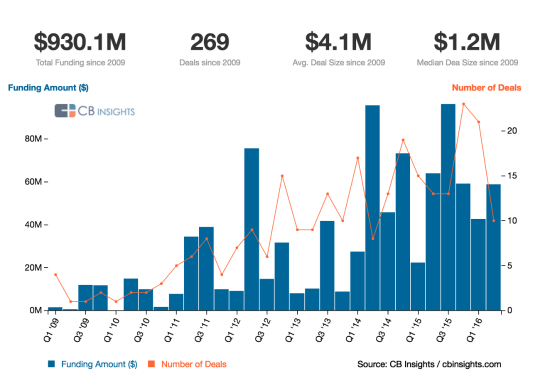
    I talked about a number of local startups in my presentation, including 500px, Wattpad and Wealthsimple. But I didn’t show any hard data. So I’d like to do that today. Below is a chart showing total venture funding (internet/software) and the number of deals (Seed to A/B/C/D) in Toronto since 2009:

    image

    It was taken from this Medium post. Supposedly this places us 12th in the world as far as startup cities go.

    Again, who knows how much of this venture growth has been helped along by intensification. After all: “Silicon Valley proper is soul-crushing suburban sprawl.” But I would bet money that it’s moving the needle in the right direction.

    Here is another relevant post by venture capitalist Albert Wenger where he talks about the great startup ecosystem that Toronto is growing. He posted it earlier today.

    All of this is important because some of these deals will spawn big companies. And those companies will the hire lots of people, as well as consume space. 

    Real estate developers like to talk about how they create jobs. And we do. But we can’t have a city of people just building buildings. People and businesses need to fill that space and that hinges on entrepreneurs who are willing to go out there and forge something new for themselves. Fortunately, Toronto seems to have a growing number of those kinds of people.

  • Building crap

    Last night I participated in an excellent dinner discussion with a group of planners, architects, city officials, and politicians from Amsterdam. They were visiting Toronto to see first hand what rapid intensification has done to this city. And I very much appreciated the invite. Thank you.

    My message was that intensification has created a far more vibrant and exciting city compared to 15 or so years ago. It’s hard to know what exactly could be correlated with intensification, but we have certainly seen an explosion of culture, innovation, and pride in this city – among many other things. (It could be all Drake’s doing.)

    However, the counter argument at the dinner table was that Toronto is letting unfettered development produce unremarkable architecture. We are simply building glass tower after glass tower. And I know that, for many of you, this will ring true. I hear it all the time, including in the comments of this blog.

    Now, I will be the first to admit that there has been a lot of shit built in this city. No argument there. Some people have no taste. But at the same time, I think it’s myopic to assume that it’s strictly because of profit-motivated developers. 

    Oftentimes the perception is that development projects are awash in cash. There’s tons of money in which to do the right thing. Developers just need to stop being so greedy and start being more creative.

    The reality is that developers operate within a market. There are real limits to what people will pay for new space. And when, for instance, land prices go through the roof (an input), municipal fees jump (cost of doing business), and approvals drag (time value of money), guess where everyone starts looking for savings? In the build.

    I say this not to justify building crap. If I had it my way, everything would be beautiful. I champion design whenever possible. I say it simply to shed light on the process. Because when we all understand the factors at a play, I believe we all become more effective at finding solutions.

  • Building the future

    Toronto-based heritage architect Michael McClelland recently published a piece in Spacing called: Misuse of Heritage Conservation Districts can deaden both past and future. 

    Here are a couple of snippets:

    The City of Toronto believes it has found a silver bullet to control development pressure in the downtown core through the use of a tool known as a “heritage conservation district” (HCD).

    The problem is that HCDs are meant to conserve intact and bone fide heritage areas, such as Wychwood Park, Rosedale, or Cabbagetown. They were never intended to control development downtown.

    In preparing for a HCD designation, consultants trained in history examine an area’s context and determine what is of value historically. They do not generally study the growth potential of an area, its future, nor any economic considerations, nor the larger planning policy framework, or even an evaluation of the built form generated by other market forces. HCDs look at heritage.

    The rigidity of the proposed new urban design controls introduced by the HCDs effectively prohibits innovative and thoughtful architecture in the downtown core.

    My own view is that it should be a balance between preservation and progress. We should respect our past, but at the same time look towards the future. Don’t fear change. Michael argues that HCDs achieve neither of those things. It’s worth a read.

    Speaking of the future, the CityAge conference is returning to Toronto on October 6 and 7. Their mission statement is about “building the future.” I was on one of their panels last year and it was an overall great event.

    If you’d like to attend, use the code “CITYAGE” to save $100. And if you’re a young professional (under 35) and/or a startup, email Marc Andrew to get an even sweeter deal. Tell him you’re a reader of this blog.

    Image: Photo by me taken at People’s Eatery on Spadina Avenue

  • BARED: Michael J. Cooper, Dream Unlimited Corp

    In 1974, at the age of 13, Michael J. Cooper won his first sailing championship in Toronto. And at this very young age he quickly learned that if you’re good at something, people treat you better. You become influential.

    But the real lesson came when he and colleague Jason Lester started making money by cleaning and taking care of other people’s boats. What Michael learned was that different professions seemed to attract, or perhaps cultivate, different personalities.

    The doctors weren’t the best customers. They weren’t that engaged. And they weren’t that personable. The lawyers were marginally better, but even then they weren’t like the business people. The business people were engaging and overall better customers.

    But then, in Michael’s words, you got to the real estate people. Now, they were charismatic. These are the people that Michael wanted to hang around. They were funny and interesting. They were the people that young Michael admired. His career wasn’t a direct line to real estate, but this early experience would later impact its trajectory.

    Like David Wex (previous BARED post), Michael started out as a lawyer. He went through law school and loved every minute of it. He found it conceptually fascinating. It was a different way of thinking. But after his first day working in a firm, he said to himself: “I can’t believe lawyers do this for a living!”

    He quickly discovered that his personality wasn’t a good fit for law. Michael framed it to me in the following way: “I asked myself, was I going to be an airline pilot or a baseball player? As an airline pilot, like a lawyer, my job would be trying to be 100% mistake proof. However, as a baseball player, I could make audacious plays, only be right 30% of the time, and still be considered excellent.”

    He wanted to be a baseball player.

    I would argue that most entrepreneurial minds think of themselves more as baseball players than as airline pilots. Billionaire Mark Cuban has famously said: “All that matters in business is that you get it right once. Then everyone can tell you how lucky you are.” Nobody remembers all of the failures.

    So Michael decided to go back to school, get an MBA, and figure out a way to do the most exciting thing possible – which in his words was “ABL, baby!” (Anything But Law!)

    In order to complete his MBA and not put himself deeply in debt, he decided to “pull a George Costanza.” Meaning, he continued to work full-time, but he also enrolled at the Schulich School of Business full-time. He would simply come into the office in the morning, put down a cup of steaming coffee, and then take off to class.

    Anything but law, baby.

    Upon graduating and upon reflecting on his childhood experience cleaning boats, he decided that real estate was the most exciting thing he could get into. So he drafted up a bunch of letters and sent them over cold to 10 different real estate developers. His offer was that he would work for free. (He had the ability to do this because of his clever George Costanza-like employment moves.)

    As luck would have it, he ended up getting a job with a man whose boat he had washed as a teenager. It was a man by the name of Walter Zwig. Walter Zwig had a 50-year real estate career in Toronto. He was responsible for developing over six million square feet of space in 13 downtown Toronto office towers, before eventually selling his portfolio to Olympia & York Properties; the legendary Toronto-based development company started by Paul Reichmann and his brothers. It was alleged to be largest development company in the world before going bankrupt.

    Michael started in 1986 and he would eventually work for Walter until 1993. However, Walter didn’t want him to work for free so he started him at $1,000 per month.

    Michael would cut his teeth with Zwig and eventually go on to develop office properties such as the Dynamic Tower at 1 Adelaide Street East, the Zurich Centre at 400 University Avenue, and the Atrium on Bay at 595 Bay Street. It was a small and flat organization without titles and Michael was able to learn a lot.

    But then the early 90’s hit and everyone went broke. The industry went into dormancy.

    However, as luck would again have it, he got a call from Ned Goodman who felt that there were great opportunities emerging in the market. (Ned also appeared in my BARED post about David Wex.) Michael had met Ned’s son, David, while he was looking for office space and Michael had greatly impressed him.

    Michael had brought David to five office buildings. Two of the buildings were owned by Zwig, but three of them weren’t. However, Michael knew that with the current economic climate, the buildings now had more debt on them than they were worth. So if the Goodman’s needed the space, he could simply buy the debt at a discount and take it over. Michael was showing buildings that his company didn’t own and he had a damn good reason why.

    On January 4, 1994, Michael, Ned, and Walter sat down for lunch at the Victoria Cafe in Toronto’s Financial District. The agenda was to figure out how to merge both Goodman and Zwig’s businesses into one and capitalize on what was starting to happen in the real estate market.

    However, Walter said that he was too old to join. He was out. But he encouraged Michael to seize the opportunity. In 1994, Michael Cooper became co-founder of what would eventually become Dream Unlimited Corp. He was 32 years old at the time.

    Remember, if you’re good at something people treat you better.

    Since 1994, Dream (TSX: DRM) has grown to over 1,000 employees and over $15 billion of assets under management in North America and Europe. They provide asset management services for 4 funds listed on the Toronto Stock Exchange and they have operating businesses that span master-planned communities and condominiums to renewable energy infrastructure and retail centre development.

    But what is not necessarily obvious from the above numbers is that, alongside Dream’s incredible growth, Michael also became one of “the real estate guys” that he admired so much as a young teenager cleaning boats. After sitting down with Michael to learn about how he got to where he is, I can honestly say that he is one of the funniest and most charismatic people I have ever met. He is the kind of guy you want to do business with and then go out drinking with afterwards.

    Perhaps not surprisingly, when I asked Michael if he had any advice for young aspiring developers (which I know is a lot of you readers), he quickly suggested that people study the classics. Speech. Drama. He said: learn how to connect with people.

    Because as a developer, your job is to conceptualize what the future could be and then get other people to believe in that same vision. Michael describes navigating all of the constraints on building as one of the most creative things you can do. And in a market like today where you have to be willing to pay the most for a piece of land, it’s the best ideas that win.

    That doesn’t sound like a lawyer or airline pilot to me. That sounds like a real estate guy with one hell of a batting average.

    ———————————————————

    This is the second post in my blog series called BARED (Becoming A Real Estate Developer). A big thanks to Mariane for helping to coordinate this piece. More posts to come in the following weeks. Subscribe to stay in the loop.


  • Photoblog: TIFF

    This past weekend was the first weekend of the 2016 Toronto International Film Festival. It’s a great time to be in the city – regardless of whether you’re into film or not. It felt as if the entire city decided not to sleep this past weekend.

    Growing up in Toronto, it was also the signal that summer is coming to an end and the city is now about to refocus itself on work. Game on.

    Here are a few photos from the weekend:

  • Open for business

    I just received the September issue of Monocle magazine. One of the features I always read is the “Observation” on the very last page. It reads as the editor in chief’s personal blog.

    In this issue he talks about the recent EU referendum and the changes he is making to his business in response to that. Monocle is headquartered in London, but he is now finding it challenging to be “an international media business in a country that hasn’t figured out how it’s going to move forward.”

    His response?

    They are shoring up the Zürich office. They are looking at the possibility of a second bureau somewhere on the continent. And they are similarly looking to increase staff in both Toronto and Singapore.

    When one place closes up, the companies and talent will find other cities that are open for business. 

    As someone who is closing one chapter this week and starting a new one, Tyler Brûlé’s Observation also reminded me of the importance of change. Oftentimes change feels uncomfortable. But that’s not necessarily a bad thing. In fact, it’s more likely a sign that you’re on to something.

    What have you done lately that made you feel uncomfortable?

  • Preserving place

    I was recently asked: How do you go into a neighborhood, build new, and not erase and/or sterilize what makes that neighborhood interesting in the first place? 

    Gentrification is a controversial topic in city building. Too often I think we ignore what happens when we don’t invest in communities, but that doesn’t mean we shouldn’t be deliberate when we do make investments.

    Development is filled with tensions. We are constantly trying to navigate through constraints and balance out the wants of each and every stakeholder. It becomes an art. It doesn’t always work out as planned.

    To state the obvious, I would say that it starts with caring. If you’re not interested in community and city building, then the default response will be to simply replicate what worked on the last project.

    But every place has a local culture. And if city builders are to have any hope of preserving and building upon what makes that place unique, we have to first understand it. What made it successful in the first place? What is its DNA?

    Because then you’re in a position to think about both built form and programming in a way that is culturally sensitive.

    One example that comes to mind is the proposed redevelopment of Honest Ed’s / Mirvish Village here in Toronto. 

    The “micro tower” design is intended to create the sense that the area was built up organically over time. And the fine grain retail (50-60 individual retail spaces) is intended to house local retailers, micro retail startups, and pop-up shops. To me, both of these elements speak to the history and fabric of the area.

    Adopting a unique approach can also sometimes mean rethinking how you measure ROI. If all you care about is who will pay you the highest rent – right now – then you’re going to make a decision based on that metric.

    Maximizing revenue is not a bad thing. That’s what businesses are supposed to do. But sometimes there is or should be a larger vision at play. And sometimes you need to take a longer view.

    In Toronto’s Distillery District, the developers made the decision to eschew large chains and franchises (in favor of more local retailers) so that they could create a very particular place. Ultimately that particular place became a great place to sell condos, but they suffered early on for it.

    I like how Gary Vaynerchuk put it when he asked: What is the ROI of your mother? Sometimes you may not be able to measure it, but that doesn’t mean the ROI isn’t there.

    Any other suggestions?