Daily insights for city builders, delivered every morning at 6 AM ET. I’m Brandon Donnelly — a Toronto-based real estate developer and founder of Globizen. I’ve been writing here since 2013.

Tag: toronto

  • Crazy home prices

    image

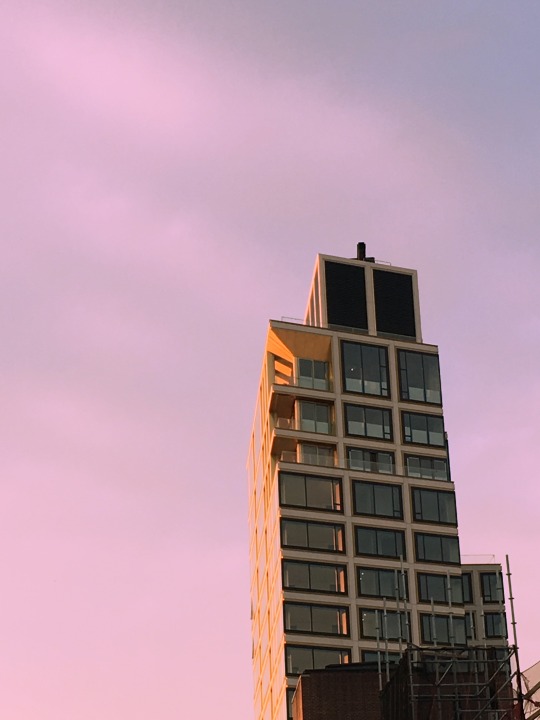
    This afternoon I walked the High Line with a friend of mine who seemed to know everything there is to know about new residential development in Manhattan. 

    She recently purchased a place and so she had done her homework. She was pointing out every building and telling me the price per square foot range; whether the floor plans were well designed (or if they had misproportioned rooms and awkwardly placed columns); and who the architect was. 

    Takeaway: To be competitive in the luxury segment in New York, you really need to have a name brand architect on the project. That seems to be the price of entry.

    As she was telling me about the “competitively priced” building in the low $2,000′s psf and the expensive penthouse that recently sold for $7,000+ psf, I started to wonder about historical pricing in New York. How has it trended? 

    I also told her that you could buy a really great condo in Toronto for $700 psf. She laughed at how affordable that was. It’s all about your point of reference.

    In any case, I found a research report from 2004 called: Why is Manhattan So Expensive? The story is one that you’ve heard before. It’s about the impact of land use restrictions on home prices. But it does also include some historical data on average condo prices.

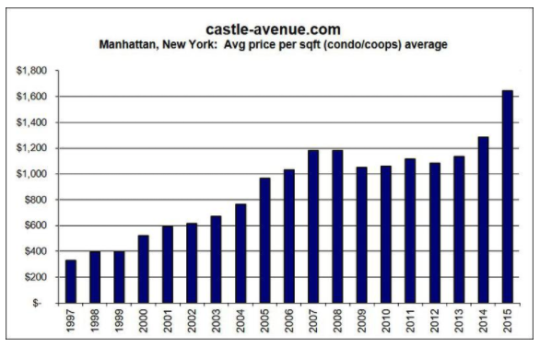
    In 1984, the median price per square for a condo in Manhattan was $359 psf. It peaked in 1987 at $505 psf and then dropped back down to the $300′s in the early 90′s. That was not a great time for real estate. However, by 2002, the median price had rebounded to $606 psf. All USD figures.

    From 2002 onwards, Manhattan saw a dramatic increase in home prices. Below are two charts from Corcoran (Q3 2016 data) and Castle Avenue, respectively:

    imageimage

    Toronto is obviously not New York, but’s interesting to consider that the average price of a downtown Toronto condo, today, is probably in the low $600′s psf. That’s in Canadian dollars and that’s pricing that New York saw decades ago. 

    It reminds me that “crazy pricing” can oftentimes be a psychological reaction to a pricing anchor that we previously set in our minds. It feels crazy. But is it?

    Image: Me
  • Pause button

    Councillor Kristyn Wong-Tam recently put forward a request for a report on the implementation of a 1-year moratorium (let’s ”hit the pause button”) on new tall building rezoning applications in the downtown core of Toronto. You can read the full letter here.

    Not surprisingly, the building industry doesn’t like this.

    But besides that obvious point, I did want to draw attention to the following comment made by Quadrangle Architects partner, Richard Witt (taken from this BuzzBuzzNews article):

    “The city has, for years, used the development charges that should have been used to upgrade infrastructure to artificially lower property taxes by putting the development charges into general revenue,” he says.

    The intent of development charges is that they fund the infrastructure required as a result of new development – everything from transit to water. In the US, they are (I think) more commonly called impact fees. In this case the name makes the intent quite clear.

    I am curious to what extent we are relying on development growth to fund the status quo. Because growth may not always be there. History has shown us that.

  • Uberpooling your way to cheap rides

    This morning on my way into the office I ran into a friend who lives in my building (downtown). She works in midtown and so I asked her how she gets into the office. She told me that she either takes the subway or an Uber, but that increasingly she has been taking Uber, particularly on the way home.

    We then started talking costs and she told me that what she does is carpool with a friend from work using UberPOOL. They live nearby and so what they do is leave from the same place at night (the office) and then select a midpoint location between their homes for the drop-off. After splitting their portion of the fare, the ride costs her about $3.25.

    As she was telling me this, I couldn’t help but think to myself: Wow, this is massively disruptive to transit. That is the same cost as taking the subway. So why take transit? With the subway, there may be a speed argument in certain instances, but that certainly wouldn’t be the case with some of Toronto’s streetcar lines (such as the King line). It’s faster to walk.

    However, there are obviously geographic limits to how far you can go in an UberPOOL before your costs greatly exceed taking transit. But as Uber and other similar services continue to bring down the price of a ride (eventually the labor cost component will disappear), how big does that area get?

    All of this – including my own mobility patterns – has got me thinking yet again about the role of transit in the city of tomorrow. 

    One segment that continues to be underserved is the regional scale. Here in the Greater Toronto Area, we are working on that by transforming our commuter rail service into a two-way all-day Regional Express Rail service. Today that strikes me as being hugely valuable. And unless driverless vehicles somehow solve our traffic problem, it will likely remain that way.

    I would love to get your thoughts in the comments below.

  • The yellowbelt

    We talk a lot about the greenbelt here in Toronto. Some argue that it’s squeezing the housing market and driving up prices.

    But what about the yellowbelt? (Credit to Gil Meslin for the term.)

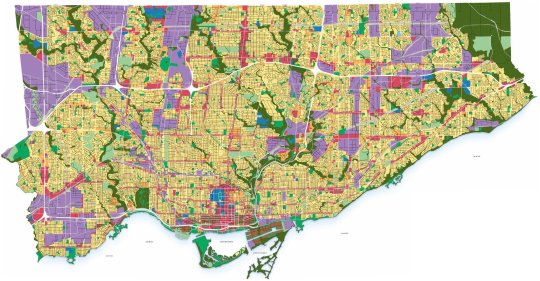
    Here is a land use map of Toronto:

    The yellow areas are “neighborhoods.” They, along with parks, ravines, watercourses, and valleys, make up ¾ of the city’s land area. The Official Plan describes these areas as being “stable” – meaning they will see little physical change. Supply cannot adjust to demand.

    I get why this is the way it is and I understand how difficult it would be change something like this. But let’s not ignore the impact that this land use constraint has and will continue to have on the housing market. 

    It’s the yellowbelt. Thank you Gil for letting me to steal the name.

  • Some thoughts on how we plan cities

    I came across this discussion on Twitter yesterday about how so many of the spaces we love in cities would not conform to today’s modern city planning practices:

    //platform.twitter.com/widgets.js

    This is a topic I’ve been thinking about lately and so it’s a timely discussion. In fact, I’ll often come across spaces in Toronto where I’ll think to myself: This is a really great space. But it’s highly unlikely that it could be built this way today. Naturally the question then becomes: What does this say about modern city planning?

    City planning is obviously important. But at the same time, we are almost certainly making mistakes and doing things that we will later regret. I say this not because I’m particularly critical of planning today, but because cities are enormously complex entities and it’s difficult to believe that we’ve figured everything out at this point.

    One thing I wonder about is if we aren’t over-planning and being too prescriptive about our cities. Some of you will probably argue the exact opposite. But hear me out.

    Vancouver is a city that has long been considered to be the gold standard in modern city planning. We talk about its podium + tower building typology. We talk about its “gentle density.” And we talk about its great public and recreational spaces, among many other things.

    But when I was there last month having dinner with a friend of mine, she said something to me that stood out. She said: “Brandon, Vancouver is a boring city. If it weren’t for my family being here, I would happily move to Toronto, New York, or somewhere else.”

    Cities are amazing places because they unleash human ingenuity. They allow new and unforeseen things to emerge. The challenge, I think, is to not sterilize that away when we plan and build. And all of us involved in the building of cities are probably guilty of doing that to an extent.

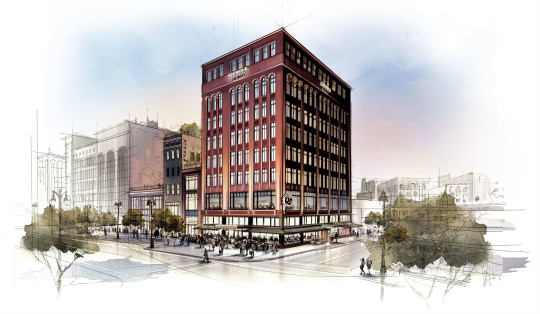
  • The Shinola Hotel, Detroit

    Hotels play such an interesting role within cities. They are public-facing in a way that many other uses are not and they invite a mixing of different people – everyone from transients to locals. It is therefore no surprise that they can serve a variety of different roles. They can be cultural hubs. But they can also be places in which to misbehave.

    When the Drake Hotel opened up on the west side of downtown Toronto in 2004, I remember it feeling far out. It was on the edge of that which was interesting at the time. But it quickly anchored West Queen West with its cultural and nightlife offerings. And today, we could be about to see the exact same story repeat itself in the east end with the new Broadview Hotel.

    It’s for these reasons that I was both excited and curious to learn that Bedrock (real estate company) and Shinola are in the midst of launching a new boutique hotel concept in Detroit. It is called The Shinola Hotel. It will be located at 1400 Woodward Avenue. And it will be all about the city of Detroit. They expect it to open sometime in the fall of 2018.

    What I am about to say may be an availability bias talking, but there seems to be a push by many companies into the hotel space. In 2015, Equinox Fitness announced that it would be opening its first hotel in 2018 at Hudson Yards in New York. And just last month furniture retailer West Elm announced that it would be opening a first set of hotels in both Savannah and Detroit. (Go Detroit!)

    West Elm sells furniture. Equinox operates gyms. And Shinola makes and sells watches, bikes, and leather goods. But all of them are now in the hotel space. What other new hotel brands have I missed?

    Image: Shinola

  • Low-rise vs. high-rise

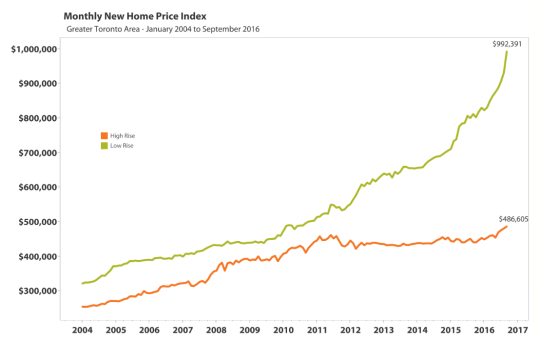
    Yesterday I sent out this tweet, which included this graph:

    The chart is from Altus Group and it is a monthly price index of new low-rise vs. high-rise housing in the Greater Toronto Area (GTA). I have posted similar charts in the past, but every time this chart gets updated the spread widens and the market looks even crazier.

    Some people responded on Twitter by saying that this is clearly an indication of a bubble. I don’t know if that is the case. 

    But, as I have said many times before, I do believe that it tells a vivid story around supply. Low-rise housing is severely supply constrained in the GTA and high-rise housing is less so. That has helped to stabilize pricing in the latter case.

    Now, you could look at this chart and say that the pace of low-rise price increases is simply unsustainable. The market must correct. 

    But you could also look at it and say that the market is going through a fundamental shift whereby more and more families will start living up, as opposed to out – which should then translate into high-rise pricing trending upwards as unit sizes increase. This is where I think we are headed. 

    What do you reckon is happening?

  • Big, bold, and global

    I love the way that urban planner Joe Berridge thinks about Toronto and city building. He is constantly considering our position on the global stage and urging us to fight for a top position by executing on real and meaningful projects. 

    Here is a recent article from the Toronto Star which lists some of those projects. They include everything from a new convention center to creating a fourth university (in addition to the University of Toronto, York, and Ryerson).

    Here’s a snippet:

    We could get “lost in domesticity — very nice, but that’s not enough,” he says, drawing on his experience leading urban renewal projects around the world.

    Toronto’s social cohesion is enough to attract 125,000 new people each year to the region. But they won’t stay if we can’t employ them and provide opportunities. And that requires global thinking.

    Berridge says it is the city’s “moral obligation” to use its taxing power, its wealth, its status as Canada’s only global city and the historical advantages of public education, public health and public services to propel Toronto into super city status.

    Cities will often talk in nebulous terms about being “world class.” That isn’t all that helpful. Let’s be specific and also acknowledge that great things cost money. Are we a top tourist destination? Are we a top convention destination? Are we attracting the smartest people in the world with the best schools? Do we have the best transit and health care systems in the world?

    Toronto is a great city and so it’s perhaps easy to become complacent. But past performance is not an indicator of future outcomes. We need to think in global terms. We need to keep in mind that this is an international competition. And every day all of us step onto that field.

    Thank you Joe for constantly reminding us of that.

  • The tech ecosystem in Toronto (and New York)

    Tech Toronto recently published a new study called, How Technology Is Changing Toronto Employment. 

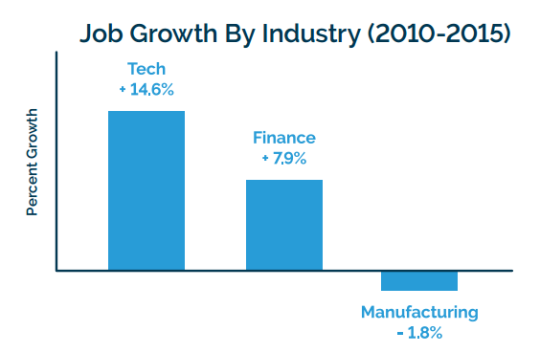
    They estimate that there are over 400,000 tech jobs in Toronto, out of a total of 2.7 million people employed. That number includes tech people working for non-tech companies, and tech and non-tech people working for tech companies. So tech jobs are thought to represent about 15% of the city’s employment.

    Within this 400,000 or so jobs, an estimated 93,000 people are self-employed (23% of tech jobs). And the belief is that there are around 2,500 to 4,100 active “startups.”

    Zooming out, it is also one of the fastest growing industries in the city:

    image

    To try and put this into perspective, a similar report for New York – published in 2014 – reported 291,000 tech jobs out of 4.27 million people employed. I was a bit surprised by these numbers, but the Toronto report seems to have been modeled after the New York one. So presumably they use similar methodologies.

    Of course, there’s the big question of quality over quantity. There’s a certainly a difference, in terms of impact to the economy, between a back office tech job and fast growing startup that will eventually reach the coveted $1 billion valuation number and create thousands of new jobs.

    Obviously every city is hoping for the latter.

  • PHLEGM video

    This past summer I wrote about the 8 storey mural (by street artist PHLEGM) that was about to go up on the side of a Slate building at the corner of Yonge + St. Clair in midtown Toronto.

    Well, that mural is now complete. It’s been in the news a bunch over the past couple of months, both locally and internationally. designboom (they’re allergic to capital letters) wrote about it last month.

    In case you missed all that press and/or you’d like to learn more about the process, here is a video that the STEPS Initiative published last week. It’s 5 minutes. If you can’t see the video below, click here.

    [vimeo 185861345 w=640 h=360]

    The STEPS philosophy of creating public art in unlikely urban spaces is a hugely interesting one. It’s really the antithesis of the white-walled art gallery.