Daily insights for city builders, delivered every morning at 6 AM ET. I’m Brandon Donnelly — a Toronto-based real estate developer and founder of Globizen. I’ve been writing here since 2013.

Tag: toronto

  • Below-grade urbanism

    I came across an interesting discussion on Twitter last night about tunnels, bridges, elevated walkways, and Toronto’s elaborate (mostly) underground shopping complex known as the PATH. It’s the largest of its kind in the world.

    Here’s the thing: the idea of pulling people off the street and into an underground shopping mall, runs counter to what many urbanists believe is the optimal outcome.

    Below is a footnote I found in a 2006 research paper by Pierre

    Bélanger called, Underground landscape: The urbanism and infrastructure of Toronto’s downtown pedestrian network.

    “The reluctance of urban designers and academics to engage the
    dynamics of the underground is stunning. For almost 50 years, urban
    designers, landscape architects and planners have longed for car-free
    pedestrian environments that are safe, secure and accessible. From a
    planning perspective, the Toronto underground may be the ultimate form
    of attrition of the automobile on the urban landscape: there are no parking
    lots, no asphalt, and no congestion. With its mass-transit accessibility, it is
    an ideal pedestrian network. This reluctance may in part be attributable to
    a prevailing attitude that privately-controlled underground shopping is
    undesirable, at best dismissible. As self-contained environments, they are
    perceived as lying outside the so-called public domain and that they kill off
    street life. As a more legitimate form of collective space, street-level
    activity located within municipal right-of-ways therefore receives much
    more advocacy.”

    Of course, there is truth to the notion that activity gets concentrated below grade. When people visit Toronto’s Financial District for the first time, they’ll often ask: Where is the retail? And then you have to explain that it’s all underground and that we live like mole people from 9-5.

    But despite this reluctance on the part of urbanists, people do seem to like it. When you’re marketing a building in the CBD, being PATH-connected is a feature, not a bug. I always joke that in the summer, I hate the PATH. But in the winter, I love it. 

    There’s also a feeling of hyper-connectivity during business hours in the PATH – particularly at lunch. You have everyone leaving their desks, descending from their towers, and mixing all about in a dense pedestrian-only network. It’s unusual not to run into someone you know.

    So love it or hate it, perhaps we should appreciate it for what it is: thriving city life.

  • Show some laneway love

    I just want to do a quick follow-up to my recent post about the momentum currently developing around laneway housing here in Toronto. 

    In the post, I mentioned that two councillors have come out in support of this housing typology. However, I neglected to mention that Evergreen CityWorks is also at the table, as well as a housing advocacy group called Lanescape. It was mentioned in the comments, but I know that not everyone checks that part of the blog.

    I say this for two reasons:

    1) I thought about starting a similar initiative to Lanescape. (I’ve had lanewaylove.com registered for many years. Brand identity shown above.) But after meeting one of the Lanescape founders this past week, I think it only makes sense for me to instead throw my support behind them. They are accomplishing a lot in this space.

    2) Lanescape has a survey up on their website and the results will be used to guide a laneway suite planning framework that will (hopefully) be implemented by the City of Toronto. So I wanted to encourage you all to complete it. Even if you don’t live in Toronto, still fill it out. It’s important for cities to learn from each other.

    Your support will go a long way in making laneway housing a reality in the city.

  • Toronto mayor proposes road tolls, finally

    When I wrote yesterday’s post about road tolls, it hadn’t been announced that Toronto Mayor John Tory was going to call for road tolls on both of the highways coming into downtown. That didn’t leak until late in the evening. So I was just writing another post on a topic that I care about.

    Today, however, that announcement was made and the proposal is a flat $2 toll on both the Gardiner Expressway and the Don Valley Parkway. It is expected that this could bring in close to $200 million a year in new revenue for the city – all of which would be dedicated towards transit and roads. Good.

    First, I want to applaud the mayor for coming out in support of road pricing. I didn’t agree with him on the Gardiner East, but I agree with him on this – mostly. It is a bold move.

    The reason I say mostly is because I hope that we don’t simply default to a fixed and blunt road toll. There are more sophisticated options out there, such as variable pricing models that change based on demand/congestion levels.

    Here’s a post that explains how that works and why I think it’s a good model.

    With this approach, it becomes more of a congestion charge rather than a toll. It also gives commuters the option of driving during off-peak times to save money. And if we implemented something like this, I am sure that we would see employers and office hours adapt. More on this in the above post.

    Still, I absolutely believe that it’s a step in the right direction for this great city. So thank you Mayor Tory.

  • Revisiting road pricing

    Following the Toronto Transit Commission’s approval of a 10-cent fare hike, Cherise Burda of the Ryerson City Building Institute penned an article titled: It’s time for Toronto to consider road tolls.

    I am a big supporter of road pricing and I have written a lot on this topic over the years. There’s even a guest post by Darren Davis on this blog – he is a transport planner with Auckland Transport. 

    I don’t have much to add right now, but I did want to help promote Cherise’s post and I did want to link back to all of my previous posts (including Darren’s). Click here for a list of posts tagged with “road pricing.”

    There’s a mental model in Toronto, and many other cities, that remains centered around subsidized roads and artificially low residential property taxes. Because, well, that’s the dream.

    Nobody wants to pay more for anything – I get it. But I think we can all agree that this region has not solved the traffic/mobility problem. In fact, it’s one of our biggest weaknesses. 

    So what are we going to do about it? I reckon the answer is something other than the status quo.

  • Carriage house disruption

    The Spaces has a post up called: 7 carriage houses on the market in New York City. They’re all quite expensive. The house on East 63rd designed by Paul Rudolph is particularly interesting. But that’s not what I want to talk about.

    As I was going through the photos – that’s what The Spaces does best – I thought of two things.

    First, there’s a segment of the market that is obsessed with living in spaces that were not originally intended to be used as residences. That’s what (hard) lofts are. That’s what carriage houses are. And that’s partially why I would love to live in a laneway house (Toronto vernacular).

    Backhouses, as they are also called, were initially designed to hold horse and carriage. But as horses disappeared from New York City, the structures got repurposed.

    Here’s one theory for how that went about:

    Barry Lewis, an architectural historian, theorizes that rear buildings became residences to accommodate the 19th-century immigrant population that moved into middle-class areas in Lower Manhattan in the 1830’s and into the Village and Brooklyn after the Civil War. “Backhouses seem to belong to the era of houses in Manhattan, not the era of apartments,” Mr. Lewis said. “The property owner probably shoved more immigrant families into the stable or workshed in the back. Other owners may have built a new backhouse just to get the lucrative immigrant rents.

    The second thing I thought about is the potential parallel between this story and the one being written right now. It feels like a transportation revolution is upon us and changes in mobility always seem to rewrite the landscape of the city.

    Hopefully that will mean more laneway houses in Toronto.

  • New political support for laneway housing

    There’s some great news in the Toronto Star this week.

    (Thank you Mike for bringing this to my attention.) 

    Two councillors – Mary-Margaret McMahon and Ana Bailao – have come out in support of allowing laneway housing in Toronto. Some cities call them detached accessory dwelling units (DADUs). 

    If you’re new to laneway housing, check out this post and this post (both are 2+ years old). I’ve been on this horse for over a decade.

    Because going beyond their small space cool factor, laneway housing has the potential to fundamentally alter the housing supply constraint that I wrote about a few weeks ago – namely the yellowbelt. It’s a way to gently allow for new housing, while at the same time preserving the character of our “stable” neighborhoods. 

    And frankly, I can’t think of any other way to add new ground related housing at any sort of meaningful scale within the city limits – not unless we’re willing to give up the “stability” of our neighborhoods. So this is it.

    If you’re on the same page, I would encourage you to reach out to Councillor McMahon and Bailao and let them know that. There’s also a public workshop scheduled for Monday, December 5th at 7pm at the Evergreen Brick Works (550 Bayview Avenue).

  • re:Public + NXT City Night

    On Friday, November 25th, NXT City will be hosting a one-day symposium here in Toronto (re:Public) that brings together some of the top people, projects, and ideas in the world of public spaces. Following that will be an after party (called NXT City Night) that runs from 8pm to very late. 🙂

    Here are some of the organizations that will be represented at the symposium: City of Toronto, Uber, CivicAction, Monocle, Arup, STEPS Initiative, Breather, The Laneway Project, Oxford Properties, as well as many others. It will be a great event.

    For the full speaker list, the agenda, and to buy tickets, click here. There’s an under 35 / student offering for both the symposium during the day and the after party at night. If you attend during the day though, you automatically get a pass to the after-party. I hope to see you there.

    Here’s a time lapse video from NXT City Night (edition 2015). If you can’t see it below, click here.

    [youtube https://www.youtube.com/watch?v=_i6R687sdk0?rel=0&w=560&h=315]

  • One Spadina Crescent

    One of the most exciting projects under construction right now in Toronto is 1 Spadina Crescent – the new home of the John H. Daniels Faculty of Architecture, Landscape, & Design at the University of Toronto. (This must be one of the longest faculty names in existence.)

    I am excited to see the existing 19th century structure come back to life by way of a new addition; especially given its ceremonial position within the city. And I am excited – as an alumnus – to see the faculty growing.

    On Monday, an event was held at the building to honor the donors and offer a sneak peek of the building. I wasn’t able to attend (as much as I wanted to), so I figured the next best thing I could do would be to write a blog post about it. 

    So here’s the official news release and here are some photos from Urban Toronto.

  • World’s best city brands

    Resonance Consultancy – they do brands and strategies for places and products – has just released a new report called: World’s Best City Brands – A Global Ranking of Place Equity.

    With all of these sorts of rankings, it really depends on the research methodology being used and the rigor in which it is being applied. In this case, they evaluated each city based on “six pillars of equity”:

    1. Place: Perceived quality of a city’s natural and built environment
    2. Product: A city’s key institutions, attraction and infrastructure
    3. Programming: The arts, culture and entertainment in a city
    4. People: Immigration and diversity of a city
    5. Prosperity: Employment, GDP per capita entertainment in a city and corporate head offices
    6. Promotion: Quantity of articles, references of a city and recommendations online

    What’s perhaps unique about this study is that it combines measurable statistics with “visitor perception metrics” – data that they mined from social media. Here’s an excerpt from the methodology page:

    “Our team became interested in the way visitors and citizens themselves influence the identity and perception of cities. Increasingly, they do it through their evaluation of experiences on social media and via the comments, images and reviews they share with family, friends and people around the world. These opinions and attitudes, much more than traditional marketing, influence the way people perceive places today.”

    This is a fascinating shift for city brands and is something that we have discussed before on this blog. All of us are now involved in telling the story of the places in which we live and visit.

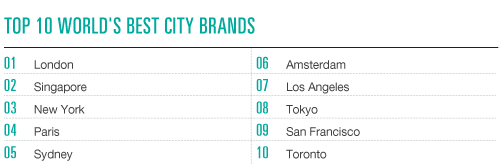
    The entire report is well done and worth a read. It’s also a free download (you’ll need to enter your contact info). But below are the top 10 world’s best city brands. Not really any surprises for me. What about for you?

    image

  • Place is dead anyway

    Aaron Renn has a few observations up on his blog from a recent trip to San Francisco. Number 2 is as follows:

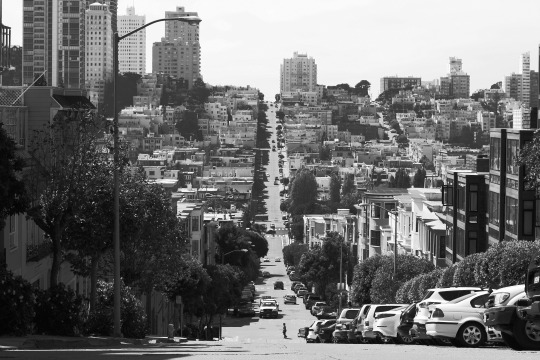
    “A curiously low energy city.  It’s tough to judge any American city’s street energy after living in New York, but San Francisco felt basically dead. Tourist areas around Union Square and the Embarcadero were crowded, and the Mission on a Friday night was hopping, but otherwise the city was very quiet. Haight-Ashbury was nearly deserted and many neighborhoods had the feel of a ghost town. It’s very strange to be walking around a city with such a dense built fabric but so few people.”

    I feel this way every, single, time, I visit San Francisco. I love San Francisco, but outside the main draws, the city feels eerily quiet. I have never understood why that is the case.

    This is something that I am sensitive to because I find it even impacts my own energy levels. For instance, Sundays in Toronto often feel too quiet for me. Fewer pedestrians. Slower drivers. Our collective metabolic rate slows down.

    I love the hustle of a busy city.