Daily insights for city builders, delivered every morning at 6 AM ET. I’m Brandon Donnelly — a Toronto-based real estate developer and founder of Globizen. I’ve been writing here since 2013.

Tag: toronto

  • Should Uber be shut down?

    image

    Last week Travis Kalanick – the cofounder who built Uber into the most highly valued privately held startup in the world – stepped down as chief executive at the request of his investors. This was the culmination of months of controversy related to the company’s toxic corporate culture.

    So what’s next? 

    Benjamin Edelman, associate professor at Harvard Business School, recently argued that this is it for the company: Uber Can’t be Fixed – It’s Time for Regulators to Shut It Down. I discovered the article through a good friend of mine who has felt similarly since the beginning. Uber’s business model is predicated on illegality and that should not be misconstrued as “innovation”.

    I have a few thoughts on this.

    But let me start by saying that this post is not a comment on the company’s corporate culture or its internal practices related to lobbying governments. I have not really been following what’s going on internally and I’ll leave other, more informed, people to comment on those matters.

    With that said, here are 3 thoughts.

    One, shutting down the company feels like an extreme case of throwing out the baby with the bathwater. Lots of companies go through restructuring, assuming that’s needed, without completely capitulating.

    Two, before Uber came along it was still challenging to pay for a taxi in Toronto with a credit card. More often than not the driver would tell you that the machine was broken or ask that you instead pay with cash. At that point, I would have accepted a clunky payment machine mounted to the rear of the front seats as an innovation.

    To say that Uber’s technological innovations were all banal things that its competitors were already about to introduce is downplaying so much of what the company has done outside of its beneficial cost structure. 

    We got perfect information: Where is my car right now? We got full pricing transparency before even accepting a ride: Should I take an Uber or transit or should I drive? We got the ability to get in and out of a taxi without pulling out our wallets: I’ll quickly jump out at this red light. We got dynamic ride pooling and cost sharing: Let’s split this ride 3 ways to bring the fare down. And we got clean cars that didn’t smell.

    Why weren’t any of the incumbent taxi companies do this?

    Three, I fully agree that Uber (unfairly?) benefited from a meaningful cost advantage by operating in the unregulated side of the market. This was a huge boon for the company because, as the data suggests, the demand for taxis is highly elastic.

    But I also believe that the incumbent taxi companies were perpetuating a marketplace that was anything but free enterprise. It ensured that the status quo was maintained and that those who historically benefited from the system continued to benefit from the system.

    Because of this, I’m not sure that we would have seen the innovation that we saw without a company like Uber deciding to operate within a gray area and not ask for permission. Protectionism may have stomped it out. This may be why Hailo – which operated in the regulated side of the taxi marketplace here in Toronto – ultimately wasn’t able to survive.

    Though I suppose you could argue that Hailo’s failure (at least here in Toronto) strengthens the argument that Uber was only able to thrive because of its illegal cost structure. 

    However, it’s important to remember that Uber got its start by actually charging more than traditional taxis. At the outset it didn’t have enough liquidity in its marketplace to compete based on speed and/or price, and so it decided to offer a premium experience. 

    UberX didn’t introduce steep discounts until later on and even today many people will gladly accept surge pricing at multiples of a regular taxi fare. Clearly customers are deriving some other benefits from the app.

    Edelman ends his piece by referencing Napster as an example of another startup that defied legality and was ultimately forced to shut down. Again, shutting Uber down seems extreme to me, but I do agree with his conclusion. Regardless of what happens, the lawful innovations that Uber introduced are here to stay.

    Photo by Carl Joseph on Unsplash
  • Laneway housing represents 19% of all new single family and two family dwellings in Vancouver

    One of the criticisms surrounding laneway housing is that – while great – there is no way for this housing typology to have a meaningful impact on the overall housing supply equation.

    I’ve previously written about the impact of laneway housing in Vancouver. But I wanted to revisit some of the data following this tweet by GRIDS Vancouver, where they link to a spreadsheet they prepared using the City of Vancouver’s building permit data.

    Laneway housing was first allowed in Vancouver in 2009. In that first year, only 18 building permits were issued. But since then the number has grown steadily. In 2014, they hit 377. And in 2015 (up to September), they hit 360. So for the full year, it is highly likely they will show yet another year-over-year increase.

    Since laneway houses became permissible (and up to September 2015), a total of 1,885 building permits have been issued. During this same time period, 8,239 permits were issued for other low-rise housing, up to and including duplexes. This includes single family dwellings, single family dwellings with a secondary suite, and two family dwellings.

    So for a period of almost 8 years, laneway houses have represented on average 19% of all new single family and two family dwellings in Vancouver. If you include low-rise multifamily product into this equation (more than 2 units, but 3 storeys or less ), the percentage is still slightly above 17%. This is something. It’s not everything, but it is certainly something. 

    More conventional low-rise housing still represents a greater number and, of course, most of the new supply is coming in the form of condos, apartments and other higher density housing. But 17-19% are still meaningful numbers when part of the affordability problem is clearly a lack of supply.

    It is for reasons such as these that I, along with many others, want to bring laneway housing Toronto. If you feel similarly, please consider supporting my prototype project by signing your name here.

    Update: A previous version of this post stated that 19% of all new low-rise housing in Vancouver had become laneway housing. This number was calculated on all low-rise housing up to and including duplexes, but excluded low-rise multifamily product. The above post has been updated to lend more precision to my understanding of the data.

  • Screw Toronto

    Hamilton, Ontario is on the rise. It’s no secret. 

    In fact, Toronto Life just ran a piece called The New Hamiltonians, where it profiled ex-Torontonians who have made the move west for more affordable housing and a higher quality of life.

    What stands out for me about the article is how there’s already growing resentment toward both developers and the local business owners who are helping to revitalize the city. Here is an excerpt:

    As builders encroach on Hamilton’s old neighbourhoods, a simmering resentment is building toward the upstart businesses that make rundown areas attractive to developers in the first place. Dave Kuruc, who owns Mixed Media, says that last year, the front door of his and neighbouring shops got slapped with a sticker that read “FUCK YOUR BOUTIQUE. DEFEND HAMILTON.” Last June, a bus tour for ­developers—branded “Try Hamilton!”—was interrupted by masked activists spraying sour milk out of water pistols and wielding signs that read “Developers + Investors = Predators.”

    So it’s not just developers. It’s also those damn boutiques. But the City of Hamilton eliminated development charges and put in place many other incentives for a reason. It wants to see more new construction. 

    Some people clearly aren’t happy about that.

  • The roots of the tree

    Yesterday morning I attended a CTBUH (Council on Tall Buildings and Urban Habitat) breakfast event called The Story of Marketing Tall Buildings.

    It consisted of a talk by William Murray, who is Group Director of the UK-based creative agency Wordsearch, and then a panel discussion with some of Toronto’s leading developers. (David Wex of Urban Capital was one of the panelists. Many of you will probably remember him from this BARED post.)

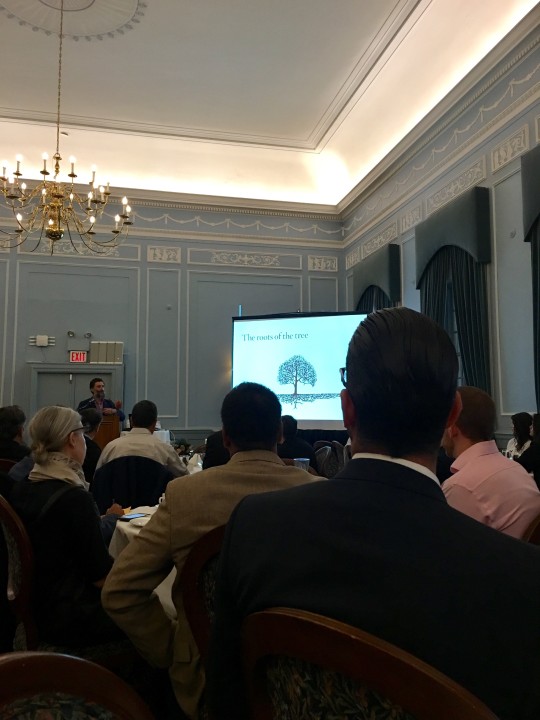
    Shown above is one of William’s slides. The title is: The roots of the tree. And I thought it was a great metaphor for what tall buildings, well really all buildings, should aspire to do.

    The tendency is to think of buildings as objects. Here, look at how beautiful this thing is. That’s obviously important, but what about its roots? What about the way in which it interfaces with its context and hopefully gives back? Is it a catalyst for positive change?

    I thought it was a good slide.

  • New Slate website

    Earlier this week, we (Slate Asset Management) launched our new website. You can check it out at slateam.com. It’s now much clearer who we are and what we do. (There’s also a neat drone video of the Toronto skyline.) 

    On the landing page and in the very first tab (What We Do) it shows our different business lines: Private Equity, Institutional Separate Accounts, and Public. This is all about matching the right capital to the right real estate.

    Lots of people in our office worked very hard on this website and so I’m excited to share it on the blog. Let me know what you think in the comment section below. You can also subscribe to the Slate newsletter here and follow on Twitter here.

  • Lessons in transit success

    image

    Dylan Reid of Spacing was recently at the International Transport Forum in Leipzig, Germany and has been publishing some interesting posts related to transit. Here is one about what makes transit systems succeed and fail.

    I really like the point that we too often think about transit projects as culminating with a big opening, while overlooking the importance of operations. It’s a bit like focusing on the wedding ceremony and forgetting that the ceremony is only really there to (hopefully) mark the beginning of a lifelong union.

    One of the reasons why this is important is because, as Reid points out, “fares need to provide a strong and consistent proportion of the agency’s funding.” So you need bums in seats, which means you need to build the right transit in the right locations. In other words, a new subway line through a low density suburb will probably result in an abysmal farebox recovery ratio.

    At the same time:

    “…fares will rarely cover all of an agency’s costs. Hong Kong’s Kam noted that, to be truly autonomous, an operator needs an additional dedicated, independent source of revenue. This cannot be based on additional transit-related non-fare revenue (e.g. advertising) – such revenue is helpful but never significant. It needs to be an external source. In Hong Kong, it is based on the agency’s extensive property ownership, but in other cities it could be a congestion charge, a dedicated sales or income tax, or other mechanism. Only with such a source can the agency have the independence to make its own choices for reinvestment and improvements.”

    This is one of the reasons why I am such a strong supporter of road pricing.

    Another point that Reid makes is that transit agencies should always have a consistent pipeline of new projects, rather than erratic periods of expansion. This makes a lot of sense given what it takes to ramp up for a large infrastructure project. But it’s obviously contingent on having sustainable funding sources.

    Click here if you’d like to read the rest of Dylan Reid’s post.

  • Laneway suites are happening

    image

    Today I learned that Councillor Ana Bailão and Councillor Mary-Margaret McMahon have put forward a motion to the June 13, 2017 Toronto and East York Community Council. It asks the Chief Planner and City Planning to undertake further public consultation and report back in Q1 2018 with an implementation strategy for laneway suites in this part of the city.

    This is an insanely great step forward. Here is the summary from the motion:

    We have been working with Lanescape and Evergreen since early 2016 to advance the dialogue around ‘laneway suites’ in order to put forward a set of responsible performance standards that address the aspirations, sensitivities and needs of residents in our communities.

    As part of the work undertaken by the team, we engaged with over 3,000 residents though an extensive consultation process that included an online survey, written feedback, in-person consultations in Wards 18, 32 and a public consultation at the Evergreen Brick Works. The feedback received has been overwhelming positive and the team has taken steps to address the key issues raised by residents as part of the recommended performance standards.

    Throughout this process, the team met with relevant City Divisions to seek feedback on how best to address the technical requirements for laneway suites and we have also sought to include your feedback into the performance standards that have been developed. We are also grateful to the City Planning and other Divisional staff who have provided their advice and feedback as the team worked to prepare this independent report and set of performance standards.

    Toronto has more than 2,400 publically owned laneways, covering more than 250 linear kilometers of public space, which have the potential to become much more active, useful spaces in our urban fabric. Laneway suites can transform underutilized spaces such as rear garages and parking pads, into sensitively scaled housing, utilizing existing infrastructure and respecting the form and character of the dense, walkable neighbourhoods in the Toronto and East York District.

    Laneway suites represent an important step forward in addressing the need for more “missing middle” housing and have the potential to add much needed rental units into the market. They can reshape our thinking about secondary suites, looking beyond the traditional basement apartment as a way to provide extra income or as a place for adult children, empty nesters and care-takers to live close to their family support networks.

    We want to eliminate the excessive red tape and unnecessary costs associated with building a laneway suite in the current context by proposing thoughtful and sensitive policy changes for Toronto to join the other municipalities in Canada who have already allowed for laneway suites to be built.

    We believe that the time has now come for Toronto to allow for laneway suites and therefore recommend the following.

    What they are recommending is a set of performance standards for laneway suites. You can download the full report here. It’s called Laneway Suites: A new housing typology for Toronto, and it was prepared by Lanescape and Evergreen. I’ve mentioned both groups many times before on the blog.

    I haven’t read through the entire report yet, but I’m thrilled to see this housing typology moving forward. I’ve been arguing for over a decade that laneway housing is an inevitable outcome for this city and it’s finally starting to feel a bit more real.

    A big kudos and thank you to Councillor Ana Bailão, Councillor Mary-Margaret McMahon, their teams, and the folks at Lanescape and Evergreen for putting in the effort and sticking their neck out around this important initiative. We’re going to look back on this one day and wonder why it took so long.

    But keep in mind that it’s still early days. So I would encourage you to visit this page, click “Submit Comments” on the top, and fire off a comment directly to Community Council. Tell them you love laneway suites to bits.

  • 150 noteworthy Toronto buildings are opening up their doors this weekend

    This weekend – May 27 and 28, 2017 – is the 18th annual Doors Open Toronto. The event provides free and open access to “architecturally, historically, culturally and socially significant buildings across the city.” And in honor of Canada’s 150th birthday, 150 noteworthy spaces will be opening up their doors. The list of participating buildings can be found here.

    I’m going through the list right now and curating my weekend itinerary. I’ve never been inside the Don Jail or the R.C. Harris Water Treatment Plant, so I’d like to check those off. I plan to be on my bike and have my Fujifilm around my shoulder. If you’re also getting out this weekend, drop me a line on Twitter and let’s connect. What buildings are on your list?

  • Building Tour: Oben Flats Leslieville

    I toured Oben Flats Leslieville today, which is a 48-unit purpose-built rental building at 1075 Queen Street East in Leslieville (Toronto). It was designed by superkül. 

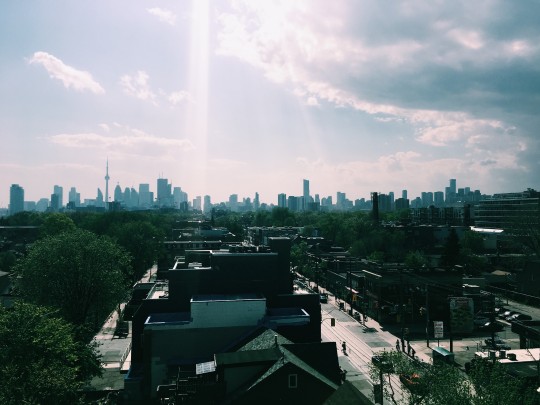
    Oben Flats is doing some very cool things, so I would encourage you to check them out if you’re in the market for a new luxury rental (or you just want to nerd out about property). The image at the top of this post is the west view from the rooftop terrace.

    Here are 3 things that stood out for me:

    1. One of the interior amenity spaces for the building is actually on the ground floor attached to the main entrance. There’s a fireplace, a wet bar, a set of wine fridges and free wifi. Oben Flats hosts regular events in this space, but I was told that residents also regularly hang out in it. They’ll bring their laptop down and have a glass of wine. 

    What I like about this is that it encourages social interaction within a multi-family building typology. I would love to see more of this kind of thinking. Part of the reason you live in a city is to interact with other humans.

    2. Oben Flats has developed their own signature scent and regularly curates a music playlist with the help of BELLOSOUND. Both of these items are pumped throughout the common areas of the building, which is not that dissimilar from what you might find in some luxury hotels. I have one of their candles sitting on my desk right now, so my office smells like Oben Flats. I’m into it.

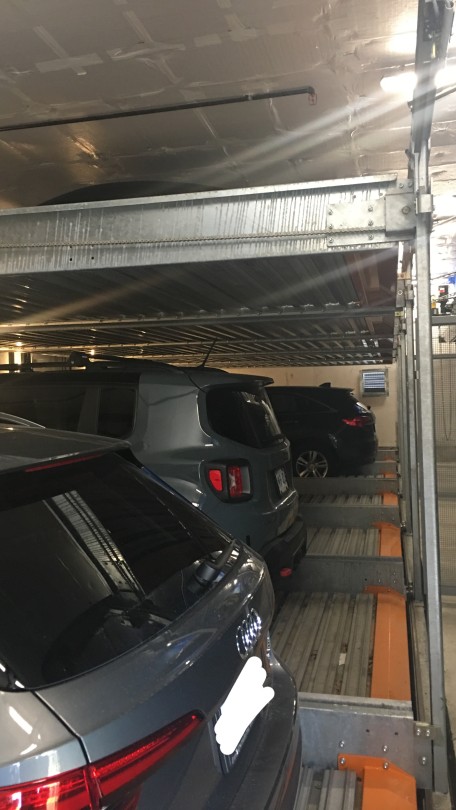
    3. Another unique feature of the building is the fully automated hydraulic car-stacking system. Here’s a photo of what the guts of that looks like:

    There are 3 platforms in each bay (the bottom one is below-grade in the above picture). And there’s always one empty spot so that the platforms are able to shuffle around both horizontally and vertically. However, as a user, you never see this. You simply hit a button and drive into your bay. It’s always the same one.

    I’ve said many times before on this blog that I think we will see way more of these types of parking solutions

    in the city

    going forward.

    There are other cool things I could mention about the building, but it’s far too nice out to sit at my desk any longer. Before I sign off though, I should mention that this is in no way a sponsored post. I simply admire what Oben Flats is doing. 

    See you tomorrow.

  • Building a city from the internet up

    There has been a lot of exciting tech + urbanism news this week in Toronto. Uber announced that it’s building a new artificial intelligence team in the city and it came out that Sidewalk Labs (Alphabet company) had responded to an RFP put out by Waterfront Toronto. 

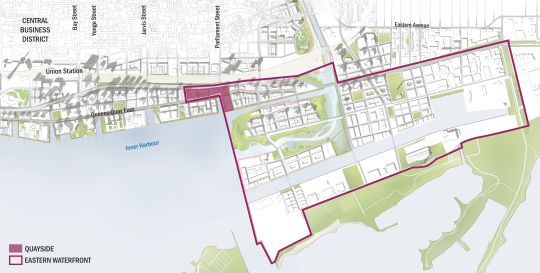
    The RFP, which closed at the end of last month, was to find an “innovation and funding partner” for the 12-acre Quayside precinct shown above in purple. It’s the first parcel of the “eastern waterfront.” (Click here if you’d like to download a copy of the actual Request for Proposal.)

    These days, it’s easy to be cynical about these sorts of announcements. Every day you hear about some new innovation center or tech hub. But what’s perhaps unique about this one is that Sidewalk Labs is thinking crazier than most and they have the financial backing that crazy sometimes needs.

    If you’re not at all familiar with Sidewalk Labs, I suggest you read this post about how the company wants to build cities “from the internet up.” It’s by their CEO, Daniel L. Doctoroff. 

    Not surprisingly, they are thinking about everything from automated trash systems and autonomous vehicles (including their impact on built form, cost of living, productivity, etc.) to exchange-based thermal grids and more cost effective construction methods. And it’s not just about the technology. It’s about marrying tech + urbanism.

    Also interesting is their model of setting up a “hyper-focused labs”, which are each run by entrepreneurs-in-residence. These internal labs are focused on things like housing affordability, the health challenges faced by low-income city residents, and so on. 

    It’s all very exciting. So let’s ensure this moves forward and let’s hope Sidewalk Labs keeps thinking crazy. Toronto is ready to lead and show the world how a city built from the internet up should perform.