Daily insights for city builders, delivered every morning at 6 AM ET. I’m Brandon Donnelly — a Toronto-based real estate developer and founder of Globizen. I’ve been writing here since 2013.

Tag: toronto

  • Superstar or bubble?

    “The term “bubble” refers to a substantial and sustained mispricing of an asset, the existence of which cannot be proved unless it bursts.” – UBS

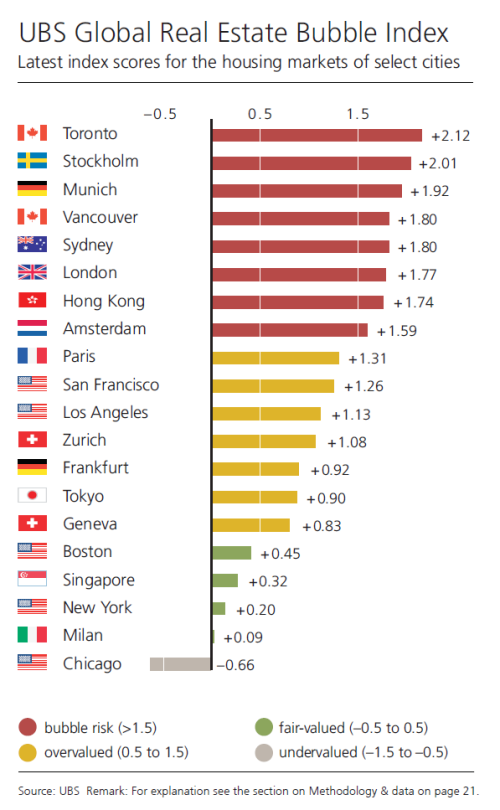
    Last week UBS released its 2017 Global Real Estate Bubble Index. At the top of the list was none other than Toronto, followed by Stockholm, Munich, Vancouver and Sydney. And at the bottom of the list was Chicago – a city that UBS feels is undervalued.

    Here is the full list of index scores:
    image

    The UBS index is a weighted average of the following five sub-indices:

    1. Price-to-income
    2. Price-to-rent (fundamental valuation)
    3. Change in mortgage-to-GDP ratio
    4. Change in construction-to-GDP ratio (economic distortion)
    5. Relative price-city-to-country indicator

    If you look at their price-to-income benchmark in isolation, Toronto drops down to the middle of the pack along with Geneva and San Francisco. Hong Kong, London and Paris sit at the top with the most unaffordable housing. 

    Still, UBS credits “an overly loose monetary policy”, foreign demand, tight zoning, and rental market regulations for the eroding housing affordability in Toronto and Vancouver.

    One of the challenges, of course, is that the capital flowing into real estate is not all local – it’s also global. And many cities around the world are seeing high price-to-income multiples, perhaps because of that. 

    So exactly how much decoupling from local fundamentals should now be considered reasonable in our globalized world? And to what extent is this a result of “superstar economics?”

    Here’s an excerpt from the UBS report:

    The economics of Superstars explains why, in some professions, show business for instance, “small numbers of people earn enormous amounts of money and dominate the activities in which they engage.” By analogous reasoning, prices in the most attractive cities are expected to outperform average cities or rural areas in the long run. Hong Kong, London and San Francisco are exemplars of this theory.

    The intuition is that the national and global growth of high-wealth households creates continued excess demand for the best locations. So, as long as supply cannot increase rapidly, prices in the so-called “Superstar cities” are supposed to decouple from rents, incomes and the respective countrywide price level.

    I guess this is one of the reasons why bubbles are proven after the fact. If you would like to download a copy of the full UBS report, click here.
  • Is Trump good for Canada?

    Richard Florida and Joshua Gans just published an article in Politico called: Trump Is Making Canada Great Again. The overarching argument is that as the US closes its borders, Canada benefits. The best and brightest from around the world are coming here.

    This fall, international student applications at the University of Toronto were up 70% compared to last year. And numerous companies in Toronto are reporting “steady, double-digit increases” in the number of job applications from Americans.

    This is exactly what I was getting at when I made the pithy prediction that Amazon is going to choose Toronto for HQ2. It’s about access to human capital (though I acknowledge the political reality of selecting a city outside of the US). 

    Perhaps here or here might work for a location.

    Here is an excerpt from the Politico article that starts to speak to the importance of foreign-born workers in the US:

    As of 2013, foreign-born workers in STEM fields—science, technology engineering and math—accounted for nearly a fifth of workers with bachelor’s degrees in the United States, 40 percent of those with master’s degrees and more than half of those with Ph.D.s. In the San Jose metro area, consisting largely of Silicon Valley, immigrants comprise more than 55 percent of adults who hold advanced degrees.

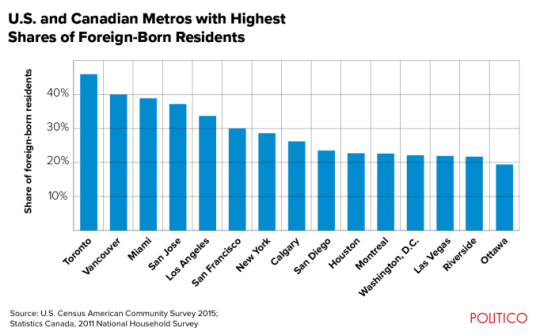
    Here is a chart showing the US and Canadian metros with the highest percentage of foreign-born residents:

    image

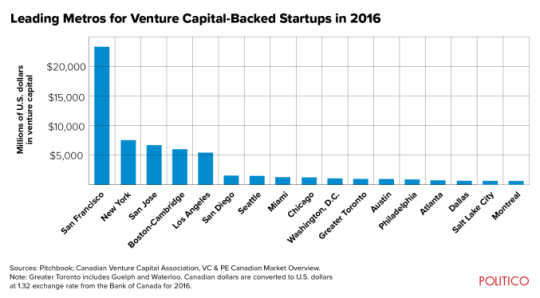
    And here is a chart showing which metro areas receive the most venture capital dollars (in millions of US dollars):

    image

    As to be expected, Toronto, Vancouver and Miami lead in terms of the percentage of foreign-born residents. Though, I would bet that Toronto’s foreign-born population is far more diverse than those of Vancouver and Miami.

    However, when you look at venture capital dollars invested, Toronto is nowhere near the top. Vancouver isn’t even on the list. And I suspect that some of you are surprised to see Miami sitting in between Chicago and Seattle (arguably a city that overperforms in tech relative to VC dollars invested). I was.

    Perhaps Trump will help with this by making Canada great again.

  • The first North American night mayor

    With Mirik Milan (Night Mayor of Amsterdam) speaking at the upcoming NXT City Symposium here in Toronto, I figured it was time to revisit the topic of night mayors. If you’re new to this topic and/or the blog, you can get yourself up to speed here (scroll down).

    Firstly, this idea is clearly spreading and it just crossed the pond. Last month on August 24, 2017, New York City Council voted to create the “Office of Nightlife.” It’s a small start. The office will have an annual budget of $300,000. But that’s okay.

    As far as I know, NYC is now the first major North American city with government humans focused on leveraging the benefits of the nightlife industry.

    For the record, my post “Why Toronto needs a night mayor” was published in March 2016. It was obvious that the idea was already spreading throughout Europe and I was hoping that this city (Toronto) take notice and decide to lead within North America. New York City decided to do that instead.

    Secondly, CityLab published an article today called how to be a good night mayor. It is about what NYC can learn from the European cities who are already experimenting with this kind of office. Perhaps my favorite is the recommendation to “reflect your own city’s DNA.”

    Of course, having a night mayor is one thing. Making it highly effective is another. In that regard, it is still early days for North American night mayors, and night mayors in general. Who will truly lead?

    Photo by Alina Grubnyak on Unsplash

  • Celebrate the sidewalk (at Yonge + St. Clair)

    I have two quick announcements to make regarding Yonge + St. Clair in midtown Toronto.

    The first is that Slate has just unveiled a new “ravine bench” at the northeast corner of the intersection. 

    Here’s a photo:

    And here’s another photo with people sitting in it. #SitTO

    Designed by Gensler (the same firm behind the renovation of 2 St. Clair Ave East), the design is all about celebrating both the sidewalk/public realm and the extraordinary ravines that cut through the area. Some people may not even be aware of these natural features, so perhaps this bench will help with that.

    The second announcement is the launch of our Yonge + St. Clair Pop-up Store at 1470 Yonge Street. I know this is short notice, but the launch party is on Thursday, September 21 from 6 – 10pm (drop in whenever). That’s tonight if you’re reading this post via email subscription.

    At the party we’ll be introducing 8 exclusive t-shirt designs from Toronto artist, Lucas Young. All of the tees will be screen-printed for you right on the spot and 50% of all proceeds from the opening night will be going to The Canadian Cancer Society. 

    Wine, beer, and snacks will be available. If you come find me at the party, I’ll give you some drink tickets. So if you’re around on Thursday night, come by for some drinks, a Toronto tee, and to check out the new ravine bench on Yonge Street.

  • The 10 most promising Hyperloop routes (and thoughts on the naysayers)

    image

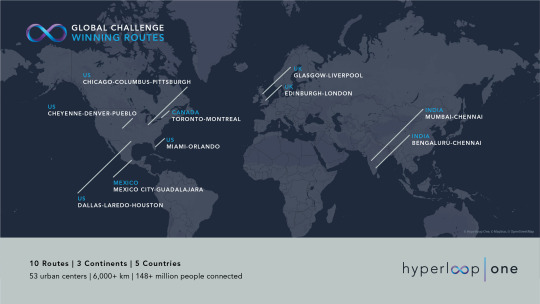
    On September 14, 2017, Hyperloop One announced the 10 winners of its Global Challenge. These are the world’s “most promising” Hyperloop routes; selected through a process that began in May 2016 and involved more than 2,600 registered teams.

    The winners:

    1. Canada | Toronto-Montreal
    2. India | Bengaluru-Chennai
    3. India | Mumbai-Chennai
    4. Mexico | Mexico City-Guadalajara
    5. UK | Edinburgh-London
    6. UK | Glasgow-Liverpool
    7. US | Chicago-Columbus-Pittsburgh
    8. US | Miami-Orlando
    9. US | Cheyenne-Denver-Pueblo
    10. US | Dallas-Laredo-Houston

    If you aren’t familiar with what Hyperloop One is trying to accomplish, here is a quick video explaining the basics. Their goal is to have the world’s first operating Hyperloop by 2021.

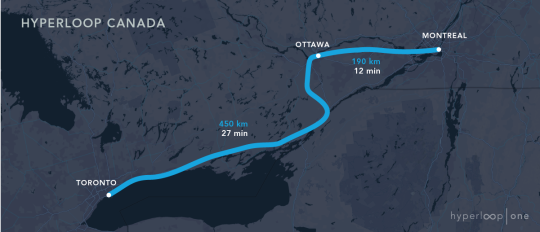
    If you happen to live in one of the above regions (about 148 million of us do), then you are probably already seeing the headlines in your feeds. For Canada, the promise is of connecting 25% of our country’s population with one single Hyperloop route.

    It would mean Toronto-Montreal in just 39 minutes:

    image

    This is shorter than many morning commutes. So it’s not hard to see why this is a tantalizing proposition. It would mean a union of our two biggest cities and our capital. More accessible Montreal bagels. And maybe, just maybe, a strengthened sense of bilingualism in this country. 

    But there are also critics who believe that all of this Hyperloop hype is simply a distraction. Why not focus on proven technologies as opposed to some fanciful pipe dream that may never materialize? This is about stroking political egos as opposed to real progress.

    My views are pretty simple on this one.

    Will Hyperloop Canada happen? Maybe. Maybe not. I sure hope it does. But it may not. It’s easy to draw lines on a map. It’s much harder to actually execute on those lines. And of course, logistics aside, the technology is still being developed.

    But if all we ever focused our energy on were things that have already been “proven”, we likely wouldn’t create many new things. Things that today are proven, were once unproven. But they became proven because there were folks who didn’t let that minor detail deter them from trying. They went for it.

    So if a private company would like to go out and raise $160 million from private investors to try and figure out how to sustainably connect Canada’s two largest cities in 39 minutes, I am more than happy to cheerlead. Because I’m not the one trying. Who am I to naysay? 

  • Fall event roundup

    image

    It’s still sunny and beautiful outside, so I don’t mean to be the one who prematurely calls fall. But I would like to get 3 Toronto events on your radar for the coming two months. 

    Full disclosure: These are all events that I support and/or my company supports in some way. 

    If you’re not based in Toronto and you don’t plan to be here this fall, you can stop reading right now and check back tomorrow. I promise to will try to be less Toronto-centric.

    1. EDIT: Expo for Design, Innovation and Technology, September 28 – October 8

    This is a 10-day immersive experience that will showcase how the intersection of design, technology and innovation can change the world. Think exhibits by Bruce Mau and Carlo Ratti; talks by David Suzuki and Scott Dadich (former editor-in-chief of WIRED and creator of the Netflix series The Art of Design); and projects spanning 3D-printed prosthetics to indigenous housing solutions. 70 speakers. 40 workshops. And over 150,000 sf of exhibits. Too much to write about here, but all topics and themes we frequently explore on this blog. Ticketing information here.

    2. NXT City Public Space Symposium, October 13 – 14

    This is a two day symposium about public space on a global stage. Talks. Public space tours. Round table sessions. And an epic after-party. Some of the speakers include Jeff Risom (Partner at Gehl Architects); Enrique Norten (Founder of TEN Arquitectos in Mexico City – and one of my grad school professors); and Mirik Milan (Amsterdam’s Night Mayor and someone who has gotten quite a bit of airtime on this blog). If you click here to grab your tickets, you’ll get 15% off. If for whatever reason that doesn’t work, use the code BDONN15.

    3. lost&gone: Romeo & Juliet, October 19 – 21 and October 27 – 28

    This is, I think, Toronto’s first truly immersive theater experience. For those of you who aren’t familiar, immersive theater is about turning the audience into participants of the production. It eliminates the “fourth wall” that traditionally divides audience and performers. I’ve heard great things about similar productions elsewhere in the world. The venue is a secret, so the show starts today with you having to try and figure out where it is in the core of Toronto. When you buy your tickets, you’ll also have to let them know if you’re a guest of the Capulets (Juliet’s family) or a guest of the Montagues (Romeo’s family). 

    Enjoy 🙂

    Photo by Brxxto on Unsplash

  • A generation of architects

    The New York Times just published a piece called “a generation of architects making its mark at dizzying speed.” It’s a current list, albeit not an exhaustive one, of notable architects and their projects. 

    Included on this list is One Spadina, home of the Daniels Faculty of Architecture, Landscape, and Design at the University of Toronto, which was designed by Nader Tehrani and the Boston practice NADAAA.

    Some of the best architecture in the city is being built on this campus.

    One thing you’ll notice about this summary of architects is the emphasis on age. Architecture is a slow process. This is true for buildings in general. So historically it has been the case that architects usually don’t hit their stride until later in their career.

    The youngest architect on the list is Bjarke Ingels at 42. An outlier for sure. He saw tremendous success in his 30s, and even in his 20s with the firm PLOT. I think great storytelling had a lot to do with this.

    Tehrani is 53. And the author rightly points out that Frank Gehry didn’t become Frank Gehry until he renovated his own house at the age of 48.

  • Transit advertising according to the numbers

    This morning I saw this tweet about Toronto streetcar advertising. The author has a “big problem” with public transit being fully wrapped in ads and so she decided to tweet her local Councillor to see if these could be somehow limited in size.

    My first thought was: I wonder how many people would accept higher fares in exchange for fewer/no advertising. Is this something people care about? Because personally, I’ll take the lower fares in exchange for someone trying to monetize my attention. I mean, every social network I use is already selling my attention off as their product.

    But then this got me thinking about what the actual numbers look like. So let’s look at some of those for not only Toronto, but also for Hong Kong, since many people view that as the gold standard as far transit authorities go.

    For the year ending December 31, 2016, the Toronto Transit Commission (TTC) posted a total operating revenue of $1.204 billion. This represents about 41% of total revenue – the rest comes from subsidies.

    If you drill down into operating revenue, advertising makes up $28 million or about 2.33% of total operating revenue. So a pretty small number. If you tried to shift this number over to “passenger services” revenue (transit fares), it actually wouldn’t increase fares by that much. But presumably fares are already at some profit maximizing number.

    Switching to Hong Kong’s MTR Corporation, their numbers have to be unpacked a little differently because the group has a number of diverse business lines, including property development.

    For the year ending December 31, 2016, total revenue from Hong Kong Transport Operations was HK$17.655 billion (almost all fare revenue). Advertising falls within the Hong Kong Station Commercial Businesses group and that company posted revenues of HK$5.544 billion for the same time period.

    To try and create some sort of comparison, I’m ignoring all of the other segments within MTR.

    Within Station Commercial Businesses, advertising revenue alone makes up HK$1.09 billion or about 20% of that group’s total revenue. The rest comes from station retail rent (the biggest chunk), telecom, and some miscellaneous station income. 

    If you add up Transport Operations and Station Commercial Businesses, total revenue was HK$23,199 billion for the year ending 2016. Advertising comprises about 4.70% of this – so more than double that of Toronto.

    It’s also worth noting that MTR’s station retail rental revenue is about 3.4x that of its advertising revenue. In the case of Toronto, the TTC actually makes more money off advertising than it does from “Property Rental.” I’ve always thought this was a missed opportunity. Transit and land use go hand in hand.

    In any event, I’m far less fussed about advertising on transit. But what are your thoughts? Let me know in the comment section below.

    Photo by Tomo Nogi on Unsplash

  • Morning bagel run

    image

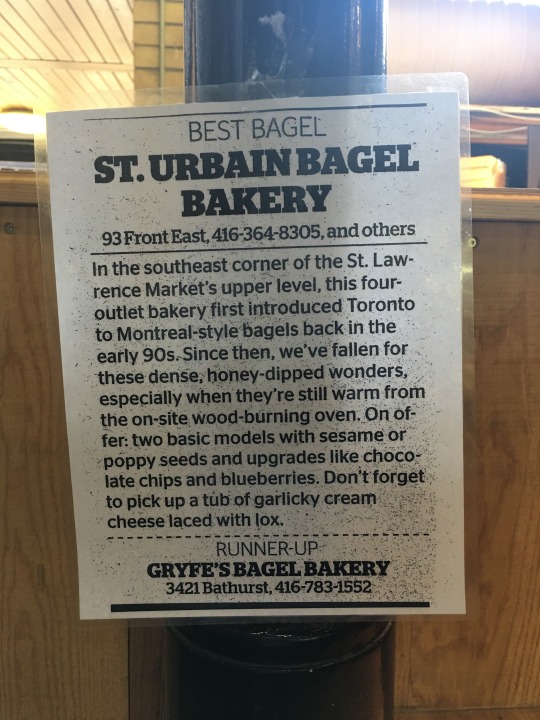
    This morning I woke up and decided that I could go for a bagel with lox and cream cheese. I figured, it’s the weekend, I’m going to treat myself. So I walked across the street to St. Urbain Bagel Bakery (see above photo).

    My Montreal friends reading this are probably thinking that this is no substitute for a Fairmount or St-Viateur bagel. But I enjoy St. Urbain. They are my go-to place for breakfast in the market.

    What I really value, though, is the ability to walk across the street and grab a bagel for breakfast. It’s a pretty simple action. Nothing complicated about it. 

    But in our world of constant traffic jams, cars that should soon drive themselves, and near-instantaneous online delivery, it can be easy to forget that there’s still something really nice about just walking down the street in the morning and saying hello to a human.

    I feel lucky that my neighborhood allows me do this. Not all do.

  • My prediction for Amazon HQ2

    “Now the trick is that we gotta look like we don’t need this shit and they give us the shit for free.“ –Mike Peters

    This is a line from one of my favorite movies, Swingers. Short video clip here. Mikey and Trent are in a Las Vegas casino trying to play it cool. They’re looking to make a scene at a table and Mikey throws out this gem of a line. He knows that people want what they can’t have and that confidence matters.

    I was reminded of this line today after Amazon announced its HQ2 Request for Proposal (full RFP document here) and every city, from Chicago and Toronto to Philadelphia and Dallas, started swooning over the prospect of housing Amazon’s second headquarters in North America. 

    But to be clear, I do not think this is a bad idea. I actually think Amazon HQ2 is an incredible city building opportunity that would generate countless positive externalities for the selected city. I’m thrilled that Mayor John Tory will be personally “leading the charge” with respect to Toronto’s response.

    Over $5 billion in construction and as many as 50,000 employees making on average over $100,000 per year. Amazon is looking for about 500,000 sf of space in phase 1 (2019) and up to 8,000,000 sf in total. Based on the RFP, they seem to be pegging their capital investment at somewhere around $600 per square foot.

    If I’m being as objective as possible, I honestly believe that Toronto is the city to beat in his competition. I think it will come down to access to talent. Human capital is the lifeblood of a company and Trump’s immigration policies simply put U.S. cities at a disadvantage in this regard.

    Of course, Toronto is also awesome. So that’s my prediction: Amazon HQ2, Toronto.