Daily insights for city builders, delivered every morning at 6 AM ET. I’m Brandon Donnelly — a Toronto-based real estate developer and founder of Globizen. I’ve been writing here since 2013.

Tag: toronto

  • LESS IS MORE OR

    Last night I went by the Toronto-Dominion Centre to check out the above public art project by French artist Aude Moreau. The message on the buildings is “LESS IS MORE OR”, which is a play on the architect Mies van der Rohe’s famous adage: “Less is more.” Here, the “or” is meant to make you question it.

    All of this is to celebrate the 50th anniversary of the Centre. The first tower was completed in 1967 and is one of Mies’ last projects before he died in 1969. His original plan included two towers and the banking pavilion at the corner of Bay and King, but three more towers were later added.

    This is Toronto architecture at its absolute best. And it may not have happened without people like Phyllis Lambert. I am so glad it did.

  • Two-hour grocery delivery

    Today it was announced that Amazon is planning to launch its “Prime Now” service in Vancouver and Toronto this November and January, respectively. 

    The pilot program will offer two-hour deliveries for members and, according to the Wall Street Journal, will be be heavily focused on groceries. 

    It’s worth noting that most of Whole Foods’ stores in Canada (now owned by Amazon) are in and around Vancouver and Toronto. And that Amazon has already started lowering prices to make those stores more competitive.

    Right now a “Prime” membership in Canada costs CAD$79 per year. I’m not sure if the price will change at all for “Prime Now”, but let’s assume for the sake of argument that it won’t. 

    If this service was available to you today (or if you’re in a city that currently has it), would you (do you) use it? I would love to hear your thoughts in the comment section below.

    Two common objections around online grocery shopping are that many people want to touch and feel the goods before they buy and that perishable deliveries are a challenging thing to coordinate.

    I think I can work around those objections and would certainly try this today if it was available in Toronto. What about you?

  • Frontier city

    Opposition to new development is nothing new in this city. In fact, it’s the norm in almost all cities, regardless of how big or small the project might be.

    But the battle happening right now in Toronto with respect to the proposed 8 storey condominium project at 321 Davenport Road is certainly taking things to the next level. All over 16 units.

    Some of the most recognized names in this city have their hat in the ring and virtually every media outlet has covered the topic. See here, here, here, and here, for a small taste.

    Just this evening I saw that Shawn Micallef (yes camp) had sent a copy of his recent book to Margaret Atwood (no camp) in the hopes that she would read it and better appreciate why it behooves our neighborhoods to move past this “village mentality.”

    If you haven’t yet read it, it’s called Frontier City: Toronto on the Verge of Greatness. I’ve just moved it to the top of my reading pile. I hope more folks do the same.

  • Official bilingualism

    When I was around 8 or 9 years old my mother put me into a French school in Toronto. Her logic was simple: “This is Canada. You should know how to speak both official languages. It will create opportunities for you in the future.”

    But I hated it. I couldn’t speak a word of French at the time and so I would come home from school complaining that I couldn’t understand anything the teacher was saying. How was I supposed to learn anything? 

    I begged her to put me back into an English school.

    To her credit, my mother remained absolutely steadfast. She would say to me: “Trust me. You’re going to thank me for this later.”

    Not surprisingly, I learned French. I was put into a special “intro” stream and so when my classmates were off learning a third language (German), I was given introductory classes designed to bring me up to their French level.

    I still remember the sense of accomplishment I felt when I could finally carry on an actual conversation in French.

    Sadly, at this point in my life, my French is fairly rusty. I really should work on that. But it’s decent enough that people in Montréal – which is where I am right now – will say to me: “You’re from Toronto. How is it that you speak French?” 

    In fact, somebody said to me last night that in Montréal they typically encounter more French speakers from the U.S. than they do from Ontario. That surprised me. As a country, about 10 million Canadians report being able to speak French (2011 number).

    Every time I visit Montréal, I marvel at the display of bilingualism that seems omnipresent in this city. And, if you grew up in an immigrant household, you may also speak a third language – the one your parents spoke to you in. I think that’s wonderful.

    So with that: thanks mom.

  • The year of the condo

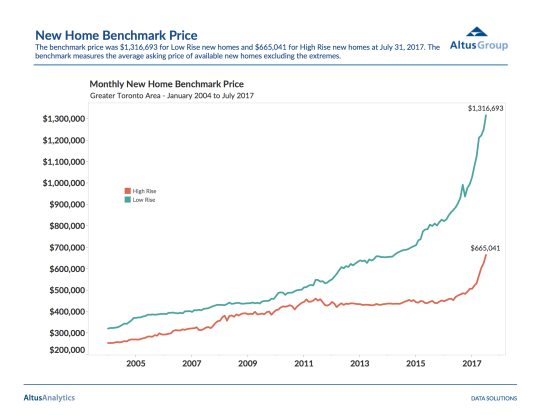
    Over the past 5 years or so, real estate headlines in the Greater Toronto Area have often focused on the rapid appreciation of low-rise housing. High-rise housing simply wasn’t appreciating at the same rate – at least in aggregate terms.

    But 2017 has brought a different story. 

    If you look at BILD’s “New Homes Monthly Market Report” (data provided by Altus Group as of July 2017), you can see that high-rise pricing is now on a similar trajectory to low-rise pricing.

    Here is that graph:

    image

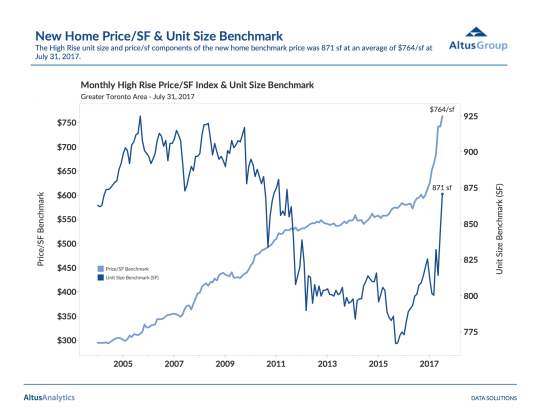
    This sharp uptick in pricing is also apparent when you look at the average price per square foot of new high-rise inventory. As of July, it was $764 psf across the GTA. See below.

    At the same time, average unit sizes have also jumped up to 871 square feet. So not only are new high-rise homes becoming more expensive on a normalized basis, they are also getting bigger, which further increases prices.

    image

    I recognize that we’re only seeing data up to the end of July, but, from the looks of it, 2017 is shaping up to be an extraordinary year for the condo.

    Of course, part of the reason this is happening is because remaining inventory for both low-rise and high-rise product is hitting 10-year lows. We’re back to the topic of supply.

    If you’re curious how some of these numbers have changed from the month prior (June 2017), check out this post.

  • A story about Toronto

    Marcus Gee of the Globe and Mail recently published “a made-up story about Toronto that never appeared, but should.”

    It goes like this:

    Toronto city hall is pressing a prominent developer to put up a taller building.

    Mayor John Tory is telling Big City Condo Corp. that the condominium it has planned for the downtown corner of Maple and Oak streets is simply too small. The proposal calls for a 25-storey residential tower. Mr. Tory said it could easily rise to 40 or even 50 storeys.

    He dismissed complaints from locals who said the tower would overshadow the neighbourhood and put too many more cars on the street. The intersection is well served by public transit, with two lines crossing there. The mayor called it a golden opportunity to create urban density.

    He insisted the city must build up instead of out if it wants to avoid more sprawl. “We love tall buildings,” he said. “We need more of them. We can’t keep spreading out and out and out. We need to grow up, and I mean that quite literally.”

    Again, this is made-up. And if you’re from Toronto, you knew that. 

    We are still grappling with the urban intensity that should come along with being an important global city.

    Photo by Redd Angelo on Unsplash

  • The Hong Kong window ledge

    image

    My friends at the architecture practice Valente Rodgers told me something fascinating about the Hong Kong real estate market last night. Both partners worked as architects in Hong Kong for a number of years.

    In Hong Kong, you’re allowed to deduct certain projecting windows from your calculation of Gross Floor Area. 

    This is provided they’re a certain height above the finished floor level, they don’t project beyond certain distances from the outer face of the building’s structural elements, and so on. The precise measurements seem to vary depending on things like the building’s use.

    Since space is such a precious commodity in Hong Kong, it shouldn’t surprise you that lots of developers and architects take advantage of this. The result being a proliferation of these projecting window ledges all across the city. 

    It’s a phenomenon that happens in many cities when a perfectly legal loophole is found in the land use policies.

    In Toronto it used to be solariums. You could also deduct these from your overall GFA, which means a lot of them them got built in condos and apartments of a certain vintage.

    In New Orleans it was the camelback house. These were houses with a single storey toward the street and a second storey toward the rear of the property. This was done because property taxes were assessed based on the height of the house as it met the street. Pushing the density toward the rear of the lot meant homeowners weren’t taxed more. 

    I find these outcomes fascinating because they have absolutely nothing to do with architectural intent and everything to do with trying to optimize within a given framework.

    But what’s even more interesting about the Hong Kong example are some of the downstream externalities.

    Firstly, it sounds to me like these projecting windows have become a normal part of underwriting projects in Hong Kong. Meaning, if you don’t factor in these projections, you’re effectively giving up free GFA. (Can anyone familiar with the HK market confirm this?)

    However, building these projections also means you can’t do unmodulated and clean floor-to-ceiling windows. And if that’s the desired aesthetic, somebody has got to be willing to pay for that “luxury.” So arguably there’s a socioeconomic dimension to having and not having this ledge.

    Secondly, because space comes at such a premium, these ledges are fully taken advantage of and furniture makers have responded by designing pieces that can dovetail with them.

    Below is a photo of a bedroom in Hong Kong that I found on bohemia.life:

    image

    This may be a custom bed and I don’t know how deep that window projection is, but it begins to show you how valuable these ledges can be from a space perspective.

    I think we should try and come up with a name to describe these sorts of built form phenomena. If you have any ideas, please drop them in the comments below. And if any of you are familiar with the HK market, let me know if I’m off the mark with any of the above.

    Photo by Jason Wong on Unsplash

  • The city refused my laneway house

    image

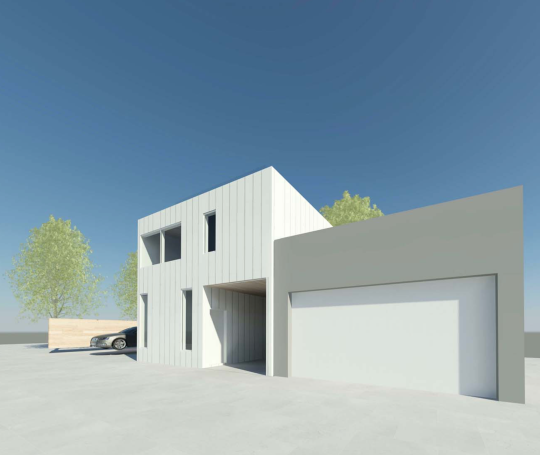
    This afternoon I stood up at the Committee of Adjustment (Etobicoke York) to present the laneway house proposal that Gabriel Fain Architects and I have been working on for the past year and that I have been working on since 2009.

    But before I could start I was told that Councillor Palacio had just submitted a last minute letter to the Committee. I was given a few minutes to read it, but the big bold “REFUSE” was probably the only word I needed to read.

    I was then asked if I had read planning staff’s report. I acknowledged that I had read it and that I was aware that they were also recommending refusal of the application. I also noted that a number of my immediate neighbors sitting behind me were also opposed to the proposal.

    That’s how my presentation started. 

    At this point you might be wondering: why bother?

    I stood up today because, as most of you already know, laneway housing is something that I feel strongly about. This isn’t just about my individual project. I mean, why do all of this work for one small dwelling unit? For me, this is about city building and trying to affect positive change. (I would also love to live on a laneway.)

    I could go on here about how the proposal was shorter than other existing structures on the lane, how the FSI was in check, how we had carefully studied shadows, and how planning staff had already supported greater densities and multiple dwellings on lots of similar size in the area. 

    But that’s not what today was really about.

    Today I heard loud and clear that whether the proposal was a laneway tiki hut or a 2 storey laneway suite, the community did not want more people living in the area and they most certainly did not want more renters living in the area.

    My message to the Committee was that in my humble opinion this is inevitable. Look to Vancouver. Look to Edmonton. Look to many other cities. What we are debating today, or at least what we should be debating today, is what these laneway houses or suites or tiki huts are going to look like.

    Right or wrong, our proposal was an attempt to answer that question. We looked carefully at what others had done before us, including our friends at Lanescape and Evergreen, and we proposed something that we believed was sensitive to its context.

    We were unsuccessful.

    But here’s the silver lining. At the end of it all, and right before a motion was made to refuse the application, one of the committee members said something very impactful. He more or less said: “I agree with you. This is inevitable.”

    Sadly today was not that day.

    I would like to thank everyone who came out today and everyone who got up to speak in support of laneway housing. It meant a lot to me. Some of you are also readers of this blog and it was great to meet you in person. Thank you.

  • North America’s second city?

    image

    Over the weekend Richard Florida sent out a tweetstorm that compared Toronto and New York City, and made the argument that Toronto’s “incredible diversity, density, and industry mix” is making the city feel a lot more like New York and London compared to any other North American city. 

    He even went so far as to say that, even though it may not be the bigger metro in terms of raw population, Toronto increasingly feels like North America’s second city after NYC. I’m obviously incredibly biased in this discussion, so I would be curious to get your thoughts in the comment section below.

    If you can’t see the embedded tweetstorm below, click here. Regardless, you’ll likely need to click through to see the entire thread.

    //platform.twitter.com/widgets.js

  • Introducing Junction House

    image

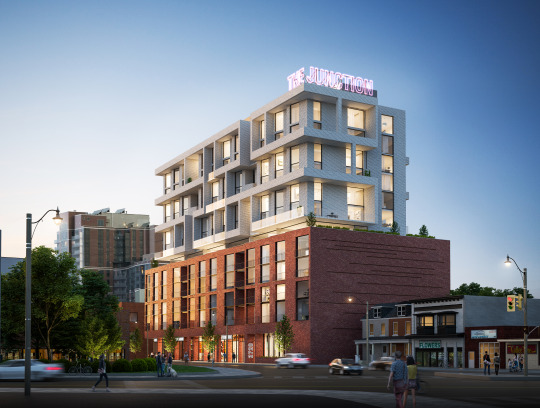
    Earlier this week I posted this teaser photo on social (full photo above) and said to stay tuned for a big announcement. Well, that announcement is here and you can read all about it over on the Globizen blog. Please let me know what you think in the comment section below.