Daily insights for city builders, delivered every morning at 6 AM ET. I’m Brandon Donnelly — a Toronto-based real estate developer and founder of Globizen. I’ve been writing here since 2013.

Tag: toronto

  • Toward smaller condominium apartments

    Statistics Canada recently published some data (from 2022) looking at investors in the condominium apartment market. Here is what they believe to be the share of condominium apartments used as investment properties in Ontario’s 10 largest census metropolitan areas:

    It’s worth noting that this is after excluding condominium buildings where every single suite is owned by a single investor. This is/was most prevalent in London, and it’s the result of there being property tax benefits to registering a condominium (individual unit assessments), even though for all intents and purposes it’s a rental building (building in its entirety assessed).

    The article goes on to rightly suggest that the prevalence of investors, and the way that condominiums are financed, could be leading to the construction of more buildings with smaller suites. Here’s the proportion of new condominium apartments under 600 square feet by period of construction:

    The unsurprising takeaway is that condominium suites have gotten smaller. In the 1990s, the average condominium apartment built in the Toronto CMA was 947 square feet. This is compared to 640 square feet after 2016. And the same thing happened in Vancouver, which went from an average of 912 square feet to 790 square feet.

    Investor preferences certainly have something to do with this. But what the article doesn’t specifically mention is that this phenomenon is also a direct response to rising build costs: making suites smaller was how the market tried to maintain some level of affordability. Put differently, imagine how expensive new condominiums would be if the average size was still 947 square feet.

    But there are obviously limits to this. I was with one of our architects the other week and he made an interesting comment to me. He said, “Brandon, before when build costs used to go up and things got less affordable for consumers, we could just make the suites smaller to offset the impacts. But I don’t see how we can go any smaller now. We’ve reached the limit.”

    This is one of the reasons why I think this downturn is going to ultimately be a good thing for Canada’s housing markets. It’s a reset. It’s forcing everyone out of complacency and, hopefully, it means that when the next cycle begins we’ll be starting from a better foundation.

  • Pedestrian plaza or parking lot?

    It is maybe comforting to know that even Europe wrestles with the decision of whether a grand urban space should be used for pedestrians, or turned into a parking lot. Take, for example, the Grand-Place in Brussels (pictured above).

    Today, it is a UNESCO World Heritage Site and one of the most important tourist destinations in the city. Perhaps its most famous. But during the 1960s, in what Wikipedia calls a “low period of appreciation,” it was a parking lot.

    This lasted until 1972, when a bunch of people from the community got together and lobbied for it to, you know, not be a parking lot. Not surprisingly, local shop owners were worried, at the time, that this would hurt their businesses. This is often the concern.

    Here in Toronto, where we continue to debate the pedestrianization of Kensington Market, we have surveys showing that 94% of visitors to the area support pedestrian-only zones, but that this number drops to 55% when you narrow to people who live/work/own stuff in the area.

    But if your goal is to sell more things to people, then there’s something to be said about listening to what your visitors want. In the case of Grand-Place, pedestrianizing the square made it far more popular as a tourist destination. And I think the same would be true of Kensington Market.

    For some photos of iconic public spaces in Europe being used as parking lots, check out this Politico article.

    Image: Wikipedia Creative Commons

  • Balkonkraftwerk

    Germany has, over the last 2 years, really gotten into balcony solar panels:

    The ease of installation and a potent mix of government policies to encourage adoption has made the wee arrays hugely popular. More than 550,000 of them dot cities and towns nationwide, half of which were installed in 2023. During the first half of this year, Germany added 200 megawatts of balcony solar. Regulations limit each system to just 800 watts, enough to power a small fridge or charge a laptop, but the cumulative effect is nudging the country toward its clean energy goals while giving apartment dwellers, who make up more than half of the population, an easy way to save money and address the climate crisis.

    Of course, there’s only so much that panels like these can produce. By some estimates, a “large well-positioned balcony” might only produce 15% of a home’s electricity needs. But hey, that’s still something, and it seems like something that Toronto should be looking at.

    We also have balconies.

  • Toronto’s highway 407 is doing what it is supposed to do

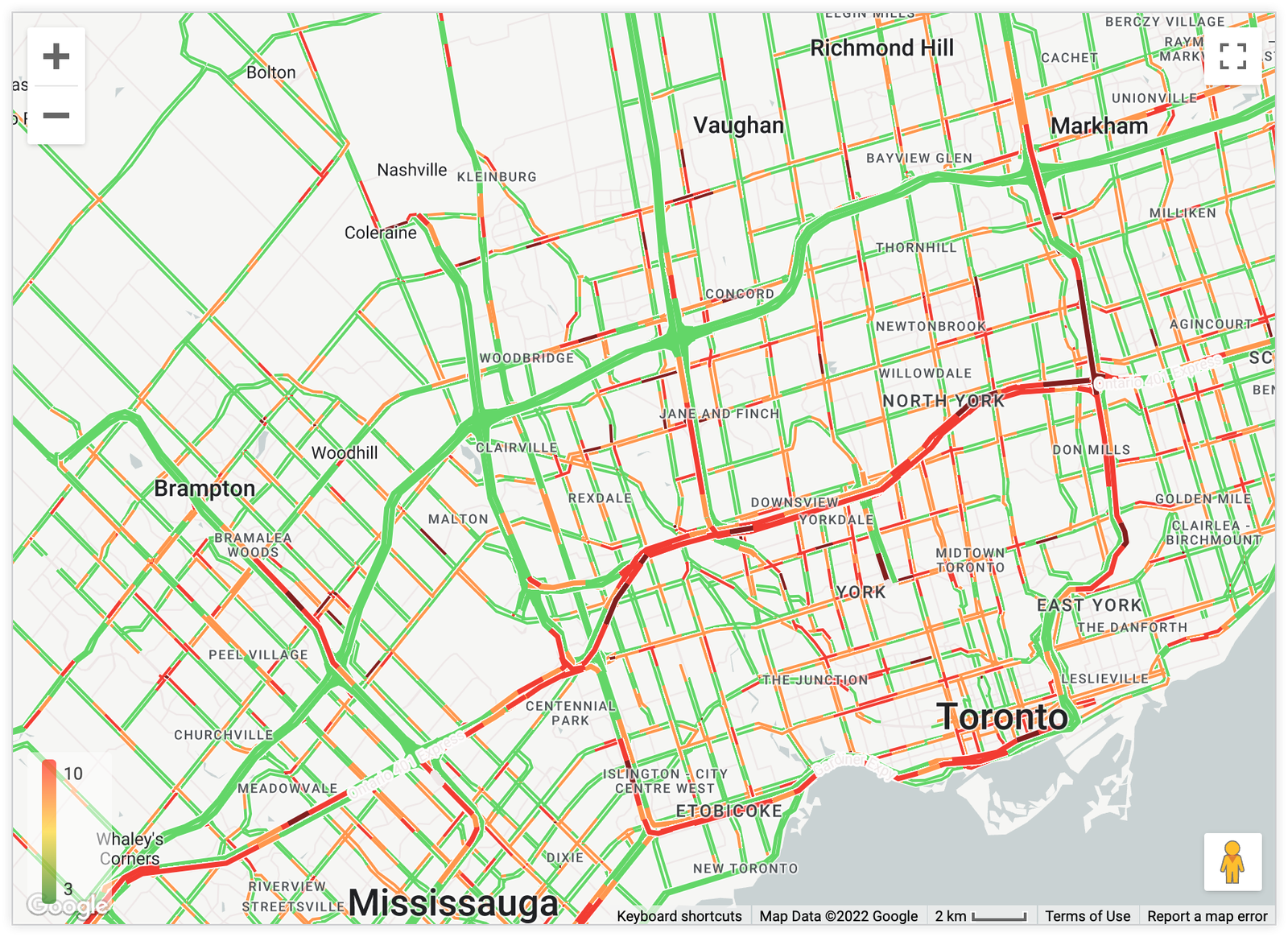
    In Google’s guide to its maps, there is a section on live traffic congestion, and in it, this image is used:

    It is a map of the Toronto region, and not surprisingly, it is showing traffic congestion on the 401 highway. But what’s interesting about this image is that there’s no traffic at all on the 407 express toll route. (This is the green highway running generally parallel and north of the 401, for those of you who aren’t familiar with Toronto.)

    This is, of course, accurate. A 2019 study by the Canadian Centre for Economic Analysis called the Economic Impacts of Highway 407 found that, at the time, an average of 413,000 drivers were using the 407 highway each weekday. And of these trips, more than 85% of vehicles were travelling at or above 100 km/h. This translates into a traffic congestion index of almost zero.

    During this same time, the highway 401 through Toronto showed that about 85% of vehicles were travelling below 50 km/h. Meaning, lots of congestion. This also had a significant impact on collision and fatality rates. On the 407, both were about half of what they were on the 401. (I couldn’t find any more decent data, but if you have it, please share it in the comments.)

    The reason for these differences is simple: the 407 charges for congestion. Here are the current per kilometer weekday rates for light vehicles travelling westbound:

    Naturally, there are people who think the 407 is too expensive and that it shouldn’t have been privatized. But the reality is that it works; really well in fact. And this is the only method that has been proven to reliably combat congestion. We can go ahead and spend a gazillion dollars building a new tunnel under the 401, and double the number of lanes (it’s already 18 lanes at its widest point), but we already know that it won’t solve our congestion problem.

    Either we price roads and congestion, or we don’t. But if we don’t, then we need to be brutally honest with ourselves about the economic trade off that we are making: free/underpriced roads = traffic congestion, and accurately priced roads and congestion = less traffic. The choice is ours. But know, there’s no such thing as a free lunch.

  • The Bentway Islands

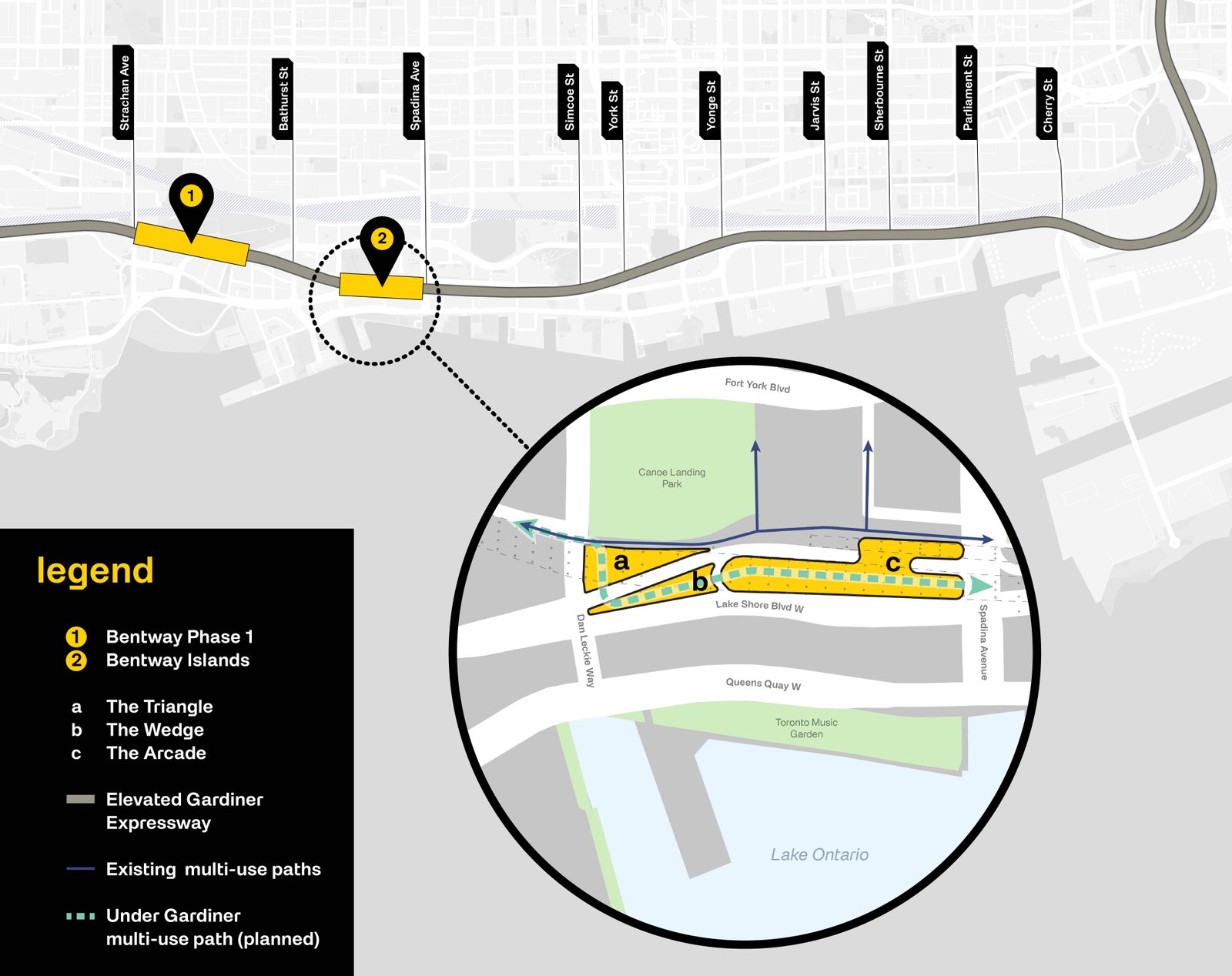
    As many of you know, Toronto has a highly successful public space underneath the Gardiner Expressway called The Bentway. I have ice skated in this space during the winter and I have listened to hard techno in this space during the summer. It has become a public space anchor in the city. Ilana Altman and the team are doing great work. And this week, they just announced that Field Operations (New York) and Brook McIlroy (Toronto) have been hired to design a major expansion. Called The Bentway Islands, this next phase consists of three “islands,” totalling 11,500 m2 (~125,000 ft2).

    Here’s a map:

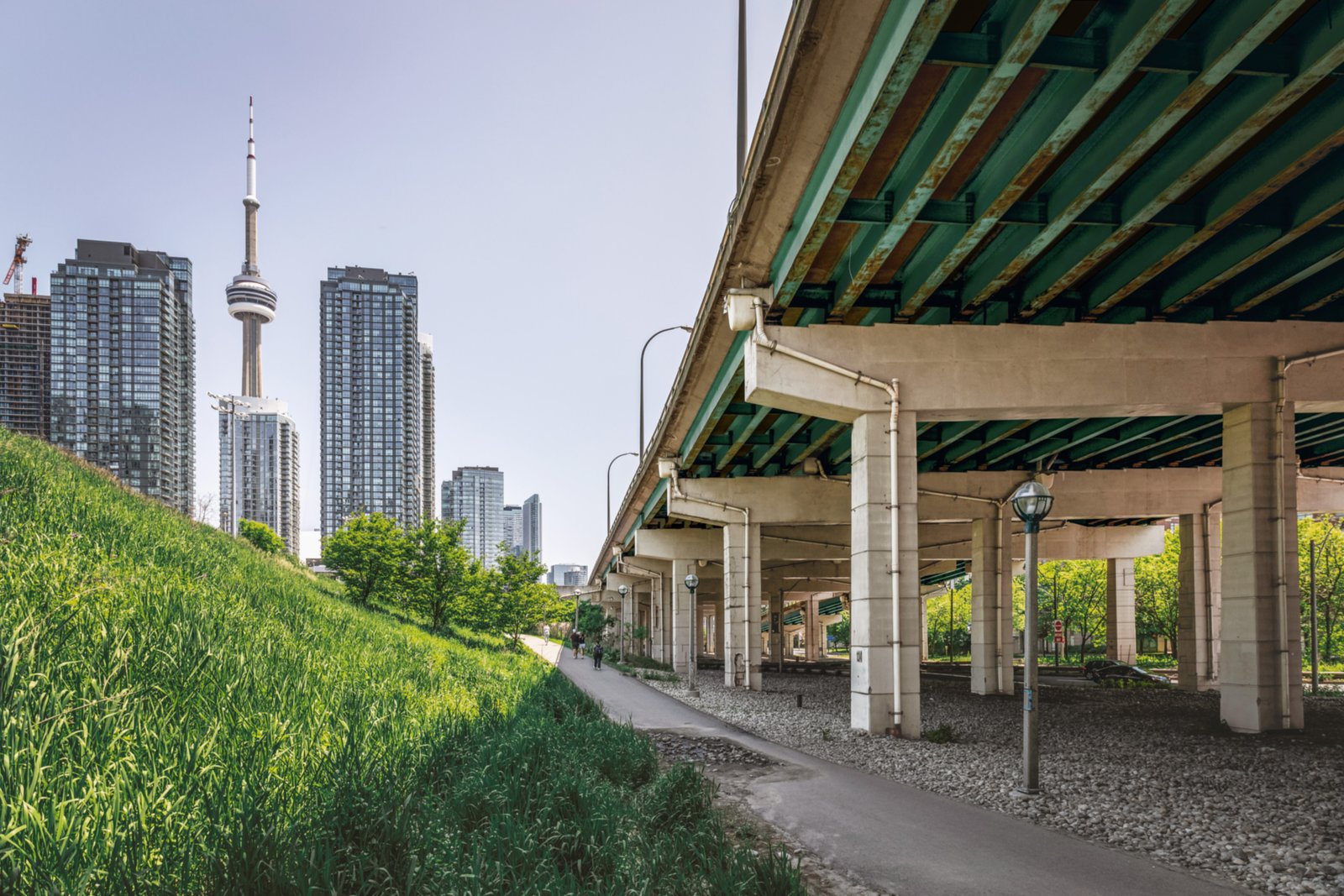
    And here’s what the spaces look like today:

    Both of these firms do fantastic work, and so I’m excited to see what they come up with. (Field Operations is the firm behind New York’s High Line.) But if I can offer two unsolicited (yet related) suggestions, they would be: 1) Let’s incorporate more commercial uses and 2) let’s aim for these three parcels to not actually feel like urban islands. Generally speaking, the spaces underneath highways aren’t the most desirable. They also tend to be surrounded by inhospitable urban environments. Stitching them in and creating continuity in the fabric of the city (existing example, here) is the best way to make the highway above more or less disappear.

  • Mapping 15-minute cities

    This is an interesting map to play around with. It allows you to see how many 15-minute neighborhoods and cities there are around the world. And it works by calculating the average time it takes to walk or bike to the closest 20 points of interest in 10,000 cities. These points include all of the usual suspects like places of work, schools, healthcare institutions, grocery stores, and so on. A blue cell indicates an average walk time < 15 minutes, and a red cell indicates an average walk time > 15 minutes. The darker the color, the shorter or longer the average time in minutes.

    By this measure, it’s hard to beat many/most European cities. Here are Paris and Barcelona:

    The city propers are completely blue, and you have to go pretty far out (or up into mountains) to find areas that don’t have 15-minute conveniences.

    Toronto has a strong core and isn’t terrible overall, but expectedly, we aren’t as uniform and as deep blue as Paris and Barcelona:

    Where things get really interesting, though, is when you look at cities like Dallas and Houston:

    It’s clear where these cities stand on walkability.

  • Rent control and road pricing — economics is the study of choice

    Yesterday’s post tried to pit politics against the realities of how we know cities and economics work. So today, I thought I would share a set of memos from Howard Marks (of Oaktree Capital) titled Economic Reality, Political Reality (which he refers to as an oxymoron), and Shall We Repeal the Laws of Economics?

    In this last one, he specifically talks about things like price gouging (starting with the grocery industry) and apartment rent controls. Each is worth a full read when you have the time, but here I’ll leave you all with a few city building-related thoughts.

    Marks describes economics as the study of choice. And within these choices, there are many complicated moving pieces and second-order consequences. Take, for example, rent control in New York City. What rent control does is stop the free market from being able to freely set rents. The result:

    A person in favor of this arrangement would argue that it maintains affordability and diversity. What it means in purely economic terms is that some people who couldn’t afford to live in New York City if rents were set by free-market forces are able to live there if they’re lucky enough to secure an apartment with regulated rent. But other people who would like to live in New York City and can afford higher rents can’t do so because there are no apartments for them. And lastly, landlords that have apartments that are somehow unregulated can command higher rents than would be the case if additions to the supply of apartments weren’t being discouraged. It’s a matter of personal philosophy whether this is good or bad. But clearly, the laws of economics and the actions of free markets aren’t at work in New York City. Someone in government is making the decisions.

    Much like inclusionary zoning in the case of new housing, the tradeoffs with regulated rents are that you get (1) less overall housing supply and (2) more expensive prices for the people that can pay market rents.

    You could argue, as Marks suggests, that these are acceptable outcomes; but regardless of your opinion, there are real consequences to this policy decision. There’s no such thing as a “free lunch” in economics, and consequently there’s no such thing as no-cost affordable housing. The question is: Who pays?

    Going back to the topic of traffic congestion from yesterday’s post, Toronto’s general reluctance to implement any form of road or congestion pricing is also an economic choice. We have priced our roads so cheaply that demand is always going to outstrip supply. And this is expected. What we are experiencing today is a natural market outcome.

    Targeting bike lanes as part of the problem is meant to counter this by increasing road supply. Less bike lanes means more space for cars, right? But the second-order consequence of this choice is that you push people off their bikes (which take up less road space) and into cars (which take up more road space). So demand is also likely to increase.

    The stark reality of solving traffic congestion is that it will require greater change. It will mean fewer people driving, more people taking transit and biking, and the people who do continue to drive will have to pay more for it.

    Of course, this is not what any politician wants to talk about. As Marks says: “In the world of politics, there can be limitless benefits and something for everyone. But in economics, there are only tradeoffs.” The tradeoff we have decided to make is cheap roads in exchange for crippling traffic congestion.

  • Toronto’s congestion crisis needs solutions, not politics

    People in Toronto are deeply and rightly frustrated about our traffic. We have truly world-class congestion. But here’s the thing, the way we’re going about solving this problem is all wrong.

    Transportation staff seem to believe that congestion charges would not reduce or deter traffic from coming into Toronto. Never mind all the global precedents, never mind that we have the tolled 407 highway to look to, and never mind that economics tells us that when the price of something increases, the quantity demanded decreases.

    Instead, we seem to think that we can solve this problem with fewer bike lanes, improved traffic management, and better policing, including higher fines for disobedience. (Interestingly enough, higher fines are supposed to deter people, but congestion charges won’t do the same. I’m confused.)

    None of this will fix the mess we’re in.

    This is a case of politics over data and experience. Identify something that people are pissed off about, and then create the illusion that you’re doing something to fix it. Good politics. But the reality is that this problem is much trickier to solve. It will require vision and meaningful change. That’s a much tougher sell.

    Think of this way. Can you identity a large car-oriented global city with millions of people that doesn’t have a traffic congestion problem? Even the Katy Freeway in Houston, which counts as many as 26 total lanes, has a congestion problem. And the last time I checked, it didn’t have any bike lanes.

    https://twitter.com/joshuahind/status/1837347617304424620

    Now let’s look at the largest city region in the world — Tokyo. The city proper has about 14 million people and the broader region has about 41 million. This is the entire population of Canada in one city region, and yet it’s generally viewed as being one of the most well-run and efficient cities in the world. How do they do it?

    Here are the modal splits within Tokyo’s 23 wards (2018 data):

    • 36% public transport (rail and bus)
    • 27% passenger cars
    • 23% walking
    • 14% bicycles and motorcycles

    Now compare this to the splits in Toronto’s census metropolitan area (2021 census data):

    • 76% passenger cars
    • 16% public transport
    • 5% walking
    • 1% bicycles
    • 2% other

    Of course, if we were to look at the modal splits within the core of the city they would look quite different and much closer to Tokyo’s numbers. This is why it can be so hard to achieve consensus on many city building issues — we are quite literally a divided and different kind of city.

    In the end, this is the root cause of our traffic problem. The vast majority of people in this city region drive. And they are not to be blamed. It’s because we’ve designed this to be the only practical option.

    But if we’re serious about solving congestion, it’s going to require some bold changes. It’s going to require reducing this 76% figure. We can fool ourselves into thinking that better construction coordination, fewer bike lanes, and higher fines will somehow solve this enormous and deep-rooted problem, but the inconvenient truth is that they won’t.

    What we need are real solutions. Is anyone going to take the lead?

  • An Ethereum story

    We’ve spoken about Vitalik Buterin before.

    He is the inventor of the Ethereum blockchain, and its most prominent figure. He also happens to have grown up in Toronto. He went to the University of Waterloo. So when I wrote this post back in 2021, I asked: Why the hell is nobody talking about this? Why are we not celebrating the fact that our great city helped birth one of the most important technologies of our time? You couldn’t ask for a better economic development story. Well, I guess the answer is twofold. Crypto isn’t mainstream. Even back in 2021 when things were frothy it wasn’t. And, we’re awful at promoting and driving a global brand for our city. Both of these things need to change. So if you’re interested in learning more about Vitalik and Ethereum, you should check out this new movie (trailer) called Vitalik: An Ethereum Story. To watch it, go to ethereumfilm.xyz and mint the NFT for $20. You’ll then be able to stream it. I haven’t done this yet, but I’ll be doing it very soon. All of the proceeds from the NFT sales will go toward getting a more mainstream distribution deal.

    So by watching, you’re helping.

    Update: I watched it. It’s great.

  • I finally tried Apple Vision Pro

    I know I’m late to the party on this, but I finally tried Apple Vision Pro this weekend. I was in the Apple Store at the Toronto Eaton Center getting the battery replaced in my phone, so I decided to do a demo. And let me tell you — I was totally blown away. I messaged everyone I knew (after I got my phone back) and told them that they need to try it.

    To be clear, though, very few people right now want to actually buy this computing device. Initially, Apple was thinking that it would sell upwards of 800,000 units this year. But now it expects to sell somewhere closer to 400,000. Maybe. The device is too expensive, too bulky, and the use cases just aren’t there for someone to feel they need to buy it.

    I also found that, when I was looking at the world around me, I could tell I was looking at a video. It wasn’t exactly perfect. (Vision Pro creates a mixed-reality experience by recording the world around you and then playing it back to you.) But that’s okay. The hardware will get better. The price will come down. And the developer community will build a bunch of killer apps that nobody has even thought of yet.

    None of this changes the fact that the device is still an astonishing technical achievement. The eye tracking works perfectly. All of my hand gestures were flawlessly picked up. And the overall experience was entirely immersive — from 3D videos (recorded on regular iPhones) to a butterfly landing on my hand and a velociraptor flaring its nostrils right in front of me.

    What was most impactful to me is that I could easily imagine a future where all of this works. Is this a more exciting way to watch sports? Yes. I sat courtside and Lebron dunked in my face. Is this a better way to watch movies on a plane? By far. Will this be used to help build buildings and coordinate design & engineering disciplines? Yes, absolutely, among many other things.

    It is also easy to imagine how spatial computing is likely to dovetail with other innovations such as AI and blockchains. Mixed-reality or extended reality blurs the line between physical and digital. And in my mind, AI becomes the way in which we will want to interact with this new computing world. (It’s not easy to type on a virtual keyboard.)

    At the same time, digital artifacts will come to be viewed much differently when they’re all blended in. An NFT sitting in a cold wallet is going to feel a lot different than an NFT hanging in a fully immersive 3D gallery that is viewed by millions of people. This strengthens the case for blockchains, and the ownership of digital objects, products, and services.

    Maybe this is really far into the future. I don’t know. But regardless, if you haven’t already, I would encourage you to book a demo at your local Apple Store. However cool and great you think it will be, it will be better. I’m not suggesting you should buy one, but I am suggesting that you need to try it out and see a glimpse into the future.

    And if any of you are working on Apple Vision Pro software that is somehow connected to the design and construction industry, I would love to hear from you and learn more about what you’re up to. I have complete conviction that this will form the future of our industry. The best place to reach out is here.