Daily insights for city builders, delivered every morning at 6 AM ET. I’m Brandon Donnelly — a Toronto-based real estate developer and founder of Globizen. I’ve been writing here since 2013.
Growing up, I had one of the best English teachers around. He was the kind of English teacher who would dim the lights, light incense and play Bob Marley in the midst of class. He had also previously taught in Jamaica, which might help to explain this behaviour.
I had him as a teacher in both elementary school and in high school. All in all, he probably taught me 3 or 4 years of English–excluding the fact that he was also the coach of my high school basketball team (which I was on).
But more than just being a cool guy, he drilled a number of important takeaways and life lessons into his students. Still to do this day I remember and try and follow them. And I know that many of my classmates do the same. So today, I’d like to share 3 of them with you.
1. Don’t say umm
We all say “umm” from time to time to fill in our sentences when we can’t think fast enough or we don’t know what to say, but it sounds awful. It also makes you sound indecisive and less clear about the message you’re trying to get across.
If we ever said “umm” in class he would make us repeat our sentence again and again until we said it without saying “umm.” He would literally stand there saying: “Start again. Start again. Start again.”
Similarly, he wouldn’t allow us to say “like”, unless we were using it to truly express that something had the same qualities as something else. But if you just said like for no reason, he would say: “Is it like that or is it that?” Again, it’s about being clear and precise in your language.
2. Don’t use very
By using adverbs such as very and extremely, you’re taking the easy way out. There’s always a better word or way to convey your message. Don’t say you’re very tired; say you’ve reached a point of debilitating exhaustion. Better yet, make up your own word (he never said that). Very is boring, lazy and uninventive.
3. Just do it
When we used to ask him how long he wanted our essays to be, he would always reply with the same thing: “As long as a piece of string.” And when we initially asked him how long a piece of string was, he would then say: “Just do it.” That was his message over and over again to us: when in doubt, just do it. We eventually stopped asking.
At the time, I never really understood how profound this simple message was. Initially I thought he just wanted us to get on with things but, in fact, he was saying so much more. He was telling us to stop relying on others for direction. Stop following orders, and take initiative. Just do it. Poke the box, dammit.
I’ve had this post sitting in my draft folder for a few months now. I don’t often deviate from city related topics, but I wanted to put this one out there. So if you’re reading this Mr. Mott-Trille, umm, like, thanks so very much! 🙂
With the cold winter that we’ve had in Toronto this year I’m going to be honest and say that I’ve, on occasion, wondered why I haven’t moved somewhere warmer. There aren’t any great mountains nearby, so it’s not like I’m putting up with this cold in order to feed my love of snowboarding.
Then yesterday, I was reading The Urbanophile blog and I was reminded of a fascinating finding from Edward Glaeser’s book, Triumph of the City: climate matters when it comes to cities and prosperity.
The single variable that best predicts a U.S. city’s growth over the past century is its average January temperature. Hence the decline of many northern and midwestern cities and the boom in the South and the Sun Belt, where the Phoenix, Atlanta, Houston, and Dallas metropolitan areas have each gained a million people since 2000. For every five degrees that a city’s January temperatures top the national average, Glaeser writes, its real-estate prices will beat the national mean by 3 percent, thanks to the increased demand.
But not all cold places are bleeding people. New York isn’t. And neither is Toronto. The Toronto area accepts roughly 100,000 new people every year. We have more cranes up in the air than any other city in North America. But it’s cold as all hell here. So what gives?
As the New York Magazine article (cited above) points out, New York essentially offers enough benefits to offset its cold winters. There are enough amenities and economic opportunities to make people put up with the bad. And we’re not just talking about weather.
The big shift is going from a site-by-site approach to a neighborhood approach. Today, each and every development site is reviewed, approved and fought over. With the DPS, the idea is to establish a neighborhood scaled by-law and then streamline the review process for each individual site (the city will get 45 days to respond to applications as opposed to the 180 days it gets today).
What this should do is shift the big fights–among developers, communities and the city–to the front end (when the neighborhood by-law is being established) and minimize the fights over each site. It takes away an element of incremental urbanism–because you’re in some ways building out a master vision (large batch versus small batch)–but it would do a lot for transparency, efficiency and for creating cohesive urban form. And, it sounds like the DPS by-laws will have some flexibility, so that could address my batch size concern.
Right now the city is hosting open houses and is expected to issue a report on their public consultations sometime next month. It’ll then go to City Council in July. I think a lot will come down to how the DPS neighborhood by-laws are formed, but I think that anything that improves transparency and efficiency is likely a good thing for our cities.
Here’s my latest post from the TAS blog. You can find it cross-posted here. I hope you enjoy it.
Over the past 5 years, I’ve become borderline obsessed with laneway housing in Toronto. In fact, sometimes I ride my bike around the city just trying to find interesting laneways and alleys, and undiscovered homes. For most people, this is a portion, or scale, of the city that’s almost completely hidden. It doesn’t even really exist. But that’s precisely what makes laneways so interesting to me.
Today, Toronto’s laneways basically function as service roads. All 2,400 of them. They provide access to people’s rear garages in the typically older parts of the city. And so by design, they’re supposed to be nondescript and utilitarian streets. They were never intended to really have a sense of place or any redeeming urban qualities. Most don’t even have a name. They’re what architects and real estate people refer to as the “back-of-house.”
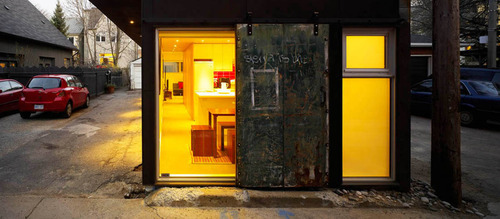
But similar to how lofts were once never considered desirable places to live, I think the same is going to to happen to laneway housing. That’s my bold assertion: compact and well designed laneway homes are going to be the new loft. From a regulatory standpoint, they’re almost impossible to build today in Toronto, but there are pioneers out there who have managed to do it. They’ve replaced rear garages with a new housing typology.
Other cities, such as Vancouver, have developed policy that allows laneway homes in certain instances. But that’s not the case in Toronto. They’re one-off exceptions. It usually helps to have an existing laneway structure (which was the case with Superkul’s project), but sometimes the city will allow them to be part of a larger redevelopment, which is what’s happening with our DUKE project in the Junction. At DUKE, we have 5 south facing live/work laneway homes at the south end of the building.
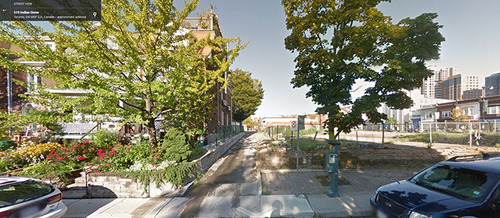
Here’s what the site looks like today from Indian Grove to the east:
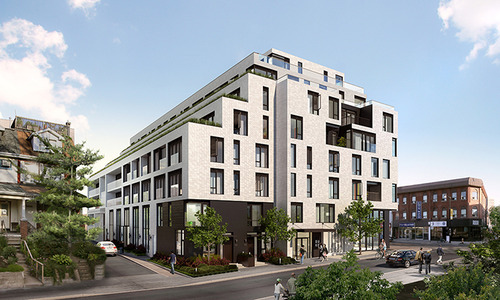
And here’s an artist’s rendering of what it’s going to look like when the project is complete. There are 5 live/work laneway homes (all 2 storeys) facing south and 2 townhomes facing east (Indian Grove):
I think these homes are going to be really great.
So why do I like laneway homes so much and why do I think they’re going to be the new loft? Here are 3 reasons.
1. The hip factor
For the same reason people love lofts, laneway homes are unique and a bit eccentric. Let’s face it, nobody wants cookie cutter these days. People want something with character. And having a beautiful home off an intimate urban laneway is cool.
If you’ve ever watched Swingers (it’s one of my favorite movies), you might remember the scene where Mikey is taking his friend from New York to a hot new speakeasy in Los Angeles. To get there, they’re forced to go down an alley and Mikey’s friend asks: “Where is this place?” Mikey then responds by saying:
For some reason the cool bars in Hollywood have to be hard to find and have no sign.
It’s kind of like a speakeasy kind of thing. It’s kinda cool.
It’s like you’re in on some kind of secret, you know?
The people who live in laneway houses today are usually architects, designers and other creative professionals. Typically, these are the kinds of people that pioneer new neighborhoods and new housing types (again, think about how lofts started becoming cool). So I have complete faith that these groups are on to something here too.
2. An intimate scale
The second one is about scale.
The way I see it, Toronto really functions at 3 main scales. You have the main streets like Yonge, Bloor, and Dufferin; you have your typical residential streets; and then you have laneways (which today have been mostly forgotten). Most people don’t want to own a single family home on a main street because it’s noisy. It’s perfectly fine to live higher up, but they often don’t want to open up their front door and walk out onto a street like Bathurst. That should be for retail.
So homeowners typically look to quieter residential streets. These are perceived as having more value. But if you want something even quieter and with less vehicular traffic, why not check out the laneway hidden behind that residential street? I can imagine these laneways being a perfect place for kids to play on in the future.
To use an example from outside of Toronto, I used to have a good friend who lived in Paris. She lived on a quiet laneway that was directly connected to an incredibly busy arterial road that led into the Place de la Bastille. But separating her laneway from that main road were a set of giant barn doors that you had to walk through. And once you walked through those doors from the main street, it was as if you entered a different world. Other than the sound of kids playing soccer on that laneway, it was absolutely silent.
That laneway is obviously different than the ones we typically find in Toronto, but the principle is exactly the same.
3. A diversity of housing options
Finally, I think laneway housing could serve as a really great way to relieve some of the pressure we’re seeing today on low-rise housing using the existing fabric of our city. If you follow Toronto’s real estate market at all, you’ll know that from the Junction to Leslieville, bidding wars are pretty commonplace. And there’s a simple reason for that: demand is exceeding available supply.
There’s no silver bullet, but I think we could improve the situation by building more, and different, housing types. In the case of laneway houses, they could be a great alternative for families wanting to stay in the city. And in the case of DUKE, our live/work units are intended as a way for business owners to both live and hang their shingle in the Junction. We’re living at a time where 3 people with a laptop and an internet connection can build something that changes the world. That’s affecting the way people live, work and play, and we’re trying to a respond to that with the homes that we build.
But that’s just my view on laneway homes. What do you think? We’d love to hear your thoughts in the comment section below.
I gave a talk about condos this evening at the Ted Rogers School of Management. For regular readers of this blog, the material wouldn’t have been all that new. I talked about supply and demand in housing markets and 2 of the projects that TAS is working on. The best part though was the Q&A, which, I think, was longer than the actual talk.
One question that I particularly liked (maybe because I’ve blogged about it before) was the question of what all these Generation Y condo dwellers are going to do when they decide they want a family. We know that people are getting married later and that more people are living alone. So there are some demographic changes at work here. But people are still going to have kids and people are still going to need more space.
At that point, I think 2 other, interrelated, factors come into play: first, a lot of people still feel you need a house in order to raise kids; and, second, there’s a problem of affordability. Multi-family dwellings (built out of reinforced concrete) are inherently more expensive to build than wood-framed single family homes.
To deal with these factors, a lot of young couples in Toronto (at least from my own empirical research) seem to be looking to inner city neighborhoods like Leslieville, Roncesvalles, Trinity Bellwoods, High Park, the Junction and so on. They still want to be in the city, but they want a house, for their kids. Problem is, everybody is trying to do the same and it’s creating tremendous pressure on our low-rise housing stock.
So what’s going to happen in the longer term?
Well if low-rise housing keeps appreciating at the rate it has been, we could reach a point, I think, where all of a sudden condos become the more cost effective solution.
For example, let’s say a young family is looking for a 3 bedroom home. It’s not inconceivable that the 1,500 square foot, 3 bedroom condo could become the cheaper option. At $650 per square foot (I’m assuming a slightly higher number because I’m assuming this is at some point in the future), you’re looking at roughly a million dollars. No question this is a lot of money, but what if the alternative (a single family home) is $1.5 million?
I’m sure there will always be a segment of the market that rushes towards the suburbs and/or a house when they decide they want to have kids. But I think we’ll see more and more families decide–either because of cost or because of a lifestyle preference–that having children in a condo isn’t all that bad.
What do you think? Would you ever raise children in a condo?
On my walk to the subway this morning I was confronted by a transformed Market Street in Toronto’s St. Lawrence Market area. New York City had taken over.
There were NYC yellow cabs, NYPD cars, FDNY trucks and lots of film people milling about in Canada Goose jackets. Toronto, once again, stands in for New York.
But while I think it’s great that we’re (presumably) creating a bunch of local jobs, there’s also a part of me that hates to see this. I hate it because I want the Toronto brand to be strong enough so that movies actually take place here, instead of just being filmed here.
I mean, who wants to be the stand-in? It’s much better to be the actor.
Yesterday I came across an article in the New York Times called “Toronto’s Ethnic Buffet.” It basically talks about how amazing and how diverse our city is, and so I wanted to share it with the Architect This City community this morning.
It’s easy to take your own city for granted sometimes. You know about all the problems and all the things that you’d like to see happen. And so it can be easy to fixate on them. I just took a look back at my recent blog posts and I’ve certainly been doing my fair share of that.
So today I’d—instead—like to say: Thanks for being awesome Toronto. You are one hell of a city.
I’ve written a lot lately about the Gardiner Expressway East. First to argue that I think it should be torn down and, second, to provide a counter argument as to why some people think North America’s urban freeways are here to stay. I wanted to avoid confirmation bias.
Well a recommendation has been made to City Council and it is, indeed, to remove the eastern portion of the Gardiner Expressway. They are now asking Council to approve it. The item will first go to the Public Works and Infrastructure Committee on March 4, 2014 and, subject to the results of that meeting, will then go to City Council on April 1, 2014.
The recommendation to Council identified the following 4 key features of the preferred “remove” option:
Widening of Lake Shore Boulevard east of Jarvis Street by two lanes into an eight-lane landscaped at-grade boulevard;
The lowest overall public investment at $240 million net present value (NPV) because of significantly lower lifecycle costs despite a higher upfront capital cost than Maintain;
Public land disposition proceeds of approximately $80 to 90 million NPV from the release of about 4 hectares of land (which could support 260,000 square metres of development)
Highest compatibility with Official Plan and Central Waterfront Secondary Plan principles and objectives as well as approved plans, such as the Don Mouth Naturalization and Flood Protection EA, Lower Don Lands Framework Plan, Keating Channel Precinct Plan and the Port Lands Acceleration Initiative.
If you’d like to read more about what’s going to Public Works and City Council, click here.
One thing I didn’t mention in my previous posts is the land disposition piece (item #3 above). By removing the Gardiner East, roughly 10 acres of public land will be freed up which, according to their estimates, could allow for 2.8 million square feet of new development. That’s roughly the size of our 72-storey First Canadian Place.
I’ve been crystal clear about my position on the Gardiner East and so I’m delighted to see it seemingly move forward in that direction. I know a lot of people are concerned that the removal option could result in some commute times being 5 to 10 minutes longer by 2031, but I think we’ll have even bigger problems by 2031 if we continue with the status quo.
Urban theorist Richard Florida has argued many times before that when cities get to around 5-6 million people they come to a point where they have to make tough decisions about the way they’re going to continue to grow and prosper. Toronto is at that moment. Our car dependent ways are already crippling productivity levels.
What kind of city do we want to be by 2031? I don’t think that we can afford to just “maintain.”
Yesterday I was at brunch for a good friend’s birthday and a few of us started talking about politics and the future of Toronto. We immediately became depressed by the fact that Rob Ford, could actually, get in again. For those of you outside of Toronto, I know this sounds like pure lunacy.
We then speculated as to whether John Tory would ultimately run again. Though it would split the conservative vote (between Ford and Karen Stinz), I was hoping he would. Then, just like magic, Tory announced his candidacy. Here’s the video:
While some would call it an oxymoron, John Tory is often painted as a “Red Tory”. He’s fiscally conservative, but then holds socially liberal views on issues such as same-sex marriages.
But perhaps more importantly for the Architect This City audience, Tory is also a city builder. He’s Chair of the Greater Toronto CivicAction Alliance, which is non-profit group focused on transportation and economic development in the region. And this comes through in his clear support of the Yonge relief subway line (see above video).
So even though this risks splitting the conservative vote, I will be supporting John Tory’s candidacy during this year’s mayoral election in Toronto.
Last week I argued that the eastern portion of the Gardiner Expressway (Jarvis Street over to the Don Valley Expressway) should be torn down and replaced by an enlarged Lake Shore Boulevard.
To quickly summarize, here’s why I support removing the Gardiner East:
Now is the time to do it (before we develop the surrounding area and it becomes both more expensive and more difficult to do it).
It would go a long way to stitching our disconnected downtown back to the lake and realizing our ambitions for the revitalization of the waterfront.
Unlocking the full potential of our waterfront is hugely important.
In my opinion, the only way to build a big, well functioning city, is on the backbone of public transportation. And this—the tearing down of the Gardiner East—could represent that paradigm shift.
It is a portion of the Expressway that has relatively low traffic volumes.
It’s the cheapest option on the table.
Somewhat surprisingly though, a lot of people disagreed with me. They told me that adding anything to our already long commutes would be simply unconscionable and that they would not support it, no matter how much it improved our waterfront.
So in the spirit of avoiding confirmation bias (that is, only seeking out things that reinforce an already established belief), I thought I would share the following article: “Like It or Not, Most Urban Freeways Are Here to Stay.” It’s from Atlantic Cities and there are 3 key take-aways that I’d like to point out.
First, I thought it was interesting that the interstate system in the United States was, from the onset, always conceived of as a solution to urban congestion. I always thought it was about connecting the country, but that, apparently, was a secondary goal.
Second, cities all across North America are engaging in the same debate about what to do with their aging highways. Detroit is debating. New Orleans is debating. And so is Syracuse. Toronto is not alone. But we could be alone in taking the lead on this issue.
Third, the author basically acknowledges that, while not ideal, we’re stuck for the time being with all these freeways and that the better solution is going to be a really tough slog:
“This is not an easy assignment, seeing as how cars are purchases we make with our hearts, more than our heads. Logic won’t convince Americans to change their ways. What will? Maybe, over time, prohibitive fuel prices and withering tolls, and, most importantly, investment in useful and convenient public transit. Only when the carrot is irresistible, and the stick stings too sharply to bear, will the shift begin, and it will take years to play out.”
And while I would agree that it’s not going to be easy, that’s par for the course with anything truly worthwhile. If it were easy, everyone would be doing it. But they’re not. And that’s why there are leaders and there are followers.
People in Toronto like to talk about how our City sometimes lacks vision. Well, here’s our chance. I’m not worrying about what the commute is going to be like tomorrow, because I know there’s an even better solution for that problem. I’m worried about something even bigger. I’m worried about the kind of city we’re all going to leave behind to our children.