Daily insights for city builders, delivered every morning at 6 AM ET. I’m Brandon Donnelly — a Toronto-based real estate developer and founder of Globizen. I’ve been writing here since 2013.

Tag: toronto

  • The tale of 2 Chicagos

    Over the long weekend I wrote a post called “On medium density development.” My argument was that Toronto has gotten exceptional at building infill towers, but not so great at midrise and other medium density infill solutions. Though to be fair, we are starting to see more and more of that today.

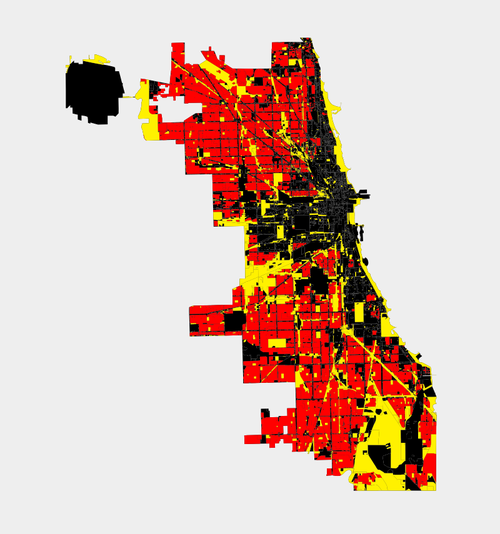
    Well it turns out that Chicago is in a similar, if not worse, position. According to Aaron Renn of the Urbanophile blog, most of the city (outside of the city center) only allows for single family homes. Though in some cases you may be allowed a duplex or triplex.

    Here’s a map:

    image

    The red is where you’re only allowed to build single family homes. The yellow represents non-residential uses (parks, industry and so on). And the remaining black is where you’d see high density development. Note how it runs all along Lake Michigan. Both Toronto and Chicago are developing in a similar “T” formation.

    Now, some of you may be saying to yourself: So what? But it’s important to remember that this type of zoning effectively creates a supply constraint in the market, which, as I’ve argued before, will drive up prices. Chicago may as well be surrounded by mountains, because that red area seems almost untouchable from a development standpoint.

    With so many people rushing back to cities today, a lot of them are struggling to create the same market environment that our parents enjoyed. You know the one where you finish school, get a job, and then you’re able to buy a house. But I think it’s because many of our cities are at a turning point, and yet are clinging to outdated principles of city building, such as single-use zoning.

    But I’m certainly no expert on Chicago, so if you are, please speak up in the comment section below.

  • Say hello to Kingston&Co

    image

    As of today, Family Day Monday, you’re going to start seeing information released regarding TAS’s (in partnership with Main & Main) newest community called Kingston&Co. It’s located on Kingston Road, just east of Victoria Park Avenue, in a neat area called Kingston Road Village. You can already register at kingstonandco.ca. And as part of the registration process, we’re also soliciting feedback as to the types of retail the community would like to see added to the area. Note: There’s already a Starbucks 🙂

    At the same time, we’ve also launched a redesign of our corporate site (tasdesignbuild.com). The biggest change is that we’ve taken the blog—which was hidden under a “Neighbourhoods” tab—and made it front and center on the homepage. We see this as a pretty significant change. One that shows that we would like you to join us in a conversation around city building. We now allow comments on all of our blog posts and you can see right on the homepage who the author of the post is.

    If you have any feedback on either Kingston&Co or the new homepage, we’d love to hear from you in the comment section below.

  • On medium density development

    Over the past decade, Toronto has seen a proliferation of condos across the city. And while I do think this intensification is a great thing, we’ve been much better at building towers than anything else. We’ve neglected medium density development and it has bifurcated our housing market: you’re either in the market for a condo or for a house.

    And since we’re not really building anymore of the latter, Toronto has become accustomed to bidding wars and multiple offers. Every young couple I know is in the market for an “hip fixer-upper in the city.” Problem is, that’ll cost you $700,000 or more and you may still need to gut it.

    At this point, it’s not realistic to expect that we’ll be building anymore single family homes in the city—at least not at any sort of significant scale. We’re tapped out. But what we can reasonably expect is more medium density development. I’m talking about midrise developments along our avenues, laneway houses in people’s backyards and other creative infill solutions that sit somewhere between a house and a highrise.

    If we’re concerned about creating equitable housing opportunities, then we’re going to need relieve some of the pressures on low rise housing. We’re going to need more diversity in our product offerings.

  • Is laneway housing a good idea or a bad idea?

    As a follow up to my recent post called “Disrupting everything”, I thought I would share this talk by venture capitalist Chris Dixon at Y Combinator’s Startup School. In it, he talks about why good ideas often seem like bad ideas at first.

    Chris frames the discussion by saying that when you have a good idea—that everyone else thinks is a bad idea—you effectively know a secret. But by a secret, it’s really that you believe something that nobody else believes to be true. So much so that when you try and tell everyone else about your secret, they all think you’re crazy, which is frustrating because it seems so obvious to you.

    He then provides a number of characteristics that can help you identity good ideas that seem like bad ideas:

    • Powerful people dismiss them as toys.
    • They unbundle the functions done by others.
    • Did it originate as a hobby?
    • Do they challenge social norms?

    Now, he’s obviously talking about startups, but I think the framework can apply outside of the technology world. I think it can apply to cities. 

    To give you one example, let’s consider laneway housing. If you’re a regular reader of this blog, you’ll know that I’m a big supporter of laneway housing in Toronto. But that it’s something the city generally does not support.

    However, there are laneway houses being built and they’re being built by architects and progressive urbanists. Some might even call it a hobby, because it remains a pretty tough business model at the moment.

    Personally, I think one of the main reasons the city is unwilling to formally allow laneway housing is because it challenges social norms. I’ve read the staff reports and the meeting minutes: people think it’s weird to live off a laneway. In fact, in one case somebody asserted that since laneways are generally undesirable urban spaces, anybody who would want to live off one is almost surely a social degenerate.

    But there’s absolutely nothing inherent to human beings that says we can’t live off a 5m wide street or that we can’t have a “house located behind another house.” Those are simply constructs we’ve created for ourselves.

    So the next time you hear about an idea that you think seems like a bad idea, ask yourself: Is it really a bad idea or does it just make me feel uncomfortable because it contravenes the norm? Taking yourself out of your comfort zone is a good thing. It’s how we grow.

  • Why the Gardiner East should be torn down

    Warning: This post turns into a bit of a rant near the end 🙂

    Since 2009 (well, much earlier actually), Toronto has been trying to figure out what to do with the eastern portion of the elevated Gardiner Expressway (the portion from Jarvis Street to the Don Valley Parkway). The process used to help make this decision is called an Environmental Assessment (or EA) and that’s what is currently underway. But it’s a painstakingly slow process.

    Recently though, a third public meeting was held in order to solicit feedback on the various design solutions and so there’s been a renewed interest in this city building issue. Since the beginning, my position has been that we should tear it down. And in this post I’m going to explain why I think that is exactly what the city should do. 

    But first, a bit of background.

    The EA started by identifying four “Alternative Solutions” to the problem of the Gardiner East. And they are: 

    1. Maintain the elevated expressway (Basically do nothing)
    2. Improve the urban fabric while maintaining the existing expressway
    3. Replace with a new above or below grade expressway
    4. Remove the elevated expressway and build a new boulevard

    They then went out and assigned these solutions to a bunch of architects and designers—whom are some of the world’s best—and asked them to come up with specific design proposals. These proposals are available online and that’s part of what the public has been commenting on.

    City Council seems to generally want the Gardiner down, but there are some naysayers. 

    Rob Ford doesn’t want it removed (option #1) because it’ll add to driver commute times (no surprise there) and Councillor Denzil Minnan-Wong is worried that tearing it down will just lead to another wall—a wall of waterfront condos.

    But I think these views are terribly shortsighted and I’ve made my position clear by submitting a formal response through the City’s public engagement portal. To explain my view here on Architect This City, I thought the best way would be to simply share my answers. So here they are.

    What do you like?

    [slideshare id=22945545&sc=no]

    I can honestly say that I love my city. I was born in this city. And I was raised in this city. This city has given me so much, which is why I feel so compelled to try and give back to it. It’s also the reason why I’m first to defend it when people talk about how great this or that city’s waterfront is and how much ours sucks. I mean, I know ours sucks. But we’re fixing it.

    We have a lot of great plans in the pipeline for our waterfront, but there’s a remaining obstacle: our elevated expressway. Boston buried theirs. And San Francisco transformed theirs into a magnificent public space. What are we going to do with ours? Now is the time to be bold and not settle for the status quo. That’s too easy. We need to remove the eastern portion of the Gardiner Expressway today and the design proposal by Field Operations offers a brilliant way to do it.

    Not only is removing the Gardiner the most cost effective solution ($470M, versus $870M to maintain, $865M to improve and $1.4 billion to replace), but it’s also the most desirable from a city building standpoint.

    The Gardiner is not the only barrier. We also have the rail lines. So while repurposing the Gardiner might be doable in isolation, we simply have too much friction standing between us and the lake. We need to remove the barriers that we can. It’s for this precise reason that Field Operations spent so much time worrying about the north-south connections. And I think their “architectural sleeves” are a really interesting way to solve this problem.

    At the same time, timing is an important consideration. As the surrounding East Bayfront area develops, it’s only going to become more costly to remove this stretch of the Gardiner. If we’re going to do this, now is the time.

    Finally, I think it’s important to note that Field Operations is the landscape architecture firm behind the wildly successful High Line in New York. So what we have is a firm that made a name for itself repurposing an old elevated rail line, telling us that our own elevated structure is worthless and uninspiring. Think about that for a minute. Should we really be spending more money to salvage the Gardiner East?

    What concerns do you have?

    That we’re getting hung up on commute times as one of the key decision making criteria. It’s a red herring. Let’s face it: irrespective of whether we tear down the eastern portion of the Gardiner or not, Toronto is fucked from a transportation and infrastructure standpoint. We’re sitting on decades of disinvestment and some of the longest commute times in North America.

    Field Operations put it well when they said that the tearing down of the Gardiner East needs to be thought of as a paradigm shift. We have a 25-year transportation plan waiting to be funded. Let’s go out and do that instead of trying to sacrifice our waterfront so that suburban commuters can save a few minutes. Let’s give them a shiny new train instead. They’ll like that.

    Either that or Torontonians need to stop talking about how great Chicago’s waterfront is, because we can do it too. Now is our chance.

    What advice do you have for the Project Team as the study moves into the next phase?

    Don’t listen to Rob Ford.

  • Mapping where people run

    I’ve been meaning to write this post for about a week now. I stumbled upon a set of maps via FlowingData that used public running data to plot where people run in various cities around the world. And since I love maps, I couldn’t resist.

    Here’s Toronto:

    Here’s New York:

    Here’s San Francisco:

    And here’s Philadelphia:

    For the full set of maps, click here.

    What’s interesting is how people tend to gravitate towards the water rather than the parks. In the case of Toronto, High Park is barely touched, which may have something to do with the fact that it’s too far from downtown. The data could also be skewed based on the type of people who make their running data available and where they happen to live.

    Either way, a neat set of maps.

  • #WeAreWinter, but #AreWeSummer?

    The 2014 Winter Olympics are under way in Sochi, Russia and I’m happy to report that Canada is currently in the lead with 3 gold medals, 3 silver medals and 1 bronze medal.

    I also love our slogan: #WeAreWinter. It’s almost as good as the “Own the Podium” one associated with the 2010 Vancouver Winter Olympics. I think it’s important to strive to be the best and I love to see us doing that.

    But beyond just sports, the Olympics can also be highly political. Consider the facts that the average daily temperature in Sochi never drops below freezing and that it’s the warmest city, ever, to host the Winter Olympics. In fact, it’s where Russians vacation to get away from the cold. 

    My only hope—through all the politics—is that the opportunity to city build isn’t lost.

    As I’ve said before, I think major sporting events like the Olympics and the Pan American Games are a wonderful opportunity to catch up on infrastructure deficits. It creates a real deadline and pushes people and government to move quicker than they otherwise would.

    It’s for this reason that I would have liked Toronto to bid for the 2024 Summer Olympics.

    A truly successful Olympic Games should leave the host city better off than it was before. It’s about the sports, but also the legacy. Here’s a fact sheet from the International Olympic Committee on the “Legacies of Games.” I would love to hear your thoughts in the comment section below regarding whether or not you think Toronto should have bid.

  • Debating Porter’s plans

    Before going snowboarding this morning, I got into a bit of a heated debate on Twitter about Porter Airlines’ plans to expand the Toronto Island Airport and fly the new Bombardier CS100 from it. The proposal is facing a lot of opposition and, since I’m generally for it, the conversation got a bit lively.

    At one point, I called somebody a NIMBY, which was probably an unproductive thing to do. But I was trying to better understand that person’s position. The argument was that parks (ie. the Toronto Islands) and planes don’t mix and so the proposal is bad. However, since we already have planes operating out of the island today, I wanted to know if what we have today was considered acceptable and, if yes, what the precise concerns are regarding the expansion.

    In other words, I was trying to get a better sense of the threshold in which people start to feel the airport is a detriment to Toronto’s waterfront. Is it already considered a hindrance to waterfront enjoyment (it certainly isn’t for me) or is it a question of increased noise and flight volume bringing it over the edge?

    Today the airport moves over 2 million people a year. So I have a hard time buying the argument that this is only a boutique airport for the elite. Clearly, it’s filling a need in the marketplace. And so I think it would behoove us to figure out how to balance the economic gain with the concerns of urban livability. I hope that we’ll be able to do that.

    What’s your position on Porter’s plans? I would love to hear from you in the comment section below.

  • To drive or not to drive

    I’m writing this post from some lounge called Apropos at Toronto’s Pearson Airport. I’m waiting to board my flight to Denver and kick-off the 5th Penn Annual. Technically, the Annual is being held in Jackson Hole this year, but 2 of us are jamming in a few extra days in Vail beforehand. I like to make the most of these trips.

    As I was arriving at the airport, I made sure to check up on the status of the new Union Pearson (UP) Express station that’s currently under construction and slated to open in spring 2015. Once the line is complete, Union Station and Pearson Airport (Canada’s two busiest transportation hubs) will be connected by a 25 minute express train operating every 15 minutes. I’m pretty excited about this.

    One of reasons I’m excited is because I think that really great cities should be easily navigable without a car. I’m not saying that cars shouldn’t be allowed or that we should make life purposely difficult for drivers; I’m saying that the decision of whether or not to use a car should be entirely personal. Some parts of Toronto meet this criteria, but other parts most certainly do not.

    One of the parts that doesn’t is the trip to Pearson. Today, getting from downtown to Pearson on public transit is a terrible experience. I don’t recommend it. And so you’re basically forced to drive, get a ride or take a taxi. That’s fine, but it’s not ideal—particularly for non-residents.

    I like to think of visitors to a city as customers of that city. From the moment they land in the airport, they’re now using your product or service. And for most people, the first thing they’re thinking about is how they’re going to get to where they need to go. How are you going to help them?

    If you can put them onto an express train, and quickly and comfortably bring them into the city, then you’re already impressing them. Unfortunately though, we often don’t think of visitors in this way—unless you’re hosting some major event like, say, the Pan American Games. Then you really start to think about customer experience.

    Either way, the Toronto experience is about to get a whole lot better next year. And I’m excited about that.

  • Development Profile: The Well

    The Globe and Mail lands in Toronto, located between Front Street and Wellington Street, west of Spadina Avenue, have been in play for quite some time. But since the Globe and Mail confirmed last year that it would be moving its headquarters to a new First Gulf office building on King Street East, the lands opened up as a prime redevelopment opportunity.

    Earlier this week I discovered the plans. It’s a new mixed-use neighborhood called The Well. And it’s a partnership between Allied Properties REIT, RioCan and Diamond Corp, with the master plan design being prepared by Hariri Pontarini Architects.

    Here are a few photos.

    Wellington Street looking east:

    image

    Wellington Street looking west:

    image

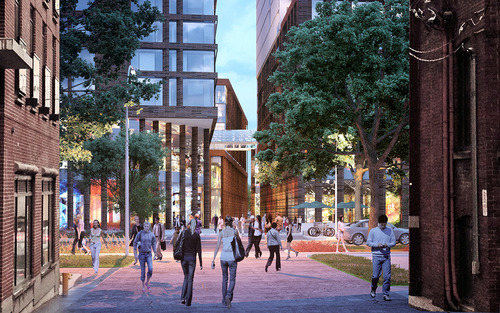
    Laneway looking south into the development site:

    image

    And here are some high level stats:

    • 7.7 acre site (Globe and Mail lands)
    • Encompasses Draper Street, which is a heritage designated street
    • Approximately 500,000 square feet of retail space
    • More than 1,000,000 square feet of commercial office space
    • More than 1,000,000 square feet of residential space

    From the early renderings, the project looks incredibly promising. Wellington Street East is a great street, but the south side of it is currently a mess. With a new lining of well designed midrise buildings on it, the street could be spectacular.

    I like that there seems to be a focus on creating a fine grain network of streets and laneways. And it’s making me think that this stretch of Wellington could work really well as pedestrian only. Both ends of the street terminate in a park (Victoria Park on the west and Clarence Square on the east), which would make it a really beautiful (dumbbell shaped) urban space.

    This is something Toronto doesn’t have today. This could be our opportunity.