Daily insights for city builders, delivered every morning at 6 AM ET. I’m Brandon Donnelly — a Toronto-based real estate developer and founder of Globizen. I’ve been writing here since 2013.

Tag: toronto

  • A brief history of T. Eaton Co.

    image

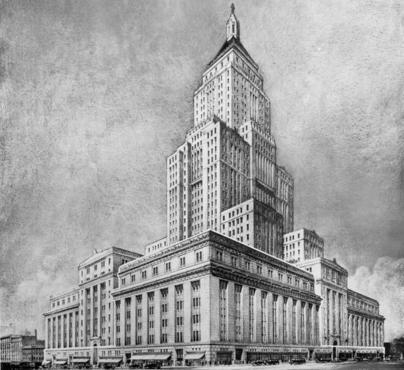
    I was out last night near Yonge and College for a friend’s going away party and the topic of the College Park building came up (originally an Eaton’s department store). We talked about how in the 1920s it was planned as a 38-storey Art Deco tower (see above photo), but that the Great Depression forced Eaton’s to scale back their plans. They ended up building a 7-storey building, albeit an impressive one.

    Then today, thinking about that discussion, I became curious about the story of Eaton’s. Where exactly did it start and how did they get to a point where they were planning the largest retail and office complex in the world?

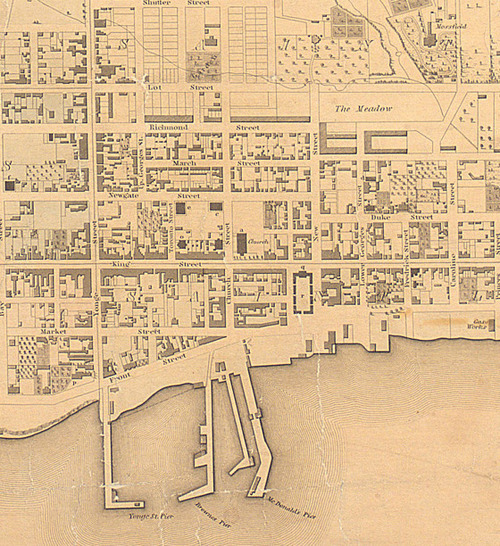
    Well, as many of you probably know or can guess, the first Eaton’s store was opened where the Toronto Eaton Centre mall currently sits today. The exact address was 178 Yonge Street, which is just north of Queen Street. But what was interesting about this location is that, at the time, it was considered to be far removed from Toronto’s center of fashion and retail. That was King Street East. Below is a map from 1842.
    image

    In 1869 when Timothy Eaton opened his first store, the heart of Toronto was what is today known as Old Town (although most people would probably just refer to it either as King East or as the St. Lawrence Market). People shopped along King Street between Yonge and Jarvis, and Queen Street probably would have felt out of the way.
    image

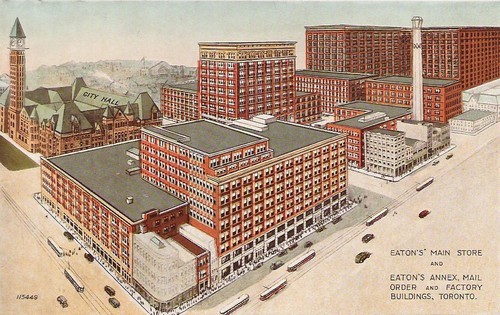
    But Eaton’s succeeded at Yonge & Queen, along with rival store Simpson’s, and retailing shifted northward. With Eaton’s College Street, the company was once again looking north. In fact, they wanted to move their entire operation from Queen Street up to College Street, and they even tried to get Simpson’s department store to do the same (somebody clearly understood agglomeration economies).

    But since the full build out of Eaton’s College Street never actually happened, both stores were kept in operation and a customer shuttle bus was run between the two of them (until the Yonge subway line opened up in the 1950s). With the opening of the Toronto Eaton Centre mall in the 1970s, Eaton’s closed both Queen and College Street locations, and consolidated operations near Dundas Street.

    In 1999, after 130 years of operation, the company went bankrupt.

    What I find interesting about this story is that it speaks to how dominant the department store business model was at the time and how it was shaping the city around it. If Eaton’s had achieved its vision for the corner of Yonge & College, Toronto might look a lot different today. Perhaps we’d all be shopping for fashion along College Street.
  • 34th Annual BILD Awards

    I just got home from the 34th annual BILD awards. It’s late and I’m tired, but I had a good time. TAS won a few awards, including green builder of the year, and I saw a lot of old friends and familiar faces.

    For those of you not in the industry, BILD is the Building Industry and Land Development Association. And every year a gala is held where a bunch of awards are given out for things ranging from the best marketing brochure to the best suite design under 750 square feet. If you’d like to get a feel for the event, check out #BILDAWARDS.

    It was held out in Woodbridge, which is a suburb of Toronto. So today, I did something that I don’t do all that often or even every week: I drove my car. That’s fine, but it reminded me that one of the perks of living in a dense and transit oriented area (like downtown Toronto), is that you never have to worry about drinking and driving.

    I’m really disciplined about not doing that, but it’s nice not to have to worry about it. It can make driving feel like a liability. So there’s another reason to love cities. You can drink whenever you want.

  • Les escaliers de Montréal

    Montreal is one of my favorite places on the planet. In fact, if I have one regret in life it’s that I didn’t do my undergrad at McGill University. Living in Montreal as a poor student would have been the best. Though I shouldn’t complain because I did spend quite a bit of time there when I was a poor student.

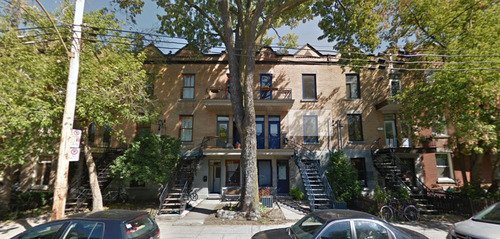
    If you’ve ever been to Montreal, the image at the top of this post will look familiar. The urban landscape of Montreal–at least in the residential areas–is filled with exterior staircases. They’re all over the place. And this always strikes everybody as a bit odd given that it’s a pretty cold and snowy place a lot of the time. Nonetheless, those staircases are quintessentially Montreal.

    Some people think it was done to minimize the amount of interior space that needed to be heated, but I’ve never really gotten a definitive answer. Either way, all those stairs are an interesting byproduct of Montreal’s commitment to one predominant building type: the multiplex. A multiplex is essentially a small apartment building containing a handful of units. They’re usually only around 3 storeys high. And they’re all over the Ville de Montréal.

    To be honest though, I don’t think I’ve ever really explicitly thought about this defining Montreal quality. But then last night I stumbled upon an interesting blog post called “Les escaliers de Montréal vs towers of Toronto." (escaliers = stairs) In it the author talks about how Montreal is essentially this city of multiplexes (with stairs everywhere) and Toronto is this, more modern, city of towers surrounded by single family homes.

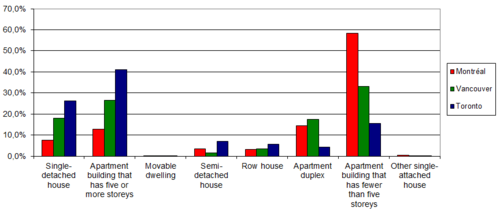
    And here’s the data to back it up:

    When it comes to single-detached houses and apartment buildings taller than 5 storeys, Toronto dominates. But when it comes to apartment buildings less 5 storeys, it’s all Montreal. And if you add in apartment duplexes, you’ve accounted for almost 75% of Montreal’s housing stock. Note: These figures are for the city proper and don’t include any amalgamated suburbs.

    The author’s explanation for this comes down to zoning and timing. Since Montreal is an older city, the belief is that Montreal was simply further along in its evolution when formal land-use planning came into effect and started to order the city. I generally agree with this hypothesis, but I think it’s also worth keeping in mind that, just because a Toronto house might be zoned as single family, doesn’t mean it’s actually begin used as such.

    A lot of the older houses in Toronto have been subdivided into what are effectively illegal multiplexes. Since this is all happening under the radar, nobody really knows what the actual stock of multiplexes might be. Nonetheless, there’s no denying that there are some real differences between the urban fabric of Montreal and Toronto. 

  • Are condos at a tipping point?

    I live in a condominium in the St. Lawrence Market neighborhood of Toronto. And recently, I’ve had a number of “empty nesters” ask me if they could come check out my condo and get a feel for what it’s like to live in a downtown neighborhood like the Market.

    And they’re asking because they’re contemplating something that has become quite common for folks whose kids have left the roost. They’re considering, for a number of reasons, selling their suburban home and right-sizing to a downtown condominium.

    Whether it’s because they want to free themselves of cutting grass and shoveling snow, they don’t like stairs anymore, they want to be able to lock the door and head to Florida for the winter, or they want an amenity rich urban lifestyle, the uptake on condos has been significant both in Toronto and other cities around the world.

    Indeed, the condo market has become great at serving “both ends” of the market: first time buyers/young professionals and empty nesters. But what I wonder is if we might be at a tipping point with respect to the middle segment of the market: families.

    The average new construction low-rise home in the Greater Toronto Area is roughly $650,000 right now. But this would be more for houses in the center of the city. There, you’re probably looking at anywhere from $650,000 to $1 million for a “typical” 3 bedroom Toronto house.

    By comparison, a new condominium might average somewhere between $550 and $600 per square foot in the city. So for a 3 bedroom condo at, say, 1,300 square feet, you’d be looking at somewhere between $715,000 and $780,000. Add in parking and you’re somewhere between the mid $700,000’s and just over $800,000.

    In all cases, we’re talking a lot of money. But the point I’m trying to make is that condominiums and houses are becoming cost competitive. There are obviously differences between both housing types, but if your goal is a 3 bedroom place to raise a family, that utility could be met in both cases.

    There may still be psychological/societal barriers to raising kids in a condo, but I wonder if we might be close to a tipping point now that the economics are starting to line up. What do you all think?

  • Natural resources drive employment growth in Canadian cities

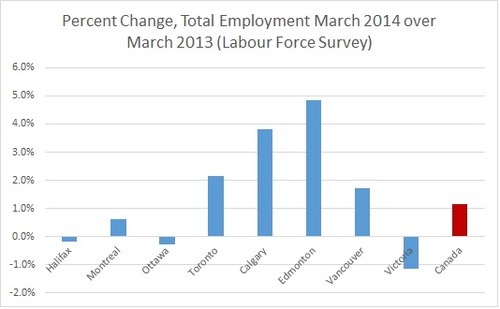
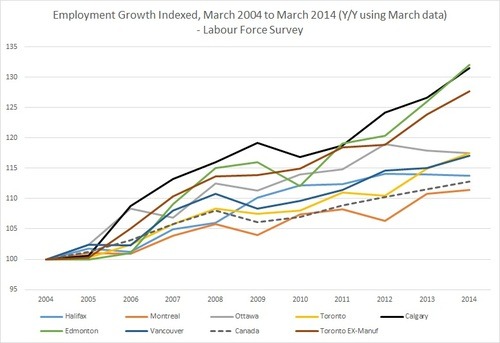
    I was reading Wendy Waters’ All About Cities blog this morning and I came across the following charts showing employment growth across Canadian cities. The first chart shows total employment growth over the last year and the second chart shows employment growth over the past 10 years.

    What is immediately obvious from these charts is that Calgary and Edmonton–both resource driven economies–have and are leading Canada in terms of employment growth.

    Toronto isn’t that far behind though, particularly if you exclude manufacturing from the equation (see second chart). The decline of manufacturing in the Greater Toronto Area really represents a structural change in the economy.

    I wanted to post these charts because, for all the talk about the rise of the information and digital age, Canada’s economy is still very much based on natural resources. We extract and sell. And we have one of the largest proven oil reserves in the world.

    Now, I’m not opposed to this business model, but there’s lots of evidence out there to suggest that resource dependency ultimately hurts innovation and productivity–which makes sense. If we didn’t have resources, we’d be forced to figure out other ways to make money.

    So while it’s great to see our cities growing, let’s not take it for granted. 

  • Berczy Park and the importance of public art in cities

    image

    Earlier this week a friend of mine was live tweeting a public consultation meeting for the revitalization of Berczy Park in the St. Lawrence Market neighborhood of Toronto. And since I live in the neighborhood, it’s a project that I’ve been following particularly closely–although anything related to the built environmental generally fascinates me.

    As soon as I saw the pictures he was tweeting out, I was immediately excited. And after reviewing the full design package (which you can download here), I must say that I think it’s going to be a brilliant change for the neighborhood. 

    image

    On an entirely superficial level, I like the paving motif they’ve chosen; even if it does appear to be be a copy from somewhere else (see above photo). I don’t think one should underestimate how small details, like paving, can have a huge impact on how one feels in a space, whether inside or out. It all counts.

    But beyond just cosmetic changes, there are a couple of significant design changes being proposed.

    First, a larger kid-friendly green space is being proposed on the west side of the park. And what was interesting to see was how the community overwhelmingly expressed a need for this play area. I’d like to believe that this speaks to the growing acceptance of raising kids downtown. There are certainly lots of families in the St. Lawrence.

    Second, the south portion of the park is being “opened up” with a much larger hardscape area. The result will be a bigger promenade along Front Street, as well as, what I hope, will become an “urban stage” for people to hang out, breakdance, busk or try and sell me things I don’t need.

    But equally exciting is the fact that along with the revitalization of Berczy Park will come a public art competition. It’s already in the works, but there aren’t any pretty images to share, just yet. Regardless, I think the topic of public art is an interesting discussion.

    In a lot of cities around the world, there are mechanisms in place to encourage or mandate public art. Commonly, it comes in the form of a “Percent for Art” program, which means that, in the case of a new construction project, 1% of the construction costs would or should go to public art.

    But the fact that we, at least in some cities, have programs to mandate it, should immediately signal to you that public art is not something universally believed in. And certainly it’s one of those things where it’s hard to measure the return-on-investment. 

    But that doesn’t mean it doesn’t or can’t exist.

    In fact, I would argue that in today’s information and digital age it’s only going to become more important. We are living in a world of too much information and too little time. We’re living in a noisy world and, whether you’re a corporation or a city, the only way to stand out is to be remarkable. You need to bring delight to people.

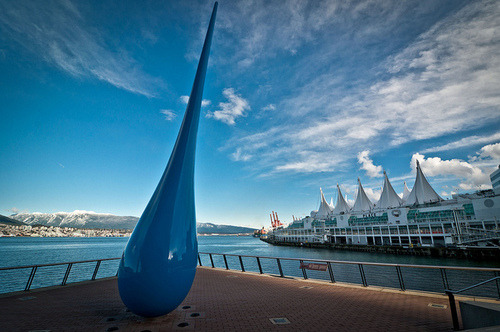
    Because when you do, you get noticed (and probably shared on Facebook, Twitter, Instagram, Tumblr, Snapchat, Vine, 500px, Flickr and maybe even Google+). As one example, how many of you recognize the public art piece below? It’s in Vancouver and I’ve seen it pop up a number of times in my social news feeds. It’s something that brings delight to people. 

    image

    But at the same time, it’s something that speaks to and creates a sense of place. What could be more Vancouver than a giant blue raindrop along the waterfront? And that’s really one of the ironies of today’s digital world. Despite the fact that, no matter where we are, we’re all hyper connected through technology, more and more of us are gravitating back towards cities. We want to live close to other people and we want to feel a sense of place.

    When done properly, public art can help cities achieve that. Whether it’s the famous LOVE sculpture or Richard Serra’s controversial Tilted Arc, public art can make you stop and take notice of your environment. It can give you that sense of familiarity or it can take you by surprise. Either way, it gives you a sense of place.

  • Who’s paying for transit expansion in Toronto?

    Recently blogTO did a piece outlining the sources of funding for Toronto’s six active transit projects: the Spadina subway extension, the Eglinton Crosstown LRT, the Georgetown South GO line improvements, the Union Pearson Express, the Sheppard East LRT and the Finch West LRT. It broke down as follows:

    image

    You can find all the specific numbers here, but what is obvious is that the province is paying for most of this city’s transit expansion. Unfortunately though, it’s being done on an ad hoc basis. Toronto first asks for money and then the province decides whether or not it wants to give it.

    This is problematic for a few reasons.

    First, it’s an inconsistent funding stream. We all recognize the need for better transit and infrastructure in the city, but the big question is always: Who’s going to pay for it? So far, as we can see, it’s been the province. But that’s not always a sure thing. And it can often become political. If we’re going to get serious about building transit, Toronto needs a consistent funding source that would allow us to start building and not stop.

    Second, how come, as one of the major economic engines in this country, we aren’t in a position to pay for our own infrastructure? It’s because our governance structure does not properly reflect the economic realities of today’s world: 

    Most local governments are formed by a charter or act granted by the province or territory. Local governments are not mentioned in the Canadian Constitution other than to say they are responsibility of the provinces. Consequently, municipalities can be created, amalgamated, or disbanded at the whim of the provincial government which controls them. They are also limited in the amount of interaction they have with the federal government because this would infringe upon an area of provincial jurisdiction. Since each province is responsible for creating local governments in its own territory, the names, functions, and powers of local bodies vary widely across the country. Local governments generally have limited powers, namely creating local by-laws and taxation (property tax).

    And yet cities, not provinces, are our biggest economic drivers. We have it backwards. And so I think it’s critical that we look long and hard at ways in which we can better equip our cities with the tools and resources to compete globally. Transit funding is just one example.

  • How inclusive are your public spaces?

    I subscribe to a blog called Cities for People. It’s the blog of Gehl Architects out of Copenhagen and their focus–both the blog and the firm—is on how the built environment affects people’s quality of life. They call themselves Urban Quality Consultants.

    This morning, they wrote a post on gender mainstreaming in public spaces, which, I’m told, is top of mind in cities such as Copenhagen and Vienna.

    The key insight was that, for a variety of reasons, men and boys seemed to be engaging with public spaces more than women and girls. For example, they found that boys were generally more assertive than girls and so, if there was a toss up between who was going to use a space, the boys would usually win out. As a result, there’s been a lot of debate around creating more inclusive public spaces, both from a design standpoint and a policy standpoint.

    Interestingly enough, this is a debate that doesn’t seem to be happening here in Toronto. And I wonder if it’s because we don’t have the same problems (or I’m just oblivious) or if it’s because we don’t care enough about public spaces to do gender mapping exercises.

  • Every street can’t be everything to everyone

    Yesterday I spoke about why Toronto shouldn’t be so quick to dismiss streetcars and light rail. Today, I’d like to talk about some of the hard decisions we need to face if we really want to get our city moving.

    Toronto is a city of neighborhoods and small main streets–at least in the areas where our streetcars live. Streets such as King and Queen are only 4 lanes. And the problem we’re facing is that we’re trying to accommodate every single use case on them: cars, on-street parking, cyclists and streetcars. But in doing so, we’ve made the experience terrible for everybody. Streetcars move at a snail’s pace, drivers are frustrated by the lumbering streetcars, cyclists fear for their life driving by parked cars (doors can swing open at any time), and so on.

    And with the rise of downtown shoulder neighborhoods such as Liberty Village, King West, the Distillery District and the soon to be complete West Don Lands, the strain on our east-west corridors is only going to get worse–much worse, in fact. Already the King streetcar is the busiest streetcar route in the city, moving almost 60,000 people per day. That’s more than the (under utilized) Sheppard subway line.

    What I hope is clear to the ATC community though, is that the answer isn’t uniformly the car. We can’t have every single resident from Parkdale to Leslieville hopping into their car and driving downtown to their office at Yonge & King. It ain’t going to work. And so we’re going to need to make some difficult decisions about how we’re going to get our city moving on the backbone of transit.

    Sure the downtown relief subway line (screw the politics I’m attaching it to downtown) would be the ideal solution to connecting our emerging shoulder neighborhoods, but that’s not going to happen overnight. And so how do we improve the efficiency of what we already have? First, we need to accept the fact that every street isn’t going to be everything to everyone at all times. We need to choose who we want to optimize for.

    So here’s an idea that’s been floated many times before but never acted upon: let’s get rid of cars on King St and Queen St in the core during rush hour.

    This would give our streetcars the room to efficiently move people across downtown, minimizing the dreaded “bunching up” that occurs as a result of traffic congestion. It would make transit a reliable choice and there are ways to pilot it. But let’s be clear: this is not about being anti-car. It’s about optimizing uses and getting people moving. Cars would continue to get priority on Richmond St and Adelaide St, and transit riders (as well cyclists) would get priority on King and Queen.

    Of course, the Rob Ford viewpoint would say that we should be optimizing all streets for cars and getting the streetcars completely out of the way. But if that’s the approach we want to take, then we’re building the wrong kind of city. We shouldn’t be focused on intensifying and creating new inner city neighborhoods, because that only tips the scale in favor of transit. Instead, we should be focused on decentralization.

    But that’s what not we’re doing. We’re intensifying our city to the point that we’re now faced with a number of difficult–yet enviable–decisions about how we’re going to live and how we’re going to move around in the future. We’re a city in transition.

    Our mission here should be to figure out how to move people around the city as efficiently possible. Let’s put politics aside and recognize that time is one of our most precious resources. And when we put people in lumbering streetcars and debilitating traffic jams, we’re completely squandering that resource. It hurts productivity and it hurts our overall prosperity as a global city.

    There’s a place for subways, streetcars, buses, bikes and cars in our city. So let’s just get on with making them all work.

  • All streetcars are not created equal

    With Toronto preparing to deploy the first batch of its new streetcars this summer, there’s been a lot of talk about streetcars in general. Rob Ford has said he wants to get rid of them all together and I hear a lot of other people expressing similar frustrations: Streetcars are rolling stop signs. Streetcars block 2 lanes of traffic. Why don’t we just use more buses? Streetcars cause traffic. And so on.

    So what should we do?

    First, let me start by saying that buses suck. I’m a huge proponent of public transportation in cities, but there’s nothing quite like a rush hour bus ride to have you question your economic status in life. Bus routes have also been shown to have little economic development value, where as fixed rail lines (such as streetcar, LRT and subway) generally increase surrounding property values and spur investment.

    Second, my view is that streetcars themselves as a transportation technology aren’t the problem. It’s our execution. I’ve touched on this topic before on ATC, but I’d like to reiterate a few points here. 

    The value of light rail is that it’s a relatively inexpensive way (compared to subway) of efficiently moving a lot of people. But in order to do that, you need deploy it in a sensible way. In my mind, that primarily involves 3 things: giving streetcars their own dedicated lanes (grade separation), having a reasonable number of required stops, and streamlining the onboarding and off boarding process. Today, we don’t do a great job at most of these things (although our new streetcars will use a proof of payment model).

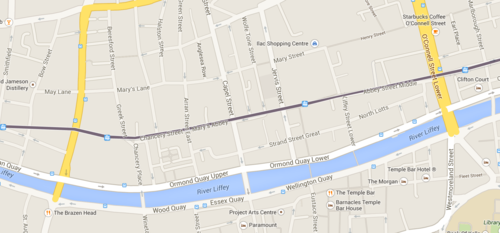
    Take a look at this comparison between Dublin’s Luas light rail system and Toronto’s streetcar system. Both images are at the same scale. Notice the dramatically different stop spacing. Much of the Luas system also runs on its own dedicated lanes.

    Dublin:

    image

    Toronto:

    image

    Every time a Toronto streetcar stops it generates waste. Cars are forced to stop behind it. Everyone on the streetcar has to sit and wait while somebody fumbles through their change looking for a token. But there are other ways to do this. There are ways to make light rail more subway-like, despite the fact that it may be above ground.  And so I don’t think we should be so quick to write off all streetcars.