Daily insights for city builders, delivered every morning at 6 AM ET. I’m Brandon Donnelly — a Toronto-based real estate developer and founder of Globizen. I’ve been writing here since 2013.

Tag: toronto star

  • Why do we choose traffic?

    Scott Stinson gets a lot right in this recent Toronto Star article about road pricing:

    There is a simple tool to combat traffic congestion that has been proven to be effective. There are real-world examples of where it has been deployed to great and long-lasting success. It’s called road pricing. And we seem to be deathly afraid of it.

    This is even if the benefits are real and measurable:

    Jonas Eliasson, director of travel accessibility at the Swedish Transport Administration, has first-hand experience with the effects of the congestion charge implemented in Stockholm in 2006. Public polling showed two-thirds of voters were against the road-pricing plan before it was introduced in a pilot program. A local politician called it the “most expensive way ever devised to commit political suicide.” But after it began, Stockholm traffic levels dropped by 25 per cent, more than double initial estimates. In a subsequent referendum, Stockholm residents voted to adopt the congestion charge permanently.

    There are lots of reasons why road pricing is commonly opposed, but at the end of the day, it works, and we know all too well — especially here in Toronto — that the status quo sucks:

    “Over the years, transportation economists and planners have pointed out that there really is no other solution to traffic congestion than more efficient pricing,” he said in an interview. “So every time somebody said ‘No, I don’t want road pricing or congestion pricing,’ they’re actually saying, ‘I want traffic congestion.’”

    I’ve been writing about this topic for almost as long as I’ve been writing this blog. So at this point, I think we just need to run a pilot. No more studies and reports. No more protracted debates.

    Let’s try it out and see how many people prefer (1) less traffic congestion and (2) more money for alternative modes of transport.

  • Thinking about the things we’re used to

    This is a powerful perspective:

    We evolved to be wary of change. Our attention is limited, new things can be a threat and the status quo feels comfortable.

    As a result, we spend a lot of time and energy being afraid (and arguing about) the upcoming changes in our lives, but almost no time at all thinking about the things we’re used to.

    As an example of this tension, check out this “exit interview” with Toronto’s former chief city planner, Gregg Lintern. The underlying theme is change and why it’s desperately needed.

    But of course, that’s not easy.

    The interviewer, Victoria Gibson, mentions this survey stat: nearly half (47%) of all Torontonians think the city is building too little housing, and yet only about a quarter (27%) think their area could handle more.

    We need this, but not here. Probably because we’re used to the way things are.

    But if you read the interview, you’ll see that the answer, or at least one answer, is to make the conversation personal, and ultimately think critically about, you know, the things we’re used to.

    Change starts with not giving the benefit of the doubt to the status quo.

  • Peaks and plains

    On the exact same day last week, the Toronto Star published two articles about housing. The first one, this one here, is about how “Toronto has protected huge parts of the city from anything denser than detached or semi-detached houses” and how this has resulted in an “uneven city.” The second article, this opinion piece, is about the “many repercussions to replacing little bungalows.” And one of the implied repercussions is that 3-storey sun blockers that invade privacy might actually kill people. Hmm.

    In effect, these are the two sides of this debate. If you zoom out and look at Toronto, you will largely see a contrasting and uneven city of tall buildings and low-rise housing. Instead of building like Paris, which is consistently mid-rise — but also far denser on average than Toronto — we have chosen peaks and large plains to constrain new housing. And if you zoom in across those plains, you’ll find many areas without sidewalks, along with people, such as the author of the second article above, who believe that nothing more than a single storey is appropriate for human health.

    All of this has persisted because it has been politically popular. But time continues to show us that it actually runs counter to our goals of building an inclusive and globally competitive city region. Thankfully, it feels like we are finally reaching a tipping point.

    Photo by Jackson Case on Unsplash

  • The great housing supply debate continues

    The great housing debate continues: Are we building enough housing, or are we not?

    Right now the media is talking about a new report from the Union of B.C. Municipalities, which is claiming that cities in British Columbia are actually building enough housing to keep pace with population demand.

    Between 2016 and 2021, the province’s population grew by 7.6% and the number of new dwellings grew by 7.2%, according to the report. So supply appears to be lining up with demand.

    One problem with this robust analysis is that many people, including the Housing Minister, don’t agree. Here’s an excerpt from the Globe and Mail:

    “The overly naive analysis comparing housing to population growth to declare the adequacy of our housing supply fails to understand that housing and population growth are intimately related,” said statistics analyst Jens von Bergmann, a regular decoder of housing statistics for Vancouver and Canada. “It’s a slap in the face of those who have been pushed out, or those who failed to move here, because of the unavailability of housing.”

    And on a related note, here is a recent piece by Shawn Micallef (Toronto Star) talking about why the left can’t get Toronto’s housing right.

  • Toronto’s condo market in 2021

    “If everyone is going left, look right.” –Sam Zell

    The right time to buy things is usually when other’s aren’t, which is why I’ve felt that this year was a great time to buy a centrally located condo. Cities aren’t going anywhere. This isn’t their first pandemic. Downtown demand will return as soon as urban life returns and the majority of people are back in their offices next year.

    I’ve also been predicting that the run-up in single-family home prices that we have seen this past year here in Toronto will eventually lead to a surge in demand for condos (and perhaps even for larger suites). It’s a question of relative affordability. And so it was interesting to see Shaun Hildebrand of Urbanation predicting the same thing for 2021 in this recent Toronto Star article.

    Hildebrand thinks the soaring prices of single-family homes will also push more buyers back to the condo market.

    As of November, the average price gap between condos and detached houses was $596,000. The gap between a condo and a semi-detached or townhome was about $217,000. Both of those were at their second-highest levels since the market peaked in late 2016-early 2017, he said.

    “This could really start to swing demand towards condos in the second half of the year,” said Hildebrand.

    Realosophy data shows condo sales were already up year over year prior to the holidays — 23 per cent the first week of December, 31 per cent the second week and 72 per cent the week of Dec. 14. That means 727 condos sold that week, compared to 418 in the same week last year.

  • Would wider sidewalks induce demand?

    One of the debates that is happening in cities all around the world right now is about whether or not it makes sense to redistribute public space in order to help with current social distancing measures. We are all being told to stay at home as much as possible, but as we venture out for food and/or sanity walks, many have started noticing that a lot of our sidewalks are in fact too small if you’re trying to stay 2m away from other humans. So with vehicular traffic way down, the question becomes: Should we start borrowing some of that space for pedestrians?

    Here in Toronto the official position is no. Closing down streets and lanes to car traffic is usually referred to as creating an “open street.” And the intent of these open streets is typically to bring people together for public life, which, of course, is the exact opposite of what we’re trying to do right now. What this implies, however, is that there’s a belief that additional space for pedestrians would induce demand, similar to what is believed to happen when you add additional lanes on a highway.

    Lewis Mumford probably had it best when he allegedly said, “Adding highway lanes to deal with traffic congestion is like loosening your belt to cure obesity.” So on the one hand, if you believe that more lanes doesn’t solve traffic congestion, you might also be inclined to believe that more and bigger sidewalks isn’t going to dampen the anxiety we currently feel when other humans get anywhere near us. The additional space would simply get filled with more bodies.

    But maybe you could argue that this is a little bit of a different situation. We’re in a global pandemic for God’s sake and most of us have the better sense to stay home unless it’s absolutely necessary. Perhaps in this case, demand would not increase and the greater supply would simply better serve the demand that is already there. Perhaps. I don’t have a strong stance on this, but I’m fairly certain that technology could help with this decision.

    What do you think?

    Photo by Jason Blackeye on Unsplash

  • SHARE NOW exits North America (and a few European cities)

    Last week, SHARE NOW — which was previously known as Car2Go — announced that it will be exiting the North American market entirely come February 29, 2020, and that it will also cease operations in London, Brussels, and Florence. A couple of reasons were cited, including the “volatile state of the global mobility landscape,” but that really translates into low adoption:

    Further, despite our best efforts and investments in Brussels, London and Florence over the years, we are unable to continue operations in a manner that’s sustainable for our business due to low adoption rates.

    Moving forward, SHARE NOW will focus on the remaining 18 European cities. We, along with our shareholders, believe these markets show the clearest potential for profitable growth and mobility innovation.

    There was a period of time when I used to use Car2Go here in Toronto. My network did as well. But that quickly stopped with the rise of Uber and Lyft. I mean, why bother finding a Car2Go and then parking it, when there’s a much lower friction option? I would imagine that’s how most people feel. (Maybe there’s a care share advantage for longer trips.)

    At the same time, companies such as Uber and Lyft have, as you know, not performed well as public companies. The market is nervous about their path to profitability. In my view, they’re largely an undifferentiated offering right now, and it’s pretty easy to switch across them. So yeah, I guess the global mobility landscape is pretty volatile.

  • Junction House featured in the Toronto Star

    This morning the Toronto Star published a profile piece on one of Junction House’s earliest purchasers: Barbara Martinez. Barbara downsized from a house to a 1-bedroom condominium in Roncesvalles, but then realized that she still wanted space to entertain and have guests over. So she decided to buy a 3-bedroom penthouse at Junction House with an approximately 350 square foot terrace. That’ll work. It is truly one of the nicest suites in the building, and will come equipped with a view of the Toronto skyline that looks something like this (see background projection below):

    I am quoted in the article as saying that mid-rise condominiums in Toronto’s neighborhoods naturally tend to attract a different set of buyers compared to, say, a downtown tower. That is true and we are seeing it play out at Junction House. Yes, we have 1-bedroom suites that are perfect for young professionals and/or investors, but we also have some spectacular 2-storey suites (the House Collection) and larger single-storey suites for people just like Barbara. Congratulations on your new home purchase!

    Photos: Steve Russell for the Toronto Star

  • Multi-Unit Housing in Urban Cities: From 1800 to Present Day

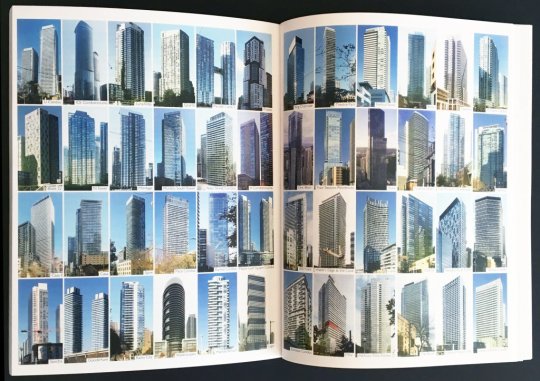
    I just ordered a copy of Multi-Unit Housing in Urban Cities: From 1800 to Present Day by Katy Chey. I figured this was a book that we should have hanging around our office. I also like to support the Daniels Faculty.

    The book covers the following multi-unit housing typologies:

    • Back-to-backs in Birmingham
    • Tenements in London
    • Haussmann apartments in Paris
    • Tenements in New York
    • Tong lau in Hong Kong
    • Perimeter block, linear block and block-edge in Berlin
    • Perimeter block and solitaire in Amsterdam
    • Space-enclosing structures in Beijing
    • Kyosho jutaku in Tokyo
    • High-rises in Toronto

    In addition to each typology, the book analyzes the connection between the housing type and the city. Why did certain typologies flourish where they did and how have they helped to define their city?

    It reminds me of what I was trying to do with some of my recent posts about Hong Kong’s typical tower plan, albeit with far less rigor than what I am sure has been applied to this book.

    I am also curious to read what has been written about high-rises in Toronto. It goes to show you just how defining the current real estate cycle has been for this city. That’s our multi-unit housing typology.

    Image: Daniels Faculty. My multi-unit home made the book.

  • Name your laneway

    Photograph Urban Explorer by Andrew B. on 500px

    Urban Explorer by Andrew B. on 500px

    Laneway housing is becoming an incredibly popular topic here in Toronto. Lots of people seem to be interested in building, or least living in a compact ground-related laneway dwelling. 

    A big part of this, I think, has to do with affordability (or the perception of affordability). A lot of people want to live in a central urban neighborhood, but it has simply gotten both expensive and difficult to secure low-rise housing. Here’s an example of a young couple in Toronto who went door-to-door in their desperation to find a house.

    I believe that laneway housing has the potential to be a more affordable low-rise housing solution in this city, as well as in many other cities around the world who have a similar urban condition. But today, at least here, it’s not that way.

    Since the City of Toronto does not officially support laneway housing, it would be an uphill to get one approved and you need to be willing to put a significant amount of money at-risk in order to try. It’s unfortunate, but that’s the reality today.

    I’m certain that will change. But it will take a bit more pioneering. The Laneway Project, which I advise, is working to change the way Toronto thinks about its laneways and I know that there are many other small entrepreneurs working on doing the same.

    One of the first things that will need to happen is that we’re going to need to name our laneways. Some of them are already named, but many of them are not. And while this may not seem like a big deal, it is. For laneway housing to become a reality, they will need to have addresses and we will need to think of our laneways as legitimate streets.

    Recently The Laneway Project published a how-to guide called: How to Name Your Laneway. So if you’re interested in laneways and laneway housing here in Toronto, I would encourage you to give it a read and then try and get your local laneway named.