Daily insights for city builders, delivered every morning at 6 AM ET. I’m Brandon Donnelly — a Toronto-based real estate developer and founder of Globizen. I’ve been writing here since 2013.

Tag: toronto star

  • Is inclusionary zoning a good or bad thing for cities?

    Today is Christmas Eve. It’s the season of giving. So I thought it would be appropriate to talk about affordable housing.

    Yesterday, Mitchell Cohen – who is a real estate developer and the president of The Daniels Corporation – wrote an opinion piece in the Toronto Star talking about just that. It was called: A perfect storm for action on affordable housing.

    Here’s a snippet that summarizes the things he believes we should be doing:

    Municipalities across Ontario also have significant tools at their disposal to make a difference. To date, these tools have not been co-ordinated to achieve maximum bang for the buck. Property taxes can and should be waived not only for affordable rental homes but for affordable ownership homes as well. Additionally, cities can and should waive all development levies and other municipal fees for affordable rental and ownership housing.

    Combined, these two measures provide municipalities with powerful leverage to implement inclusionary zoning — the most important tool in the affordable housing tool box. Inclusionary zoning on a city-wide basis creates a level playing field, an opportunity for a constructive partnership between municipalities and private sector developers to create both affordable ownership and rental homes within every new building approved for construction.

    For those of you who might be unfamiliar with inclusionary zoning, it’s essentially a zoning requirement to build a certain number of affordable units in any new construction project. It originated – as far as I know – in the US, but has been fairly controversial since the outset.

    So today I thought we could have a discussion on the merits of inclusionary zoning. Do you think it’s a good or bad thing for cities? Is it really the most effective way to deliver affordable housing at scale? Leave your thoughts in the comment section below 🙂

    I don’t have a strong view on inclusionary zoning, but I do believe that affordable housing and a mix of incomes is critical to cities and neighborhoods.

    I do, however, wonder if it’s one of those things that seems to make a lot of sense, but actually has a bunch of negative externalities associated with it. Maybe the answer is to just prototype the idea and then iterate on it.

    What do you think?
  • The demand for character office space

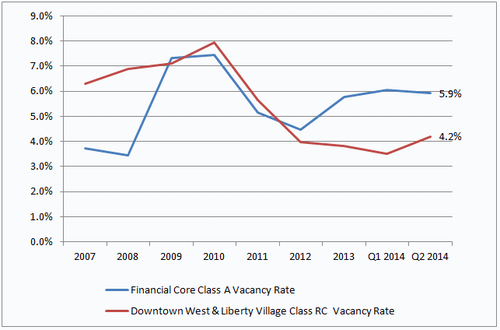
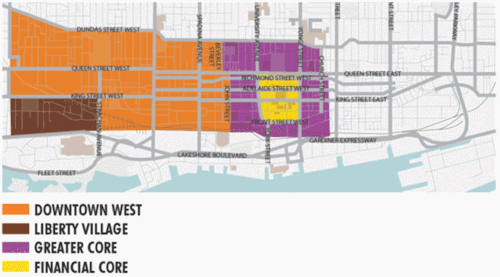
    Last Friday the Toronto Star published an article talking about the growing demand for character office buildings in submarkets outside of Toronto’s core. Specifically, it was talking about the Downtown West and Liberty Village submarkets (citing a report from CBRE).

    I’m sure this isn’t news to most of you. Cool loft spaces have been popular for years. But it’s interesting to look at how rents and vacancy rates have changed for these submarkets and product types over time.

    Since 2002, average (net) asking rents for brick-and-beam buildings in the west end have gone from $16.12 to $22.23 per square foot. Almost a 38% increase. By comparison, office space in the core has gone from $28.40 to $32.38 per square foot. A 14% increase.

    And if you look at vacancy rates since 2007, you’ll see that the character office market has really tightened up over the past 4 years or so. There’s growing demand for a limited amount of supply.

    With the growth that the downtown core is seeing and with the rise of Toronto as a creative startup hub, I’m sure we’ll continue to see strong demand for this type of space. But there’s only so much of it to go around. So I think we’ll also end up seeing greater interest in the east side of downtown and also more interesting new builds.

    Images/Charts: CBRE

  • Streetcars are just a tool

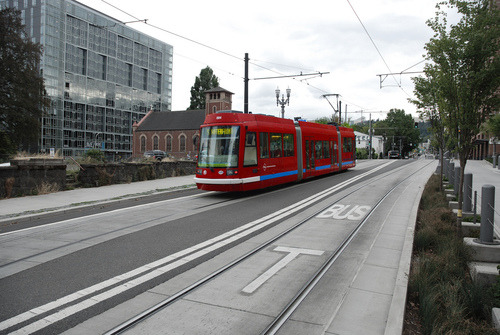
    Earlier this month the Toronto Star published an article talking about the resurgence of streetcars in American cities. According to the Star, 89 cities in the US are currently implementing or at least considering building some form of surface-rail system.

    But the article also goes on to argue that it could be a snobbish fad. Streetcars are new. They’re shiny. And they make yuppies –  who don’t like taking buses – feel better about themselves. But is the ROI really there? Is the economic impact of streetcars as big as people are making it out to be?

    To support this argument, the Star quoted transportation planner Jarrett Walker, who I’ve mentioned here before on Architect This City. But according to a follow-up post that Walker did on his blog, it would appear that he was misrepresented in the article. Here’s a snippet of his response:

    Here’s the bottom line. Streetcars are just a tool. They can be used in smart ways and in stupid ways. Asking a transit planner for an opinion about a transit technology is like asking a carpenter what his favorite tool is. A good carpenter sees his tools as tools and choses the right one for the task at hand. He doesn’t use his screwdriver to pound nails just because he is a “screwdriver advocate” or “hammer opponent”. Yet the Toronto Star assumes that nobody involved in transit debates is as smart as your average competent carpenter.

    I wanted to share this because I think it’s a great way to approach transportation planning and because I think it gets at a larger issue that we continue to face here in Toronto: We keep politicizing mobility tools. Cyclists have become pinkos. Streetcars are a war on the car. And the list goes on. How about we just look at the problem, and figure out what solution would work best?

    Image: Flickr

  • 2 parents, 2 kids, and 1 cat in 1,000 square feet

    Yesterday a colleague at the office sent around this Globe and Mail article talking about a Vancouver family of 4 (plus one cat) who live in a 1,000 square foot loft near downtown that they purchased in 2003 for $269,900. There weren’t really any photos of the place, but the article makes it sound like they have 3 beds crammed into one room. (I wonder how the parents ever manage to have sex. There are better ways to lay out 1,000 sf.)

    In any event, the point of the article is that there’s a growing number of families who are clinging to the downtown lifestyle that they’ve grown accustomed to and are refusing to follow the path of a conventional suburban house – regardless of how tight their current quarters might be. It’s happening in Toronto (here’s an article from the Toronto Star and here’s a post I wrote) and it’s happening in New York:

    A recent New York Times article on a similar trend noted that the number of white professionals with one or more children living in one-bedroom condo units in that city had jumped by almost a third between 2000 to 2006. Prof. Andrew Beveridge, from Queens College of the City University of New York, said the pattern was showing up in other expensive American cities. In Toronto, the 2011 National Household Survey showed there are about 72,000 families living in 71,500 units in buildings with five or more storeys – undoubtedly many of them the new, tiny condos proliferating there.

    To some this might sound crazy. I mean, why would a dual income family–such as the one in Vancouver–subject themselves to a smaller space when they could easily afford a bigger place somewhere else? Isn’t that the dream – to have a big house?

    The answer is that these families are considering–in addition to the direct costs of a bigger place–both the indirect costs of living further away from the core (such as longer commute times) and the inevitable lifestyle changes that would happen should they move out from their downtown neighborhoods. The urban lifestyle is different.

    But what I find interesting about this phenomenon is that if this trend continues (and I think it will), we’re going to have a new generation of people in North America who grew up in apartments, condos, and lofts, and don’t have the same biases around single family houses and suburban living. To them, an apartment will be a perfectly normal place to raise a family.

  • $30 million class-action lawsuit against condo developer

    Last Sunday the Toronto Star ran this article talking about a $30 million class-action lawsuit against developer Elad Canada. The claim is that the developer failed to deliver on the promise of direct underground subway access from its project—Emerald City Condominiums—to the Don Mills subway station.

    The developer, however, doesn’t feel that they made such a representation:

    The lawyer for condo developer Elad disputes the claim saying, “there was never any representation that there would be underground access” from the condo building to the subway or directly to Fairview Mall: Both are easy to reach by walking out the lobby doors and six metres to the subway entrance right out front.

    But when you check the project’s website, it says the following:

    Emerald City is also a commuter’s dream come true. With easy underground access to the Don Mills subway, you can be in downtown Toronto in just minutes.

    Now, I suppose you could argue that, since it’s the subway, that all access is underground. And that it’s certainly “easy”. But when I read the above statements, I can understand why somebody might think there’s underground access to the subway station from within the building. That’s what I would think. It’s misleading.

    But I want to hear from all of you (especially if you’re a lawyer).

    Do you think the developer unfairly led purchasers into believing that they would have direct and underground access to the subway station from their building?

  • Why real estate is an imperfect market

    I’ve said many times before that the real estate market is an imperfect one. Participants lack access to a lot of valuable information and there’s a significant amount of friction between buyers and sellers.

    A perfect example of this can be found in this recent Toronto Star article, which is suggesting (at least in the headline) that only about 23% of Toronto’s condos are owned and rented out by investors. The article is reporting on the Canada Mortgage and Housing Corporation’s annual publication called the Canadian Housing Observer.

    Of course, to come up with this number, CMHC is only reporting on data held by the MLS. It does not include units that may have been rented out via Craigslist, Kijiji, social media, a billboard in the lobby, or some other means. And I would argue that the rental side of the marketplace has a much stronger tendency to go outside of MLS as compared to sales.

    So what what this means is that we have absolutely no idea what the actual percentage of investor owned units in the city really is. Here’s how CMHC put it:

    Mathieu Labarge, CMHC’s deputy chief economist, acknowledged that “to complete the picture there’s a need for data,” and it simply doesn’t exist.

    Nobody seems to know exactly where buyers, or their money, is coming from, why they are buying and how they intend to use the condo.

    In reality, the investor percentage is going to be higher:

    “We think the number is closer to 50 per cent,” says veteran Toronto development consultant Barry Lyon. “The data they (CMHC) are using has some shortcomings. It’s only part of the story.”

    Now, I don’t have the answer, but I think it’s pretty safe to say that consumers and the market as a whole would be better off if it had all the information.