Daily insights for city builders, delivered every morning at 6 AM ET. I’m Brandon Donnelly — a Toronto-based real estate developer and founder of Globizen. I’ve been writing here since 2013.

Tag: tesla

  • Tesla is winning the arms race

    “If we have data, let’s look at data. If all we have are opinions, let’s go with mine.” – Jim Barksdale, former Netscape CEO

    Fred Wilson wrote a post yesterday about Tesla’s data advantage in this self-driving car arms race that we are currently living through. (I found the above quote in the comment section of the post.)

    In their Q3 2016 update, Tesla claims to have logged more than 1.3 billion miles on its vehicles equipped with Autopilot hardware. This is important because the more data it collects – across diverse road and weather conditions – the better the vehicles get at driving without human intervention. As Fred Wilson put it: “more data is better than more software engineers.” So that places Tesla ahead of Google, Uber, GM, et al.

    I spent a lot of time driving over the past week, certainly more than usual, and I couldn’t help but think about how much better it would have been to instead sit in the backseat and read a book (or mindlessly scroll through Instagram).

    I always try and use cruise control on long drives, but unless the road is fairly empty, I find it doesn’t work very well. Everyone is driving at different speeds and so I usually end up having to reset it / adjust it every so often.

    The big question in my mind is still: How does the world look when driving longer distances doesn’t suck so much? What changes when you can get into your / a car (important distinction) at bedtime, fall asleep, and then wake up in a new place?

    A lot, I think.

  • Full self-driving hardware

    Tesla has just announced “full self-driving hardware” on all of its cars, including the upcoming Model 3, in anticipation of a big software update to be released sometime around December 2016 (hopefully). 

    This will enable fully autonomous driving “in almost all circumstances” – they mention rain, fog, and dust, but no snow – at a level of safety that Tesla believes is already 2x better than the average human driver.

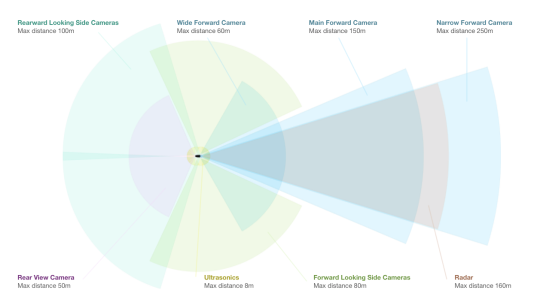
    This is being accomplished through a souped up onboard computer and by increasing the number of surround cameras from 4 to 8. Here’s a diagram (via Tesla) of how those cameras work and how they will capture a 360 degree view:

    image

    A couple of immediate thoughts / takeaways:

    The Smart Summon feature is obviously very cool. Summon on your smartphone and your car will come find you. Elon Musk has said that it will eventually find you even if you happen to be on the other side of the country. 

    But this assumes that there are solid metal snake chargers (or something else) to automatically charge your vehicle somewhere on route. It also suggests that the vehicles won’t be equipped to cross international borders by themselves.

    Elon Musk has said that (unfortunately) retrofitting older Tesla vehicles to full self-driving hardware will be very difficult and costly – the cost delta is greater than buying a new car. This reinforces my belief that leasing, rather than owning, is probably a wise strategy right now given how much change is happening in the auto space.

    Lastly, here’s some fine print from the Tesla Auto Pilot website:

    “Please note also that using a self-driving Tesla for car sharing and ride hailing for friends and family is fine, but doing so for revenue purposes will only be permissible on the Tesla Network, details of which will be released next year.”

    Uber vs. Tesla. Round 1. Fight.

    If you’d like to see a full self-driving Tesla in action, check out the video on their website.

  • The self-driving car arms race

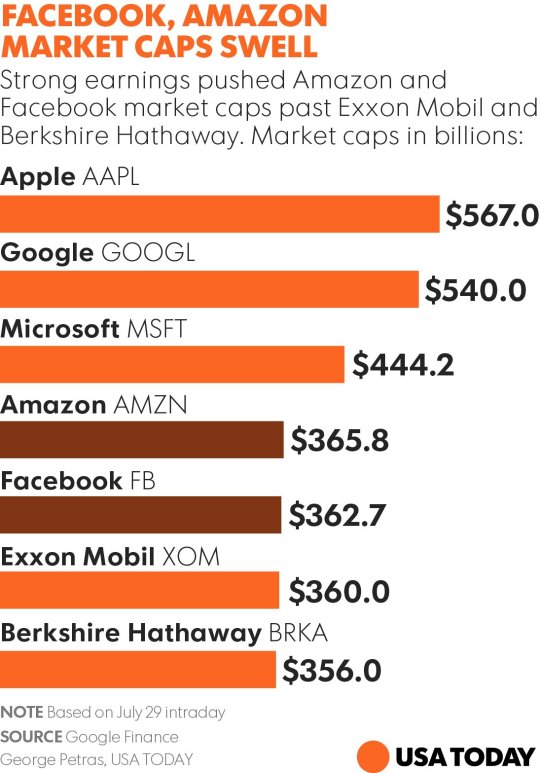
    Earlier this month, I came across the following chart from USA today. 

    image

    It was based on market caps as at July 29 and so the order wouldn’t look quite the same today. Still, here are the largest companies by market cap and the top 5 are US consumer-facing technology firms.

    Remember when it was a big deal that Apple had surpassed Exxon Mobil as the world’s most valuable company?

    We are living in a tech-driven world.

    Then yesterday, I was reading this New York Times article talking about Uber’s acquisition of Otto (a startup focused on self-driving truck technology) and its plans to allow riders in Pittsburgh to summon self-driving vehicles later this month.

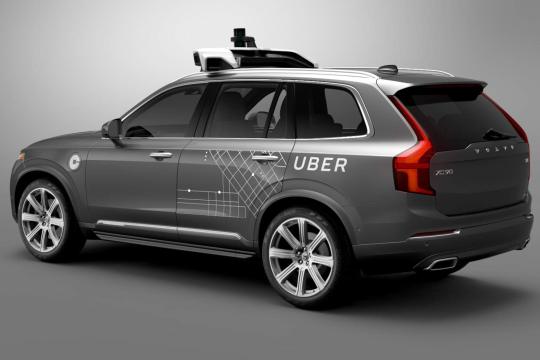
    The vehicle will be a tricked out Volvo:

    image

    These two snippets from the NY Times stood out for me:

    Suddenly, it seems, both Silicon Valley and Detroit are doubling down on their bets for autonomous vehicles. And in what could emerge as a self-driving-car arms race, the players are investing in, or partnering with, or buying outright the specialty companies most focused on the requisite hardware, software and artificial intelligence capabilities.

    “There’s an urgency to our mission about being part of the future,” Travis Kalanick, Uber’s chief executive, said on Thursday in an interview. “This is not a side project. This is existential for us.

    The way it will work in Pittsburgh this summer is that the self-driving Volvos will still arrive with a driver, in addition to a sidekick in the passenger seat taking notes about how the vehicle is performing. But the goal is to start weaning us off of human drivers. These pilot rides will be free to start.

    This is quite possibly the start of a general change in terms of the way cities operate (quote from Bloomberg):

    In the long run, Kalanick says, prices will fall so low that the per-mile cost of travel, even for long trips in rural areas, will be cheaper in a driverless Uber than in a private car. “That could be seen as a threat,” says Volvo Cars CEO Hakan Samuelsson. “We see it as an opportunity.”

    Uber is currently logging about 100 million miles per day. Hopefully it is clear at this point that this is not as simple as ride sharing vs. traditional taxis. Cities who are thinking about it in this way are thinking short-term and missing the bigger picture.

    Companies such as Uber, Tesla, and Google are aiming for a fundamental rethink of urban mobility. There is an arms race going on that I believe will completely eradicate the need for human drivers.

  • How will self-driving vehicles change our cities and our habits?

    Last night
    I had a dream that I was driving around in a snowstorm and, for whatever
    reason, my tires had almost no tread on them. So I was all over the road.
    Strange. I have no idea what this means, if anything at all.

    But it did
    remind me that I can absolutely imagine a time when the thought of driving your
    own car (outside of it being maybe a hobby) will seem positively archaic. I
    mean, think about how messy our current system is. Roads are a chaotic and
    oftentimes dangerous place.

    The more
    interesting question for me though is: how will self-driving vehicles change
    our cities, our habits, and so on? In Elon Musk’s recently published Master
    Plan (Part Deux)
    he outlines 4 main goals for Tesla:

    1. Create stunning solar roofs with
      seamlessly integrated battery storage
    2. Expand the electric vehicle product
      line to address all major segments
    3. Develop a self-driving capability
      that is 10X safer than manual via massive fleet learning
    4. Enable your car to make money for
      you when you aren’t using it

    Let’s think
    about what these could mean.

    One
    translates into decentralized energy generation and storage. Now all of a
    sudden the cars on our roads will be roaming around our cities collecting and
    storing energy, eventually returning home at the end of the day to power our homes.
    I can already imagine fleets of sun worshipping cars chasing the light as it
    moves across our cities.

    Two is recognition
    that self-driving vehicles are going to have a meaningful impact on traditional
    public transit. (Elon reveals that Tesla is working on high passenger-density
    urban transport.)

    Three
    addresses the chaotic current state and the massive potential of networked
    cars.

    Four is particularly
    interesting to me. I wonder to what extent this income will simply subsidize
    car ownership or if it could actually transform cars into an investment (rather
    than purely an expense). Will people end up buying self-driving vehicles in the
    same way that people buy real estate for yield?

    Furthermore,
    how does this notion of a shared vehicle pool now completely change the way we
    think about parking requirements. For instance, today we think about parking in
    terms of individual usage. This tenant requires/wants X amount of parking. All
    2-bedroom apartments require Y amount of parking.

    But if we’re
    now all sharing our vehicles, parking requirements would then be based on some
    broader and collective demand curve. Parking would become less individualistic
    and instead become more of a yard where self-driving vehicles come to store
    themselves when not in use.

    Once again,
    we reach a point where utilization rates go up for each vehicle and overall
    parking demand goes down. Good thing we’re getting rid of parking minimums.

    What else could
    you see happening?

  • The master plan

    I’m going through and dissecting Elon Musk’s second “Master Plan” this morning. 

    I love how he drops earth-shattering news in such a casual and honest way. Two days ago he tweeted that he was planning to pull an all-nighter to complete the “master product plan.” And then yesterday, he outlined his vision in a simple – and at times personal – blog post for how Tesla is going to change the world. It all feels very genuine.

    //platform.twitter.com/widgets.js

    There are so many interesting snippets from the master plan, that I’m simply going to quote them all here. There’s lots to think about and discuss.

    A reminder of the broader vision:

    The point of all this was, and remains, accelerating the advent of sustainable energy, so that we can imagine far into the future and life is still good. That’s what “sustainable” means. It’s not some silly, hippy thing – it matters for everyone.

    By definition, we must at some point achieve a sustainable energy economy or we will run out of fossil fuels to burn and civilization will collapse. Given that we must get off fossil fuels anyway and that virtually all scientists agree that dramatically increasing atmospheric and oceanic carbon levels is insane, the faster we achieve sustainability, the better.

    The solar roof and other electric vehicles that Tesla has in the pipeline:

    Create a smoothly integrated and beautiful solar-roof-with-battery product that just works, empowering the individual as their own utility, and then scale that throughout the world. One ordering experience, one installation, one service contact, one phone app.

    In addition to consumer vehicles, there are two other types of electric vehicle needed: heavy-duty trucks and high passenger-density urban transport. Both are in the early stages of development at Tesla and should be ready for unveiling next year.

    Thoughts on self-driving vehicles:

    Even once the software is highly refined and far better than the average human driver, there will still be a significant time gap, varying widely by jurisdiction, before true self-driving is approved by regulators. We expect that worldwide regulatory approval will require something on the order of 6 billion miles (10 billion km). Current fleet learning is happening at just over 3 million miles (5 million km) per day.

    The most important reason is that, when used correctly, it is already significantly safer than a person driving by themselves and it would therefore be morally reprehensible to delay release simply for fear of bad press or some mercantile calculation of legal liability.

    Once we get to the point where Autopilot is approximately 10 times safer than the US vehicle average, the beta label will be removed.

    Why an even lower cost vehicle (compared to the Model 3) may never be necessary:

    You will also be able to add your car to the Tesla shared fleet just by tapping a button on the Tesla phone app and have it generate income for you while you’re at work or on vacation, significantly offsetting and at times potentially exceeding the monthly loan or lease cost. This dramatically lowers the true cost of ownership to the point where almost anyone could own a Tesla. Since most cars are only in use by their owner for 5% to 10% of the day, the fundamental economic utility of a true self-driving car is likely to be several times that of a car which is not.

    And finally, Uber has a new competitor (that, to me, is a good thing):

    In cities where demand exceeds the supply of customer-owned cars, Tesla will operate its own fleet, ensuring you can always hail a ride from us no matter where you are.

    I’ll provide my thoughts on all of the above in a subsequent post. I’m out of writing time for today.

  • The back-end of our cities

    I love cities. We all love cities right now. 

    Everyone, for good reason, seems to be fixated on both people returning to cities (like those narcissistic Millennials) and people urbanizing for the very first time. This latter scenario is happening rapidly across the developing world and in many cases – but not all cases – it is helping to lift people out of extreme poverty.

    But by most measures, urban areas represent only about 2-3% of the world’s land area, despite housing over 50% of our population. So here’s an interesting thought for this morning: What is happening and what will happen with the remaining 97-98%?

    In this recent talk by architect Rem Koolhaas, he attempts to dissect the future of living, loving, and working through the lens of architecture. However, he starts by saying that architecture is, in fact, too slow to properly capture the zeitgeist of any time period. It is, “an unbelievably slow art.” That said, Koolhaas has a remarkable ability to identify what is happening (see Delirious New York) and then call it out in a way that you probably haven’t thought about. 

    In the above talk, he hones in on the impact of Silicon Valley – certainly the spirit of our time – on the rural landscape outside of our cities. Interestingly enough, he also talks about how the tech industry has begun to borrow terminology from architecture in order to describe itself.

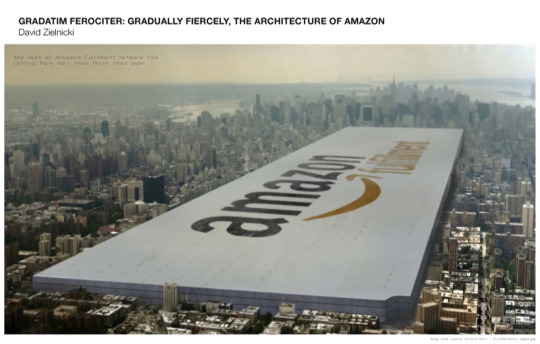
    Screenshot from the video:

    image

    Despite their ethereal appearance, technology giants still have large physical footprints for servers, production, logistics, and so on. But there’s no reason – or way – to accommodate them inside of our cities and so they cluster outside, in the 97-98% areas. These are places like the Tahoe-Reno Industrial Center, which is the home of Tesla’s new Gigafactory.

    Because of sheer scale and because there’s no need for them to possess much in the way of humanistic qualities, these are spaces which are void of architecture, urbanism, and, in some cases, a light spectrum beyond what is absolutely necessary for the specific function of the building (discussed in the video).

    Of course, the periphery has long serviced the core. But Koolhaas’ thinking has, as it often does, made me consider this phenomenon in a slightly different way. He paints a picture of a spiky world where we are all crammed into sensor and app-driven cities (the front-end), all of which are then powered by big mechanistic boxes that many of us may be naive to (the back-end). In some ways it feels like the Matrix. What we see and experience could just be the tip of the iceberg.

    Architecture may be unbearably slow, but as a society we have always built what matters to us most at the time. At one point it was places of worship. But today, at least for part of our landscape, it is boxes not intended for us to really experience. Maybe that’s not really architecture. Maybe it is simply the back-end for our cities.

  • Toronto exploring road pricing on downtown highways

    Road pricing is on the table in Toronto. (Somebody has to fund the expensive Gardiner Expressway East rebuild.) On March 11, 2016, the City issued a Request for Proposal for: “Options for Establishment of Toll Facilities on F.G. Gardiner Expressway/Don Valley Parkway.”

    As a vocal supporter of road pricing, I am happy to see us headed in this direction. And I bet that today’s post will just be the beginning of my ruminations on this topic.

    Because naturally, it raises a lot of questions:

    Should the pricing be fixed or variable? Similar to how Uber’s surge pricing model is intended to ensure that there are always enough drivers on the road, should our road pricing model strive to eliminate traffic congestion by increasing the price of the road as demand rises beyond road capacity? I like the idea of a “congestion charge” rather than just a road toll. There’s something very efficient about it.

    Who should pay? Should anyone and everyone who uses the road pay? Or should it just be be non-Toronto residents who aren’t already paying property taxes in the city? I would imagine that this latter scenario would be easier for Toronto politicians to get behind, since there will obviously be a segment of people who flat out don’t want road tolls/pricing. But if we stick with the principle that it’s a “congestion charge”, then everyone should pay. It doesn’t matter where you live when you are demand trying to exceed the available supply of road.

    (I’m running a Twitter poll right now with this exact question. At the time of writing this post, “everyone should pay” is winning.)

    Should electric vehicles be exempt from the road tolls or congestion charges in order to help accelerate our transition away from fossil fuels? With Tesla getting ready to announce its mass market Model 3 (price $35,000), I’ve been thinking lately that the car I currently own may very well be the last gasoline car I ever own.

    It’s still early days for road pricing and our mayor doesn’t seem to be a fan. So who knows how far we’ll get with this RFP. But I for one hope that we find the courage to make the difficult decisions and that this new revenue stream is leveraged for the purpose of building more sustainable forms of urban transport in this city. 

    Let’s make a 50 year decision and not an election cycle decision.

  • Getting distribution and how that is changing

    Aaron M. Renn recently published an article in The Washington Post talking about carless cities and driverless cars. It’s an interesting read, but I’m not going to talk about those topics today. So if that’s what you’re looking for, you’ll have to read his piece.

    I do, however, want to focus on one particular aspect of it. 

    In it, he talks about how Tesla is shifting the “locus of power in the auto industry” from Detroit to Silicon Valley and, at the same time, changing the way cars are sold. Tesla sells direct to consumers through its corporate stores, whereas franchise laws in almost every U.S. state mandate that new cars need to be sold through dealers.

    I’m not sure how these laws came to be, but it’s interesting to note yet another example of technology and the internet sparking disintermediation. That is, the removal of middle people, distributors, brokers, and so on. It’s the same thing that is happening as a result of companies like Uber and technologies like Bitcoin.

    I would imagine that lot of these legacy distribution models exist today because it was previously the most efficient option. If you were a car company based in Detroit, a network of local franchisees all across the country working to sell your cars was probably a great thing. But now there are other options, as is the case with many other industries.

    So what’s next? 

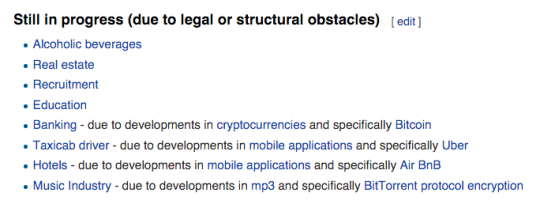
    Wikipedia calls out the following industries as still being in the midst of disintermediation:

    I bet you all know which one I’m watching closely.

  • We are all selfish bastards

    cyclist on bike lane by Axel Bueckert on 500px.com

    https://500px.com/embed.js

    We are all selfish bastards when it comes to sharing road space and public space.

    When we drive, we complain about pedestrians jumping out in front of us, crazy cyclists who get in our way, and under-utilized bike lanes that are taking away valuable driving space and creating traffic jams.

    When we take surface transit (such as buses and streetcars), we want all the cars out of the way so that we can move more efficiently. And we complain about drivers who don’t stop to let us off and on when the streetcar doors open. (Toronto specific reference.)

    When we cycle, we complain about cars parked in the bike lanes, people who don’t look before changing lanes or opening their car doors, and drivers who honk at you because they just want you off the road and onto the sidewalk.

    And when we walk, we complain about cyclists who ride on the sidewalk (they should be on the road!), cars that don’t stop to let us go, and slow walking groups who linearly block the entire sidewalk so you can’t pass.

    We are never happy. And we automatically assume that we could do it better. (I know I’m guilty of this.)

    But here are a few things to consider the next time you’re flipping the bird to someone on the streets. Here are a few things that we do know about urban mobility.

    There is an unprecedented number of condominiums in the development pipeline right now in Toronto. For argument’s sake, let’s assume 75,000 condominium suites – many of which will be built in central areas of the city.

    At a parking ratio of 0.6 stalls per unit, which isn’t an unreasonable assumption today, that’s 45,000 new parking spots and potentially 45,000 new cars in the city. 

    If you think that 45,000 new cars will be able to get fully absorbed into the core and somehow move around in an unfettered way, then I believe you are mistaken. 

    If you think that there’s something that can be done to magically expand road capacity to handle all of these additional cars in the city, then I believe you are mistaken.

    And if you think that adding a bike lane is the only reason you are currently stuck in traffic, then I believe you are missing the bigger picture.

    Over a decade ago, we made a decision in this region to encourage building up, instead of building out. And along with that decision came a necessary rethink of how we get around. That transition is what we are living through right now.

    The other thing we know is that the 4 modes of mobility that I started this post with are ordered from least sustainable to most sustainable. 

    Electric self-driving vehicles will reduce the impacts of driving, but it will also transform it into something that feels more like transit and less like the driving we know today. That will be a very good thing.

    But I’m not yet convinced that it will solve all of our problems. To do that I think we will need to adopt a much more balanced and unselfish view of what it takes to move around a city. That, of course, isn’t always easy.

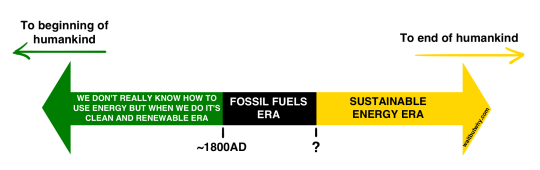
  • A history of energy and cars (and how Tesla is changing the world)

    image

    I spent this morning reading a long – but incredibly worthwhile – article by Tim Urban on Wait But Why called, How Tesla Will Change The World. (Are they all this long? It was my first time reading WBW.)

    The article, of course, talks a lot about Tesla, but it’s so much more than that. It talks about (1) the history of energy, (2) the history of cars, and then about (3) Elon Musk and Tesla. If you have the time, I highly recommend you give it a read.

    But since it is long and many of you probably won’t do that, here’s an extract from the third section on Tesla (EV = electric vehicle/car):

    EVs aren’t there yet. Right now, there are legit cons. But as the next few years pass, EVs will get cheaper, battery ranges will get longer and longer, Superchargers will pop up more and more until they’re everywhere, and charging times will just decrease as technology advances. Maybe I’m missing something, and I’m sure a bunch of seething commenters will try to make that very clear to me, but it seems like a given to me: the gas era is over and EVs are the obvious, obvious future.

    The car companies, as I mentioned, aren’t happy about all of this—they’re acting like a kid with a cupcake whose parents are forcing them to eat their vegetables.

    But how about the oil industry?

    Unlike car companies, the oil industry can’t suck it up, get on the EV train, and after an unpleasant hump, continue to thrive. If EVs catch on in a serious way and end up being the ubiquitous type of car, oil companies are ruined. 45% of all the world’s extracted oil is used for transportation, but in the developed world, it’s much higher—in the US, 71% of extracted oil is used for transportation, and most of that is for cars.

    As Tim states at the end of his article, this piece is all really about change and progress. Progress is not inevitable. It doesn’t just happen as time marches on. It happens because of strong willed people who believe in something that many others probably don’t. 

    Because with many changes – regardless of how critical or beneficial they may be to society as a whole – there will almost always be entrenched interests that would rather see things stay exactly the same. But in my view, that shouldn’t get in the way of doing the right thing.

    Image: Wait But Why