
I have a friend who is a big fan of Tesla. And judging by what’s going on with the company’s stock these days, he is not alone. This morning he sent me this article talking about how Tesla has introduced an entirely new business model for the automotive industry. The two key takeaways are as follows. One, Tesla is in many ways a software company. The hardware and software onboard each vehicle are continually getting better and oftentimes these improvements are delivered to their customers for free via over-the-air updates. This is not how the incumbent car companies work. And two, fully electric vehicles are going to crush after-sales revenue by virtue of the fact that electric vehicles simply don’t require the same amount of service. So now you’re in a position where the cars last longer (and apparently depreciate a lot less). This might seem bad for business, but if you can build an ecosystem of energy products and services around said car, then maybe you’ve got a big ass Tesla moat. Maybe. I have no idea what the company should be valued at today, but all of this is interesting to me and I’m fairly certain that the car I have right now will be the last combustion engine vehicle I ever own. Depending on when autonomy arrives, it may also be the last car I ever own.
Tag: tesla
-
The car revolution is being powered by software

Frederic Filloux publishes a regular newsletter called the Monday Note. It’s generally all about tech and new emerging business models. His latest post, called “Code, on wheels,” is about Tesla and the software revolution that is currently underway in the car industry. And it’s a good reminder of just how unique Tesla appears to be as a car company and how software is bound to infiltrate all aspects of our economy. Already you’re hearing people make a distinction around “pure” software companies. This is necessary because of how ubiquitous it has become.
Here is a a longish excerpt from Filloux’s article:
But the ultimate leap in value will be the creation of an application ecosystem. The limit will only be the imagination of app creators. As an example, airport operators are likely to develop apps to manage car traffic and passenger flows. Here is a use case: Your flight departing from San Jose Airport leaves in an hour. Your dual app system — one in your phone, the other in the car — checks the flight status, the gate, and the traffic. It notifies you when it’s time to leave. Once in the vicinity of the airport, the app guides you to the parking space nearest to the gate. An alternative and slightly more futuristic scenario involves you dropping your car in front of the terminal, then letting the autopilot send the car to the long-term parking lot a few miles away (this will soon become feasible as geofenced environments such as airports will be well-suited for Level 4 autonomous driving).
Again, this implies major changes in the way car software is currently handled. These scenarios require the car and the phone apps working seamlessly, exchanging data in real-time with the airlines, the airport, the navigation system of the car, the parking infrastructure, and eventually, the autopilot. We are not there yet, but by that time, the dust will have settled: either carmakers will have developed their own OS — along with the SDKs to foster the development of third-party apps — and/or, tech giants will have taken-over, leveraging their current market positions in the phone sector to impose their own norms. I always thought that Apple had that in mind when it hired legions of engineers for its Titan project and filed applications for self-driving cars to the California Department of Motor Vehicles. I doubt that they completely gave up on the idea of replicating what they achieved for the 500 billion smartphone market with the 3 trillion dollar car sector.
There are many in the planning world who are quick to dismiss autonomous electric vehicles as being more of the same. They’re still cars, right? For better or for worse, the internal combustion engine was massively transformational to cities — just as previous advances in transportation were. But what comes next is still mostly unknown because, even if you assume that autonomy is a foregone conclusion, it’s unclear how this and an app ecosystem could change how “cars” function in our cities. What will be the spatial impacts?
It is, however, clear to me that when things do start to really change, it will be because of software.
Photo by Jannis Lucas on Unsplash
-
Comparing ICE vehicle and electric vehicle travel times
While we were doing our West Palm Beach to Toronto road trip last weekend, I started wondering how much longer the trip would be taking had we been driving a Tesla. The drive, according to Google Maps, is normally about 20 hours and 46 minutes. It’s a long one. About 2,288 km. The mountains in Virginia are nice, though.
The route I threw in is West Palm Beach to Junction House (2720 Dundas St W, Toronto):

According to Tesla, this same route using a Standard Range (400km) Model X SUV is now estimated to take 34 hours.


The additional travel time is a result of charging time (anywhere from 20 – 70min per charge depending on the device) and the fact that you need to go where the chargers are. In this scenario, you end up driving an additional 155 km. However, you will end up saving money on gas.
This reminds me of something that Bill Gates argued in the talk I recently posted. Electric vehicles are the future of personal transport, but they’re not great for commercial applications: planes, boats, and so on. The battery capacity simply isn’t there, and it’s unlikely to be there anytime soon. But perhaps the charging times can be brought down. That would help.
I’m not planning on doing this drive again anytime soon. But if any of you are, you may want to leave the Tesla at home if you’re in a rush. However, using an EV would, of course, be the right thing to do for our planet.
-
Thoughts on Autonomy Day
This past Monday, Tesla held an event for its investors called “Autonomy Day.” It was livestreamed, but if you missed it, here’s the video. It’s almost 4 hours long, though the first hour is just footage of Tesla vehicles driving around. I’m assuming it was background content.
I’ll be honest in that I haven’t watched it all. But there’s a lot here if you want to get into the inner workings of how their self-driving cars work. Musk also promises, at the event, that Tesla will have level 5 autonomy ready by the middle of next year (2020). At that level, you will no longer need to pay attention to the road as a driver.
Along with this autonomy, the company plans to start rolling out “robotaxis” and a ride-hailing app that will allow owners to rent out their cars. Musk is predicting that this could generate upwards of $30,000 in profit per year for owners. Of course, at this point, nobody really believes any of these promises. Musk is notorious for overselling.
But let’s imagine that robotaxis are the future. Maybe it won’t happen by the middle of 2020. But it will happen at some point.
If taxis are automated machines that drive people around all day and then go and park somewhere during off-peak times, where do they want to go and park? Does autonomy all of a sudden disconnect the locations of owners and parking, because your car will simply come to you when you need it?
And what do these feature mean for parking supply? Presumably (and we have talked about this before on this blog), you need less parking and it wants to be in locations where the real estate values are less. But because of this, I bet that we’re going to need to start — and get really good at — pricing road usage.
What are your thoughts?
-
Boring Company ran a Tesla through its test tunnel
This week Elon Musk’s Boring Company ran a Tesla through its 1.14 mile-long test tunnel in Hawthorne, California. This was accomplished by using a set of tracking wheels that Elon said, “turns a car into a rail-guided train & back again.” Apparently it is safe up to 150 miles per hour. Here is a video from yesterday’s unveiling (click here if you can’t see it below):
[youtube https://www.youtube.com/watch?v=WQn-D-i5lyM&w=560&h=315]
Some, or perhaps many, are skeptical of how this could work at scale in a dense urban environment. The company is imagining a world where every house or office building has one of these lifts (shown in the video) in their garage or basement. But there’s no question it is very cool and apparently this test tunnel only cost about $10 million per mile to dig. That’s progress in and of itself.
-
Is Tesla the new iPhone?
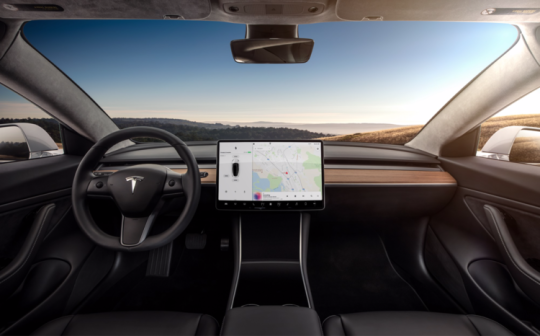
Benedict Evans just published a great post on his blog about “Tesla, software and disruption.” I recommend a full read. In it, he tries to answer whether Tesla is really “the new iPhone” and if it will be as disruptive to the car landscape as some/many people think.
In his line of thinking, electric (as opposed to an ICE vehicle) feels a lot more like a sustaining innovation, rather than a disruptive innovation. In other words, it something that incumbents will be able to incorporate. So it will not change the “basis of competition.”
The more critical aspect is instead autonomy. Here are two snippets from the piece:
All of this takes us to autonomy. Electric is compelling but will probably be a commodity, whereas Tesla’s improvements on top of electric may not be commodities but are not necessarily decisive. Autonomy changes the world in profound ways (I wrote about this here), and it’s a fundamentally new technology that doesn’t look at all like a commodity. And Tesla is doing this, too. Sort of.
In this competition, Tesla’s thesis is that the data it can collect from its cars will give it a crucial advantage. The only reason that anyone is interested in autonomy today is that the emergence of machine learning (ML) in the last 5 years probably gives us a way to make it work. Machine learning, in turn, is about extracting patterns from large amounts of data, and then matching things against those patterns. So how much data do you have?
But even if we are to all agree that autonomy is the “disruptive innovation”, it is not yet clear who will get there first. Maybe it is Tesla. Maybe it is Waymo. Regardless, many or most people seem to agree that it will arrive in 202x.
Image: Tesla
-
Economies of scale in the car and housing industries
Over the weekend I watched this interview discussion between Elon Musk and Marques Brownlee. If it doesn’t show up below, you can find the video here.
[youtube https://www.youtube.com/watch?v=MevKTPN4ozw&w=560&h=315]
Elon figures that if Tesla works really hard they could probably come out with a USD 25,000 car in about three years. The key to that affordability is twofold: (1) design & technology improvements and (2) scale.
So part of the answer is just time. As design and engineering iterations continue to take place, the components will become better and cheaper, just as they have for things like cell phones. Elon estimates that we’re in the 30th iteration of the cell phone today.
But the second factor is simply volume. And that got me thinking about housing production and the similar importance of scale and density. We do a lot to limit volume, despite saying we want more affordable housing.
-
Great things that happened on transit
Elon Musk’s apparent distaste for public transit and random strangers prompted a Twitter battle last week. Though for the record, Musk later clarified that he loves trains, most subways and London buses.
Transit planner Jarrett Walker retorted that Elon’s views are the “essence of elite projection”. What’s good for Elon Musk may not, in fact, be good for the broader society. Elon responded by calling him an idiot.
All of this prompted Brent Toderian – city planner and former chief planner of Vancouver – to initiate the hashtag: #GreatThingsThatHappenedOnTransit. It then took off and the transit stories started pouring in.
Not surprisingly, this has been getting a lot of attention. It’s Elon Musk after all. But billionaire celebrities aside, it does serve as a good example of the two sides of this debate.
Some people seem to think that I am anti-car. I can see why some people might think that, but I am not anti-car. I love nice cars. And I love nice trains. What I value first and foremost is the city.
The kind of city you can build on the backbone of transit is very different than the kind of city that gets built around the car. And as a rule of thumb, I prefer the former over the latter.
But this is not to say that the public transit model is perfect. It’s far from perfect for many reasons. And it can get even more imperfect when we don’t pair it with the right land use policies.
Deploying heavy rail through low density areas – that are by design inhospitable to car-less humans – will not magically flip the modal split. Public transport alone cannot solve that problem.
At the same time, if you’re a regular reader of this blog you’ll know that I am enamoured by the possibilities of autonomous electric vehicles. I am not assuming that the “car” of tomorrow will look and perform anything like the car of today.
Mobility is such an exciting space right now.
-
Why I write about tech on my city building blog
I had a friend ask me this week about how I decide what to write on this blog. His comment was that I tend to write about a variety of different topics. He wondered: Isn’t it better to focus on one particular niche?
The simple answer is that I write about what interests me. And secondary to that is any concern around what will get the most clicks. In fact, I try not to fall into the trap of worrying about the latter. Sometimes it can be paralyzing to fixate on what will appeal most to the tens of thousands of people who read this blog on a regular basis.
The reality is that my interests are much broader than, say, just design and real estate; though these two topics are clearly central.
I learned a long time ago while studying architecture and art history that what we make as a society is generally a product of the cultural milieu at the time. In other words, the built environment doesn’t happen in a vacuum. It is the physical manifestation of what we believe to be true at a particular moment.
Today, it’s pretty hard to ignore the importance of tech. Think of some of the most valuable companies in the world right now: Apple, Google, Amazon, Facebook, and so on. Now, technology has always shaped our cities, but what makes this moment different is the decisive shift toward software.
It’s arguably no longer about who can build the best mousetrap. It’s about who can build the best software layer on top of that mousetrap.
In 2011, venture capitalist Marc Andreessen (previously the co-founder of Netscape) published a widely shared essay called, “Why Software Is Eating the World.” And over the past 6 years he has been proven to be very right.
The 3 main points he aimed to make with that essay are as follows:
- Every product or service that can become software will become software.
- Every company will have to become a software company.
- The winning companies will be the best software companies.
Depending on your industry, this may sound ludicrous to you. Certainly in 2011 it probably seemed that way.
But a perfect example of this phenomenon is the iPhone. The phone itself is manufactured in China, albeit where a lot of great hardware innovation is taking place.
But at this point, phones have become fairly commoditized. The profits that Apple makes from the iPhone disproportionately come from the software layer and the app ecosystem it has developed.
You could make a similar argument with Tesla. Autonomous navigation – which most of us can agree will have a profound impact on cities – is largely a software challenge.
And so if you believe that autonomous vehicles will be a fundamental part of the future of mobility, then it’s not that hard to believe in point number three: the winning car company will also have to be the best car software company.
Some industries have been less touched by tech and software – real estate being one of them. But if Andreessen is right and it’s not a question of if, but a question of when, then it behooves all of us to think about the potential impacts.
I love how Andreessen ends this podcast discussion with Barry Ritholtz of Bloomberg and so I’m going to repeat it here to close out this post. He says: “There are no bad ideas. There are only early ideas.”
And that’s why I write about tech on my city building blog.
Photo by Michal Pechardo on Unsplash
-
Betting on electric and autonomous
On Monday, Tesla surpassed GM in market value, making it the most valuable U.S. automaker. It’s also the first time in modern history that this title was held by a car maker not based in Detroit. The gravitational pull to Silicon Valley is immense, today.
I subscribe to Alan Murray’s CEO Daily newsletter and his overarching comments were as follows: GM sold 10 million cars last year. Tesla sold 76,230 cars (albeit high value cars – my 2 cents). And Tesla lost three quarters of a billion dollars last year. Are we partying like it’s 1999?
This is an expectations game.
Elon Musk crafted an electric sports car that was actually cool and Tesla is certainly one of the leaders when it comes to autonomous vehicle technology. If Tesla is the company that transitions our economy to both electric and autonomous vehicles, then is a current market cap > $51 billion justified?
I don’t know.
But given how often we talk about electric and autonomous vehicles on this blog (in the context of city building), I thought it would be worthwhile to also talk about where Wall Street is putting its money and placing its bets.