Daily insights for city builders, delivered every morning at 6 AM ET. I’m Brandon Donnelly — a Toronto-based real estate developer and founder of Globizen. I’ve been writing here since 2013.
One of the reasons why I’m interested in the autonomous vehicle space is that I know our built environment is sticky. And because we’ve designed so much of it around the car, it’s hard to imagine this dependance going away anytime soon.
In fact, there’s a very real possibility that autonomy leads to further decentralization. That is typically what happens when we make it easier and cheaper for people to travel longer distances. They sprawl. So we ought to start preparing ourselves for the positive and negative externalities.
I’m not a deep expert on autonomous vehicles, but as an interested observer, Waymo appears ahead of Tesla in delivering this future. Waymo has been offering fully driverless rides since 2020 and Tesla is still at L2 autonomy, which means a driver needs to be present in the vehicle.
I hear from lots of people that their Full Self Driving (FSD) software is pretty good, but according to some studies, it can require human intervention as often as every 13 miles. This doesn’t necessarily mean that Tesla won’t be first to “solve autonomy,” but their Cybercab isn’t here yet.
If you’re interested in this topic, here is an article by Timothy Lee summarizing a discussion that he recently had with the co-CEO of Waymo, Dmitri Dolgov. Some of it is a little technical, but it does offer a comparison between Tesla and Waymo.
That is, how their approaches differ and what the future might look like.
I like the way that Scott Galloway describes entrepreneurship in this recent post about why he’s bearish on Tesla:
Entrepreneur is a synonym for salesperson, and salesperson is the pedestrian term for storyteller. Pro tip: No startup makes sense. We (entrepreneurs) are all impostors who must deploy a fiction (a story) that captures the imagination and attracts capital to pull the future forward and turn rhyme into reason. No business I have started, at the moment of inception, made any sense … until it did. Or didn’t. The only way to predict the future is to make it.
He then goes on to describe the difference between an entrepreneur and a liar:
This is not the same as lying. There’s a real distinction between an entrepreneur and a liar: Entrepreneurs believe their story will come true, as they are laser-focused on making it true. A liar, well, they know they’re misleading people with false data. Usually for money (i.e., fraud). This is where Tesla turns gray.
Scott continues to say things about Elon and Tesla. But that’s not the point of today’s post.
The point I would like to make is that real estate development is an inherently entrepreneurial endeavor. You need to be a salesperson and a compelling storyteller, because that’s the only way you’ll be able to create the future. And creating the future is what developers do.
I watched Tesla’s We, Robot event last night. As many of you know, Elon and his team showcased a Cybercab, Robovan, and a humanoid robot that dances funny, all of which will be available in the market for purchase at some unknowable date in the future. What was obvious is that Elon himself has no clear idea of when this will be.
What I will say, though, is that the designs look cool. The Cybercab looks like a Porsche and a Cybertruck had a love child, and the Robovan looks like an Art Deco rendition of what the future is supposed to be like. I first wondered why they’d create a robotaxi with only two seats. But thinking about it now, most Uber rides probably only have 1-2 passengers.
Despite these pretty designs, the overwhelming reaction to the event seems to be one of disappointment. We’ve heard what was said before. Public transportation is bad (I disagree). Autonomy will free up your time and remove unnecessary parking spaces from our cities (allowing for more public space). And soon you’ll be able to put your under-utilized car to work and earn extra cash.
Cool, but when?
Waymo and Uber are not, as far as I know, hosting similarly flashy events. But as far as I can tell, they’re making meaningful progress in advancing toward full autonomy. As of June of this year, Waymo had already logged over 22 million rider-only miles. And in September, they announced a partnership that would bring AVs to Austin and Atlanta by way of the Uber app.
At this point in the hype cycle, I don’t think anyone is interested in hearing promises about what the future of autonomy will be like, especially without any firm dates. They want to know: Are we there yet? So I think it’s no surprise that people, including investors, weren’t all that pumped up by the event.
On a more important note, Tesla had bicycles with brightly illuminated wheels circulating around their event set (at Warner Bros.) to presumably demonstrate that their Cybercabs can successfully navigate around moving objects (when brightly illuminated). If you missed them, look at the 29 second mark in the below video:
I can’t be the only one who thought: “What are those? Now, that’s what I want!” So I’ve asked Elon when they’ll be available and when I can buy one. I’ll keep you all posted on his response.
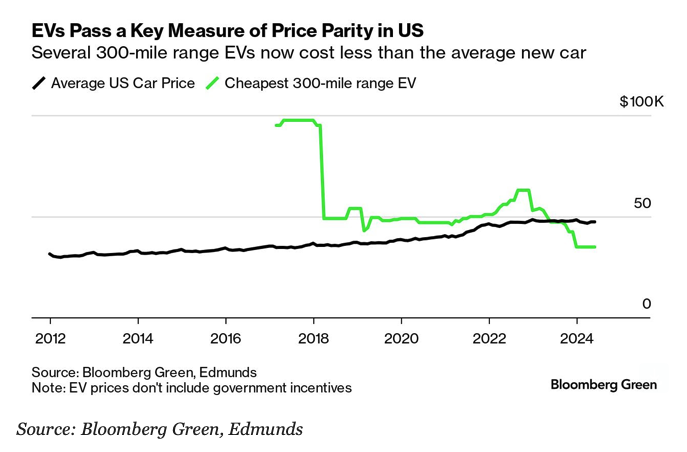
According to Bloomberg Green, there are now at least three car manufacturers — Tesla, Hyundai-Kia, and GM — with electric vehicles that (1) have a range greater than 300 miles (480 kilometers) and (2) cost less than the average price of a new vehicle in the US (which is currently around $47,000). This means that we are now approaching price parity:
This is an important adoption milestone, even if it does, at this point, feel totally expected. The International Energy Agency (IEA) is forecasting full price parity by 2030. But in my mind, I’m already done with ICE vehicles. When I bought my current car over 6 years ago, I knew it would be the last internal combustion engine I ever own.
I’ve said this before, but the car I currently have will certainly be the last internal combustion engine vehicle that I own. I truthfully even felt a bit weird buying it 6 years ago, but at the time, there weren’t that many options other than a Tesla. And I didn’t want a Tesla.
This means that we are just under 1 out of every 10 new cars sold in the US. The trend line is also working in the right direction. 1.44 million new EV units is roughly the total number of EVs sold between 2016 and 2021 in the US.
So things are accelerating. And presumably there are other people like me waiting on the sidelines. I am deliberately roughed in for an EV charging station in my new parking spot and, if/when it comes time to purchase a new car, that’s exactly what will get installed.
(I added “if” because, depending on how mobility evolves over the next 5-10 years, there’s a chance I may no longer want to own a car.)
This is the current state of global electric vehicle adoption:
Last year was the first year that global electric-vehicle sales reached 10% of all car sales — the total was around 7.8 million cars (see above chart)
Fully-electric vehicles accounted for about 5.8% of all car sales in the US, 11% of all car sales in Europe, and about 19% of all car sales in China — China is leading in this department
The US saw 807,180 fully-electric vehicle sales last year — Tesla remains the biggest EV maker in the world
In Germany, electric vehicles accounted for about 25% of all new vehicles produced last year — BMW reported a 5% decline in new-car sales, but saw its EV sales more than 2x
Similar story with Volkswagen: 7% decline in new-car sales; 26% increase in EV sales
This year, some are predicting that China will see EV sales increase to every third car, and that it will reach its tipping point sometime between 2025-2030
It is obvious where all of this is heading. It is simply a question of how fast, and who will be the leaders at the end of the day.
Nabr, which I wrote about last year over here, recently announced its first residential project in San Jose’s SoFA district. Named SoFA One, the project is expected to have 125 apartments that will be offered up on a hybrid lease, own, and lease-to-own model. In this latter scenario, the company is saying that people will be able to buy with as little as 1% down. Construction isn’t scheduled to start until later this year, but if you’d like to get early access, you can add yourself to their waitlist, here.
As a reminder, Nabr is touting itself as a direct-to-consumer real estate company that aims to bring the same manufacturing and supply chain efficiencies that we have seen in virtually all other industries to the production of housing. This, of course, is not a new ambition. The flatlining of construction productivity is well documented, and lots of architects, builders, and entrepreneurs have tried to innovate in this space over the years. But it’s clearly a notoriously difficult problem to solve. So the obvious question here is: What is going to make Nabr any different?
Nabr is trying to productize housing. To do this, they’re building a vertically integrated process, going deep into supply chains, and trying to standardize their product offering as much possible. In the case of SoFA One, the base building is expected to consist of a CLT loft-style frame that can then be fitted out with various interior offerings. The idea here is that 90% of the build will be a repeatable system but that the remaining 10% is something that their customers will be able to customize — similar to when you’re buying a new car. The car is the same, but would you like black leather or brown leather?
Continuing with the car analogy, the company is also taking a move out of Tesla’s playbook for how they plan to roll out their products. The plan is to start at the top of the market (like what Tesla did with its expensive roadster) and then move downmarket as they drive efficiencies and cost savings in their delivery process. What they are trying to do is find the compounding innovation that has been present in most industries but that has been noticeably lacking from construction.
This all sounds great, but we know that buildings have a myriad of unique challenges compared to other products like cars and smartphones. My iPhone is the same as your iPhone, except for maybe the color and the case I put on it. But each development site is unique. Some have a high water table below it and some don’t. Some have adjacencies that will impact how you need to build and some don’t.
Each jurisdiction also has unique codes and regulations — everything from urban design guidelines to more or less stringent seismic requirements. Some cities have snow and some cities don’t. The list goes on. So what Nabr is going to have to do is create regionalized products with as much repetition as possible. And if they can generally lock the ~90% base building systems and just adjust the balance as needed, maybe that’s enough to do it.
At the end of the day, our industry is not completely void of innovation. It’s just a bit slow to change. We never used to build skyscrapers, but now we do. So I’ve decided to cast my developer cynicism aside. Today, we don’t have truly productized housing, but maybe we will.
As an aside, Nabr also recently shared their leaderboard of cities where people want to see a future Nabr building. Those cities are New York, London, Los Angeles, Toronto, and San Francisco.
Google Maps recently introduced a new feature that allows you to search for electric vehicle charging stations by plug type. Here’s what it looks like when I tried it here in Toronto:
While helpful, it demonstrates two things. One, there are too many plug types and that’s a problem for EV adoption. Nissans and Mitsubishis use CHAdeMO, BMWs use CCS, and Tesla has its own proprietary plug, for example.
Two, this is one the main reasons why Tesla is so far ahead when it comes to EVs. They’ve been very purposeful in building out an expansive network of charging stations so as to avoid what is very clearly a chicken-and-egg problem. You need great EVs and then places to charge said vehicles.
As of January 2021, Tesla operates over 2,105 Supercharger stations worldwide with over 1,094 stations in North America, 589 in Europe, and 423 in Asia/Pacific. This is how you start to compete when there are over 160,000 gas stations in the US alone.
This week, Union Square Ventures, which describes itself as a “thesis-driven venture capital firm,” announced a new $162 million Climate Fund. The thesis for this fund is pretty simple. They want to invest in companies that either provide mitigation for or adaption to the climate crisis. The thinking behind this approach is as follows. They want to invest in companies that directly attack the causes of climate change (mitigation), but they are also recognizing that the climate crisis is not some distant thing. It’s already here, which is why it’s important to also focus on companies that are dealing with the consequences of it (adaptation).
One of their first investments is in a company called Leap. What Leap does is provide the connective (software) tissue between local energy devices/applications and the broader energy markets. For example, let’s say you have a Leap-enabled smart thermostat. If the grid is in need of power, it might automatically reduce your local energy consumption so as to help with load balancing on the broader network. In exchange for this, you would earn money for your contributions. In effect, Leap acts as a kind of virtual power plant.
Why does this matter? Well, it matters because two important things seem to be happening with energy production: (1) It’s moving toward renewables and (2) production and storage are both decentralizing. Assuming this trend continues, there will be an increasing need for software to help manage energy consumption, production, load balancing, the broader energy markets, and so on. That’s where companies like Leap come in. It’s also why many are arguing that Tesla is so valuable. More than an EV company, it is creating a new decentralized renewable energy network through its car batteries, powerwalls, and solar panels.
But here is the thing about speculative frenzies – they are generally directionally correct but off in their order of magnitude. And they finance the trend that they are directionally correct about. It may be the case that Tesla’s market capitalization is too high, but that allows Tesla to raise $10bn without diluting more than a few percentage points. And that $10bn will go towards accelerating the conversion of the auto industry from carbon-based fuel to renewable energy. And that is a good thing for society.
When I first read this my mind immediately went to tulip mania. Was that directionally correct? Did tulip bulbs ultimately rebound and maintain their value over the long-run? I actually don’t know.
But if you think about the dot-com bubble, that was directionally correct. Sure, infamous “companies” like Pets.com never ended up going anywhere, but the idea of tech and the internet becoming dominant was absolutely right.
Fast forward twenty years and you can be sure that many people are now buying their pet supplies online, along with pretty much everything else. Sometimes we simply overshoot and get the timing wrong.
This is perhaps a good thought for all of us to consider as we welcome 2021 and say goodbye to what was one weird and terrible year.
Being directionally correct means that it’s okay for there to be bumps, mistakes, and speculative frenzies along the way. They are expected. What matters is the path forward.