Daily insights for city builders, delivered every morning at 6 AM ET. I’m Brandon Donnelly — a Toronto-based real estate developer and founder of Globizen. I’ve been writing here since 2013.

Tag: tech

  • My new gig…

    image

    So this is interesting.

    Earlier this month, Travis Kalanick – co-founder of Uber and its former CEO – formed a new venture fund called 10100. According to the WSJ, it was funded with his own money after he sold 30% of his position in Uber for a cool $1.4 billion. 

    Ten-one-hundred’s spartan website explains that the goal of the fund is “large-scale job creation, with investments in real estate, ecommerce, and emerging innovation in China and India.” On the non-profit side, the initial focus will be on “education and the future of cities.”

    Then this week, Travis tweeted out “My new gig…” and disclosed that 10100 had entered into an agreement to buy a controlling interest in a real estate holding company called City Storage Systems (CSS) for $150 million. 

    He also announced that he would become CEO.

    The focus of CSS is on the redevelopment of distressed real estate, particularly parking, retail, and industrial assets. He goes on to say: “There are over $10 trillion in these real estate assets that will need to be repurposed for the digital era in the coming years.”

    This whole series of events is a big bet on some significant changes in the real estate space.

    Photo by Martin Reisch on Unsplash

  • UNStudio announces new tech architecture company (and thoughts on the smart home)

    Dutch architecture firm UNStudio has just launched a new company called UNSense, whose purpose is to explore and develop “new sensor-based technologies that are specifically designed to positively impact people’s physical, mental and social health.” They are calling the new business an “arch tech company” and it is their belief that, at some point, all architecture firms will become arch tech companies. You can learn more about UNSense, here.

    This announcement got me thinking about the state of smart home technologies, which, of course, is this massive buzzword that everyone is throwing around these days. Many of us have smart thermostats, voice assistants (that may be listening to our every word), wifi lights, and so on. And you can do some pretty neat things with software like IFTT, such as program your lights to come on at sunset or when you walk in the door.

    But as cool as they may be, these smart home devices have always felt like patchwork add-ons to me. I understand that this is partially driven by what customers can easily adopt and I don’t mean to discredit the value that they bring, but today’s post is about reminding us to also think more fundamentally, as opposed to just incrementally.

    Smart thermostats, for instance, give us the functionality to adjust our heating/cooling from our phone. But at the end of the day, they still control the same underlying system, which, by the way, is a fairly simple one. When it gets cold (because of our R-3 windows), the heat turns on. When it gets warm enough, the heat turns off. Zoned systems certainly add another layer of sophistication, but are we optimizing for the right variables?

    UNSense works at three scales: Cities, Buildings, and Interiors. And if you look at what they are trying to do at the building scale, it is around the interface between inside and out. Designing transformable facade systems and buildings that can respond to their environment and our changing needs. These are not new ideas, but in today’s tech-driven world, the timing may just be right.

    If you think about the climate we have here in Toronto, it is actually an incredibly difficult design problem. We have cold winters and hot humid summers, which means we have to solve for two different extremes. Mechanical systems have made that a lot easier to do, but if we’re going to meet the energy and greenhouse gas emission targets that we’re all talking about, we’re going to need a hell of a lot more than just smart thermostats.

    Image: UNSense

  • Amazon buys video doorbell company

    So Amazon is buying Ring (they make video doorbells, among other things) for north of $1 billion. Supposedly, it is the second largest acquisition that Amazon has ever made – the first was Whole Foods.

    If you consider that Amazon is also looking to enter the delivery business, it should be obvious that they want to control everything related to the home delivery process.

    For one, it likely enhances Amazon Key and helps with the “porch pirate” problem. Apparently Amazon has had to restrict same-day delivery from some high crime neighborhoods because of this exact problem.

    And there’s already speculation about what this could mean for grocery deliveries. Amazon needs to find a frictionless way to get your food orders into your refrigerator. 

    There are also many possible tie-ins to Alexa/Echo. It’s probably safe to assume that Jeff Bezos sees a lot more than just a doorbell with a camera in it.

  • Last-mile electric scooters — will they work?

    I’ve been hearing a lot about Bird recently. Perhaps it has something to do with the $15 million Series A round they raised last month (February 2018) and the $100 million Series B round they announced earlier today.

    A “Bird” is small electric scooters that look like this and can be rented from your phone for short haul trips. They are currently available in Santa Monica, Venice, UCLA, Westwood, and San Diego, and they are intended to be ridden in existing bike lanes.

    What may be particularly interesting to this blog audience is the fact that Bird is calling itself a “last-mile electric vehicle sharing company.” The pitch: 40% of car trips (in the US?) are less than 2 miles long. Let’s replace those using electric scooters.

    One of the first things that came to my mind is that this feels more accessible than cycling. Cycling to work can be a commitment. You have to think about your attire and the sweat factor, among other things.

    Would you agree?

  • Hmm…architecture and basic income

    Albert Wenger recently published a post on his blog about architecture and basic income. Albert is a venture capitalist and is currently working on a book called World After Capital, which I have mentioned before on this blog. He is also an advocate of basic income as a solution to the growing inequality that the modern economy seems to be producing.

    In this latest post he wades into the world of architecture with two assertions that I would like to respond to today. The first is that with basic income the current trend of everyone piling up in large cities will end. We will decentralize in search of cheaper land on the outskirts of cities. And the second is that affordable housing could perhaps be produced with a more open source approach to architectural drawings and new construction.

    In terms of his first point, I’m not entirely clear why someone earning a basic income would suddenly decentralize. In the comments there is some discussion about how retirees, on a fixed income, often move outward in search of more affordable housing. I understand that phenomenon, but I am not convinced in this scenario. 

    There has been lots of talk about the demise of cities because of new technologies and other factors. But agglomeration economies have proved, again and again, to be a powerful centralizing force. Let’s also not forget about the environmental impacts of large scale decentralization, which would only be partially mitigated by the widespread adoption of electric vehicles. 

    Secondly, you can build a house without an architect. The issue isn’t that good bathroom details are hard to come by. Some of the bigger issues are likely the availability of land (decentralization, I guess, is supposed to solve this); construction costs (it’s a highly inefficient process that generates copious amounts of waste); and the immense regulatory burdens imposed on new construction (process, time, and costs).

    All of this stemmed from a visit that Albert did with a group of architecture students who are researching the relationship between architecture and basic income. I would be very curious to see what they produce.

    What are your thoughts?

    Photo by Mathyas Kurmann on Unsplash

  • InsurEye acquires the Dirt

    Back in 2013, my friend Mike Lerner and I designed, developed, and launched a condo review platform called the Dirt (thedirt.co). It’s hard to believe that it’s already been five years.

    Our mission was to empower real estate consumers through greater transparency in the marketplace. And we did this by crowdsourcing condo building reviews, as well as pricing comps.

    Today we are excited to announce that InsurEye Inc. has acquired the Dirt. InsurEye began as a moderated insurance review platform for home, auto, and life insurance, but it has since grown to include condo reviews.

    The team at InsurEye shares a very similar goal of creating greater transparency in the marketplace, and so we are thrilled that they will be picking up where we left off.

    Press release, here.

    P.S. The Dirt is the reason why I started the daily blog that you are reading right now. I started writing for the company and fell in love with it as a discipline and practice. Life is lived forwards, but understood backwards.

  • Are we entering a new era of tech-driven city building?

    Emily Badger of the New York Times published an interesting piece yesterday talking about the tech industry’s current obsession with trying to fix cities. And there are certainly many problems to fix.

    Staying true to tech and engineering parlance, there’s lots of talk of optimization. How do you technologically optimize a city, for things such as affordable housing?

    There’s no doubt that many of you will sympathize with this statement: 

    To planners and architects, all of this sounds like the naïveté of newcomers who are mistaking political problems for engineering puzzles.”

    But naïveté is not always a bad thing and with all of the money sloshing around in this industry, there’s also no doubt that this is likely a new era of city building.

    The article ends by quoting JD Ross, the 27-year old co-founder of Opendoor – a startup that we have discussed many times before on this blog and is now valued at over $1 billion.

    It is him saying that he wants to figure out how to put $100 million into this space as soon as he can figure out the right target to optimize for. “It’s better than buying a Bugatti.”

    Of course Sidewalk Toronto – which is mentioned a few times throughout the article – is already a perfect example of tech infiltration.

    But I think Dan Doctoroff gets it right when he posits that the real naïveté will come from disrespecting urbanist traditions.

    Photo by David Alacaraz on Unsplash

  • Attract and extract

    Chris Dixon’s recent piece on why decentralization matters is currently making the rounds online. It clearly explains the first two eras of the internet and how the third era is developing as we speak. Cue decentralized cryptonetworks.

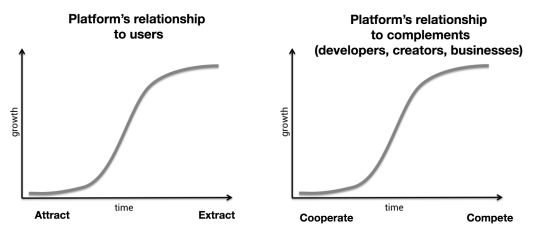
    I particularly like how he describes the relationship that centralized platforms – like Facebook – have to their users and to their complements (other businesses, software developers, creators, and so on). 

    Here are two graphs from his article:

    In the early days it’s all about cooperation and doing everything you can to attract users. The platform gets more valuable the more users are on it and so the immediate goal is to build up the network effects and lock people in.

    But as the platform grows, the relationship flips (top of the S-curve). In Dixon’s words, it becomes a zero-sum game whereby to continue growing the platform starts extracting data from its users and competing with its complements.

    The promise of cryptonetworks is that they will do away with many of these negative externalities, but at the same time empower the kind of sophistication that we see today with centralized platforms.

    The venture capitalists are circling because a fundamental shift in the architecture of the internet will mean disruption. I’m following it because I want to understand how it may apply to real estate and the built environment.

  • Experiences over fashion — or is that really the case?

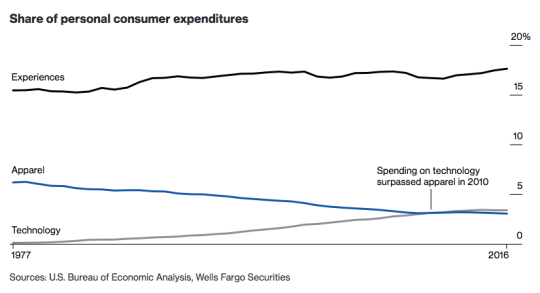
    Bloomberg recently published this interesting piece talking about the death of clothing. The reasons are as follows: we’re spending more on experiences, as well as technology (tech spending surpassed apparel spending in 2010); casual dress in the workplace has become more widely accepted; fast fashion companies like H&M and Zara are putting downward pressure on prices; and social media influencers – instead of big companies – are now the ones showing us what to buy and wear.

    Here is a graph from the article comparing experiences, apparel, and technology expenditures: 

    image

    The first thing I noticed is that experiences, while still increasing, haven’t really spiked since 1977, even though everybody seems to be talking about how social media-fueled Millennials are all about experiences. I was also surprised to see that the share of US employers that allow casual dress every day seems to be closing in on 50%. (Informal survey for the comments and for Twitter: Do you wear casual clothes to work? I’m a no.)

    But perhaps the biggest contributors to this decline are fast fashion and low-cost manufacturing. Stanley Pignal – South Asia business and finance correspondent for the Economist – pointed out on Twitter that since 1982 inflation in US apparel was only 123% compared to 248% for overall CPI. So maybe a lot of the above reasoning is just a distraction.

  • The case for self-driving electric car fleets

    Below is a presentation by Frank Chen – head of research, deal, and investing at the venture firm Andreessen Horowitz – which makes the case for self-driving electric car fleets.

    He starts the presentation by talking about why he thinks this shift is going to happen faster than most people think. 

    One reason for this is that the batteries are becoming dramatically cheaper and the battery makes up a large part of the cost. By 2025, it is expected that electric vehicles will become cost neutral with ICE (internal combustion engine) vehicles assuming zero government subsidies.

    And by 2038, Bloomberg believes we will hit peak ICE vehicle sales. That is, electric vehicle and ICE vehicle sales globally will hit 50/50. Norway has already hit this threshold but they impose heavy financial penalties on ICE vehicles.

    2025 is not that far away.

    If you can’t see the presentation below, click here.

    [youtube https://www.youtube.com/watch?v=of5j-Lztqrg?rel=0&w=560&h=315]