Daily insights for city builders, delivered every morning at 6 AM ET. I’m Brandon Donnelly — a Toronto-based real estate developer and founder of Globizen. I’ve been writing here since 2013.

Tag: tech

  • 1 out of 5 commuters in Manila relies on ride-hailing

    Earlier this year Uber sold its Southeast Asia business to Grab. At the time, it was estimated that Grab had 95% of the ride-hailing market in Southeast Asia. That’s why Uber decided to sell. Instead of continuing to bleed, they figured it would be better to instead merge businesses in exchange for a “sizeable stake in Grab.” This is similar to the deal that it struck in China with Didi.

    It’s clear evidence of cultural advantage. Though maybe you could argue it’s first mover advantage. Either way, many, including Wired, have argued that while Uber has dominated in the West, it has often struggled in the developing world. Different markets. When Grab launched you could pay with cash because so many users didn’t have a credit card.
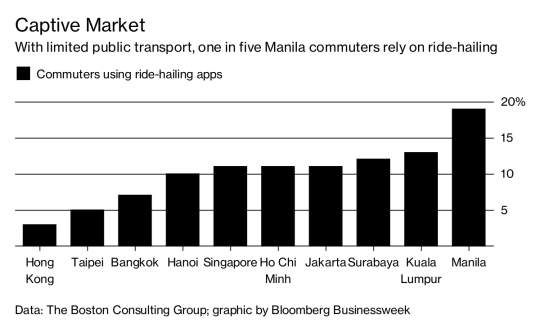
    Here is another interesting insight from Bloomberg (see above): Nearly 1 out of every 5 commuters in Manila relies on a ride-hailing service because the public transit situation is allegedly so dire. Grab controls 90% of the market with 35,000 vehicles receiving somewhere around 600,000 requests a day.

    When Uber launched it was positioned as “Everyone’s private driver.” It was expensive. It was luxurious. And it was done because they knew they weren’t going to be able to compete on speed and/or price in the early days. But now ride-hailing services are tackling the very opposite end of the spectrum.
  • IBI launches Smart City Sandbox

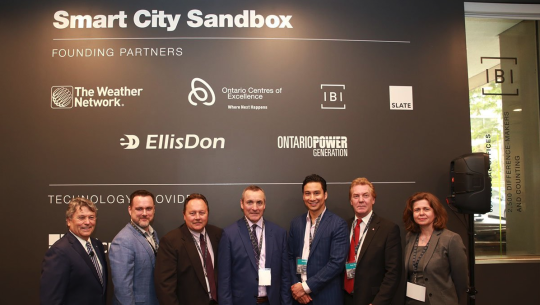
    This morning I was at 55 St. Clair Avenue West for IBI Group’s annual general meeting. And at this meeting their CEO, Scott Stewart, officially launched a new accelerator called the Smart City Sandbox

    Here is a description of what that is taken from a press release that was also published this morning:

    The Sandbox is a smart city-themed accelerator, focused on bringing innovative new products and systems to urban environments that improve the quality of life for residents. A technology hub that supports small-and medium-sized enterprises (SMEs), as well as entrepreneurs and start-ups, the Smart City Sandbox will operate out of a designated space at IBI Group’s Toronto headquarters, be open to global applications, and officially open doors with its first smart city-themed cohort in September 2018.

    And here is a photo from this morning:

    Slate Asset Management is proud to be a founding partner of the Smart City Sandbox and we’re thrilled that it will live at Yonge + St. Clair in midtown Toronto. 

    Our role is to provide our domain expertise as asset managers and developers, and to offer participants in the program access to real-world building systems and data from our holdings in the area.

    For more info, go here.

    And if you were at (or listening to) the meeting this morning, I’m sure you noticed something that we talk a lot about on this blog. To thrive today, virtually every company now has to think and act like a technology company. IBI Group is doing precisely that.

  • Two sides of the same bitcoin

    Warren Buffet recently said in a Yahoo Finance interview that when you buy cryptocurrencies you’re not actually investing. Instead, you’re speculating – speculating that “somebody else will come along and pay more money tomorrow.” Investments need to generate a return. And nobody is at all clear on how to value these crypto-assets. This is noteworthy, of course, because it’s Buffet.

    But I thought Fred Wilson wrote a good rebuttal on his blog where he points out that, while, yes, a discounted cash flow model isn’t going to be very useful in helping you determine value in this instance, what we are actually seeing is, “the creation of a new internet, built upon protocols that allow for decentralized networks to form…” We’ve talked about this many times before on the blog.

    So where I stand on this debate is that I agree with both Warren and Fred. I don’t see crypto-assets as something I want to start putting a lot of money into right now because I don’t know how to calculate what the IRR may be. But at the same time, if crypto-assets are creating decentralized infrastructure that will one day power the “new internet”, I am positive this new internet will eventually create businesses that will fit into Warren’s definition of an investment. 

  • Tech salaries and brain drain

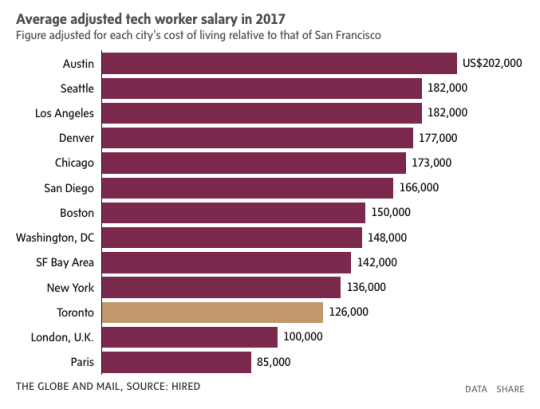
    The Globe and Mail recently ran an article arguing that tech salaries in Toronto are significantly less than those in the US and that it is leading to “alarmingly high rates” of brain drain. The claim is that the average tech salary in 2017 was US$73,000 in Toronto, compared to US$140,000 in the Bay Area or US$129,000 in New York City. 

    However, if you adjust these salaries for each city’s cost of living, the numbers look like this (chart taken from the same article):

    Now all of a sudden Toronto is lumped together with the Bay Area and New York City. It was adjacent to London even when you didn’t adjust the salaries. As Tobi Lütke – CEO of Shopify – points out in his Twitter rebuttal of the article, housing is the determining factor in this adjustment: “Toronto is a very expensive city, and Austin isn’t.”

    Lütke also points out, in case you’re in the market, that Canadian-based Shopify pays its tech employees well above market, provides stock compensation, and is currently “hiring like crazy”. But perhaps more importantly, he stresses the importance of Canadians building the economy of the country in which they are from. I feel exactly the same way.

  • First day of summer

    Today was the first day of the year that truly felt like summer here in Toronto. It also happens to be my birthday. 

    So I did the only sensible thing one should do on a day like this. I went to a rooftop patio after work, with my family, for two of my favorites: a bowl of spaghetti al limone and a negroni. Simple.

    image

    In other news, Fred Wilson wrote a great post on his blog today about why he loves Canada and why it is an increasingly important place for the tech sector. 

    For those of us who already know that Canada is the greatest country on earth, it’s a noteworthy post not because it is likely to tell you a lot of new things, but because it was written by Fred fucking Wilson.

  • Writing is thinking

    Steven Sinofsky recently tweeted out this thread where he talks about the virtues of writing in business. His argument: writing is thinking.

    Writing is difficult. It takes a lot of time. I’ve been writing posts – albeit short ones – on this blog every day for almost 5 years and I can tell you that somedays it is downright painful. Somedays I ask myself: Would I be better served spending this time elsewhere?

    It’s much easier to talk, throw down bullet points on a slide, or send out pithy emails. And because, today, we’re all so focused on “agility” and “execution”, it is easy to dismiss writing as being slow and cumbersome. 

    But the act of writing is indeed thinking. To write about something you have to wade into the details and actually understand what you’re talking about. It’s far more nuanced.

    One of Sinofsky’s arguments is that “execution is in a constant state of diverging as more expertise deals with more details that fewer people understand.” Business becomes “I just know.” Writing can fill in those missing parts.

    He goes on to argue that agility is also not mutually exclusive with writing. In fact, when you write, clarify, and collaborate early on, overall execution speeds up because now people get the details and better understand the context.

    I’ve mentioned this before on the blog, but my Grade 4 English teacher used to make us write a daily journal. He would tell us that it didn’t matter what we wrote or how long it was, but we had to write something every day.

    I did it and I enjoyed keeping those journals, but at the time I didn’t really appreciate was he was trying to get us to do. I do now.

  • Meet Replica

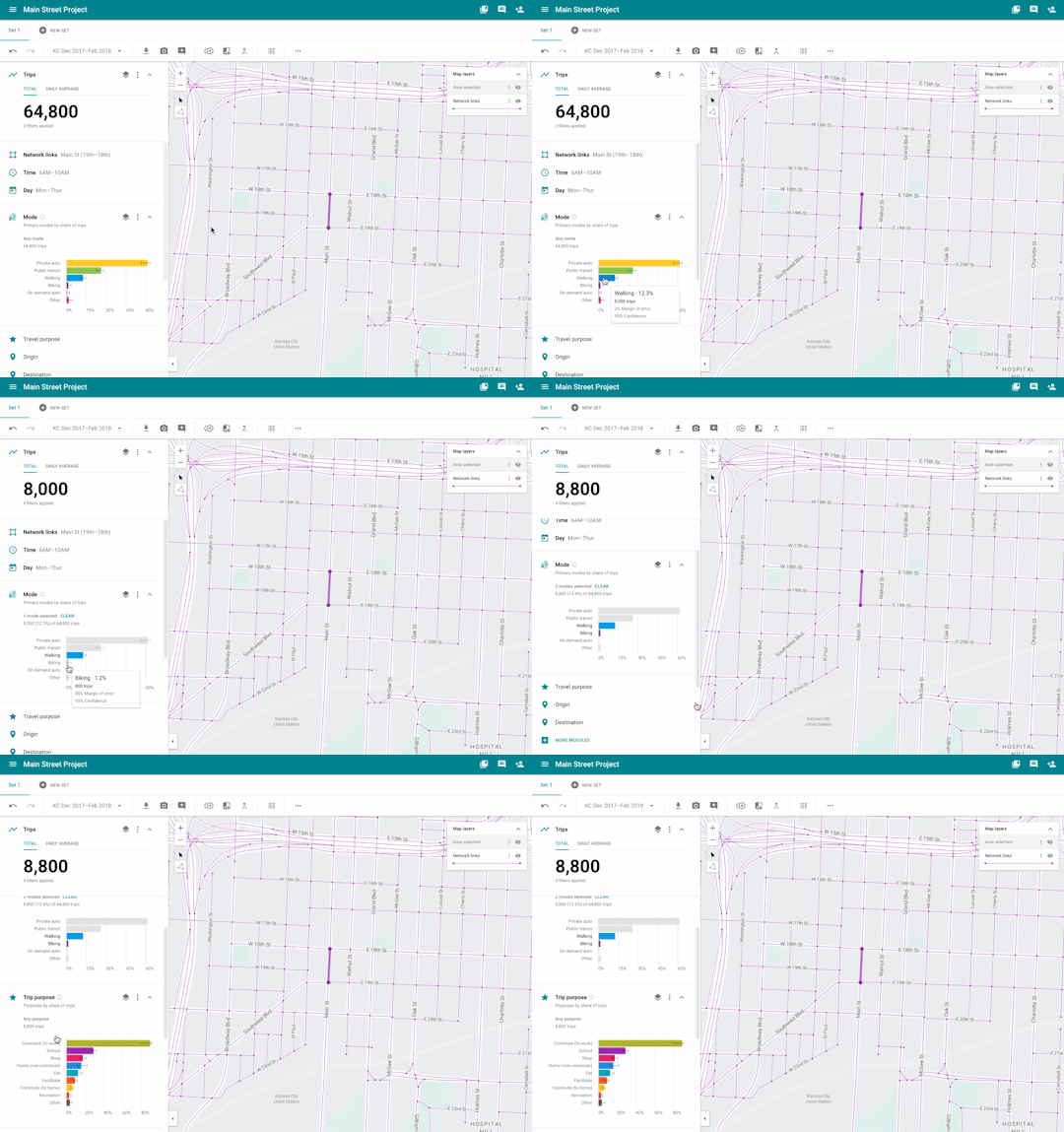
    Sidewalk Labs is currently building out a platform called Replica that will support them in their development plans here in Toronto. Replica is

    “a user-friendly modeling tool that uses anonymized mobile location data to give planning agencies a comprehensive portrait of how, when, and why people travel in urban areas.”

    Here is a preview of the Replica dashboard showing a section of Main Street in Kansas City. I hope the animated GIF shows up for you.

    The platform uses a combination of mobile location data (~5% of the population) and on-the-ground checks, typical stuff like manual traffic counts and transit boardings.

    The goal is to understand in real-time who is using a street, as well as how (driving? cycling?) and why (going to work?).

    Their introductory blog post obviously stresses the importance of personal privacy, but I am curious how they determine where people are going.

    I suppose if they pair journeys with destinations (and the durations at those destinations) they can make reasonable assumptions around the why.

    I think the benefits to all of this are clear. But does any or all of this worry you from a privacy standpoint?

  • Top US metro areas for VC investment

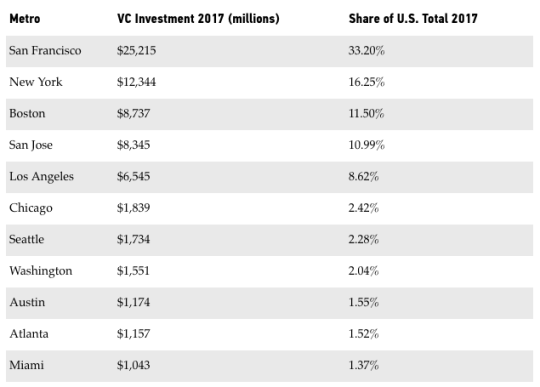
    Below is a list of the US metro areas that saw a billion dollars or more in venture capital investment last year (2017). It is taken from a recent CityLab article by Richard Florida where he talks about the “geographic inequality of high-tech venture capital.”

    image

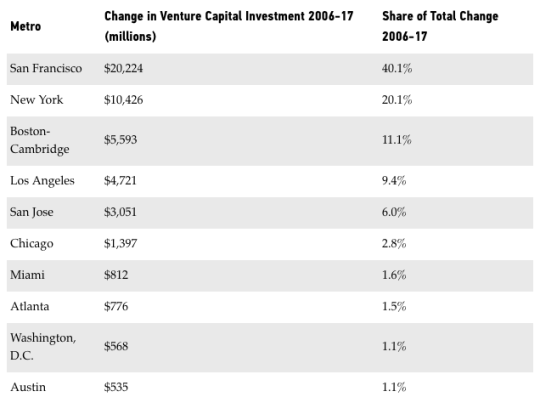
    It’s worth noting that San Francisco – not San Jose (Silicon Valley) – is at the top of the list with nearly 1/3 of the US total last year. It’s also interesting to note that when you look at each metro’s share of the total change from 2006-2017 (the chart below), you get Los Angeles now punching above San Jose. 

    image

    Florida also gets into which economic and demographic variables seem to be associated with higher levels of venture capital investment. For the rest of the article, click here

  • Autonomy, sometimes

    Benedict Evans raises a number of good points and asks a bunch of good questions about the “steps to autonomy” in his recent blog post.

    Right now we’re all talking about autonomous vehicles in terms of their level of autonomy – namely 1 through 5. L1 is some degree of autonomy, but in almost all situations, you still need a human driver. L5 is no human driver needed, ever.

    But as Evans points out, the level of autonomy depends on the place, and it is unlikely – at least initially – that L4 or L5 will mean L4 or L5 in all environments. Here is an excerpt from his post:

    It naturally follows that we will have vehicles that will reliably reach a given level of autonomous capability in some (‘easy’) places before they can do it everywhere. These will have huge safety and economic benefits, so we’ll deploy them – we won’t wait and do nothing at all until we have a perfect L5 car that can drive itself around anywhere from Kathmandu to South Boston. And so, if we call a car even L4, we have to say, well, where are we talking about? We might mean ‘most of this country’. But more probably, it will be L4 in one neighborhood, L3 in another and only L2 in a third – and a car might encounter all three of those on one journey. Put your route into the map and it will tell you if today is an L5 day or not.

    Thinking about the Gartner Hype Cycle, there’s often (always?) a “peak of inflated expectations”, as well as a chasm that new technologies need to cross as they are being adopted.

    Benedict’s article reminded me that we’re probably coming off that peak with autonomous vehicles and about to enter the so-called “trough of disillusionment.” 

    Autonomous vehicles represent a monumental shift in mobility, which will in turn impact our cities. That’s going to seem like an insurmountable challenge – until it doesn’t.

  • What’s the realtor jiu-jitsu move?

    Today’s post is a set of related questions for all of you.

    Fred Wilson has a post up on his blog today called, The Jiu-Jitsu Move. It’s about how people often dismiss new technologies, market entrants, and/or consumer behaviours as silly; whereas the real power move is to embrace and leverage them. That’s what he is calling the jiu-jitsu move.

    He gives a few examples, but for obvious reasons this one stood out to me:

    I spent the day yesterday at a real estate industry event and talked to a lot of agents about the fact that their clients are often more informed than they are these days. I encouraged them to embrace that fact and use it to their advantage and not fear it. It is hard when you have grown up in an industry when your advantage was information and you no longer have that working for you.

    For all the agents (and real estate consumers) who read this blog, I am curious if you agree with the above. Are consumers increasingly more informed than agents? I am sure that many of you will disagree. But if things are really changing, what should the jiu-jitsu move be?