Camera: Fujifilm X-T3 (23mm lens)
Daily insights for city builders, delivered every morning at 6 AM ET. I’m Brandon Donnelly — a Toronto-based real estate developer and founder of Globizen. I’ve been writing here since 2013.
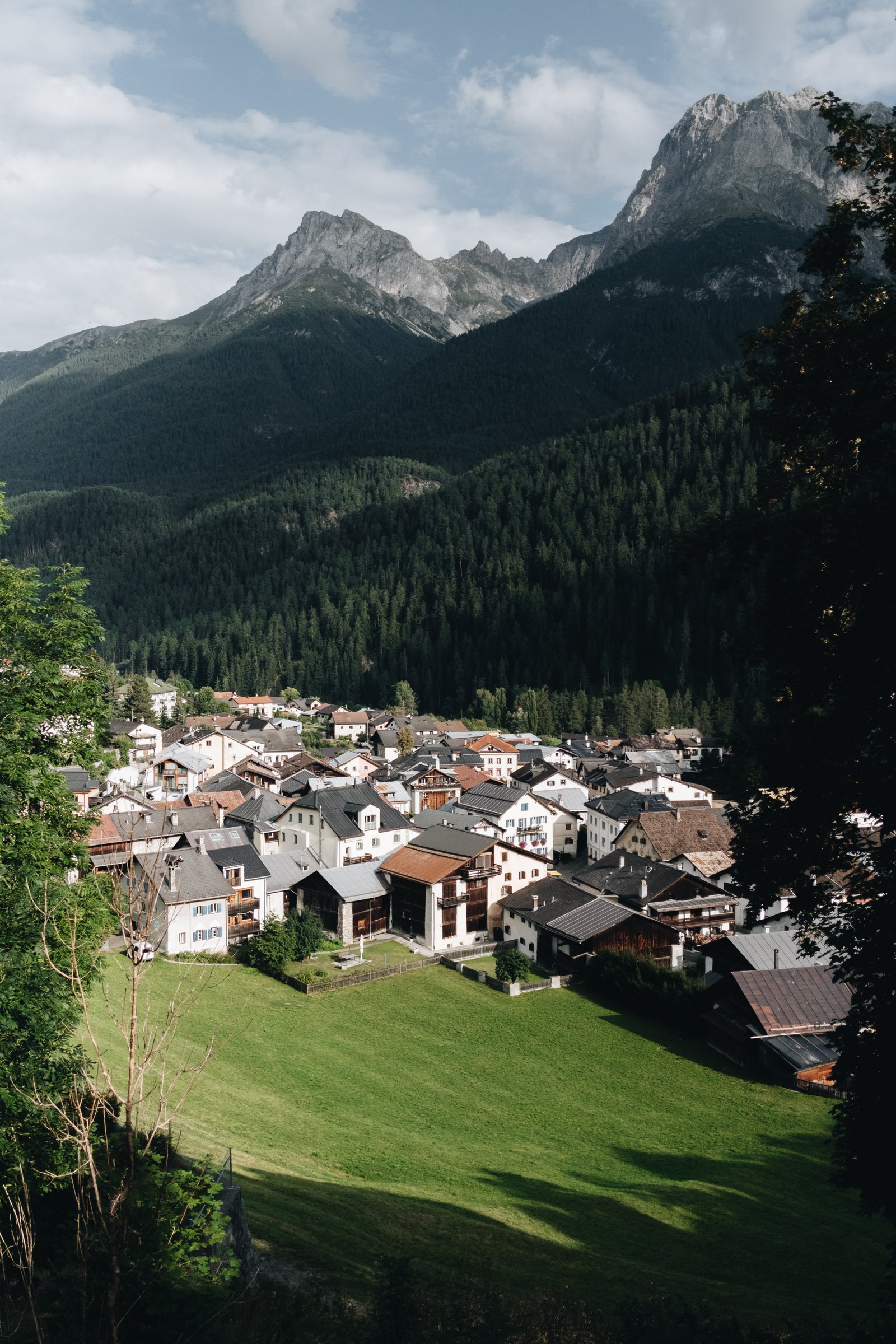
We spent the last few days in Scuol, Switzerland. Scuol is a small mountain town with under 5,000 people (2018 figure) near the eastern border of the country. The town first achieved notoriety in the 1860s because of the various naturally-occurring mineral waters that can be found in the area. They were / are thought to have healing properties, and so a spa tourism destination was created. Skiing and snowboarding were later added to the town’s repertoire.
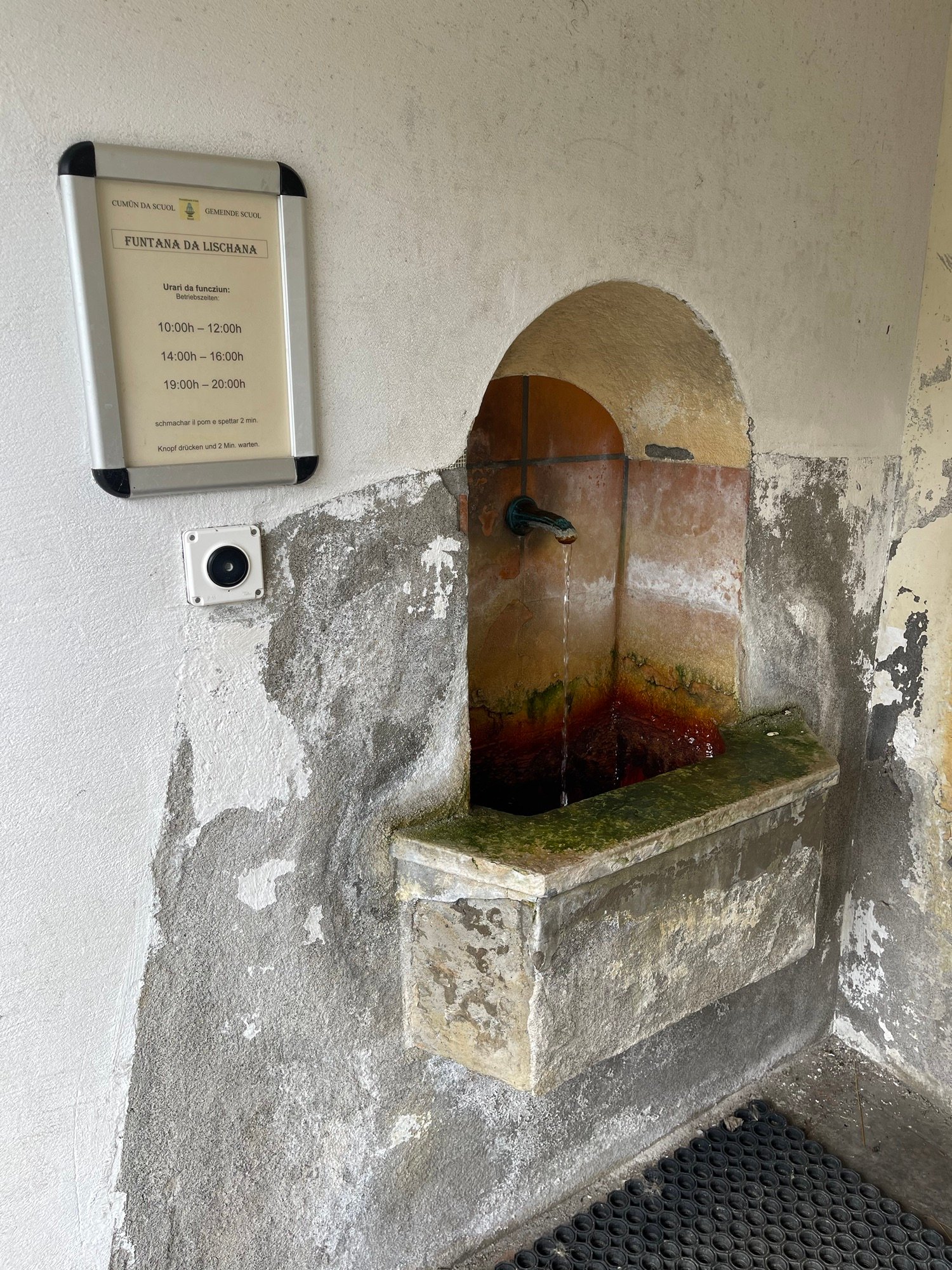
We tried the water from this fountain — the Lischana source:


The best way I can describe the taste is to say, imagine water that has had pennies soaking in it for the last 100 years. That’s what it tastes like, which is not good. But it is rich in magnesium and other things, which is why people (especially athletes) seek it out. It comes out clear from the source but if you let it sit in a bottle it will naturally become carbonated and turn brown. That’s why the embankment above has the color that it does.
I had a handful of respectable sips. Hopefully that’s enough to make me strong. A big thank you to Klaus, Peter, and Jaimie for the invite to Scuol!

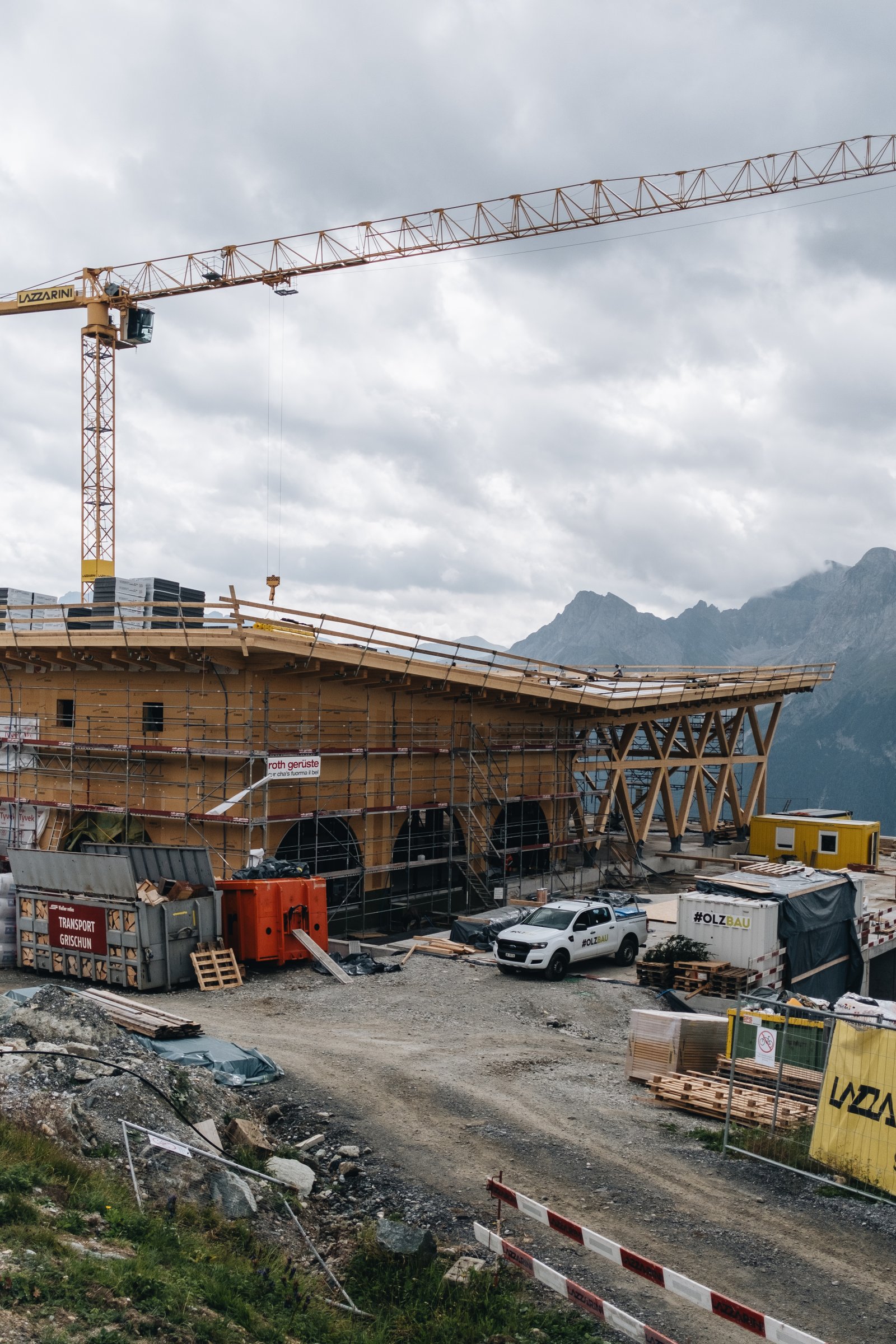
Ordinarily, solar panels make the most sense on the roof of a building. This is often where you can harvest the most solar energy. But sometimes it can make sense to install them vertically, like in the case of the above building in Scuol, Switzerland. I am by no means an expert on solar, but I am told that this can make sense in snowy climates (where rooftop panels are likely to get covered) and in northern locations where the lower angle of the sun means a vertical position actually catches the sun more effectively (especially during the winter months). It could also be the case that you just don’t have any available roof space. Either way, you have to look at and model out the entire year when it comes to solar.

Portable toilets are needed on every construction site, and in lots of other places too. Generally speaking, though, they are not pleasant spaces. But that doesn’t seem to be the case in Switzerland. I just discovered a Swiss company called Kompotoi. They make high-quality portable toilets out of spruce, and they have made a commitment to composting as much human waste as possible.
But the really unique feature that I had never seen before is that each toilet comes equipped with a bin of wood shavings (“litter”), which you are supposed to sprinkle over your poop once you’re done. This serves two important functions. One, it dries out the waste which greatly reduces any smells. I can attest that the toilet I used smelt just fine. And two, doesn’t it just look better to go into a toilet and see wood shavings as opposed to poop?
This might be an instance of “yeah, only in Switzerland.” The retail price for their classic toilet model is CHF 5,966. That works out to about C$9,500 once you covert it to our painfully weak dollar.
I was speaking with our lawyer in Park City this week, and he commented to me that he wouldn’t be going into the office next week because Old Town would be too hectic with the Sundance Film Festival going on. His office is right on Main Street.
When small mountain towns host major international events, there are going to be spillover effects. This is true of Sundance in Park City (population ~8,500) and it is true of the World Economic Forum, which was hosted in Davos (population ~10,000) this past week.
Perhaps the most obvious impact is that people can rent out their homes for large sums of money. And so lots of people both do that and try to profit maximize while doing it. Here are some anecdotes from Davos (via NZZ):
Ten days before the WEF, there are still 25 listings on the Airbnb internet platform. The prices here range from 8,000 to 56,000 Swiss francs. The son of an apartment owner says that his family receives 12,000 francs a week for their three-room apartment, which is quite close to the convention center. However, he says he assumes that they could achieve significantly more. The family rents out the apartment through an intermediary.
Another interesting impact in Davos happens on the retail side (also via NZZ):
According to expert Robert Weinert, the average rent per square meter of retail space in Davos is 248 Swiss francs. A businessperson renting a storefront of 80 square meters must therefore pay almost 20,000 francs in rent per year. However, if that business vacates the store during the WEF, it can earn 60,000 francs – three times the annual rent for the facilities.
What this means is that some retail spaces remain vacant all year, just so that they can be available for when the WEF arrives and people need temporary commercial spaces. And why wouldn’t this be the case: 20,000 francs for the year or 60,000 francs for a week. If I’m the landlord, I’ll take the additional 40,000 francs and not think about the property for the rest of the year.
Of course, if you’re trying to create a vibrant community with things, like, occupied retail spaces, then this isn’t ideal.
Zurich is today one of the hottest real estate markets in Europe:

And based on UBS’ Global Real Estate Bubble Index for 2023, it also has the highest bubble risk:

According to Bloomberg, there are a number of reasons for this: low housing supply, a constrained geography, a key interest rate that is less than half of the ECB’s, and Google. Google is one of the largest employers in the city, with more than 5,000 employees. And supposedly the starting salaries for a software developer there can reach 200,000 Swiss francs (nearly CA$300,000).
I also just learned that the minimum wage in Switzerland is 23.90 Swiss francs per hour. Based on 160 hours per month, that’s 3,824 francs per month or 45,888 francs per year. In Canadian dollars, that’s over $68,000 per year. Pretty healthy. Although, as we can see here, Zurich is also expensive.
Here’s a potential scenario:
“When you have investors competing with first-time buyers who walk in with a couple of [baby] strollers, typically the investor is going to win,” Mr. Pasalis says. “They are well capitalized. They can pay a higher price. And this is why our home ownership rate is declining, because more and more homes are actually going into the hands of investors who rent them out, and amplifying home and amplifying condo prices. We are seeing that.”
But let’s break this down a little.
Where are these first-time buyers walking into? Is it a resale home showing or is it a pre-construction showroom? If it’s the latter, then we know it’s going to be difficult / atypical for them to make a buy decision so far in advance. They already have multiple strollers in hand, do they want to wait 4-7 years for their pre-construction home to be ready?
I would also add that in our current environment — where investor demand for pre-construction homes has waned significantly — the development industry has not seen a marked uptick in end-user demand. Why are they not stepping up now that they’re not being outbid by investors? In my opinion, it’s an ideal time to buy!
One reason could be that people who own strollers still largely prefer low-rise housing. Maybe it’s for reasons of affordability, maybe it’s a cultural bias, or maybe it’s a genuine preference. Either way, let’s turn our attention to resale homes. In this scenario, who is likely to pay the most?
If you’re an investor, then you are looking for a specific yield. And so in theory, it should be a mostly dispassionate decision: “Here’s the most that I can pay in order to meet my minimum returns. Do not exceed.” But the question is whether is this is going to be more or less than what a stroller-owning group of people would pay.
The answer is probably that it depends. However, if the answer is that the investor wins and they then turn around and rent it to people who own strollers, is this actually a problem? And if this same investor happens to own 25 other rental homes and they’re all rented to people who own strollers, is this an even greater problem?
I suppose it is a problem if you’re worried about Canada’s homeownership rate, which has in fact declined from about 69% (in 2011) to 66.5% (in 2021). But what does this even mean? Is a higher homeownership rate always better? Does Canada have a target number? As of February of this year, the homeownership rate in Switzerland was only about 36.3%. And the last time I checked, it was still a rich country.
There is nothing wrong with renting. I know wealthy people who have opted to rent their entire life because they enjoyed the flexibility and/or had better places to put their money.
All of this said, the argument in the above scenario is that, but for investors outbidding people with strollers, these homes would be more affordable and that would in turn increase the homeownership rate. It’s a similar argument to, but for foreign buyers or but for Airbnbs, these homes would be more affordable.
But in a city like Toronto, we are building very little in the way of new low-rise houses. New supply is virtually non-existent. Similarly in Seattle, they are now building more accessory dwelling units than they are single-family houses. So it is any wonder that demand is constantly outstripping supply and that prices are being bid up?
In my opinion, a better solution is to rethink how we build our low-rise neighborhoods. And here and here are two good places to start.

A Pigovian tax is a tax on market activities that produce some kind of negative externality for society. The basic idea behind the tax is to try and use it to correct something that is happening, but that isn’t all that desirable. Examples of negative externalities might include things like pollution and traffic congestion.
Traffic congestion is a bad thing, which is why I have long been a supporter of road pricing. We know how to do this. It has been proven to work in countless cities, including Singapore, London, Stockholm, as well as many others. But in most cases, there isn’t the political will. That has certainly been the case here in Toronto.
Maybe this post will help.
A recent study by ETH Zurich, the University of Basel, and ZHAW has looked at the effects of Pigovian pricing on mobility within Switzerland. The study included 3,700 participants and spanned both French and German-speaking parts of the country.
The way the study works is pretty simple. They took thousands of people, gave them a transportation allowance (in Swiss francs), and then assigned costs to the various mobility options. These costs were intended to be commensurate with their amount of negative societal impact.
Driving, for example, came at a cost of 0.1 Swiss francs per kilometer. Whereas participants actually earned money for walking, since you could fairly easily argue that walking produces a net benefit to society. At the end of the four-week experiment, participants were allowed to pocket whatever money was left in their transportation wallet. So in theory there was an incentive to spend less.
What the researchers were trying to do was simulate Pigovian transport pricing and give people a more direct understanding of the societal costs associated with how they move around. And based on their results, it looks to have worked.

What the results show is that when you start pricing transport in this way, all mobility declines slightly (the “all modes” line). But that the biggest hit is, not surprisingly, driving. Car use declined by almost 5%, whereas walking, biking, and using public transit all increased. (The price elasticity of demand for car travel was found to be similar to when the cost of gas increases — people drive a bit less.)
The authors go on to argue that longer-term Pigovian pricing is likely to produce an even greater impact on mobility, as people would likely adjust and start making bigger decisions about where and how they live. That seems plausible to me.
For a full copy of the study, click here.

Few people in Toronto seem to be talking about the important role that this city has played and is playing when it comes to cryptocurrencies (specifically Ethereum). And if you believe, as I do, that Ethereum and other blockchain technologies have the ability to form the backbone for an entirely new kind of world, then this is kind of a big deal.
The Financial Times recently published this article about “Wall Street’s crypto whisperer.” It is about a guy named Joseph Lubin who is the founder of a crypto company called ConsenSys and previously the co-founder of Ethereum. Lubin is from Toronto.
If you read the article, you’ll see that Lubin is a pretty bright guy (and now a billionaire with his crypto assets). Born in Toronto, he ended up going to Princeton to study computer science. He worked on Wall Street for a bit (hence the whisperer moniker), but also did a bunch of other interesting stuff, including moving to Jamaica with a girlfriend and working on music production.
In 2013, he was back in Toronto and went to a Bitcoin meetup in the city. The article says it was in a downtown warehouse (which makes it sound pretty cool and underground). And at this downtown warehouse meetup, he met a guy (actually a teenager) named Vitalik Buterin. Vitalik had just written a white paper on what would ultimately become Ethereum and he gave Lubin a copy. Lubin was so “blown away” when he read it that he decided to join the movement.
The two (and presumably others) would then go on to live together in shared houses in Toronto, Miami, and Zug (Switzerland), and work on this new smart contract technology. Today, Ethereum has a market cap of nearly $400 billion (as of September 12, 2021).
Even if you ignore for a second that we’re talking about crypto technologies, this is still a fascinating city building story. It is fascinating because it shows the value of in-person urban interactions (again, the two allegedly connected at a meetup in a downtown warehouse). And it is fascinating because the Toronto braintrust has been instrumental in advancing a technology that could arguably end up powering not only the future of the internet but perhaps the world.
At the same time, it strikes me that we need to be much better at both celebrating and encouraging these kinds of new ideas locally. Are we out in the world telling this story to the best of our abilities? Have we properly positioned Toronto as one of the most important places for cryptocurrencies and innovation in general? Mayor Suarez of Miami has been a great promoter of his city in this regard.
“Innovation” isn’t usually neat and tidy. It happens on the fringe and it is often not obvious at the outset. Imagine what an Ethereum pitch would have sounded like back in 2013. But this is how new ideas start. And Toronto has proven to be full of them.
Photo by Narciso Arellano on Unsplash


This past spring a new restaurant called Ooki Pavillon opened in the Sihlfeld neighborhood of Zurich. It’s an izakaya-style Japanese restaurant that is housed in a seven-sided pavilion that was initially constructed in the 1950s. The place looks great (see above), but what you may also find interesting is that the pavilion was initially built as an amenity space (leisure room) for one of Zurich’s first high-rise apartment blocks. Check it on street view, here. Supposedly there are only a handful of these sorts of pavilions remaining in the city. And so it is nice to see this one get repurposed (I don’t know what it was prior to Ooki). It is also a good reminder that, while many of our post-war apartment blocks aren’t the most urban in their approach, rethinking the ground plane can go a long way.
Images: Ooki Pavillon